





This Dublin Exhibition Argues Peace Is Possible—If We’re Willing to Affect Change

Marina Abramović, The Hero (2001). © Marina Abramović. Courtesy of the Marina Abramovic Archives and LI-MA
War continues to ravage Ukraine, debates surrounding UK immigration have turned ever-more violent and a far-right party has claimed victory in a German state for the first time since the Second World War. But, in Ireland, a new exhibition is offering some respite, focusing not on conflict, but on the state of peace.
Technologies of Peace: Art and Transition in Contemporary Europe (1989–2026), which opened on 12 September at The Irish Museum of Modern Art, is a speculative exhibition that brings together more than 50 artists, alongside researchers and curators from across the continent to consider—and to attempt to visaulise—the state of being at peace. They do so by framing peace not as a fixed condition or end point, but as an active process of negotiation and maintenance.
“It’s not a literal visualisation of peace in the typical sense,” curator Mary Cremin told Ocula ahead of the show’s opening. “It’s not about peace doves or peace signs, it’s much more about that in between space, the transition from being post-conflict into a peaceful environment. It’s about collective imaginations, ideas of resistance, or how you change power dynamics through civic engagement.”
The show is divided into five chapters: Technologies of Peace, Language and Translation; Trauma and Reverberation; Ecology and Architecture; and Imagining Futures. Each considers the aestheticisation of peace through social movements and civic activism, via feminist collectives, queer intellectuals and community campaigners.
Belfast-born Cathy Wilkes, known for her use of modest, everyday and discarded materials, presents a fragile but powerful installation in cardboard, paper, wire and acrylic, which addresses the 1972 bombing of Abercorn restaurant in the Northern Irish capital. The explosion, for which the IRA was blamed though no organisation has officially taken responsibility, killed two people and injured over 130.
The work is part of IMMA’s collection, and underlines the Dublin museum’s unique position, which allows the space to explore both the politics and the aftermath of peace. The exhibition includes works by 12 Northern Irish artists and reflects heavily on the periods both leading up to and following the 1998 Good Friday Agreement.
“I think it’s really important for people to think that, whatever wars are happening now, they will have reverberations into the future,” Cremin explained. “And that intergenerational trauma is something that people have to live with into the future. How do we stop that?”
Truth and suspicion
Contributing to this trauma is the proliferation and constant dissemination of images of conflict, alongside the growing mistrust of such images in the post-truth era. Addressing this directly, Spanish artist Alán Carrasco returns to traditional newsprint with 2023’s History Loves Paradoxes.
The collection of 20 newspaper headers, in which all other text has been removed, each share one name: The Truth. As the artist notes on his website, the work reminds us that, before believing “the truth” of a newspaper, we should consider who is paying for the ink.
Cremin sees this combination of suspicion, alongside distressing, often violent images of conflict, as the cause of both dehumanisation and anxiety. “There’s this sense of helplessness too, that you can’t really affect change,” she explained.
“But I think if you look at history, there was always this idea of hope. That you can affect change, you can do things through social protest, we do have a role in stopping these things by reaching out to our governments.”
For the curator, this message is particularly key to the exhibition, and especially for younger audiences—a generation too young to remember the relief of the Belfast Agreement, but who, in recent years, have been confronted with increasing geopolitical instability and social fragmentation. The exhibition’s final chapter, Imagining Futures, is a reminder, particularly to these younger visitors, that peace is difficult, unpredictable—and possible.

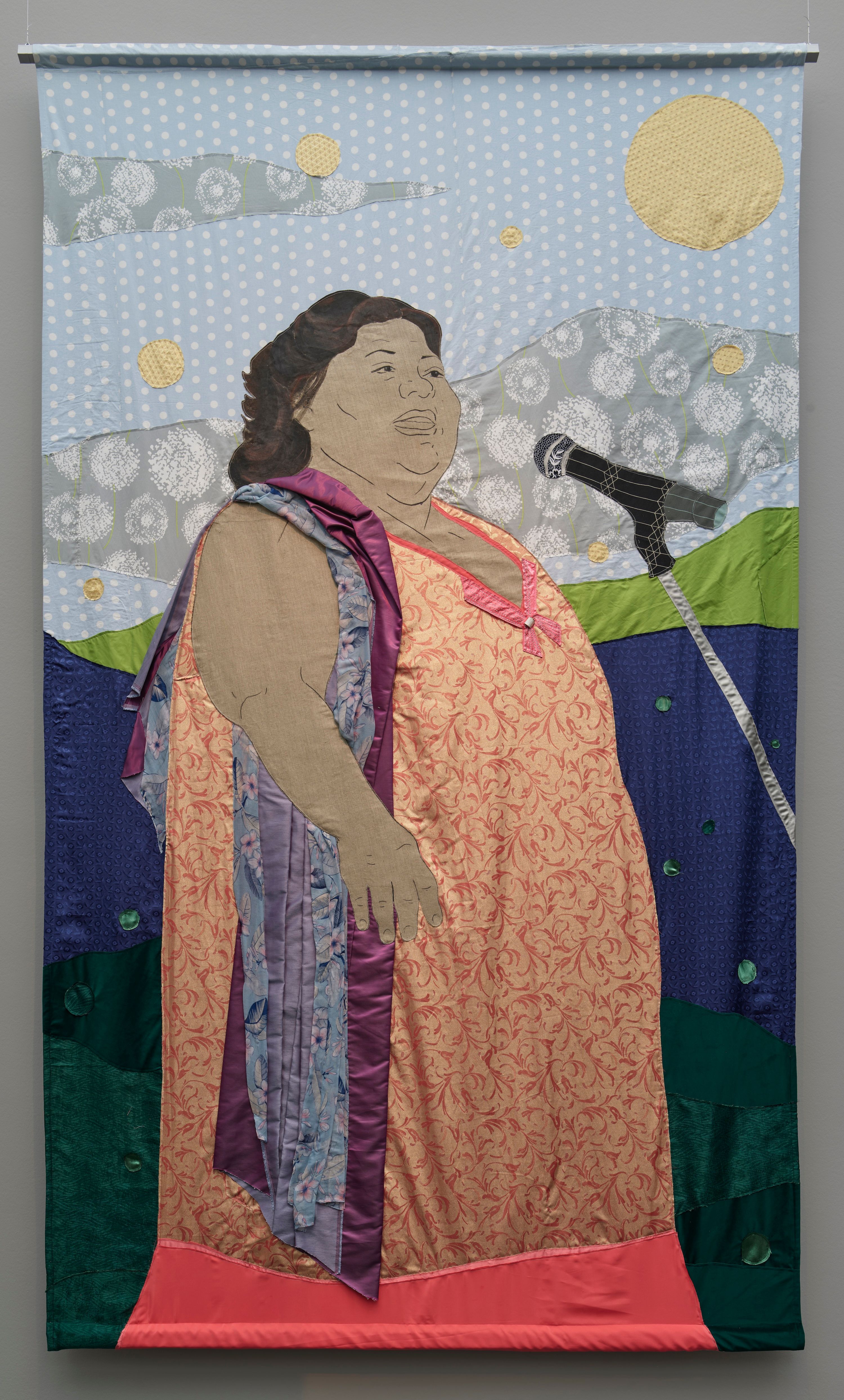
This message is illustrated by a selection of intimate portraits from Phil Collins’ 2001 series young serbs, taken around eight months after the democratic revolution of 5 October 2000, when mass demonstrations in Belgrade and other Serbian cities overthrew the regime of communist leader Slobodan Milošević. They’re accompanied by Małgorzata Mirga-Tas’s 2025 textile portrait of the acclaimed folk musician Věra Bílá—one of a series created to celebrate extraordinary women from within the Romani community.
Cremin sees the power of these Roma activists, singers, writers and poets in the face of racism as a signal of hope, indicating that with collaborative work and dialogue, peace can be achieved and maintained. “It seems so unattainable,” she said, “but it is attainable when the right positions align.
“We can see it across the world now, if people really wanted to drive for peace, it could happen. It is possible. It’s just that the current forces aren’t allowing that to happen.”
Technologies of Peace: Art and Transition in Contemporary Europe (1989–2026) (until 9 May 2027) at The Irish Museum of Modern Art, Dublin





A respected voice in contemporary art discourse.
Focusing on ambitious storytelling and insightful art-world commentary. Ocula Magazine publishes in-depth interviews, critical essays and timely analysis on the artists, exhibitions and ideas driving the global art world.
Learn more about Ocula Magazine
Showcasing the best of the art world.
Ocula partners with galleries from around the world to highlight their artists, artworks and exhibitions. Gallery membership is by application and invitation, with each member vetted by an independent panel.
Learn more about Ocula Membership
Specialises in the sale of major artworks.
Led by a team with deep ties to the world’s leading auction houses, galleries and collectors. Ocula’s advisory team offers bespoke services to high-net-worth clients from around the world who are looking to acquire the best of contemporary and modern art.
Learn more about our team and services