The art world in focus
Subscribe to our newsletter for news and insights on artists, galleries and exhibitions.

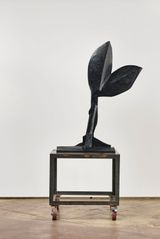
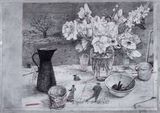
William Kentridge, Cat / Coffee Pot IV (2019). © William Kentridge. Courtesy Kentridge Studio. Photo: Christoph Wolmerans.
William Kentridge, the South African artist and director whose animations and performances have critiqued South African society, is the subject of an upcoming survey at Sharjah Art Foundation.
The exhibition is a surprising choice for the Emirati city given the humanitarian politics commonly ascribed to Kentridge’s work. The survey reconciles these views by focusing on the artist’s work in performance, situating his commentary within the theatrical realm.
From 28 September to 8 December, Shadow of a Shadow will feature 17 of Kentridge’s performance projects from the late 1980s to today—notably, his short animations and opera productions, alongside drawings, stage backdrops, animations, props, costumes, and installations.
The title references the artist’s collaboration with the Handspring Puppet Company in Cape Town since the 1990s, derived from a play by 13th-century Arab writer Ibn Daniyal, whose puppet shows often defied the status quo.
On view is Kentridge’s interpretation of King Ubu, Alfred Jarry’s 1896 play satirising how power can engender madness, as a metaphor for South Africa’s introduction of apartheid. Another work, The Head and the Load (2018), casts a light on Africa during World War I.

Born into an activist family in Johannesburg, South Africa, in 1955, Kentridge studied political science before pursuing visual art. In the early 1980s, he attended theatre school in Paris, where he learned directing and reconceptualised drawing as an expression of motion and energy.
The stop-motion films that earned him acclaim in the 1990s attested to this understanding of form and Kentridge’s fluid merging of mediums: theatrical narratives emerged from charcoal drawings, photographed and erased, addressing the impact of late capitalism in South Africa.
‘With the spectre of apartheid in South Africa, we’re dealing very much with colonialism’s continuation and ongoing questions of extreme privilege and extreme depravation,’ Kentridge told Ocula.
Kentridge’s restaging of Mozart’s The Magic Flute (1791), first shown in Brussels in 2005, on the other hand speaks to the artist’s fondness for the form as a site where ‘complex and deep questions can be played out’. —[O]




A respected voice in contemporary art discourse.
Focusing on ambitious storytelling and insightful art-world commentary. Ocula Magazine publishes in-depth interviews, critical essays and timely analysis on the artists, exhibitions and ideas driving the global art world.
Learn more about Ocula Magazine
Showcasing the best of the art world.
Ocula partners with galleries from around the world to highlight their artists, artworks and exhibitions. Gallery membership is by application and invitation, with each member vetted by an independent panel.
Learn more about Ocula Membership
Specialises in the sale of major artworks.
Led by a team with deep ties to the world’s leading auction houses, galleries and collectors. Ocula’s advisory team offers bespoke services to high-net-worth clients from around the world who are looking to acquire the best of contemporary and modern art.
Learn more about our team and services