





Angela Tiatia Responds to Henri Matisse
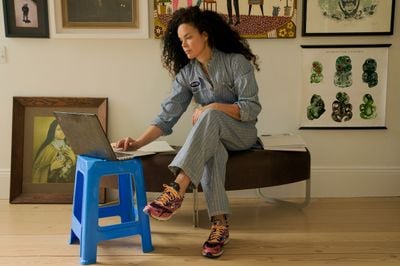
Angela Tiatia. Photo: Kieran Cooney.

Reflecting on the differences between her Sāmoan and Western gaze, Angela Tiatia employs reverse-ethnography to seek out thematic representation in her new work.
In her video work The pearl (2021), showing at Sydney‘s Art Gallery of New South Wales as part of the exhibition Matisse Alive (23 October 2021–3 April 2022), Tiatia follows the footprints of the iconic painter Henri Matisse to locate the iconography of the Pacific Islands that inspired him.
Together with three other women artists (Nina Chanel Abney, Sally Smart, and Robin White), Matisse Alive prefaces Matisse: Life & Spirit, Masterpieces from the Centre Pompidou, Paris, a retrospective dedicated to the painter showing at the Art Gallery of New South Wales (20 November 2021–13 March 2022).


Matisse Alive celebrates Matisse’s artworks by bringing them in dialogue with those by contemporary artists, with a focus on colour, energy, and joy. In this exhibition, Tiatia has crafted a realm of the hyper-real, what she describes as ‘overly beautiful, hyper-beautiful, hyper-surreal.’
In her new work, audiences are invited to unpack multiple layers of inspiration drawn from Matisse’s artworks and his technique while in the Pacific, drawing links between the painter’s collages and the Tivaevae art-making practices of Pacific Island women.
A second layer muses on the evocative nature of Matisse’s sculpture of Venus in a Shell (1930/1951), tying it to the beauty of Pacific Island women.

Alongside this, Tiatia draws attention to the effects of climate change in the Pacific—a fundamental concern that underpins the artist’s practice, as seen in video works Tuvalu (2016) and Holding On (2015).
Prior to 2017, Tiatia would often place herself in front of the camera in works like Lick (2015), Hibiscus Rosa Sinensis (2010), Heels and Walking the Wall (both 2014), and Dark Light (2017) to explore tensions between the sexualisation of Pacific women and sexism in Western and Pacific culture.

In The Fall (2017), Tiatia took on the role of director and brought together a community prompting reflections on systems of care, inclusion, and collaboration during the filming process.
This approach is preserved in Narcissus (2019), The Golden Hour (2020), and Tiatia’s upcoming work at the Art Gallery of New South Wales. Drawing from surreal and saturated images across media, Tiatia’s representations inspire their own beauty.

For the artist, it’s a critical examination of what will make the most visual impact. Each frame is considered as an individual shot—capturing the attention of audiences overwhelmingly presented with developing technology.
Earlier this year, Tiatia was announced as recipient of the 2022 Ian Potter Moving Image Commission. Her submission Liminal Persuasions (2022) will explore tensions between the public and the private, and the real and the augmented, all of which seems to contribute to the chaotic and overwhelming feeling of the present.


In the following conversation, Tiatia unpacks our relationship to a world in perpetual change, with new records constantly being set for the hottest day, wealthiest person, and fastest technology. She asks, how will our culture change as we become increasingly immune to the spectacle of contemporary life?
At the time of this conversation, Sydney was entering its third month of lockdown, the weight of Covid-19 hitting Australia after 15 months of relative normality. While production for The pearl had been affected, Matisse Alive opened in time at the Art Gallery of New South Wales.

EKW: How have you been?
AT: Work has been busy. It’s a nice distraction, but I’ve been feeling flat from this lockdown.
EKW: I can imagine. Creativity is not one of those things you can force. It can be hard to generate work if you’re not feeling it. Do you think Covid-19 is something that will leave a mark on your works?
AT: No, I don’t think it will. I don’t want to comment on Covid-19 within the work, but it has impacted my practice. We were supposed to be filming The pearl for the Art Gallery of New South Wales two weekends ago.

I wanted to film performers and composite them inside the work. However, because the cast are young women under the age of 30 from large Pacific Island and Indigenous families, unvaccinated on top of that from lack of access to the vaccine, I thought it was too much of a risk. I didn’t want to make anyone sick.
As a result, the work is being presented in two iterations. The first iteration will open on 23 October and is absent of the women. When it’s safe to film again, we will film the women as planned and insert them in the work for the second iteration.
Covid-19 is impacting the logistics and the creation of the work, but I don’t want to comment on it within the work itself.

EKW: Can you tell me more about the artwork that you’ve created for the Matisse Alive exhibition? I remember you talking about how you had traced where Matisse had been through the Pacific Islands?
AT: There are several layers to my response to Matisse’s work. The first layer responds to the physicality and methods that Matisse picked up while he was in the Pacific. I’m drawing links between Matisse’s collage techniques and the Tivaevae and tapa cloth art-making practices of the Pacific.
The Tivaevae quilt-making practice is an evolution of the Tapa cloth art-making practice of the Pacific and the quilt-making practice of European missionary wives.
I see a direct connection between the Tivaevae art form and Matisse’s cut-out style developed in the islands. You can see visual linkage and the influence that enabled the development of his cut-out technique for canvases of leaves, flowers, fish, and birds.

In the same way, with The pearl, I wanted to reference the collage technique within digital technology.
In addition, there is a work in Matisse’s exhibition—a small bronze sculpture Matisse made of Venus. She is in a shell, and her pose is quite different to all the Venus iconography I’ve come across in old European paintings.
“I am constantly asking myself, what will create the most visual impact?
Venus is usually represented lying down or standing. Here, she is crouched on her knees, with her arms up and bent over her head. It’s quite a provocative pose for its time, especially with the exposure of her armpits. I found myself attracted to the meanings behind Matisse’s Venus.
The final layer explores the spectacular in modern-day culture. I wanted to present a world of the hyper-real; overly beautiful, hyper-beautiful, hyper-surreal. It’s to allow audiences to see something different, but also a comment on how there are visual techniques and styles that are growing in potency and for this new work, there is a simultaneous oscillation between the spectacular and the everyday object.
Our cultural appetite for the spectacle has been incremental over time. I don’t see how it can be sustainable without impacting our worldviews and experiences.

EKW: Almost similar to technology and how it keeps evolving.
AT: And how it’s blurring the lines between reality and fantasy. We’re getting more used to it.
EKW: Does the environment and climate change come into the work?
AT: Yes, but only very lightly. If the audience chooses to see it in the work, it’s definitely there. In all my works, there are elements of water. Here, there is a deluge of water.
In The pearl, I use water as a visual break, but you can certainly read into climate change and the rise of water if you wanted to. It’s not to solely speak about climate change; it’s just a very light linkage.

EKW: I guess it’s inherent to the conversation when you think about the Pacific Islands.
AT: Yes, that’s true. Unfortunately, while it should be more heavily discussed, it’s always set to the sidelines or recovered as an afterthought.
EKW: Did you find out much about Matisse and his impact on the area or his legacy?
AT: No, I didn’t really focus on his legacy. I focused on what he may have been inspired by. I’m looking at the detail of the environment that he would have been in. The way that the light flickers against the water at noon and how it shimmers, simultaneously looking at the colour of the water against the sand beneath.

EKW: What will the component of the women look like? Are they activating the space?
AT: Yes they do activate the space and I think the work is poignant with or without them. Their absence speaks volumes in terms of the difficulty of filming during Covid-19, but it also speaks about who gets access to what and who gets overlooked.
In the same way, it’s equally poignant to have them in the work. They are certainly symbols of beauty, power, and empowerment.

EKW: These are themes that I’ve seen throughout your work consistently, the sexualisation of Pacific Islander women through colonialism and stereotypes. Does that come across in this work as well?
AT: Again, much like the presence of water, the presence of women does touch lightly on those themes, but I’m not being explicit about it. I leave it to the audience.
There will be a different reading of the work depending on a person’s worldview. You can draw meaning from the work, enjoy the visuals, or reflect on the layers of symbolism and themes in modern-day culture impacted by colonialism, stereotyping, and representation. I am leaving it open to interpretation.

EKW: Will there be elements of virtual reality or immersive aspects in the work?
AT: No, rather, it’s a huge screen—over 14 metres long by four and a half metres high. But it doesn’t require any technology to view it; it’s just like viewing a short film.
EKW: You’ve always touched on video and photography in your practice. Do you find that it helps you express your concepts?
AT: It does in terms of visual impact. I am constantly asking myself, what will create the most visual impact?
In this sense, I am constantly building the work through a photographic lens and ensuring that each frame is potent enough to be extracted from the video work as a still image. Each frame is highly constructed with the thought that hopefully, it will hold audiences from start to finish.

EKW: Thinking about photography and video, their colonial legacy is still visible today—it’s a loaded medium in both aspects.
AT: Totally. In terms of pulling apart the image, like who was behind the camera, who’s in front of the camera, was there money exchanged, what was exchanged, was there anything exchanged?
What was the level of power or influence that the subject was able to have over the composition and representation of their own body? There’s so much within a single frame that can be pulled apart in terms of who had the power and who didn’t.
EKW: There’s a reflection of that throughout your works. I know you used to place yourself inside the frame. It’s that element of reclaiming the image. But now you’re the director and changing that perspective. Has it been interesting for you to go over to the other side?
AT: It has been, in terms of re-evaluating the relationships I have with those in front of the camera.
Since The Fall, made in 2017, I’ll often recast the same people over and over because I want to maintain relationships with them.

EKW: Will you be engaging some of the same people for this new work?
AT: Yes, alongside a couple of new faces.
EKW: Is this a reflection of your community?
AT: I think it’s a reflection of community and checking in with each other. Each new work is an opportunity to spend time with one another.
EKW: Congratulations on the 2022 Ian Potter Moving Image Commission! Is Liminal Persuasion still in the development phase?
AT: I am still developing that thinking space, but it’s hopefully going to be very layered.

EKW: Will it be similar to the last few works you’ve done? With you as the director and a group of people?
AT: Well, now, I’ll have to be careful about the number of people involved, because we’re still in the times of Covid-19. I have to find my way around that.
I was just thinking about works like Narcissus and The Fall, where there were so many people on set, how that kind of work would be so difficult to make now.
EKW: It makes you reflect on the opportunities we’ve had and the things we’ve been able to do—realising that nothing is set anymore. It’s so strange, we took our plans for granted. It makes you reassess things.
AT: The strangeness of it all! How is Covid-19 going to impact our ease with being in proximity with each other, for example. Touching on how you said we take things for granted, like being able to kiss people on the cheek and hug them.
Will this impact us in the future? Will we keep one another at arm’s length, until the next generation forgets all about it and eases back into hugging someone?

EKW: I wonder how much of that is an inherent part of human nature, to want to touch. Is it something that will come back?
Does this new work stem from a theory that you’ve worked on before, or what is the inspiration for it?
AT: I think it’s going to be a mash-up of everything I’ve learned and picked up from the last ten years of being in Australia. One of the main ways that I’ll be constructing this work is the concept of creating images or an image that is of slight discomfort. Although what may be presented on the surface is something relaxing or beautiful, and unassuming in a way.
One of the filtration devices that I have within my art practice, in terms of how an image is constructed, is the question, ‘Is this image going to draw the audience member in?’ Where audiences are drawn into a surface level of beauty and aesthetics, but then simultaneously punching outwards with something strange or uncomfortable or uneasy within the image.
Contextually, I’m always intrigued by social media and seeing images and interactions from all around the world that appear to be both real and constructed.

EKW: It is curious to think about the impact of social media, especially in art. I think it can be such a great tool to bring people together. But there is just so much that you’re constantly questioning what you see. It’s hard to take anything at face value.
But when you think about it layered within art, where you are constantly questioning what you see, it’s all about playing with perception.
AT: Exactly. And everything is constructed.
“I don’t feel the pressure to add social activism as an additional layer within my works, but I do feel the pressure of making works that mean something. They must always mean something.
EKW: Are you working on anything else at the moment?
AT: I’m working on another project for 2023.
EKW: It’s amazing to me, thinking about 2022/2023. It’s hard to imagine that time.
AT: It feels unreal. Scientists are saying that by 2025, we would have reached a 1.5-degree rise in temperature, so when I think about 2022 and 2023, it fills me with terror that we are approaching 2025 and the implications of that.
There’s a strong domino effect in terms of food security, migration, education, and health. Everything is going to start amping up from poor management.

EKW: I’ve really noticed in the last few years the level of natural disasters and how much destruction they cause. The year 2025 doesn’t seem too far away to me; just look at what happened in New York recently.
AT: It is amping up, but then at the same time, we are refusing to look at it. And that’s what I’m trying to say when I describe the growth or the evolution of work, or visual culture. There’s an amping up all the time.
EKW: You just become a bit more immune to it.
AT: That’s the word. As things become more terrifying, more unreal, more sci-fi, more spectacular, and more fantastical. But we’re also becoming immune to it. What will be the price for this impact?
I am aware that the reason a lot of us refuse to face these issues head-on is because it is depressing and is anxiety-inducing, but in the same way, how can we not look at it?
From my position, it’s frustrating how it has fallen on individuals and communities to generate the conversation like it’s something politicians don’t want to discuss.

EKW: Artists have taken on the role of social activists. Does that add to the pressure of your own practice and creating new works?
AT: Artists have always taken on the role of social activists—it’s either taken on very consciously or an outcome of responding to the relevant and important themes of their times.
I don’t feel the pressure to add social activism as an additional layer within my works, but I do feel the pressure of making works that mean something. They must always mean something.

EKW: As an outsider looking at your career, the works appear effortless, with a natural flow to them. You can see them building on each other. They’ve always been strong—the concepts, imagery, and the aesthetic.
AT: To make work that feels effortless takes a lot of effort. There are always complications with each new work. For example The pearl was largely made during Covid-19 lockdowns, which spun up logistical and production challenges. I find the process of making anything of this scale seems oscillate between moments of deep joy and moments of sheer terror!
EKW: It sounds like if everything goes according to plan, and Sydney can open by then, it would be the perfect work to return to.
AT: I think so too. I really wanted the work to be beautiful, joyful, and spectacular. —[O]
Main image: Angela Tiatia. Photo: Kieran Cooney.



A respected voice in contemporary art discourse.
Focusing on ambitious storytelling and insightful art-world commentary. Ocula Magazine publishes in-depth interviews, critical essays and timely analysis on the artists, exhibitions and ideas driving the global art world.
Learn more about Ocula Magazine
Showcasing the best of the art world.
Ocula partners with galleries from around the world to highlight their artists, artworks and exhibitions. Gallery membership is by application and invitation, with each member vetted by an independent panel.
Learn more about Ocula Membership
Specialises in the sale of major artworks.
Led by a team with deep ties to the world’s leading auction houses, galleries and collectors. Ocula’s advisory team offers bespoke services to high-net-worth clients from around the world who are looking to acquire the best of contemporary and modern art.
Learn more about our team and services