






Atul Dodiya
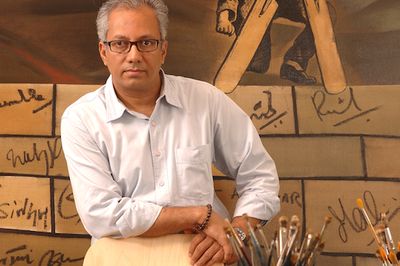


Renowned Indian artist, Atul Dodiya recently opened his first solo exhibition at 10 Chancery Lane in Hong Kong. The exhibition, which is entitled Duplicator’s Dilemma, takes places contemporaneously with the opening of an extensive survey of Dodiya’s work at the National Gallery of Modern Art in New Delhi. Throughout his career, Dodiya has bought together and juxtaposed references from politics, art history and folklore for his work, as well as Indian and North American popular culture.
He is probably best known for creating this amalgamation of visual imagery upon the metallic surface of shutter doors taken from Delhi shop fronts. The earliest shutter works were commissioned by the TATE Modern for its Century City exhibition, and now the latest iteration of this series appears in Hong Kong in the form of three large shutter works, which are contrasted beautifully with several delicate and poetic watercolours that also appear in the exhibition. Anna Dickie spoke to Atul Dodiya about his career, including what inspired him to become an artist, his passion for art history, and how his work reflects on India.
AnD: Let’s go back to the beginning. You studied fine arts at university, but from what I understand, your parents were not artists, nor particularly interested in art so where did the inspiration to study art come from?
AtD: It is strange. The beginning came out of one moment. It happened while I was in school. I was in the sixth grade and our teacher, he did a drawing of a boy kicking a football, and we were all asked to copy it. I also copied and I thought that I almost achieved the lightness of the motion of kicking — it may have not been the case, but I felt then that I had. After that moment — which was a type of revelation — I knew I enjoyed painting and I really wanted to paint, and do nothing else.
AnD: And so then from the age of ten you were prolifically painting?
AtD: Yes. I was a boy possessed by this idea of drawing and painting, and I started doing that all the time. But during my secondary school days I also became very interested in literature. I started reading poetry, fiction. I also became interested in film. I started to watch the television, which started in ‘72 in Bombay, and sometimes on Saturdays they would show some European films and some ‘so called’ art films. I watched those movies and so I think it then all came together, the cinema, the literature, painting. Painting was the easiest thing because I could just sit in a corner with a piece of paper and pencil and draw, and it was very convenient. And so finally I went to art school.
AnD: So, right from the beginning your work has been characterised by sort of an amalgamation of influences? Certainly the work in 10 Chancery Lane references art history, religion, poetry, and so on.
AtD: Yes. It also reflects how passionate I am about painting. Growing up, I didn’t get to see museums — we are not a museum culture. Of course we have our museums, the national museums and so on, but they relate primarily to ancient art. Of course, now in Delhi we have a lot of modern museums, in fact where right now my major survey show is happening. However, when I was studying if you wanted to see a work by a great European Master ... well, the art school where I went, we studied European history, painting and so on, but it was all through reproductions, through transparencies and those were often faded. So I always felt deprived. I was screaming to see the scale, how the works looked in the museum space — the size of oil painting, lots of layers and surface. Due to that, there was an immense need to understand. To see these works as they really were.
AnD: Was it this desire to see the works you had studied that took you to Paris —which is the place you went after you finished your studies?
AtD: Yes. I always wanted to go outside India, particularly to the west. Then it happened that almost ten years after I passed art school, I was awarded a French scholarship, and I went to Paris.
AnD: Do you remember the experience of seeing those Masterpieces you had studied for so long? Do you remember what struck you most?
AtD: Yes, exactly. I remember in ‘91, ‘92, when I was in Paris, I obviously wanted to go to the Pompidou Centre and being an artist from this current time, you want to see the recent art, so we started with that.
There were a huge Léger and there was quite a few Picasso’s. There was Robert Rauschenberg, Jasper Johns, a huge relief in bronze by Matisse, Duchamp — expressionism, abstract, cubist work — it was all there, all under one roof. It was fantastic to keep on going back. Then of course, going to the Louvre, to see 19th Century art from France. I still enjoy looking at Impressionists. It is just the light, the light and colour — the detail.
AnD: And how did your interest in art history translate into your work?
AtD: With my work what happened is that I think I knew a lot of things about artists and I would read and then when I started painting my own images, I would be reminded of someone else’s art - of a work by a great artist. Then a particular time came when I wanted to know what would happen if I incorporated my own imagery with existing well-known existing imagery by well-known artists — to create a sort of hybrid of imagery, and that looked quite different. The situation in the Indian art scene of that time was such that this was something always doing this and they started labelling me the first post-modern artist.
AnD: Your art, while it references art history etc also is very much a reference to where you are from. It reflects on much of the diversity in particular of India?
AtD: Yes, exactly. I was born in Bombay and I think one of the major influences for me is the city itself.
You know however that when I went to Paris, after two or three months I stopped doing my own work. I felt that I would completely stop painting forever because I felt that so much work has been done in such a profound way. So much great work had been done. I felt what I was doing was nonsense. I had lost faith in myself. So on one side it was a joy looking at great art and at the same time, learning from within.
But then when I returned to India, after that stage in Europe, I felt how different India was to Europe. And I thought — what if I do something from my personal life, my surroundings, my family. So many of my earlier works are autobiographical and then they become very much about what I was looking at and experiencing in the city of Bombay, what was happening in India at that time. So I felt I had something to paint about.
And at that time in India in 92, there was a huge conflict that happened between the people. There was a terrible bombing of a Mosque in the north of India. Due to the bombs that happened, a lot of people died, a lot of innocent people, who had nothing to do with all those things. And this is the sort of life situation that prompted my work.
AnD: Your Shutter Series in particular was influenced by the curfew. Perhaps you can explain more about how you came to create the Shutter Series?
AtD: I would come back sometimes late at night, catch the last train and the shutters would be down. I jokingly said: “What if we paint the shutters?” But I never took it seriously, but then one thing happened. In 1993, during the curfew, on one particular day, I thought to myself that my home and studio are not very far apart and although curfew was strictly enforced, I thought I would walk from my home to my studio. However, as I was a walking a truck with military soldiers with machine guns saw me in the streets. They said, “Just go and keep your hands up” and I walked with my hands up until I entered my building. It was a scary moment. Later in 2000, when they opened the Tate Modern, they had an exhibition that was called Century City. The exhibition focused on nine cities and one of the cities was Bombay and each of the cities was chose for a specific period. Bombay was chosen for the last decade of the 20th Century. During that time there were riots in Bombay, it was a time of terrorism, violence, and all these things... lots of injustice in many ways. So they asked me to do something and I said I’m thinking to use the shutters — because to me they were such a part of the urban landscape and the idea of their closure represented a city under siege.
AnD: Perhaps we could discuss a particular work? I am interested in the work Eyes, 2013 - it has written upon it “What, why did you ask that? What do you know about my image, duplicator?”
AtD: To begin with, one thing that is very important to me relates to the concept of sharing. I want my work to be shared with all sorts of people. Exhibiting is not just about selling work. It is essentially about sharing work. Those who are into art will come, but there is a much bigger world out there and I don’t distinguish between the common man and the person who is more educated in art. If you are educated its good, but that doesn’t mean a less fortunate person has no way of looking at art. Particularly when you are living in a country like India, you cannot afford to be too highbrow. So when I decided to make work to be shown in Hong Kong, I started by asking myself about how the audience will be looking at my work and I took it from there. I have a huge body of work, but I wasn’t sure how people here would react — so I decided to do something that was more accessible. So this work references Lichtenstein’s work and references comic book illustrations so there is already a sort of appropriating of work...My work has a touch of philosophy. You will see a reference to a scribe — it’s a reference to an artist. Then you will also see a reference to Fontana — the Italian Master. There is a ‘thinker’ and then again there is a mirror and a t-shirt. So when I was doing this, I came up with this particular work of Lichtenstein, and it says ‘what do you know about my duplicator?’ It’s a playful, joyful image when the shutter is down, but when the shutter goes up, the work is more complicated.
AnD: You have a major exhibition opening in Delhi — it is a survey of over 100 works. How did you feel reflecting on these works that date from 1981 to today?
AtD: Well I have not really had a chance to reflect on it as I came here just after it opened. I am going back again. And you are right - I will be looking for the threads. You know my very first work is in there — it’s a portrait of Cezanne. I painted it while I was at school in Bombay. So there it is - you can see throughout all my work that interest in other people’s art - that respect for it. The threads are there at the beginning and they are still here in my latest work. There is a passion for art and for the grammar of painting.
AnD: What’s next for you?
AtD: Next is the same exhibition — not the full exhibition- part of it will move to Bombay in February/ March and then in March I am showing some works in the Museum of Picasso in Barcelona. It is about the contemporary artist responding and appropriating Picasso’s image. I have some forty works that are relevant — of which three works will be shown. And then an exhibition at the Bhau Daji Lad Museum, Bombay - a Municipal Museum. The Museum is in the zoo. As a young boy I would visit that zoo. For that show I am conceiving small bodies of works — creating many solo shows within the exhibition — a response to the Museum’s collection.






A respected voice in contemporary art discourse.
Focusing on ambitious storytelling and insightful art-world commentary. Ocula Magazine publishes in-depth interviews, critical essays and timely analysis on the artists, exhibitions and ideas driving the global art world.
Learn more about Ocula Magazine
Showcasing the best of the art world.
Ocula partners with galleries from around the world to highlight their artists, artworks and exhibitions. Gallery membership is by application and invitation, with each member vetted by an independent panel.
Learn more about Ocula Membership
Specialises in the sale of major artworks.
Led by a team with deep ties to the world’s leading auction houses, galleries and collectors. Ocula’s advisory team offers bespoke services to high-net-worth clients from around the world who are looking to acquire the best of contemporary and modern art.
Learn more about our team and services