






Sarah Sze: Constructed Experiments in Space and Time
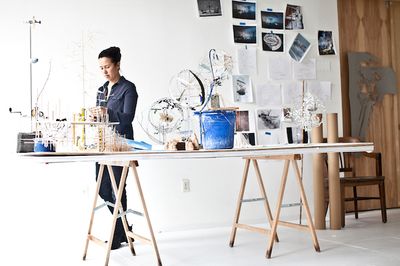

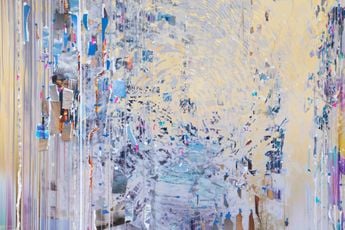
To encounter a work by Sarah Sze is to experience a continual recalibration of scale: the eye moves between the totality of the installation and the minutiae of its constituent parts, each detail forming a self-contained yet interdependent composition.
Sze, who represented the United States at the 2013 Venice Biennale, transforms a myriad of everyday objects into site-specific sculptures of monumental scale and astonishing intricacy. A painting graduate of Yale and the daughter of an architect, she brings the formal languages of both disciplines into play—structuring space and movement with architectural precision while orchestrating colour, texture, and composition with a painter’s sensibility.
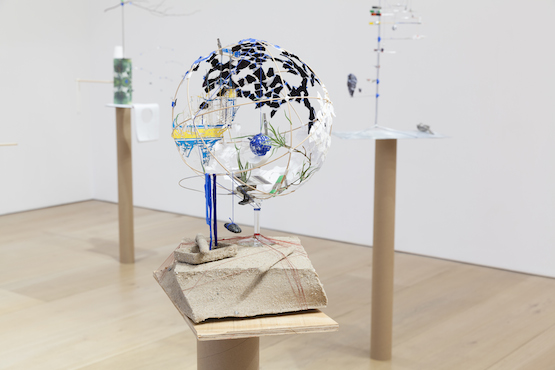
This interview takes place as the artist installs her eponymously titled exhibition at Victoria Miro, on view from 30 January to 14 March 2015 across the gallery’s London spaces—her first presentation in Europe since Triple Point at the U.S. Pavilion in Venice. Spanning the gallery’s two London sites, Sarah Sze unfolds as both constellation and continuum: a field of small-scale sculptures and mobiles occupies the Mayfair gallery, while immersive, landscape-like installations, including works from the ‘Stone Series’ and the ‘Model Series’, extend across three floors at Wharf Road. Across these spaces, Sze reconfigures everyday materials, printed images, and instruments of measurement into provisional architectures that map behaviour in time and space, slowing the pace of looking and foregrounding processes of observation and accumulation.
Central to the exhibition is Sze’s ongoing inquiry into how discrete units cohere into larger structures—and, conversely, how wholes fragment into new configurations. This logic extends to her engagement with time, as she uses material to give form to that which resists representation: the psychological and emotional dimensions of duration. In conversation with Anna Dickie, Sze reflects on her sustained dialogue with painting, her use of literature and chance, and her understanding of her works as experiments—propositions that generate questions whose answers remain just beyond the limits of imagination.
AD: It has been over two years since your last exhibition at Victoria Miro, and in the interim you represented the United States at the Venice Biennale. What are the ideas central to this show in London, and how do they relate to what you were exploring in Venice??
SS: I love this great Lawrence Weiner work that is at the Walker [Art Center] called Bits & Pieces Put Together to Present a Semblance of a Whole, and this relates to something I think about in my work. I am very interested in the idea of smaller units that add up to a whole. So that is one idea.
In this show, each space is very different in character, but they all are spaces where when you walk in, you have a sense of an overall landscape that fits together as a whole. I was also interested in this idea of modeling, and how you model an idea that is impossible to model. This was something I was thinking about in Venice, but it has become more focused here.

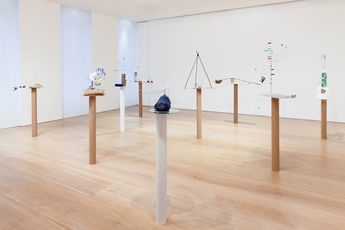
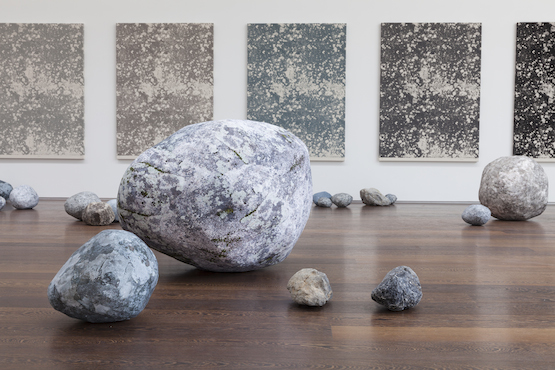
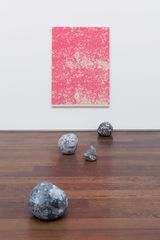
For this show, each room has a very specific question to it. For example for the Mayfair space, I focus on the question of how you model an idea. Then in Wharf Road on the top floor there is a piece that is really all about rocks and how they break down as materials. It has this strong [sense of] landscape, but it plays with colour and weight and is really about questioning materials and their breakdown.
AD: You have been resident at The Fabric Workshop and Museum in Philadelphia. How has that experience filtered into the ideas relevant to this exhibition?
SS: I started working at the Fabric Workshop right after Venice. There is one piece that acts as a calendar of every day that I was in residence—we are showing about three months worth at Victoria Miro. This piece comprises pages from the newspaper, which I took each day and have made into a sculpture. It became a marking of time or a calendar in real space and the question in the questions became: How do you measure either space or time through materials or objects? What is our behavior in doing that? How do you make sense of the moment in time—why is one minute any different than the next? How do we mark time not only physically, but emotionally or psychologically? I wanted to consider how time cannot be made into units because events and time have a different length and importance that is measured, not in a quantitative way physically, but in a quantitative way psychologically and emotionally.
“Often I am starting by responding to the architectural space, and begin with the larger strokes of how you move through the space, or how the composition flows, and then I consider the points of details which marks that larger scope.”
AD: It feels very much as if these ideas extend your long-standing investigation into size versus scale?
SS: Yes, absolutely. I think it is interesting you have said that. I want to come at scale literally in a physical sense, but also come at it in terms of how you measure the importance of things.
AD: Sudden shifts in scale are a trademark of your larger installation works. But I saw a small sculpture of yours at Basel Hong Kong last year, and I was interested to know what it means for you to work on small sculptures, rather than big installation works?
SS: That’s a good question in relation to the show now. Because for this exhibition, I started by working on smaller works, that then gathered to became part of a larger landscape. Often I am starting by responding to the architectural space, and begin with the larger strokes of how you move through the space, or how the composition flows, and then I consider the points of details which marks that larger scope. But for this show at Victoria Miro, I actually started with the detail.
The piece that you saw at Hong Kong is very related to one of the first pieces I did for the Mayfair space of Victoria Miro. If you saw that work at Basel Hong Kong, then you have a good sense of what Mayfair will look like. These works are very intimate works, and very much about modeling; the works have titles such as: Model for a Passing Thought; or Model for a First Impression. These works are about modeling things that are impossible to model—modeling a sort of poetic idea that is much more fragile than something we could ever grasp, or something that is given to chance or fate. This is than obviously tied to the idea of time too, and the question of how you can model a time based concept out of materials? These smaller works are more like little poems, or sonnets, rather than novels, and I hope they have that kind of density to them too.
AD: You mention chance. To what extent are you happy to abdicate authorship to chance?
SS: I set up a situation where there are particular frames I want to work within that allow for chance to play a large role. So for the part of the show in Mayfair, I wanted to work on a scale similar to that piece you saw at Basel. All of the pieces are small in size—they are model size. But within that, it is very intuitive, and a lot is left to chance. It is like petri dishes which are set up, and which then evolve from one step to the next.
There is so much work—like in any show—which is discarded because it is a failed experiment, or it is changed (and that can happen right up to the last minute). So I rely on chance a lot.
AD: You refer to your work as ‘constructed experiments’. What is the main subject of these experiments: the materials, the space or the audience?
SS:

The subject of the experiment is a question—which is a much more scientific way to think of it. The way a science laboratory usually works: there is a question that presides over the work. Partly because there is a need for a guiding question, which arises because a laboratory has to be funded and they have to write and articulate a lot of what their project is. But I think what is interesting about laboratory research is when you look at many great breakthroughs in science, more often than not, the question they were asking is not related directly to the answer they found.
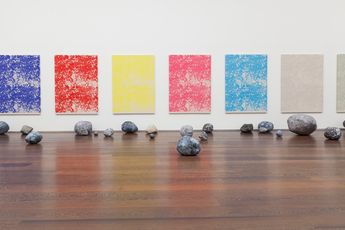
A good scientific experiment is like a good artistic experiment—actually the best ones lead you to places outside of your questioning. They take you beyond your imagination. The question is always limited by your imagination, and the moment it arose in, but a good experiment is one that leads to an answer that is beyond the imagined answer. Having said that, when the audience enters a space, I want to ensure the question and process of questioning is still hovering there. That relationship with audience is really important. I try and make a space where that process of discovery is somehow live in the exhibition space, and I hope that in every space you have a sense of the work and the decisions being made in real time that relate to the works. For example in the room that experiments with the qualities of a rock. There are real rocks and fake rocks and they gather in different constellations across the gallery. At one point there is a rock placed on the balcony, and it was placed there at the very end of the install, and I hope that as a viewer you can see the sort of tail end that is discovered and happens in the moment, and was discovered by chance.
“A good scientific experiment is like a good artistic experiment—actually the best ones lead you to places outside of your questioning. They take you beyond your imagination.”
AD: You graduated from painting at Yale, and I understand the formal elements of a painting continue to be important to you. How is this specifically relevant to the show at Victoria Miro?
SS: I love painting and it is deeply behind every work I make.
In this particular show, the room with the rocks actually has canvases in it. That is different from how I usually deal with painting. I usually talk about painting in terms of its process being transferred to a sculptural process. In doing so, I am speaking of the process of painting in the most traditional sense—as a very improvisational step-by-step piecing together of a work. I bring this into the way I make sculpture—one that favors a lot of incremental decision making in the moment and a lot of improvisation, as opposed to a lot of pre-planning and fabricating.
In this show, the rocks—there were rocks in Venice too—are made from photographs of rocks that have been printed and wrapped around an armature. Hopefully they create a strange location, where the viewer feels compelled to prescribe a sense of weight to the rocks, but equally is aware they are created by a photograph. So I am playing with this two-dimensional and three-dimensional use of formal language. Also a relevant idea from architecture, and the relationship of ornament verse structure and how this relationship can effect our perception of weight, gravity and form.

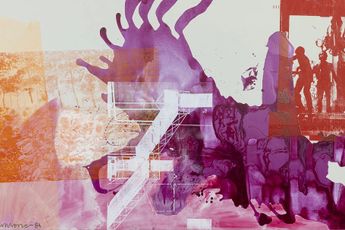
For this particular exhibition, I also took the colour spectrum breakdown for the photograph and I made prints in the colours that are used to calibrate colour. So we have a field of rocks and then along the wall you have these colour separations—these are silk screens of the rock photographs on canvas and they act almost like a colour bar tool for the actual print. It is a sort of breaking down of colour. It raises the question of how you measure colour? But these are on canvas, and immediately it brought up many questions about painting. Once you put a canvas on the wall, I think it is a painting, while they are in direct relationship to printmaking, sculpture and photography. And I am interested in the place where you might trace that idea to Picasso’s Still Life With Cane Chair, or Rauschenberg‘s Bed. In relation to Rauschenberg, I am thinking about painting coming off the wall, and onto the floor. You have the canvas with the colour breakdown, but then you have the rock right on the floor next to it.
I am very interested in that location between painting and sculpture and what a painting can do, what a sculpture can do, and what they cannot.

AD: You often make references to other artists in your work.
SS:

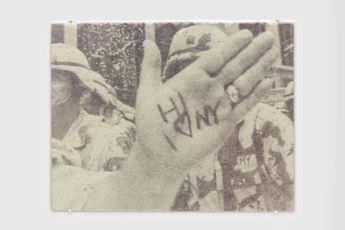
People often ask me about artists who I am influenced by, and I think it is like reading a book: when you read a book and it affects you, you can virtually only smell that book for that time of reading. I think artists frame historically their work with certain people self-consciously, but things very much relate to the moment and what you have been looking at. So in the show, the two things I was thinking about the most, and which I had seen recently were Rauschenberg and also the work of Felix González-Torres.
I was thinking about González-Torres just today, when I was installing. I was thinking about the breakdown of units, the dissemination of an object, and the ephemerality of an object and the repetition of an object in a pile, a pile that is then broken down, which relates also to the grief of the passing of time. This all has something to do with the composition of these works. It may not be immediately apparent on the surface, but somehow it is there.
AD: The titles of your works often include literary references. Could you discuss the connection between literature and your work?
SS: I think people generally understand the creative and formal language of literature in a much more sophisticated way then they do visual language simply because that is how we learn to communicate—so a lot of the time, I make these literal analogies.
When I am installing, I always think about what the first sentence in a book is, and how different that might be from the last sentence. It’s about circulation: what are you going to see first; and what are you going to see next? There are narrative transitions. When we see a film or read a book, it is so inherently time based. But actually seeing an artwork is also time-based. We experience it in real time. So I like to play with narrative in the same way as writing plays with narrative time. It helps me to understand how a viewer might see a work in real time. I can think about a work as a piece of writing and think then how it might be read, and to unpack how it might communicate with the viewer that way. So much of the time you are having a strange conversation with a viewer, one that you never get to experience.
AD: On this basis, are your works complete once they have an audience?
SS: Without being hubristic, I make work that talks about its own ephemerality, but I hope that my artworks will have a conversation that lasts beyond my lifetime. I never think of an artwork as having one conversation. Hopefully a show is but one stop in the life of a work, and that is an amazing thing.


When I did the Venice Biennale, I met the widow of Gordon Matta-Clark and in one of the moments at Venice that I really enjoyed the most, I told her about an exact point in the Pavilion where I was having a conversation or making reference to Gordon Matta-Clark. It was really interesting to talk to her about her own relationship to his work, and my work at Venice, and it was a conversation over time through an art work.
That is what is incredible about an artwork. You know in Venice, you can see Bernini’s work and have these amazing conversations with him, and then you go to the Biennale and you have another conversation with a contemporary work. You hope that the viewer is but one person who will be part of an ongoing conversation. As an artist, you have to believe that. —[O]



A respected voice in contemporary art discourse.
Focusing on ambitious storytelling and insightful art-world commentary. Ocula Magazine publishes in-depth interviews, critical essays and timely analysis on the artists, exhibitions and ideas driving the global art world.
Learn more about Ocula Magazine
Showcasing the best of the art world.
Ocula partners with galleries from around the world to highlight their artists, artworks and exhibitions. Gallery membership is by application and invitation, with each member vetted by an independent panel.
Learn more about Ocula Membership
Specialises in the sale of major artworks.
Led by a team with deep ties to the world’s leading auction houses, galleries and collectors. Ocula’s advisory team offers bespoke services to high-net-worth clients from around the world who are looking to acquire the best of contemporary and modern art.
Learn more about our team and services