





Simone Fattal: Fragility and Fiction

Simone Fattal. Image and art direction: Europium (Julia Andréone and Ghazaal Vojdani).


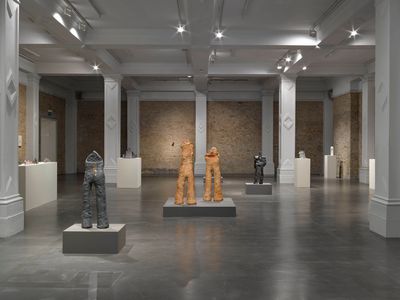
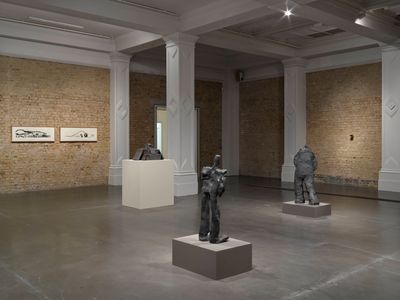
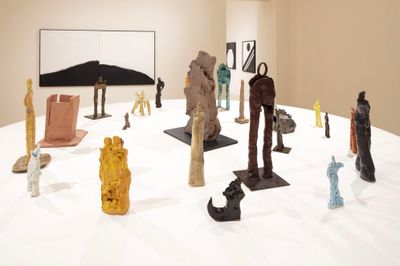
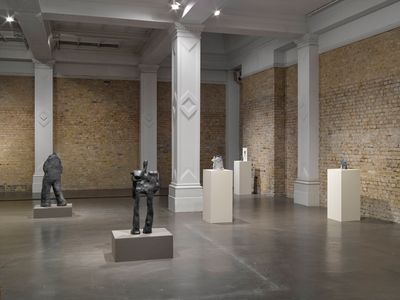
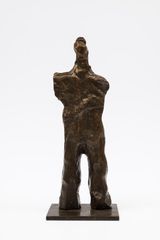
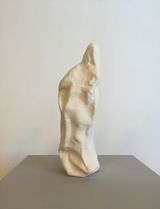
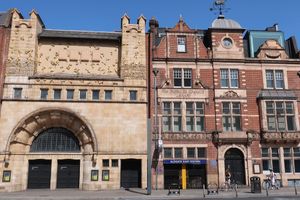
Modelled after the inside of a kiln, Simone Fattal‘s recent commission Finding a Way at Whitechapel Gallery, London (21 September 2021–12 June 2022), featured bronze and clay sculptures of varying sizes, creating a world drawn from history and memory.
Assembled as if a procession, these figures, as the artist explains, are an expression of the personal journey that every one of us undertakes, which ultimately is a quest for being and finding one’s true self. Other sculptural elements, including a ceramic ladder, a series of carved architectural steles, and a Mesopotamian ziggurat temple, connect the earth to other realms.
Simone Fattal was born in Damascus, Syria, raised in Beirut, and studied philosophy at the Sorbonne in Paris. After returning to Beirut in 1969, she took up painting, working in the city for ten years. There she met the late Etel Adnan, her collaborator and long-time partner. Fleeing the Lebanese Civil War, Fattal settled in Northern California in the 1980s.
Fattal’s artistic ambitions paused between 1980 and 1988, during which she established The Post-Apollo Press, a renowned publishing house founded in 1982. Dedicated to promoting experimental literary work, its authors, scholars, and poets have included Alice Notley, Ahmed Toufiq, Etel Adnan, Marguerite Duras, Jalal Toufic, Barbara Guest, Leslie Scalapino, and Lyn Hejinian.
Fattal explores a range of themes rooted in her displacement from Syria, to lived experiences in Europe and the U.S., alongside politics of excavation related to mythology, antiquity, modernity, and contemporaneity. Fattal works across a variety of mediums including painting, ceramic, stoneware, terracotta, and bronze.

Sculpture and ceramics were foregrounded in the artist’s practice during her studies at the Art Institute of San Francisco in 1988, where she explored the possibilities of clay as a medium for figurative and abstract sculpture.
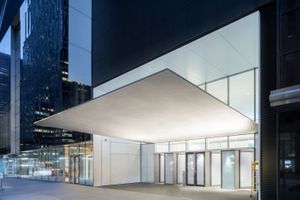
Fattal’s work has been exhibited internationally at institutions such as MoMA PS1, which held a 2019 retrospective gathering over 200 of the artist’s sculptures, paintings, and collages, as part of Work and Days, which explored the effects of this displacement over four decades.
In the following interview, Fattal describes her fluid relationship to history, initial encounters with clay, and love for publishing. She reflects upon how living across the Middle East, Europe, and the U.S. has enabled multiple ways to approach the past and make sense of the present.
JD: Clay exists in every context in the world, in different communities, and across civilisations. The material is in a continuous state of evolution. What sparked your initial inquiry into clay, and how does it help you think through sculptural form?
SF: After painting for ten years in Beirut, I felt it was time to leave Lebanon as the Civil War showed no signs of relenting. I moved to the U.S. in a period of dramatic change. During this hiatus I took up publishing, and after several years of not making art, I began sculpting with clay.
The idea to work with clay came about as a friend was working with bronze, which got me fascinated by the waxing process. I began making little things in wax and funnily enough, they look exactly like what I do today with clay, 40 years later.
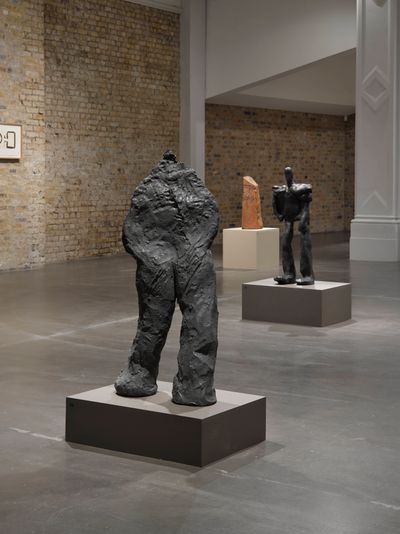
Why clay? First, it allows full interaction between your body and the material, and because it is living matter. It answers you. It doesn’t let you do what you want all the time, and this is valuable as there is a constant dialogue between material and maker.
Clay is also very hands-on compared to other materials. When wax is hot, for example, you can’t touch it. You also need tools to work with different metals. I think weaving and embroidery are the only other ways to work directly with touch. I have done both, but clay has offered me more possibilities.
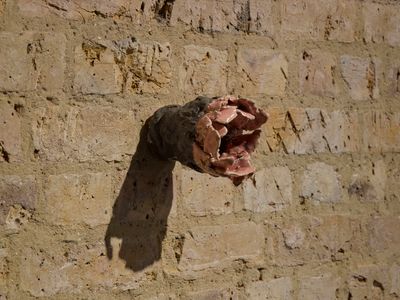
JD: You highlight the limitless possibilities of clay and the embodied dialogue that occurs when working with the material. Would this indicate that it’s not a passive medium?
SF: When working with clay, one has to be careful with every move. For example, waiting for it to be dry enough before firing, but not too brittle that it breaks on the way to the kiln. It’s transformative: process and firing in unison, a repetitive firing to the clay body, and glazes to add its finishing colour.
The resulting object is probably far from what you thought you would get. So the conversation is permanent, but it’s also a fiction, from the idea to what becomes the finished work. There is also an overarching sense of fragility, as the object can break.
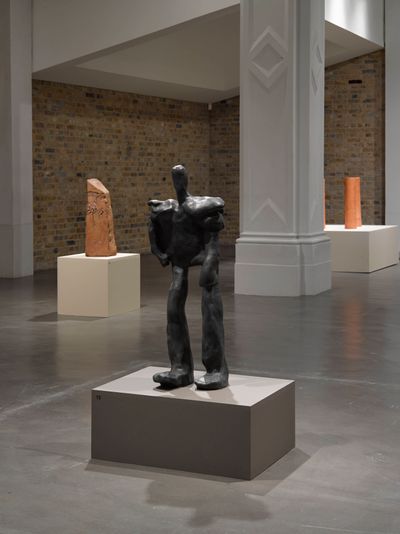
JD: That’s an interesting way to think about the relationship between clay and fragility and Finding a Way at Whitechapel Gallery, where figurative sculptures, according to the exhibition text, embark on a spiritual and physical metamorphosis.
I was drawn to how these differently scaled works confront viewers with their physicality and presence, especially given they began as small wax maquettes and progressed to monumental sculptures like Adam and Eve (2021), which was on view at the 2022 Venice Biennale.
Additionally, your sculptures express the fragility of the body, or humanity, and our interactions in the world. Their figures appear incomplete or partly formed, or perhaps on a journey to being formed. Could you expand on this in-between state they embody?
SF: Working in any practice, you have to utilise available possibilities. Very often, you don’t know in advance what you want to do, but when you can make large-scale work, you go for it.
“It’s a journey of self-discovery—not only do you discover what you can do, but what it means for you to be doing this.
I was doing small pieces that were about 40 centimetres high. An opportunity then came to work at the Art Institute in San Francisco where I encountered huge kilns of about five metres. It was a transition from working alone, where you can’t really go further up as you need help.
I wanted to take advantage of this opportunity and began scaling the work up, as we saw with the sculptures in Venice. It’s wonderful to work on your own; you work small and it’s just as good.
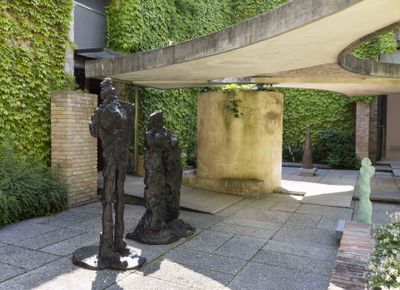
The most important factor, regardless of scale, is having a clear intent so that once you put your hands on the clay, your idea comes through and you do it. Before this moment, I did not know that I was going to be interested in these figures, ancient myths, and forgotten heroes—it just came.
“These figures are witnesses and relate to the Lebanese Civil War, which lasted 15 years.
Because my paintings are totally abstract, it was a complete surprise. This is what art can do for you. It’s a journey of self-discovery—not only do you discover what you can do, but what it means for you to be doing this.
In no way are my pieces unfinished—they are totally finished and present. They represent well what they have started to portray, but they are abstracted figures.
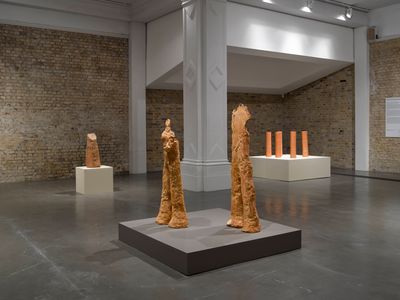
JD: When I visited Finding a Way, rather than seeing the space as the interior of a kiln, it brought to mind an archaeological excavation site. There is slippage between past and present, and the ceramic sculptures displayed alongside etchings made me think about the relationship between drawing and sculpting. Do your drawings inform your sculptures?
SF: The exhibition at Whitechapel depicted characters advancing—one could say through life—and they walk on the other side of the central line. There are pieces like ziggurats or steles that they think about, which occupy their minds.
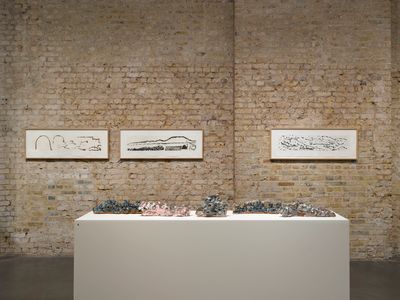
JD: I can really connect with what you said about witnessing and how these abstract and figurative sculptures bear witness to time and a retelling of events. They also seem to allude to being on a journey, but whether it’s a beginning or an end is hard to tell.
Your publishing house is called Post-Apollo. Its logo is the moon, and it speaks to the moon landing achieved in 1969. Why this symbolism?
SF: The moon is certainly up there with the planets that interfere with you the most, and because it’s the closest, you see its transformations. For me, it embodies time even more than the sun, which looks at you as if it’s there all the time.
The moon landing felt like a dawn of new possibilities—the fact humans were now able to go into the galaxy and look at things differently. I used the moon as the logo of my publishing house for this reason—its symbolism and importance. In ancient Syria, the moon god was revered.
JD: How does publishing sit alongside your art practice?
SF: Publishing is really wonderful, you produce work that is like a child birthed into the world to have a life of its own—and books go everywhere. I started my life as a reader and read everything from childhood.
I have a love for literature and a very good ear for it. I discovered this joy for publishing, and while it’s a lot of work, it’s something that you continue once you’ve started. It’s very much concerned with others, rather than being for you or your glory. —[O]
Main image: Simone Fattal. Image and art direction: Europium (Julia Andréone and Ghazaal Vojdani).









A respected voice in contemporary art discourse.
Focusing on ambitious storytelling and insightful art-world commentary. Ocula Magazine publishes in-depth interviews, critical essays and timely analysis on the artists, exhibitions and ideas driving the global art world.
Learn more about Ocula Magazine
Showcasing the best of the art world.
Ocula partners with galleries from around the world to highlight their artists, artworks and exhibitions. Gallery membership is by application and invitation, with each member vetted by an independent panel.
Learn more about Ocula Membership
Specialises in the sale of major artworks.
Led by a team with deep ties to the world’s leading auction houses, galleries and collectors. Ocula’s advisory team offers bespoke services to high-net-worth clients from around the world who are looking to acquire the best of contemporary and modern art.
Learn more about our team and services