The art world in focus
Subscribe to our newsletter for news and insights on artists, galleries and exhibitions.

Murakami is referring to Matabei Iwasa, the celebrated painter of folding screens that depicted Kyoto in the 1600s, and Katsuhiro Otomo, the creator of the legendary manga and anime AKIRA (1982–90), set in a futuristic Tokyo. The comparison comes up in conversation with the artist, conducted on the occasion of his solo exhibition Mononoke Kyoto at Kyoto City KYOCERA Museum of Art (3 February–1 September 2024). An ardent fan of manga since childhood, with a PhD in nihonga (traditional Japanese painting), Murakami coined the term ‘Superflat’ in 2001 to describe the two-dimensional forms and the cute, soft kawaii aesthetic found in postwar Japanese popular culture.
The definition of Superflat is intentionally open-ended. In works by contemporary artists associated with the term, such as Chiho Aoshima, Yoshitomo Nara, and Aya Takano, common themes include various attributes of postwar Japanese culture—consumerism, sexual fetishism, subcultures—and citing influences from both traditional Japanese art of the Edo period (1603–1868) and modern Western art.
The bold appropriation of imagery from popular culture by Superflat artists evokes parallels with Pop art. Murakami’s art-trading company, Kaikai Kiki, which comprises a studio of around 160 assistants and an eponymous Tokyo-based gallery, has been compared by Western media to Andy Warhol’s Factory.
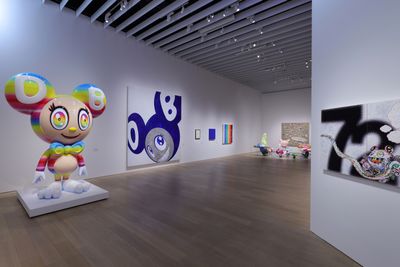
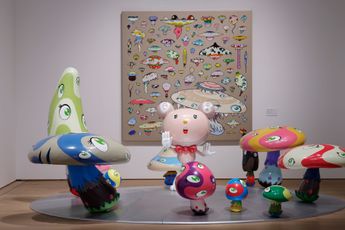
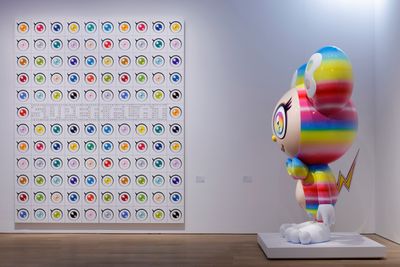
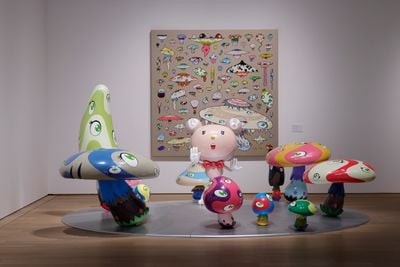
Murakami’s own Superflat work can be traced to the creation of Mr DOB in 1993, an original drawing which is included in Mononoke Kyoto. In one of the exhibition’s six rooms, the A4-size pencil drawing depicts a character with Mickey Mouse-like ears, large glossy eyes, and toothy grin alongside its painted, sculptural, and collectible toy versions. Other works in the room include Murakami’s pantheon of characters, among them the overly sexualised youth rendered in Japanese manga style; kitsch, chibi-style duo Kaikai and Kiki; and mushrooms covered with cartoonish googly eyes.
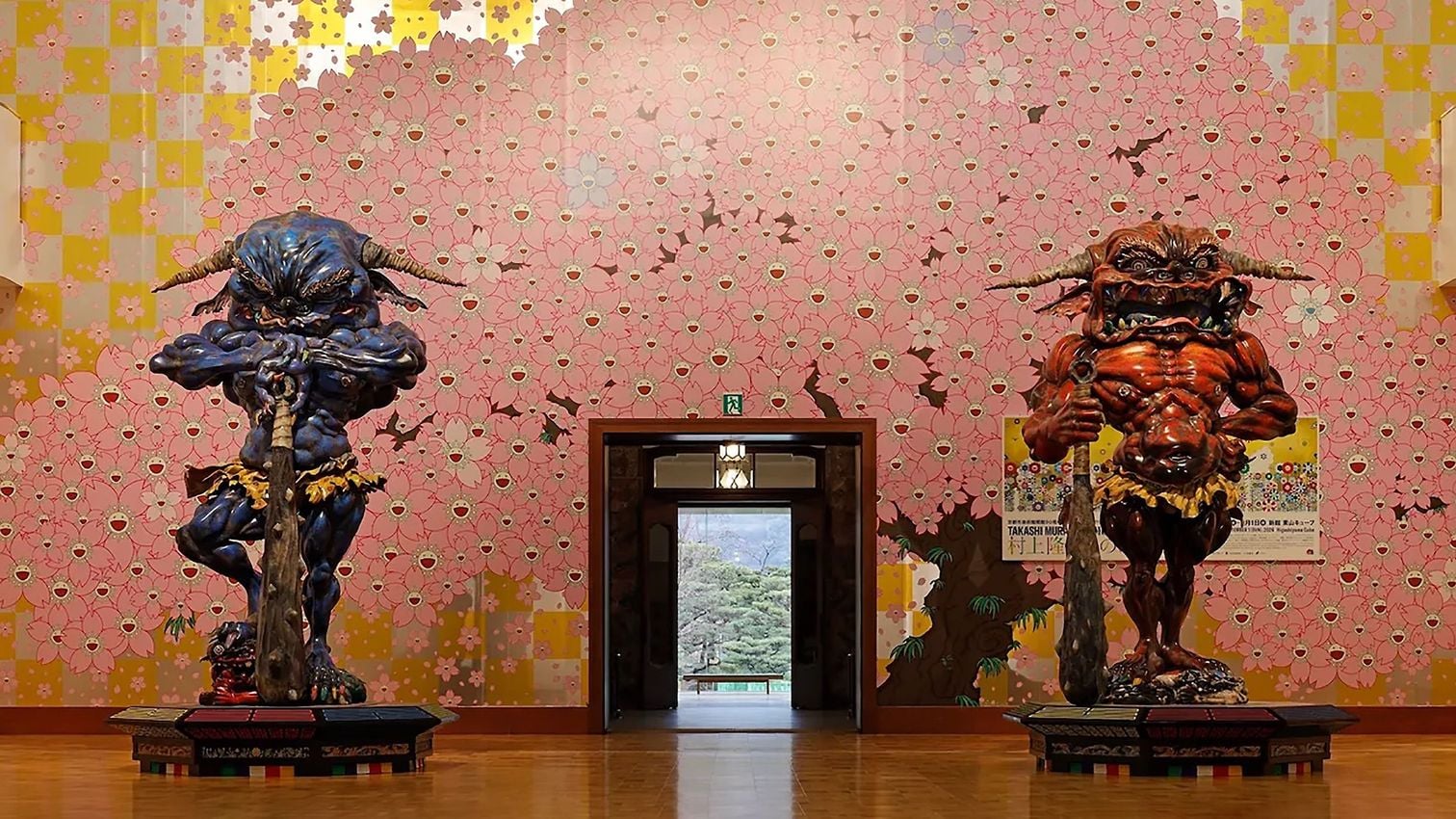
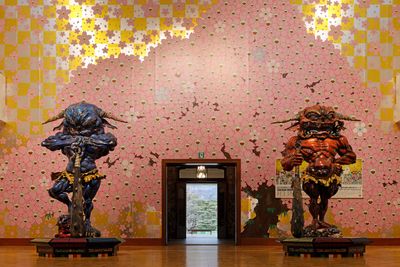
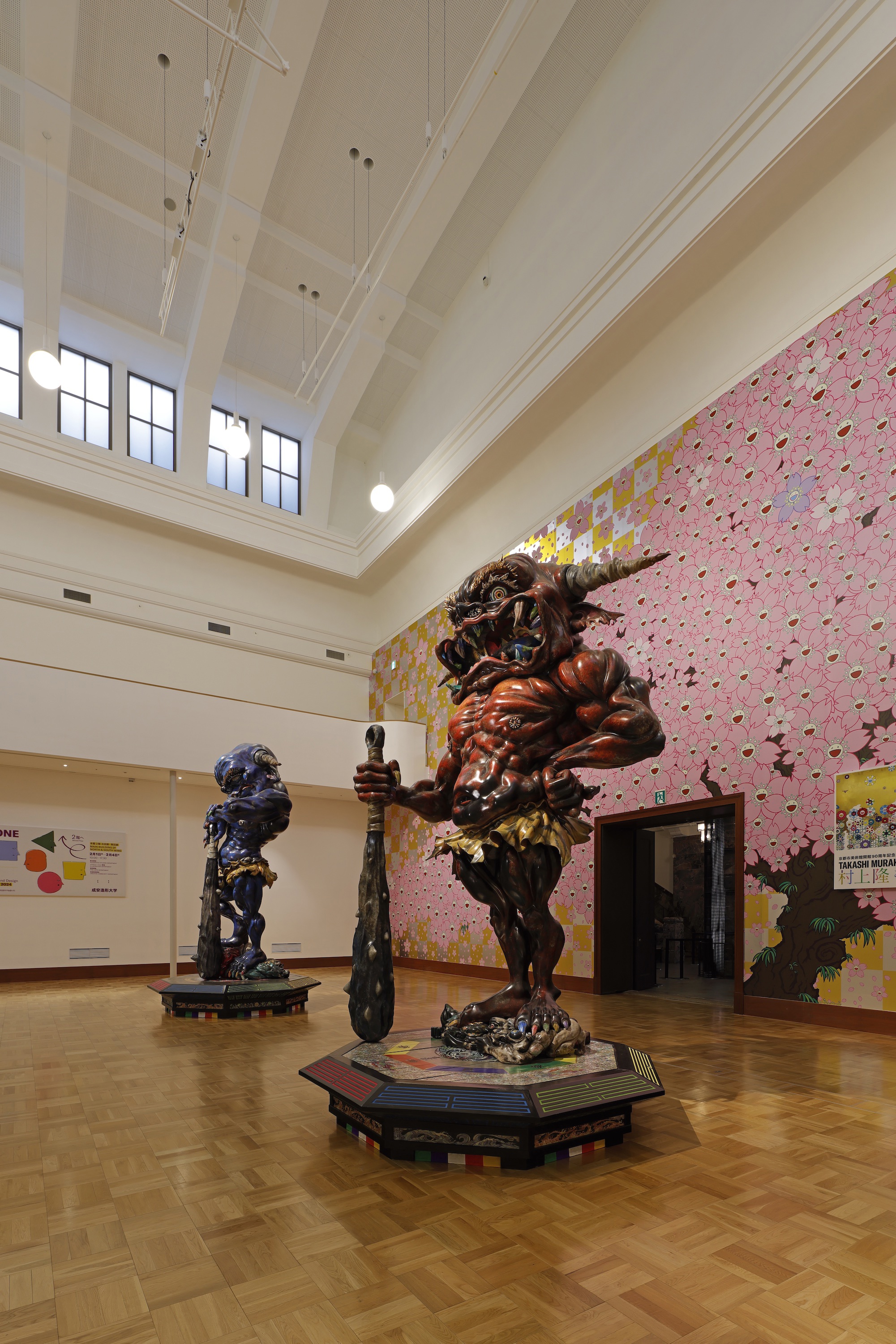
Mononoke Kyoto begins in the central hall of the museum, where a pair of four-metre-high red and blue sculptures guard the entrance. Titled Embodiment of ‘A’ and Embodiment of ‘Um’ (both 2014), they represent the demonic creatures of Japanese folklore known as oni, which Murakami has converged with fearsome protector figures from Buddhist mythology. Their menacing faces and extreme musculature diverge from the lovable characters for which the artist is best known, such as the smiling cherry blossoms on a gold-and-white chequered backdrop that have been painted on the entrance wall. The presence of gold here evokes the foil used in traditional Japanese painting, especially in the Kanō School that flourished in late 15th-century Kyoto.
Murakami created the oni sculptures in the aftermath of the Great Tohoku Earthquake in 2011, a catastrophe that prompted him to engage more deeply with historical Japanese art and its response to natural disasters and mortality. In Mononoke Kyoto, he focuses his lens on the history of Kyoto, the seat of Heian-period Japan (794–1195), which witnessed a proliferation of art and literature. The city was home to many of the Edo-period painters that Murakami admires—and it is also where he relocated following the earthquake.
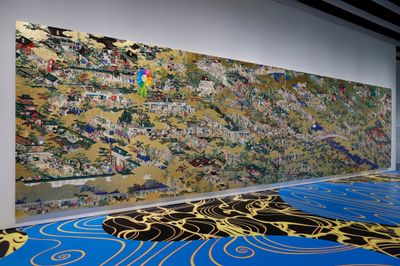

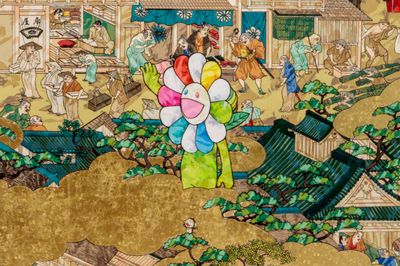
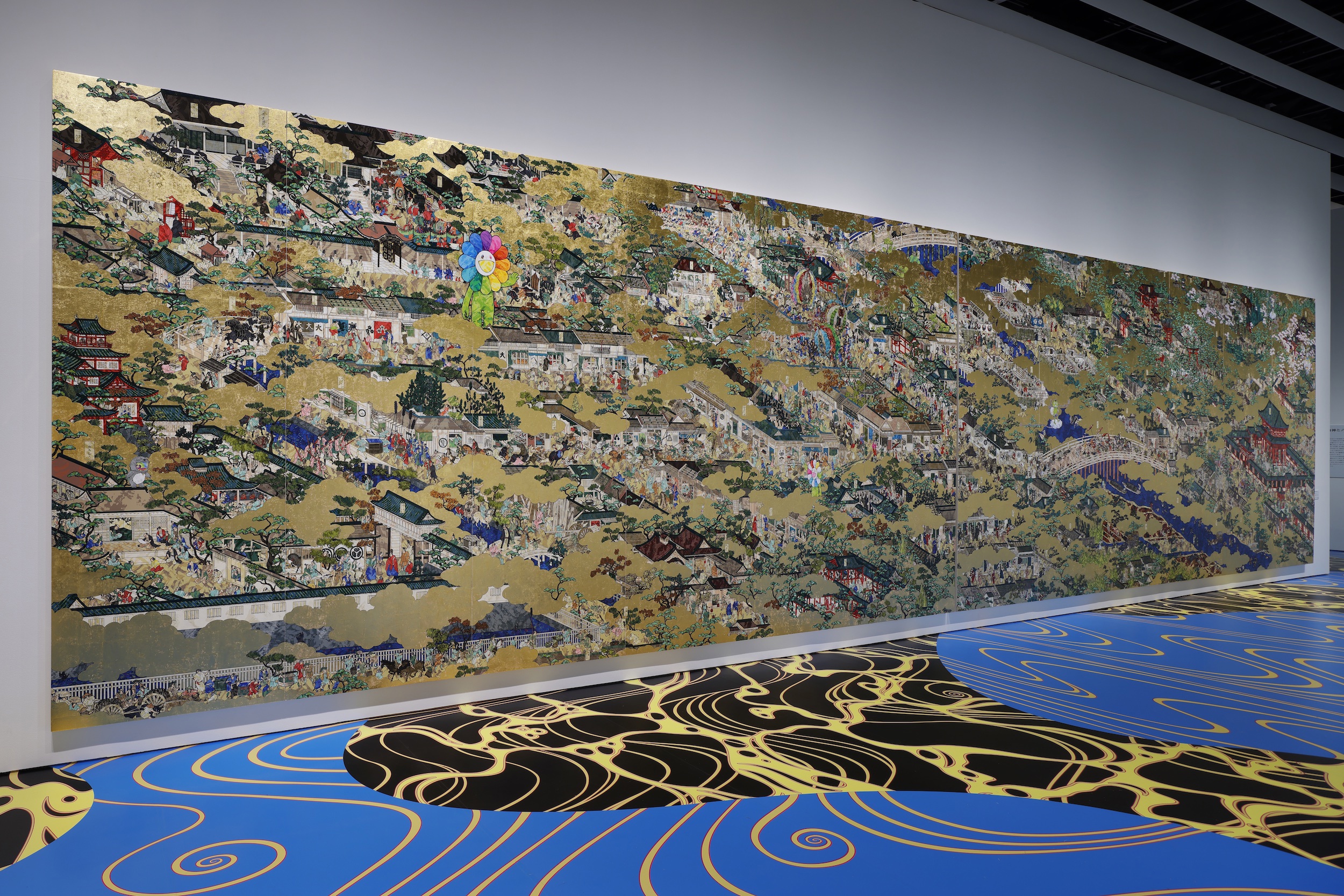
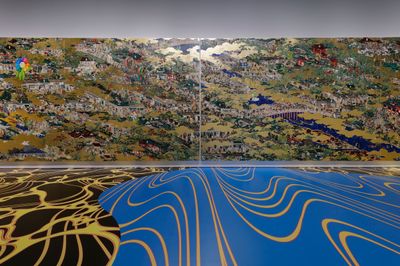
Fittingly, the first work past the entrance is Murakami’s 13-metre reimagining of Matebei’s Edo-period masterpiece Rakuchū-Rakugai-zu Byōbu (Scenes in and around Kyoto, c. 1615). Murakami’s version, Rakuchū-Rakugai-zu Byōbu: Iwasa Matabei RIP (2023–24), features smiling flowers and creatures painted on top of a reproduction of Matabei’s everyday scenes of Kyoto, accentuating the supernatural mononoke or vengeful spirits of the exhibition title.
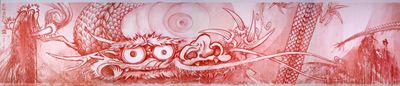
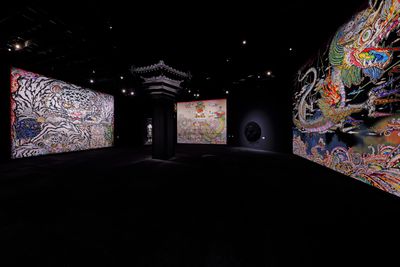
A decade before Mononoke Kyoto, Murakami rose to a challenge from a renowned art historian. The artist explained his rationale in the resulting work’s lengthy title, Dragon in Clouds—Red Mutation: The version I painted myself in annoyance after Professor Nobuo Tsuji told me, “Why don’t you paint something yourself for once?” (2010). The painting replicates the massive scale of its inspiration, the eight-panel Dragon and Clouds (1763) by Kyoto-based Edo painter Soga Shōhaku. Other historical and contemporary works that Murakami referenced include the red monochrome scheme of Katsushika Hokusai’s scroll Zhongkui (Shōki), the Demon Queller (1811) and the flared nostrils on the album cover of King Crimson’s In The Court of the Crimson King (1969).
As Murakami notes in our conversation, his exploration of Kyoto extends to the more macabre side of its history—for example, it was the site of the most intense battles during the Ōnin War (1467–77)—which he taps into in a darkened room where the walls and floors are patterned with small skulls. The references to death continue in the gold skulls attached to the columnar Hexagonal Double-Helix Tower (2023–24) and the wall-mounted sculpture Skull disc BLACK (2015–24), while the four enormous paintings depicting each of the Four Symbols—imaginary creatures in East Asian mythology—reflect the four cardinal directions of Kyoto.
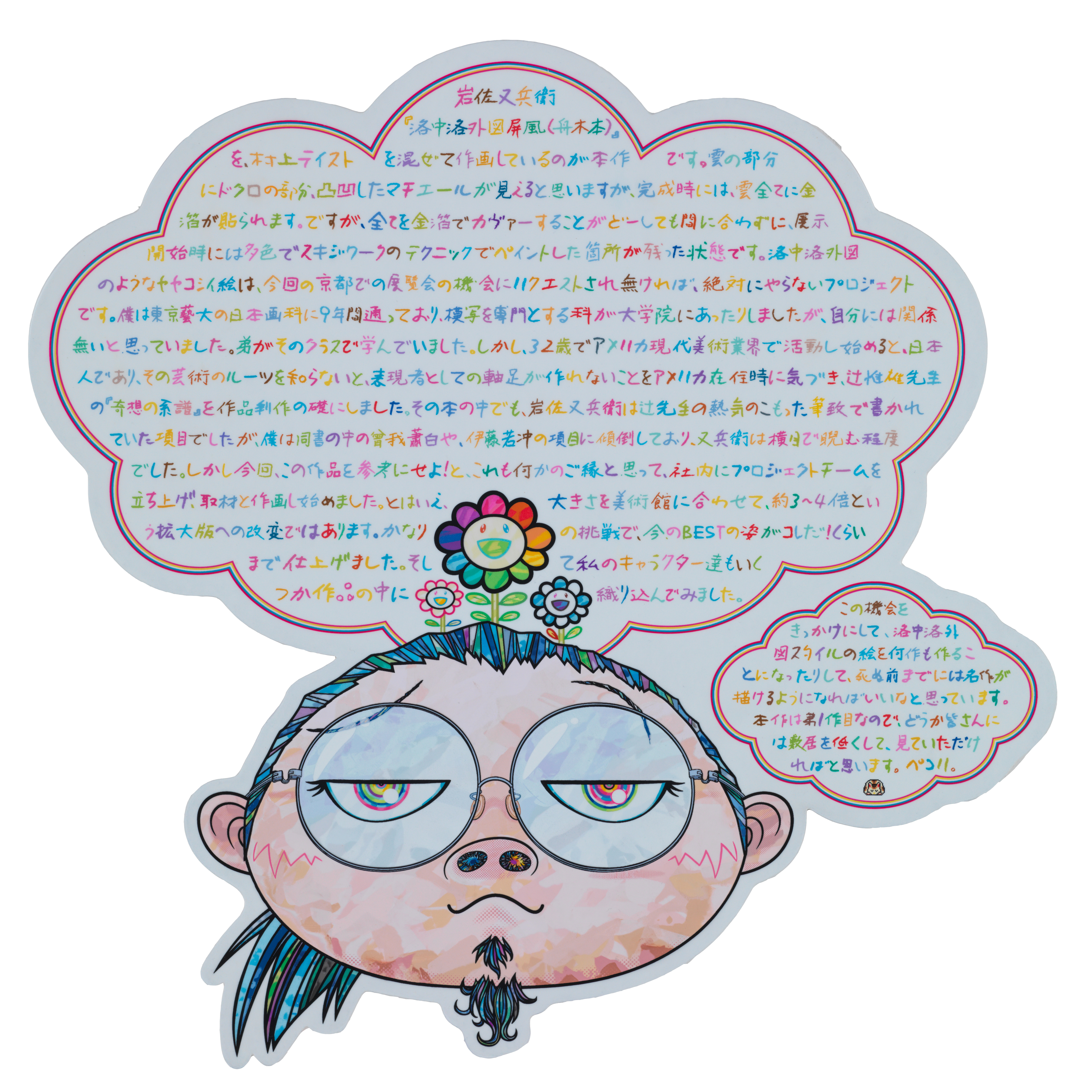
Impressively, most of the works Murakami created for Mononoke Kyoto were made around the same time as the artist was preparing more than 120 new works for the exhibition Hiroshige’s 100 Famous Views of Edo (feat. Takashi Murakami) at the Brooklyn Museum in New York (5 April–4 August 2024). The artist is candid about the challenges of relentless production while on a deadline, as well as working with institutions on a restricted budget, which he addresses throughout Mononoke Kyoto in text-based works titled Excuse Paintings. Written in Japanese with English translations, they explain that many of the works which were incomplete at the time of the opening would be gradually finished, hopefully by the time the exhibition closed.
Our conversation ranges from the artist’s relationship with Kyoto, the similarities between the works of Matabei and Otomo, and the liberating potential of mononoke both in his work and in the popular imagination.
TM: Onis are truly familiar characters ubiquitous in Japanese folklore and almost always appear in pairs, red and blue. For the Japanese, they symbolise anger. I combined them with the gatekeeper figures in Buddhism, ‘A’ and ‘Um’ (from the first and the last letters in Sanskrit alphabet symbolising beginning and end, the whole universe), to arrive at these demon sculptures.
During the pandemic I exhibited these works in the hope that they would blast away the coronavirus, but now that the pandemic is over, I am having them keep watch to stand against any future epidemics.
“Although Kyoto has become a world-class tourist destination, underneath it all, it has a macabre history . . .”
TM: The Kyotoites are ‘Kyoto people’ or ‘Heian people’ rather than ‘Japanese people’. An apt analogy might be Italians living in the Vatican.
The people of this town seem to have no sense of belonging to the framework of Japan even since the establishment of the Edo shogunate in the early 17th century to the present day. In Kyoto there seems to exist an independent community, within the ecosystem of which people carry on with their lives. Kyoto’s unique, preserved landscape has been maintained, I presume, thanks to some unwritten rules that have been carefully followed by Kyotoites. I am hoping that this exhibition will provide me with an opportunity to become part of Kyoto society, even if in some small way.
TM: When I was copying Matabei Iwasa’s painting for the production of this work, I realised anew what I had thought when I was young; namely that Matabei Iwasa, a 17th-century painter, had the same genes as Katsuhiro Otomo, a manga artist and film director known for his world-renowned work, AKIRA (1982–90).
Matabei’s Rakuchū-Rakugai-zu (c. 1615), a bird’s-eye view of Kyoto and its surroundings, captures the city with remarkable scrupulousness. There are more than 2,000 characters in the painting, each with their own detailed setting, and you even feel a sense of motion as though you are watching a movie. Matabei must have had a special talent for memorising everything he saw in an instant, for he was able to create such paintings in an age when there were no photographs or moving images. And Otomo, according to anecdotes by those around him, also has an incredible visual memory, for instance, being able to depict a Chinese restaurant he has been to only once without missing any details.
On the other hand, one of Otomo’s great strengths is his unique pictorial technique, in which he mixes painting techniques from the time before the establishment of single-point perspective and the perspective technique in a single painting, evoking the space in reverse perspective. I believe that this astonishing spatial expression can be found in Matabei’s Rakuchū-Rakugai-zu as well. I don’t know how these artists might feel about this, but in my opinion, this is the epitome of Superflat. Although there haven’t been many contexts in which to examine Otomo as a ‘painter’, I would say that the two artists share a unique ability to grasp and construct space, as well as unparalleled memories.
“I don’t know how these artists might feel about this, but in my opinion, this is the epitome of Superflat.”
This new painting, Rakuchū-Rakugai-zu Byōbu: Iwasa Matabei RIP (2023–24), is a work in which I deciphered Matabei’s unique spatiality and added my own twist. I conducted thorough research on the details of the people and the cityscape and created the work with a team of about 100 people consisting of Kaikai Kiki and external staff.
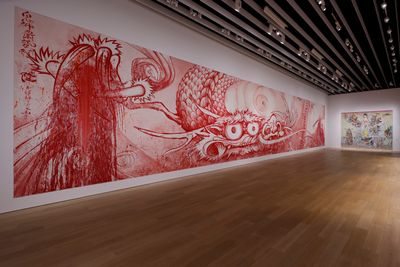
TM: As the title of the work says, art historian Nobuo Tsuji once said to me: ‘You always have your assistants paint for you, and you have forgotten the soul of a painter. Why don’t you try actually painting once in a while?’ I was so annoyed that I decided to show him that I could, in fact, paint. I completed the work in just two days. I had picked up Mr Tsuji’s book, Lineage of Eccentrics [1970], in the first place because of Dragon and Clouds [1763] by Soga Shōhaku on the cover, so I had always wanted to somehow make this work my own and paint it someday.
TM: Although Kyoto has become a world-class tourist destination, underneath it all, there is in fact a macabre history that is marked by heaps of corpses. It is a city that is also strongly steeped in the context of geomancy and yin-yang. Since the Heian period, it has been believed that there are Four Symbols, or deities, who each protect the city of Kyoto from one of the four cardinal directions.
“I believe that art has the power to liberate people’s minds and hearts . . .”
When I created The 500 Arhats (2012), I composed it as a work consisting of four 25-metre-wide paintings and depicted the Four Symbols because I wanted to include some character or another in each of the four sections. This time, I upgraded the motif based on the said work. When I created Black Tortoise, I managed to put myself into a trance and finished the drawing [in] no time.
As for Hexagonal Double-Helix Tower (2023–24), I produced a 5.7-metre-high installation work called Bakuramon in 2014 with Toshihiro Isomi, who was the art director for my film [Jellyfish Eyes, 2013]. We scanned that work in 3D and worked on the data to produce this new work, once again under the supervision of Mr Isomi.

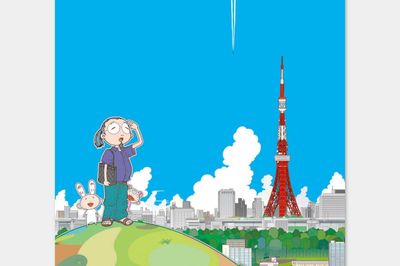
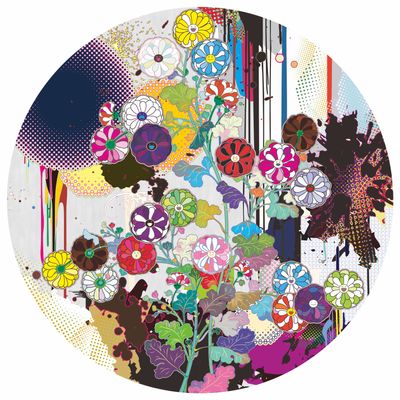
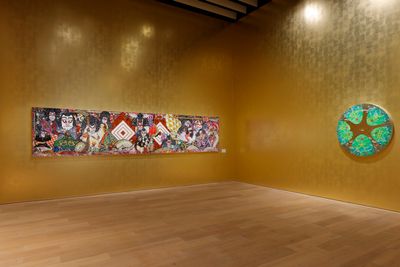
TM: Since presenting the first iteration of this work in 2002, I have been creating its variations as part of a series [the ‘Flower’ series]. This time, Shinya Takahashi asked me to create this work because it follows the tradition of the [17th-century] Rinpa school of painting. Back when I presented the first work in the series, mainstream animations often had summer as their theme, so I made the background blue to incorporate a ‘summer vacation’ landscape, but times have changed and now that mode is gone, so I have applied gold leaf to the background instead to express the quintessentially Rinpa atmosphere.
TM: What do you think is the common denominator of Japanese manga and anime works that have become international hits, such as Jujutsu Kaisen, Chainsaw Man, and Demon Slayer? In all of these stories, jealousy and resentment are the sources of evil. In short, it is a mental matter—a matter of the soul. These works reflect the reality of today’s Japanese society, and I believe that the terrible enemy facing Japanese society right now is the dark emotions that each one of us individually carry around. In fact, if you look at social media, they are exploding everywhere. People see someone as an enemy, bash them hard, and feel refreshed. There is probably resentment and envy behind such an act.
Why is there a need for spellbinders and magicians like the main characters in manga? I believe that art has the power to liberate people’s minds and hearts, and that this power will increasingly be sought after today. As with the spread of conspiracy theories before and after the pandemic, Japan is by no means the only country where such problems of the mind are becoming prevalent. I believe that we were able to present some answers to these issues in this exhibition.
TM: Through Hiroshige’s ‘100 Famous Views of Edo’, a series of prints he supposedly created in the hope that Edo would be restored as soon as possible after a devastating earthquake, I could sense his strong wishes and was deeply moved. I decided to make all of them into my paintings because his sincere feelings about social contribution struck me, and I thought that if I painted all of them, a different kind of chemical change might occur within me. —[O]




A respected voice in contemporary art discourse.
Focusing on ambitious storytelling and insightful art-world commentary. Ocula Magazine publishes in-depth interviews, critical essays and timely analysis on the artists, exhibitions and ideas driving the global art world.
Learn more about Ocula Magazine
Showcasing the best of the art world.
Ocula partners with galleries from around the world to highlight their artists, artworks and exhibitions. Gallery membership is by application and invitation, with each member vetted by an independent panel.
Learn more about Ocula Membership
Specialises in the sale of major artworks.
Led by a team with deep ties to the world’s leading auction houses, galleries and collectors. Ocula’s advisory team offers bespoke services to high-net-worth clients from around the world who are looking to acquire the best of contemporary and modern art.
Learn more about our team and services