






‘There’s a Big Richness in Nothing’: Tobias Pils on Working with Limitations
With his new exhibition at mumok, Vienna, Tobias Pils speaks with Annabel Downes on the gradual changes in his relationship with colour and drawing. Save to My OculaWhen you watch a black-and-white film, you are absorbed less by the colour that is absent than by the story taking shape. For Tobias Pils, painting in black and white has always worked in much the same way. Even when his canvases have been drained of hue, he has thought of them not as monochrome but as alive with temperature and mood. ‘There’s a big richness in nothing,’ he says, and it is this sensibility that has defined his work for more than two decades.
Born in Linz in 1971 and now based in Vienna, Pils has become one of Austria’s most distinctive painters. Over the years, his career has extended well beyond Austria, with exhibitions across Europe through Capitain Petzel and Galerie Gisela Capitain, in the United States with David Kordansky Gallery, and at home in Vienna with his long-time gallerist Eva Presenhuber.
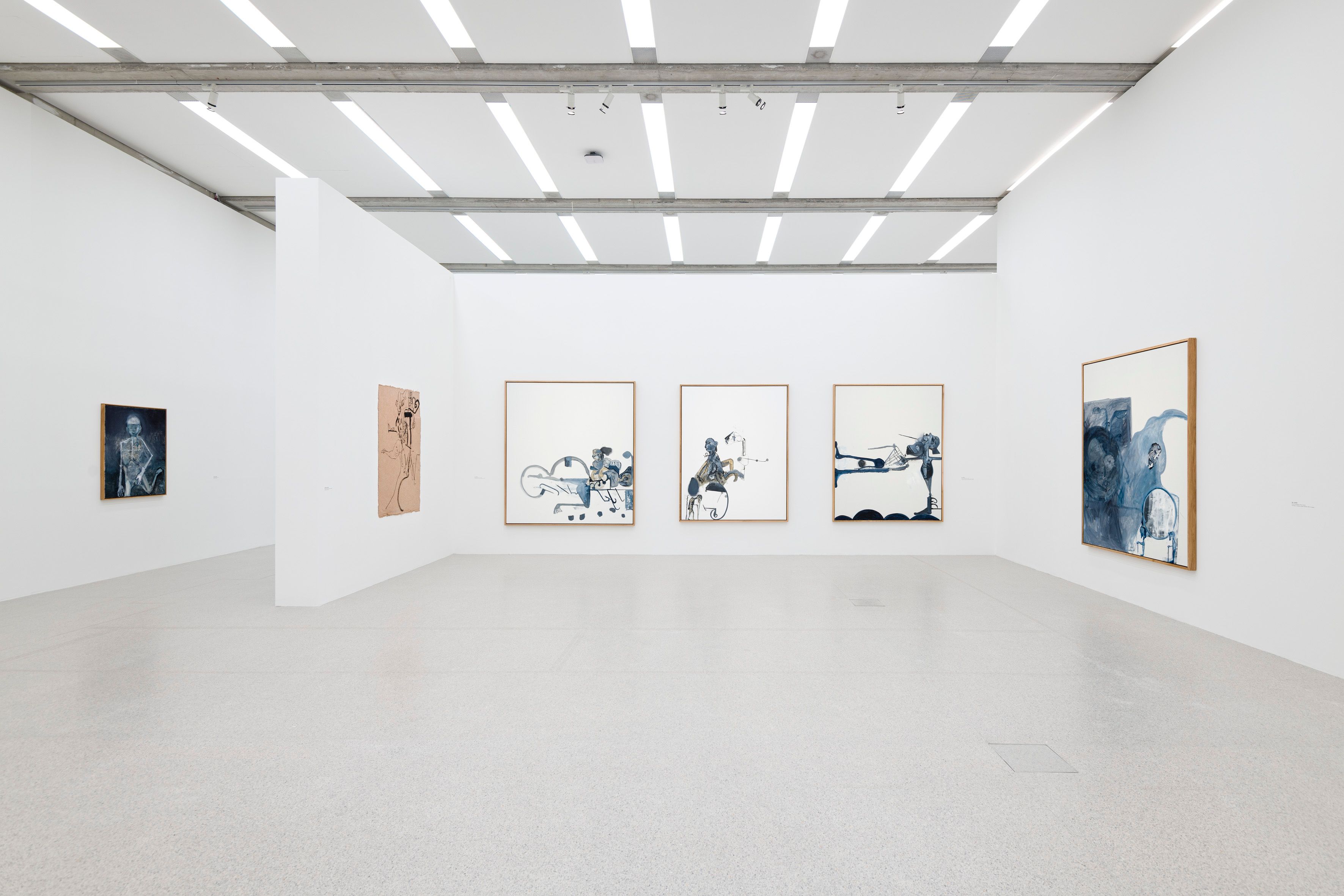
Now Pils returns to the Austrian capital with his most ambitious exhibition to date. Shh, at mumok (27 September 2025–12 April 2026), brings together more than a decade of work and traces the gradual transformation of his practice. What begins in black and white opens onto canvases where colour enters at first tentatively, then with greater insistence. In the interview that follows, Pils speaks about the chance introduction of colour into his studio, the pleasure he continues to find in drawing, and the 20-metre mural that unfurls across the walls of Central Europe’s largest museum of modern and contemporary art.
AD: Could you start by introducing the exhibition? What can visitors expect when they walk into the space?
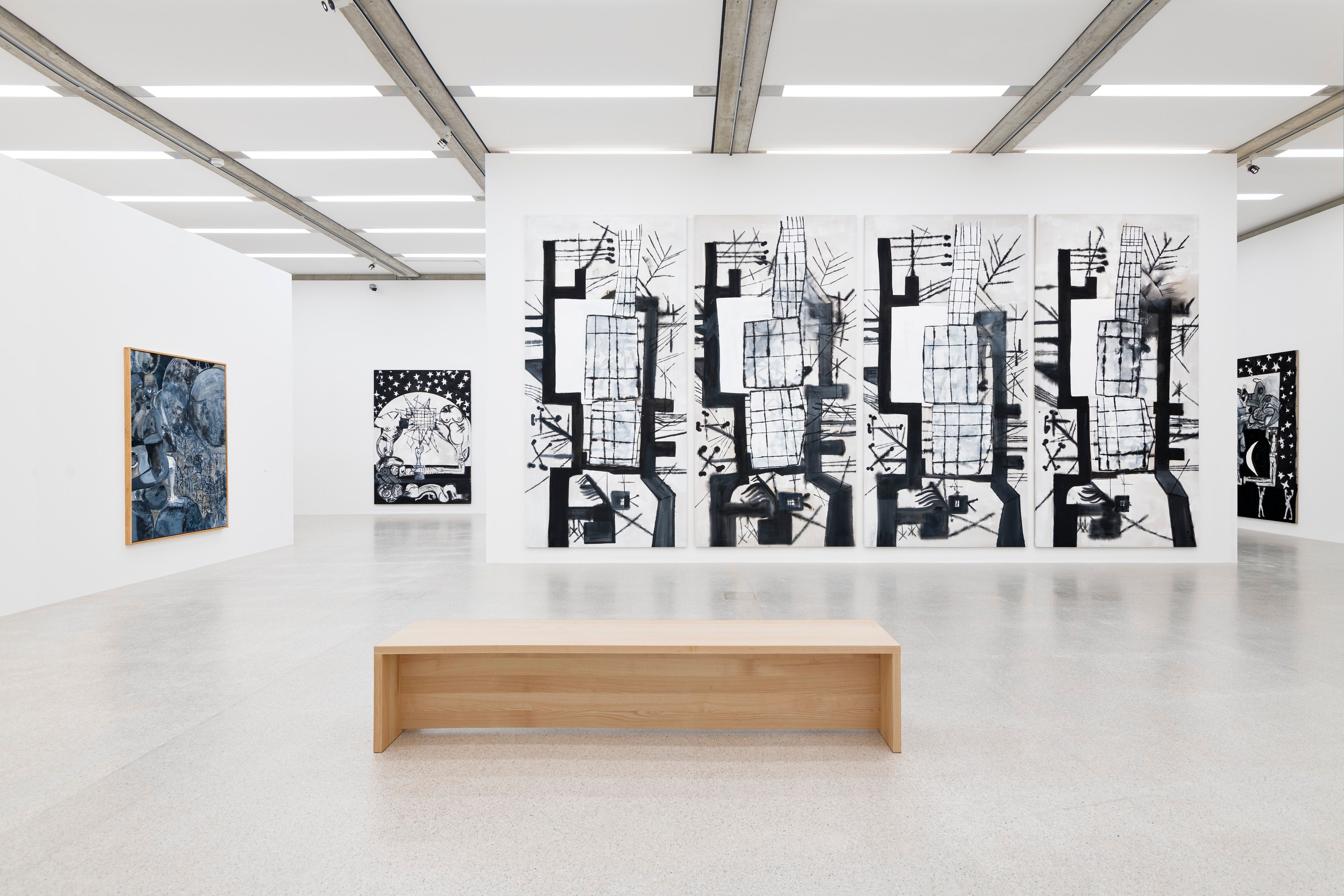
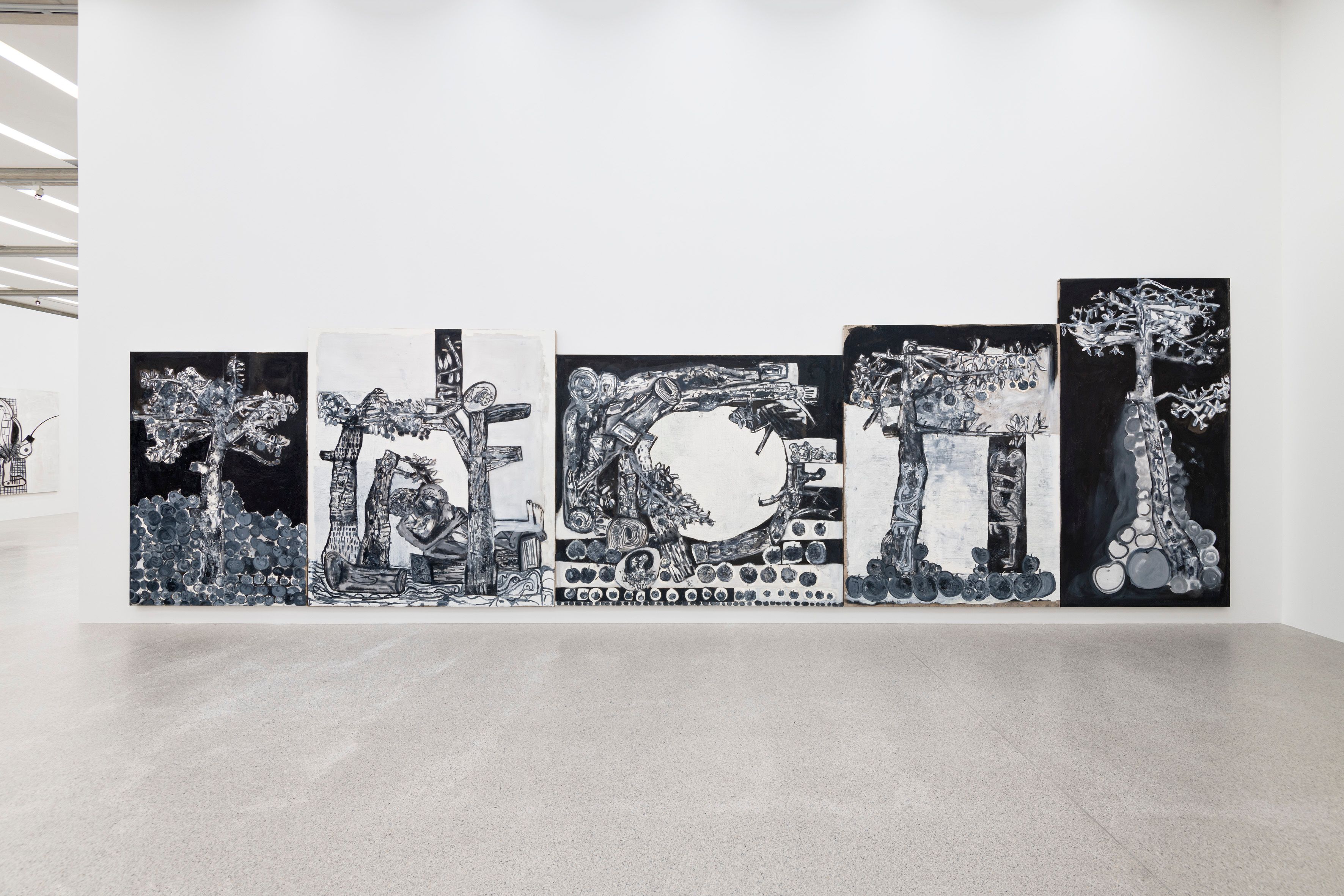
TP: I don’t see it as a retrospective. For me it’s more about looking forward. It’s a show about the last decade of my work, but in some ways it could have been three separate exhibitions. There are recent works from the past three years that are much more colourful. There’s also a large wall mural facing a wall lined with about 40 small pencil drawings, collectively called Alphabet.
AD: Many would think of your paintings as rooted in shades of black, white, and grey, yet here we see canvases with undertones of blue, green, and brown. What brought this on?
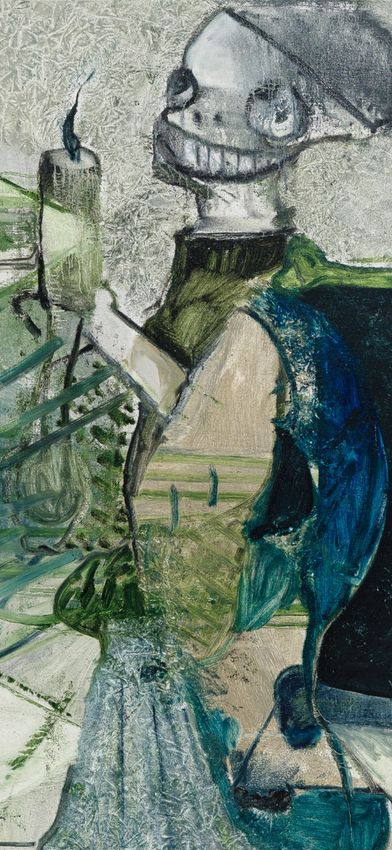
TP: I never felt that I was a black-and-white painter. When you watch a black-and-white film, you don’t really experience it in black and white, you experience a mood, a certain temperature. That’s how I’ve always thought of my paintings, even when they were in greyscale. Colour arrived quite organically, and in fact it began by accident one day when I bought the wrong tubes of paint, and so ended up with blue in the studio. But then I began mixing it with colours I already had, like a brownish grey, and it turned the green you see in paintings such as Blindensturz and Geist (both 2024). So the presence of colour was never a planned decision. It evolved out of chance, and once it appeared I just followed where it led.


AD: You’ve previously spoken of your admiration for Agnes Martin, whose luminous yet restrained paintings reveal how much can be achieved with the lightest touch of colour. Given that much of your own practice has also been shaped by a pared-back palette, what do you take from her work?
TP: It’s the energy. At the beginning of painting you may be working with nothing, no connection at all. By the end of the process there is a deep connection between the painting and the person who made it, and, hopefully, with the person who encounters it.
AD: You once described your paintings as ‘personal, naked, and colourful’, which I loved. Could you talk a little about what you meant by that?
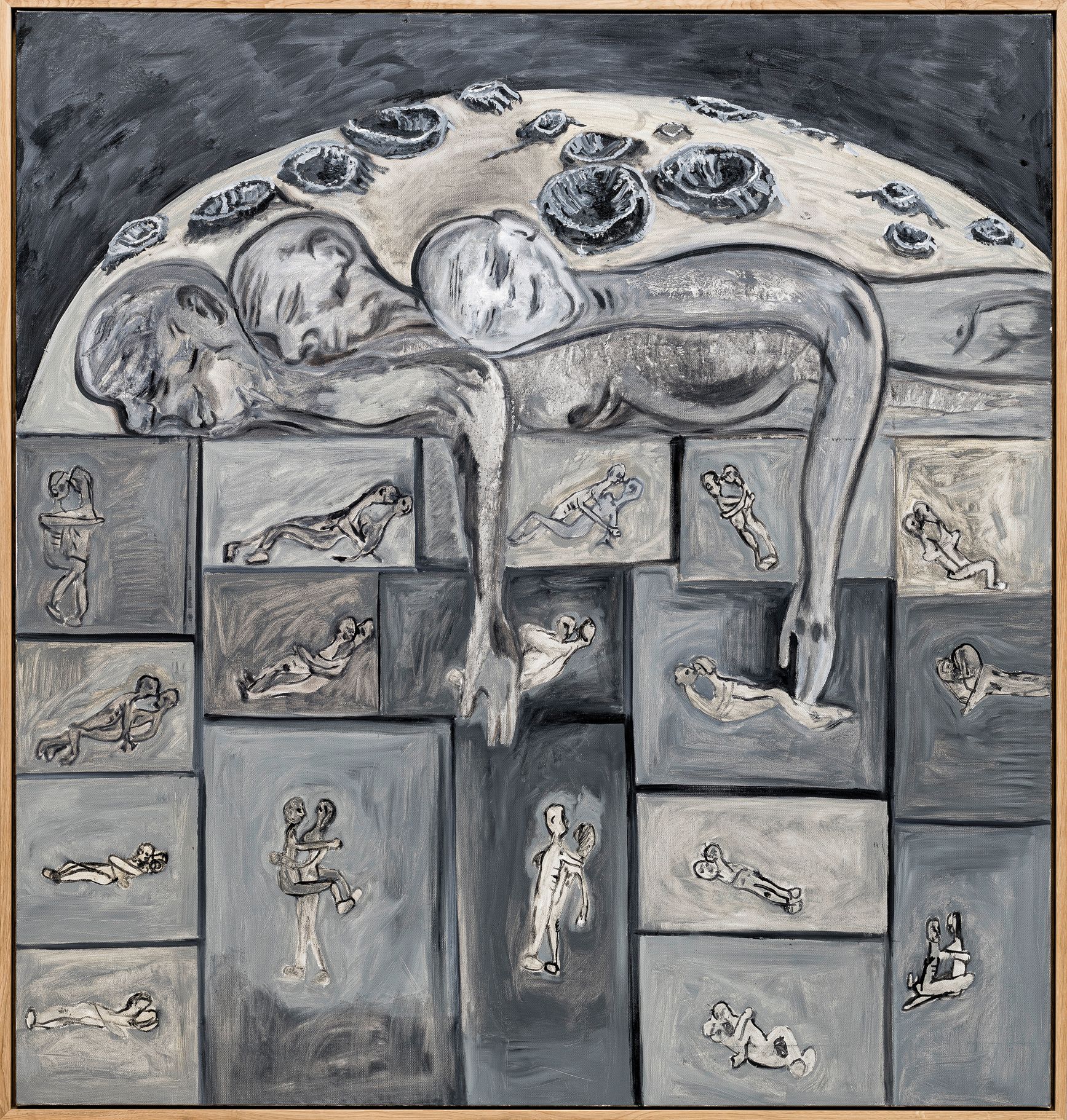
TP: When I say ‘naked’, I mean ‘limited’. I love working within restrictions. That’s why I’m really into drawing, and working with limited material and colour. There’s a big richness in nothing. If you’re naked, you’re limited in what you can do, and I find that limit to be liberating. As for the personal, I try to let life enter the paintings as much as possible. If you see a pregnant woman, it’s possibly because my wife was pregnant at the time. If there is a flower, it is because it was blooming in my studio. But at the same time, I want the paintings to move beyond me and I try to connect them with something I’m not familiar with. They are personal and impersonal at once. I bring the work close, and then push it away again.
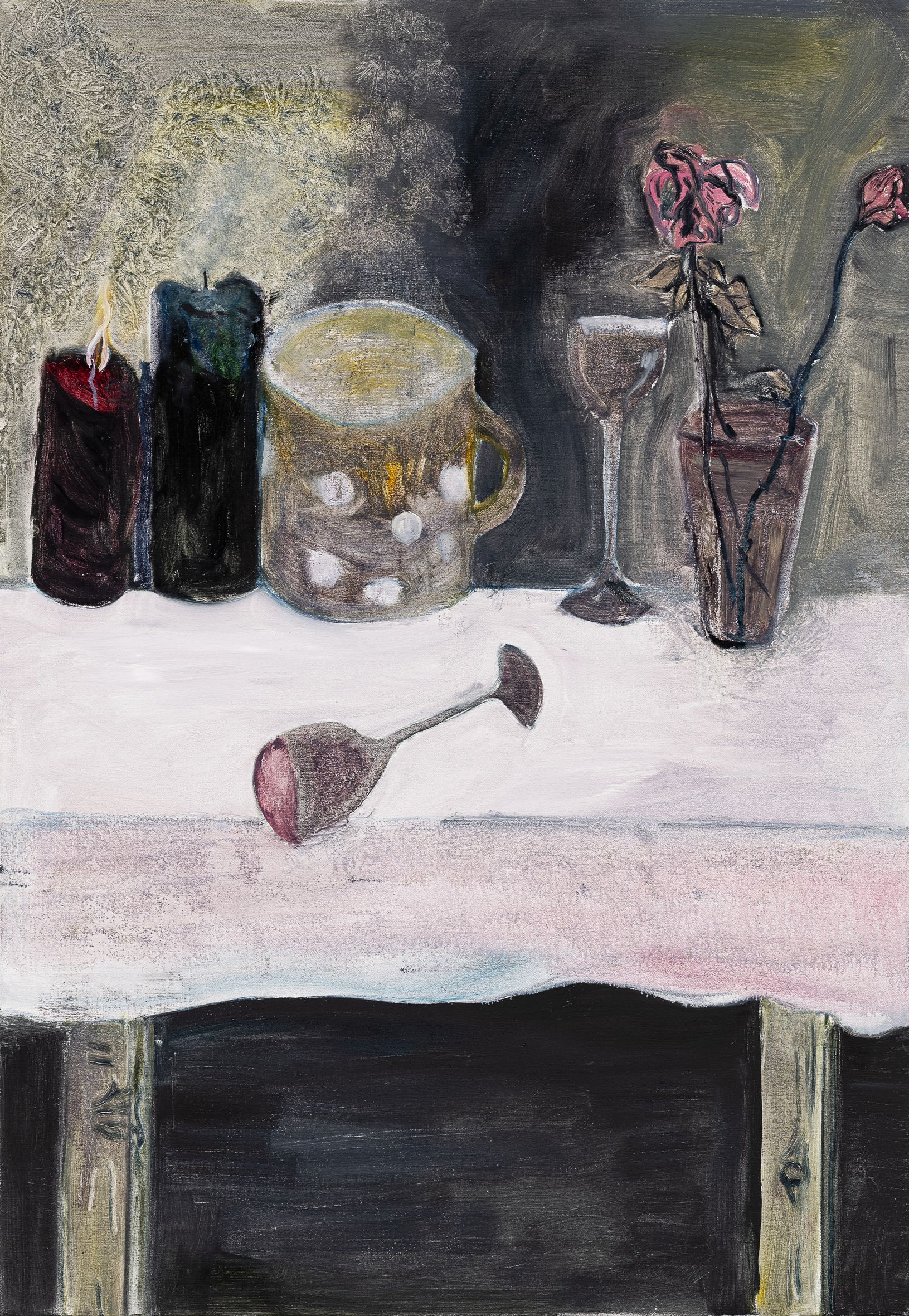
AD: Still life feels like it’s emerged as a new theme in your work. One of the paintings you made this year, Hmm, feels particularly different: it’s more colourful, more textural, more meditative. How did you arrive at this painting?
TP: Yes, that was the first still life I made, and to be honest, I questioned whether I should even do it. I thought, is this something I can or should attempt? But then I realised that still life is one of the most existential subjects you can imagine. These objects are simple but they carry weight. They are what we leave behind, and they are also like our bodies. A glass that holds something, a candle that burns down, a flower that blooms and fades. There is something theatrical about these objects, almost like actors on a stage, and that theatricality is also very human.
AD: Drawings also form a large part of this exhibition. You have spoken about drawing as a medium where there is ‘no cheating’. What does drawing mean to you today?
TP: My relationship with drawing has changed over time. When you start making art, drawing is something you do constantly. It is the most immediate way of working, and for many years I drew every day. Now I usually draw only a few times a year, often when I am travelling. In this exhibition you will see two kinds of drawings. There are ink drawings, which are like meditations on paintings I have made or might make, and then there are smaller sketches that capture ideas in their earliest form.
AD: So drawing is both a private, intimate act and a space for new ideas. In this exhibition, though, you also scale that language up dramatically. You have created a large mural for the show. What can you tell me about it?
TP: It is a huge wall work, about 20 metres long and five metres high. I think of it as a drawing on a monumental scale, and it also incorporates bronze heads. What makes it interesting is the dialogue with the opposite wall, which has 40 tiny pencil works. So you have this enormous drawing on one side and these delicate, almost miniature pieces on the other. It’s like one of those pencil drawings got high on drugs and got really huge.
AD: The exhibition is titled Shh. Where did that come from?
TP: I wanted a title that would not be descriptive in a literal sense but would carry a mood. Shh is like a sound, a whisper. It suggests that space between sleeping and waking, where things are quiet but charged with potential.
AD: Looking back over the span of work in the exhibition—more than a decade—what was it like to bring all of this together?
TP: On one level it feels very recent, but in another sense it covers more than seven years of my life. You can clearly see that it is one artist, but you can also see the differences. The earlier works are larger and were made on the floor using a different technique. That change in approach gives them a very different energy. The later works are smaller, more upright, and often more colourful. It feels like a journey that holds different phases, but they all belong together.
AD: Is there a particular work that you feel captures the essence of the exhibition?
TP: Perhaps Geist (2024), which in English could also be read as Ghost. It is a greenish painting full of bodies and figures. In German the word ‘Geist’ has a double meaning; it is both spirit and ghost. I liked that ambiguity. For me the work is about the connection between the body and the spirit, the figure and its ghost. It is a painting that holds both presence and absence at the same time. —[O]
Main image: Tobias Pils, Geist (2024) (detail). Oil on canvas. 150 x 180 cm. © Tobias Pils. Courtesy the artist; Galerie Eva Presenhuber, Zurich/Vienna; and Galerie Gisela Capitain, Cologne. Photo: Jorit Aust.




A respected voice in contemporary art discourse.
Focusing on ambitious storytelling and insightful art-world commentary. Ocula Magazine publishes in-depth interviews, critical essays and timely analysis on the artists, exhibitions and ideas driving the global art world.
Learn more about Ocula Magazine
Showcasing the best of the art world.
Ocula partners with galleries from around the world to highlight their artists, artworks and exhibitions. Gallery membership is by application and invitation, with each member vetted by an independent panel.
Learn more about Ocula Membership
Specialises in the sale of major artworks.
Led by a team with deep ties to the world’s leading auction houses, galleries and collectors. Ocula’s advisory team offers bespoke services to high-net-worth clients from around the world who are looking to acquire the best of contemporary and modern art.
Learn more about our team and services