





Vincent Namatjira

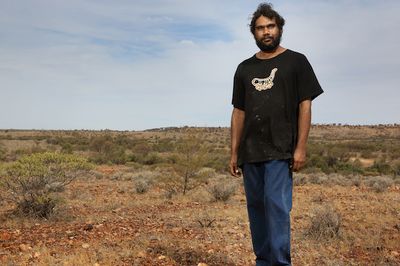
Vincent Namatjira, studio shot at Iwantja Arts (2018). Courtesy the artist and THIS IS NO FANTASY dianne tanzer + nicola stein.

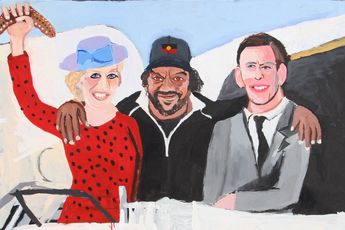
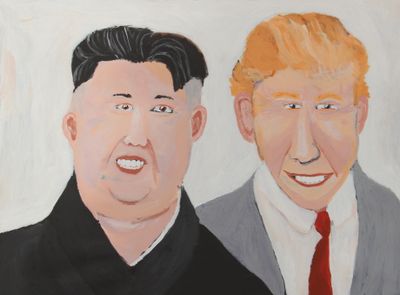
Vincent Namatjira relishes painting famous people who are humorously redeployed across vivid canvases and depicted in his community in remote Indulkana in South Australia. His powerful paintings are part portraiture and part caricature, in which politicians are placed side by side in wryly preposterous juxtapositions, such as Donald Trump and Kim Jong-un grimacing together in Donald and Kim (2017).
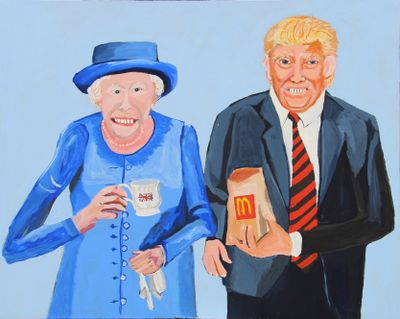
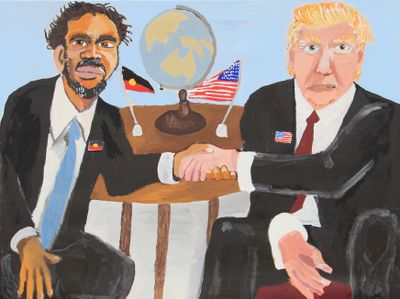
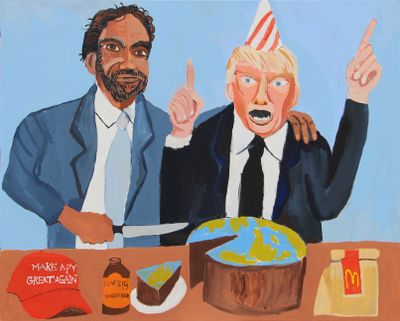
Namatjira often inserts himself into his mischievous compositions, as is the case in Vincent & Donald (The Handshake) (2018), in which the artist is depicted shaking Trump’s hand in an impossible gesture of allegiance. By conflating unlikely figures, including Queen Elizabeth holding a teacup emblazoned with the Union Jack alongside Trump clutching a McDonald’s bag (Queen Elizabeth & Donald, 2018), Namatjira wittily highlights the politics of history, power, and leadership from a contemporary Indigenous perspective. Namatjira has developed a signature style with political potency, often inserting himself within his mischievous compositions.
Originally from Ntaria (Hermannsburg), Namatjira identifies as Western Aranda, which is located southwest of Alice Springs. Losing his mother at seven, Namatjira and his sister lived in foster care in Perth and he returned to live with his extended family in Hermannsburg when he was 18. Now, Namatjira lives in the remote community of Indulkana, in the Anangu Pitjantjatjara Yankunytjatjara (APY) Lands in the far northwest of South Australia. He works in what he describes as a messy, busy studio located in Iwantja Arts, a studio complex and arts centre owned and run by members of the Indigenous community that provides support, advocacy, and context for artists including Alec Baker, Peter Mungkuri, Tiger Yaltangki, and Kaylene Whiskey.
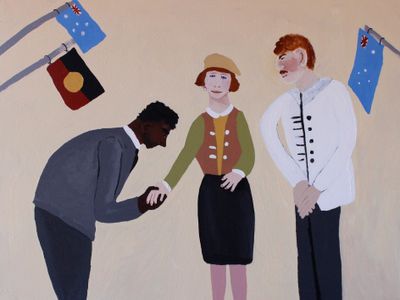

A direct descendent of renowned landscape painter Albert Namatjira, Vincent Namatjira produced a series in 2014 titled ‘Albert’s Story’, which chronicles the extraordinary life of Albert Namatjira in a suite of 13 paintings that were acquired by the Queensland Art Gallery. Subsequently, Vincent Namatjira participated in the TarraWarra Biennial 2016: Endless Circulation (19 August–16 November 2016), and more recently at the Australian Centre for Contemporary Art in Hannah Presley’s curation of the celebratory exhibition A Lightness of Spirit is the Measure of Happiness (7 July–16 September 2018). On this occasion, Namatjira remarked in an interview on the power of painting: ‘When you touch a paint brush, it makes you bigger, it makes you gigantic.’
Natalie King conducted this interview on the cusp of Namatjira’s participation in the prestigious Art Basel in Miami Beach (6–9 December 2018) with THIS IS NO FANTASY dianne tanzer + nicola stein, marking Namatjira’s first solo presentation at an international art fair.
NK: Can you elaborate on your studio practice in Indulkana in South Australia? What is a typical day in the studio?
VN: My studio is within Iwantja Arts, the art centre in Indulkana Community. It’s a busy place with lots of artists working; men and women of all different ages. My area is usually a bit of a mess—there are paints, brushes, rags, books, magazines, reference images, and sketches scattered everywhere. I paint every day—I start early, have a cuppa tea and warm up with some drawing and sketching. I usually have a few different paintings in progress at any time; it helps me keep moving. Changing between different ideas and paintings keeps things fresh and interesting.
NK: Can you discuss your artistic lineage of being the great grandson of one of Australia’s most significant painters, legendary Western Aranda watercolourist and painter Albert Namatjira?
VN: I didn’t know a lot about this side of my family history when I was growing up, but once I got older I learned more about my grandfather’s incredible legacy. He made his mark on the world through his art—his paintings were celebrated and he travelled overseas and even met the Queen; but he was also persecuted, taken advantage of and imprisoned. I’m fascinated by the old man’s story and have used my own painting practice to research this part of my family history. My grandfather is a recurring figure in my paintings because I feel his influence as I work—that old man made his own path with watercolour landscapes of his country, and that made me determined to find my own path, and not follow anybody else’s.
NK: When and how did you decide to become an artist?
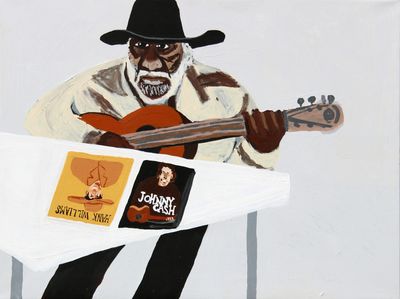
VN: A big part of my decision to become an artist was finding out about my family history. My wife Natasha is also a painter and she encouraged me to start coming to the art centre when we relocated to Indulkana. My father-in-law, Jimmy Pompey, is also an artist—a great figurative painter who paints cowboys, stockmen, and country singers. He was an early inspiration for me, showing me that desert art could be more than dot painting.
NK: Your portraits are both political and personal. Can you describe your compositional approach of placing famous people in the desert in unexpected places as a type of colonial inversion?
VN: I am really interested in people in positions of power; people who have incredible wealth and influence. When I see politicians, world leaders, royalty, and other power-players on the news, I see this huge disconnect between their world and the day-to-day reality of life in a remote Aboriginal community. A lot of my recent paintings are about the reversal of power structures—displacing powerful figures takes away some of their dominance.
NK: What are your primary influences?
VN: I’ve been really lucky to be guided by the elders in Indulkana Community. In the art centre I work alongside some really strong leaders, like Peter Mungkuri, Alec Baker, and my father-in-law. These men are highly respected for their knowledge of culture and country, and I’ve been influenced by the integrity of their art practices and their work ethic.
NK: Where do you find inspiration?
VN:


Being an artist based in a remote community, you can feel pretty isolated. But I’ve always been hungry for ideas and stories and wanted to know what other artists in other places were doing, and why they were doing it. I’m constantly researching other artists’ work, and whenever possible I go to exhibitions to see paintings in the flesh. Recently I’ve been really getting into Henry Taylor‘s work—I love the raw honesty of his portraits. I’ve only seen Taylor’s works in books and online, but I really hope to be able to check out some of his work in person soon.
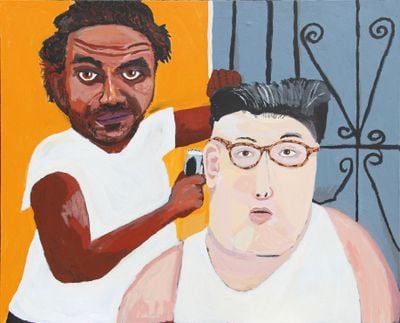
NK: You have said that ‘A sense of humour and a paintbrush is a powerful thing’. What is the role of humour in your work in relation to your comment, and your use of wry wit and grimacing characters?
VN: If a painting is making me laugh while I’m working on it, then I know there is something there, like a spark that’s going to get people interested. Humour can disarm, and in my paintings, I use humour as an equaliser, to put everyone on the same level. If I start out painting someone powerful, usually I can’t help but exaggerate some of their features or give them a strange expression or pose to make them seem a little less comfortable—I sort of chip away at their power. There’s definitely humour in my work, but there’s also a serious side to my paintings—I want to shed light on some untold or overlooked Indigenous stories. Humour helps grab people’s attention, but I hope they look a little deeper.
NK: You are exhibiting at Art Basel in Miami Beach with THIS IS NO FANTASY dianne tanzer + nicola stein, and the 9th Asia Pacific Triennial of Contemporary Art (24 November 2018–28 April 2019) in Brisbane. Could you talk about what works you are showing?
VN:

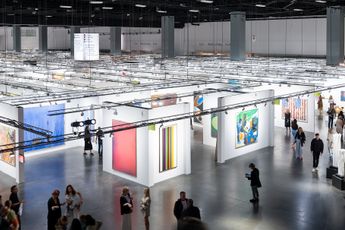
For Art Basel in Miami Beach, I’ve made a body of paintings that look at current US politics and global politics. Donald Trump is in quite a few of the paintings—I recently found out that Trump and I have the same birthday, which is pretty weird!
At APT9, three series of paintings are being exhibited together for the first time. This is really special because I always thought of these series as being one big body of work that contains the same themes from different perspectives. The three series depict the seven Australian prime ministers who have been in power in my lifetime (up until 2016 when they were painted) (‘Prime Ministers’, 2016); seven senior Anangu men, artists, and cultural leaders from the APY Lands (‘Legends’, 2018); and the seven richest people in Australia (in 2016 when they were painted) (‘The Richest’, 2017). All these works look at ideas of power structures and different concepts of leadership and influence.
It’s amazing to have my works shown at both APT9 and Art Basel in Miami Beach; to have my work in such a significant international context is a great recognition of my practice. I feel really proud to be presenting a remote Indigenous perspective on the world stage.
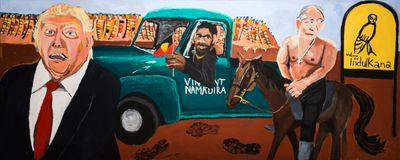
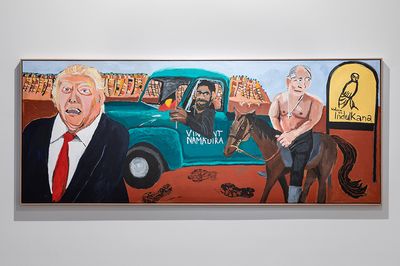
NK: In the large-scale horizontal painting, Welcome to Indulkana (2018), you present a portrait of yourself waving the Aboriginal flag from the window of a green ute flanked by Donald Trump and Vladimir Putin in the outback. Can you elaborate on the narrative of this strident painting that interweaves and satirises power? How do you insert yourself into these scenarios?
VN: Last time I was in Melbourne I saw E. Phillips Fox’s famous painting of Captain Cook at the National Gallery of Victoria (Landing of Captain Cook at Botany Bay, 1770). In that painting, Cook is at the centre of a heroic scene with a flag being planted as a declaration of ownership by the British. Off to the side there are a couple of Aboriginal blokes who are in the background and barely part of the composition. Welcome to Indulkana is like a contemporary update on heroic white-guy paintings like Fox’s. It’s a cheeky response where everything—status, power, and ownership—is reversed.
Painting Trump and Putin in Indulkana puts them out of their comfort zone—they’re on Aboriginal Land and their power is stripped away, and so is Putin’s shirt for some reason. They’re here in the red dust with the heat and the flies, while I’m cruising past in my grandfather’s famous truck proudly holding the Aboriginal flag. Do you reckon I should give them a lift? —[O]
Main image: Vincent Namatjira, studio shot at Iwantja Arts (2018). Courtesy the artist and THIS IS NO FANTASY dianne tanzer + nicola stein.


A respected voice in contemporary art discourse.
Focusing on ambitious storytelling and insightful art-world commentary. Ocula Magazine publishes in-depth interviews, critical essays and timely analysis on the artists, exhibitions and ideas driving the global art world.
Learn more about Ocula Magazine
Showcasing the best of the art world.
Ocula partners with galleries from around the world to highlight their artists, artworks and exhibitions. Gallery membership is by application and invitation, with each member vetted by an independent panel.
Learn more about Ocula Membership
Specialises in the sale of major artworks.
Led by a team with deep ties to the world’s leading auction houses, galleries and collectors. Ocula’s advisory team offers bespoke services to high-net-worth clients from around the world who are looking to acquire the best of contemporary and modern art.
Learn more about our team and services