The art world in focus
Subscribe to our newsletter for news and insights on artists, galleries and exhibitions.

When does reality slide into illusion, and how does it slide back out? The ‘Mandela effect’ is a term coined by paranormal researcher Fiona Broome to describe the phenomenon of the collective misremembering of events in popular culture. The expression originates from reports of multiple individuals falsely recalling Nelson Mandela’s death as occurring during the 1980s, decades before his actual death in 2013. According to Broome, this apparent confusion can be attributed to us all ‘sliding between parallel realities’... meaning that a reality does in fact exist in which Mandela died in the 1980s; we just aren’t in it right now.
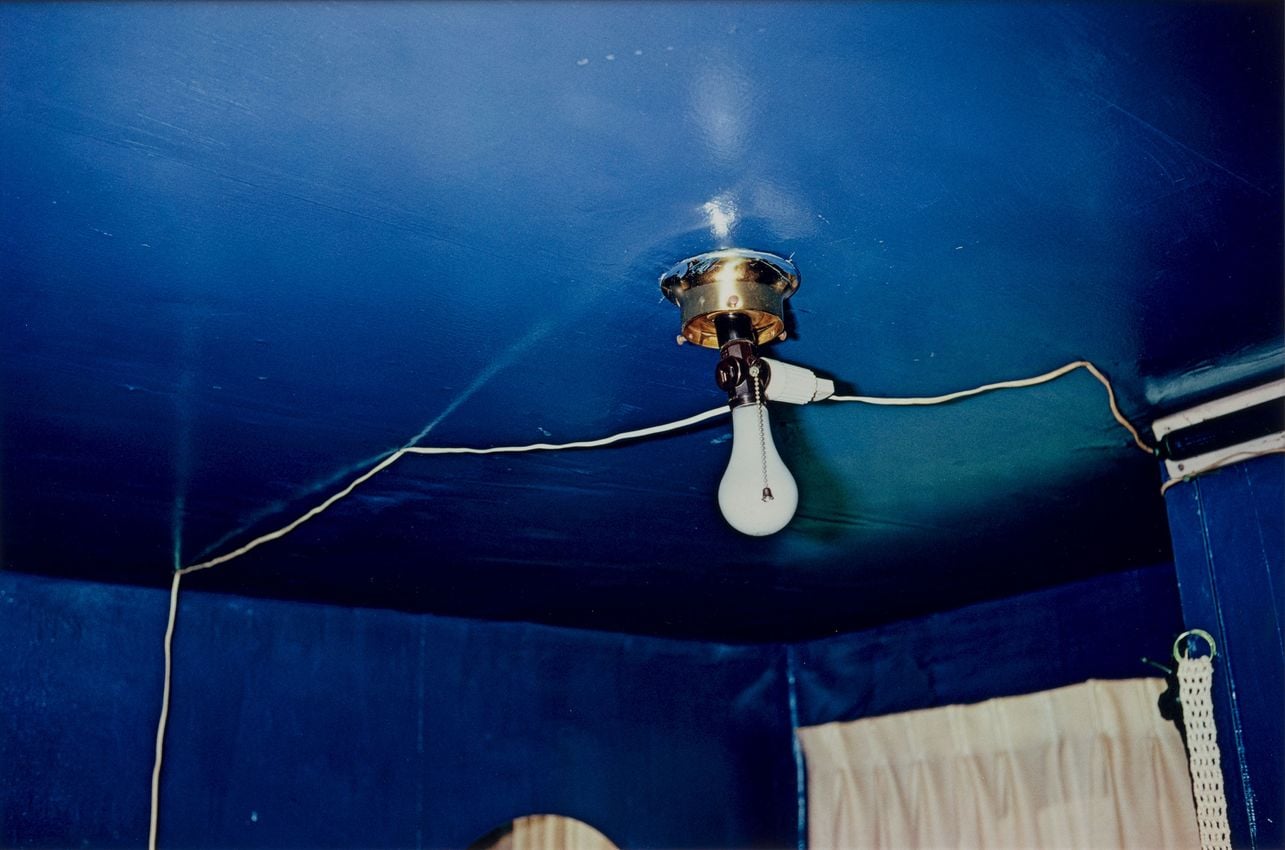
An untitled work by photographer William Eggleston—dubbed the Godfather of Colour Photography, as well as the most important artist from Memphis, Tennessee since Elvis Presley—currently hangs in The Last Dyes exhibition at David Zwirner in New York. Taken in 1973, the image depicts a close-up of a single lightbulb waywardly suspended from the ceiling of a room painted entirely in one hue of a vivid blue. When I encounter it, I wonder if I am sliding between realities. Surely this is just a bizarre glitch, an illusory swap-out of Eggleston’s most famous work, taken in the same year, Greenwood, Mississippi (The Red Ceiling), sometimes known as Untitled (Grenwood, Mississippi, 1973). This photograph of a lightbulb is so illustrious it has its own Wikipedia page, served as the cover art for the band Big Star’s 1974 album Radio City, and was the subject of a 2016 restaging, Making of ‘Untitled’ (by William Eggleston, 1973), by Swiss art duo Cortis & Sonderegger.
Both lightbulb images were printed using the dye-transfer process—Eggleston’s signature—which splits photographic slides into three separation negatives, then enlarges them on to three transparent film matrices coated with light-sensitive emulsion. Known for its brightness range of more than 500:1, described in a 2025 article as ‘from blackest black to whitest white’, the process is a notoriously fussy, devil-in-the-details affair that demands the patience of a saint. Each matrix is bathed in cyan, magenta or yellow dye. Kodak stopped manufacturing materials for dye transfer in 1994 (giving the exhibition, which focuses on a selection of Eggleston’s lesser-known photographs printed using this method, its title).
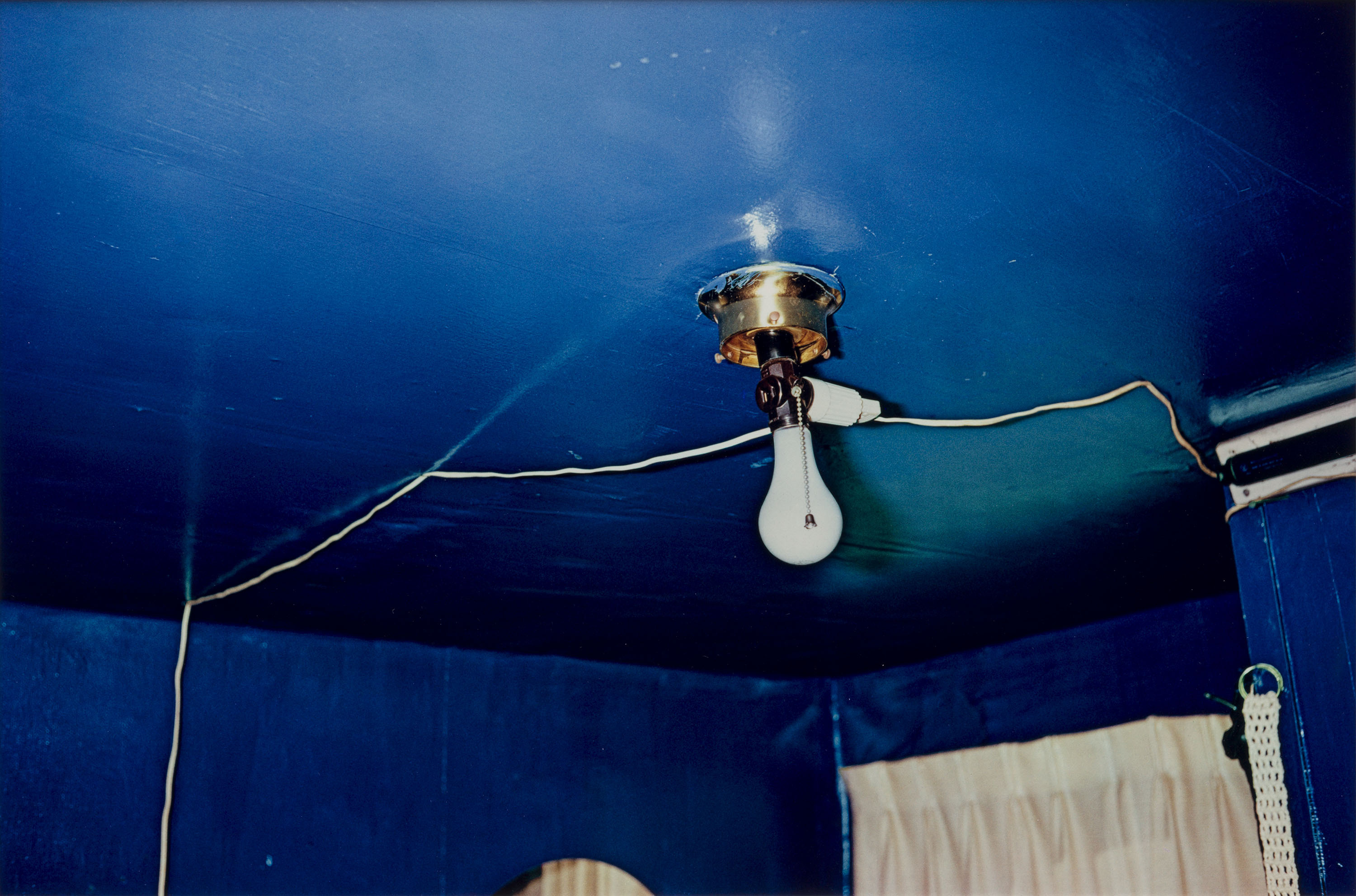
“Untitled is the yin to The Red Ceiling’s yang. It is cosmic and alien and oceanic”
The composition of the ‘blue’ Untitled (1973) offers an uncanny mirror to The Red Ceiling. My initial thought is that it must be an image made from only the cyan-dyed matrix of the latter, isolated from its two other siblings. Yet there are subtle differences. The Red Ceiling, which was taken in a guest room at Eggleston’s friend’s house on the Mississippi Delta, features a teasing snippet of a poster illustrating various sexual positions in one corner, and has three white extension cords spidering out from its centre-left-hanging, dimmed lightbulb. Untitled has only two cords, no sex poster, and an unlit bulb hangs centre right.
The menacingly claustrophobic perspective of The Red Ceiling has always reminded me of being a little kid and getting mercilessly hauled around to community halls and other low-ceilinged event spaces. Places where my father’s band played or my mom’s best friend would host a party, and I would scamper under a table to hide from grown-ups who had gotten too drunk. It brings me back, unpleasantly, to the feeling of being a child in a world full of louche adults. The photograph is murderous and ferric and earthbound: Eggleston once said, of printing the photograph using dye transfer: ‘When you look at the dye it is like red blood that’s wet on the wall’.
Untitled is the yin to The Red Ceiling’s yang. It is cosmic and alien and oceanic, like the blue, copper-based hemocyanin blood of a horseshoe crab. Writing in Artforum in 2001, author Donna Tartt claimed: ‘When I was a kid in Mississippi, I heard a story of Eggleston being hired to take pictures of a Delta wedding and lying on the grass the whole time taking pictures of the sky’. And here he is again, ignoring the customs and chaos, as though this janky lightbulb is the North Star in a cold, cobalt-blue sky—and his camera is creating a slide between this reality and whatever lies beyond. —[O]
One Work is a column where we ask writers to reflect personally upon a single artwork on display in a current exhibition.



A respected voice in contemporary art discourse.
Focusing on ambitious storytelling and insightful art-world commentary. Ocula Magazine publishes in-depth interviews, critical essays and timely analysis on the artists, exhibitions and ideas driving the global art world.
Learn more about Ocula Magazine
Showcasing the best of the art world.
Ocula partners with galleries from around the world to highlight their artists, artworks and exhibitions. Gallery membership is by application and invitation, with each member vetted by an independent panel.
Learn more about Ocula Membership
Specialises in the sale of major artworks.
Led by a team with deep ties to the world’s leading auction houses, galleries and collectors. Ocula’s advisory team offers bespoke services to high-net-worth clients from around the world who are looking to acquire the best of contemporary and modern art.
Learn more about our team and services