The art world in focus
Subscribe to our newsletter for news and insights on artists, galleries and exhibitions.
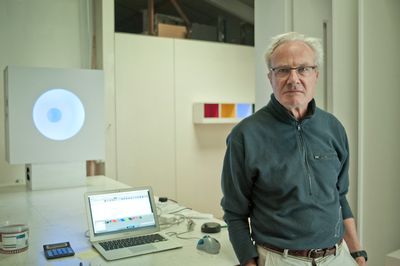
Josef Albers.
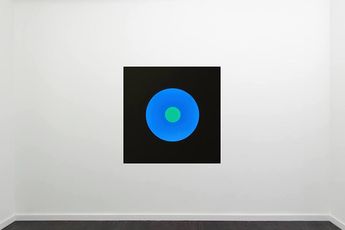
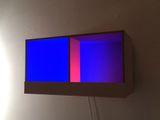
My first light piece was an attempt to put light of a certain colour into the context of light of a second colour in order to experience how changing the intensity and hue of the latter (gradually, over time) affected one’s perception of the former.
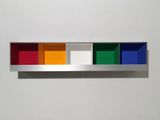
Until I was given the opportunity to install a work of this type into a wall, I had produced box-like objects that required to be presented at eye level, either by being floor-based, supported on a column, or placed on a wall. These objects had to either contain, or be attached to, the sometimes bulky peripheral equipment (essential but extraneous to the work itself) needed to control output from colour-changing light sources. The results were then presented either via translucent “screens”, or by reflection from surfaces within the piece.
Whilst functioning well enough to focus attention on the processes of colour-changing phenomena, I was aware that these objects tended to intrude upon the immersive experience that I wanted to offer the viewer. By installing a piece into a wall, the work became much simpler, merely an aperture in the much larger surface of the wall (both being separately illuminated; the aperture from within and the wall from above). Freeing it from the distractions of a three-dimensional object, the work became less visually busy, permitting a more intense concentration on what was occurring.
When I have an idea for a piece, I construct a series of prototypes in card or foamboard, or using found cardboard boxes or tubes, painted white. I am not able to pre-visualise the scale and proportions of a piece by means of preliminary drawing, because the effects of light, within the piece or falling onto it (how it will actually “behave”) can only be assessed with an actual object. Drawings come later, when I need to present the finished version to whoever will construct the work, whether a carpenter, metal fabricator or concrete technician. I typically use inkjet-printed photographs of various views of the work onto which I draw the necessary indications of dimensions, materials etc, as a shorthand form of drawing. Or, the prototype can be given to the fabricator to follow exactly via CAD drawings (which will ultimately control waterjet or laser cutting machinery).
There usually follows a period of collaborative investigation of new materials, tools or techniques, or methods of construction, in order to arrive at a finished “product”. The final surface may be applied industrially (powdercoating of metal) or by myself (pigment or varnish).
In the case of a colour-changing works using the latest LED lamps and control technology (developed to illuminate buildings at night), the sequence of changes then has to be programmed using a laptop computer connected to the controller. Intensity, hue, duration and rate of change of colours in the “scenario” are adjusted until a satisfactory outcome is arrived at. This is then downloaded into the control peripherals. From then on, playback and automatic repeat from the top is controlled by a simple on/off switch.
Recently, after a period of working on large-scale works for installation in totally dark spaces, without ingress of daylight, I have been investigating works that do not absolutely insist on darkness, that can coexist with medium to low light levels of ambient light.
I have also become interested in how coloured light interacts with coloured pigments, becoming absorbed or reflected to varying degrees.
On the one hand I like the spontaneity and speed of working with watercolour, the fact that nothing can be repeated or done over again once it’s on the page.
On the other hand the demands of the medium require a level of hand/eye coordination that feeds back into other work.
My recent watercolours meant total commitment to the process over a period of four hours to complete a work at one sitting. Completion, without any “mistakes”, having gone through the whole process of stretching the paper, drawing and then painting the graduated colour bars, brings its own sense of satisfaction.—[O]



A respected voice in contemporary art discourse.
Focusing on ambitious storytelling and insightful art-world commentary. Ocula Magazine publishes in-depth interviews, critical essays and timely analysis on the artists, exhibitions and ideas driving the global art world.
Learn more about Ocula Magazine
Showcasing the best of the art world.
Ocula partners with galleries from around the world to highlight their artists, artworks and exhibitions. Gallery membership is by application and invitation, with each member vetted by an independent panel.
Learn more about Ocula Membership
Specialises in the sale of major artworks.
Led by a team with deep ties to the world’s leading auction houses, galleries and collectors. Ocula’s advisory team offers bespoke services to high-net-worth clients from around the world who are looking to acquire the best of contemporary and modern art.
Learn more about our team and services