The art world in focus
Subscribe to our newsletter for news and insights on artists, galleries and exhibitions.

Leonora Carrington, Forbidden Fruit (1969) (detail). Oil on canvas. 50 x 47 cm. Courtesy Gomide&Co, São Paulo. Photo: Charles Roussel.
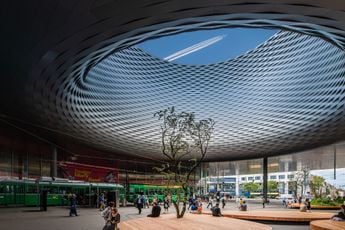
Art Basel, a yearly pilgrimage for the global art elite, marks the beginning of the summer art season in the Northern Hemisphere.
Returning to Messe Basel, the flagship fair runs from 13 to 16 June 2024, with pre-events including Unlimited Opening, VIP Days, and Vernissage from 10 to 12 June.
With Maike Cruse at the helm as the new director, this year’s edition brings together 285 galleries, welcoming 22 first-time participants across three sectors.
Ocula Advisors, Simon Fisher, Rory Mitchell and Eva Fuchs, have picked out eight must-see artworks at the fair. Among them are Alice Neel‘s portrait of her lover’s daughter at Victoria Miro, Thomas Schütte‘s glass cast face at Frith Street Gallery, and Atta Kwami‘s colourful abstract at Goodman Gallery.
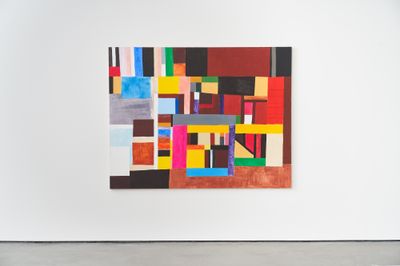
Atta Kwami‘s Another Moment at Goodman Gallery
Goodman Gallery announced its representation of the estate of Ghanaian painter Atta Kwami (1956–2021) earlier this year.
Kwami’s colourful works, characterised by blocky, geometric patterns, draw on the rich artistic heritage of his native Ghana. His vibrant colour fields tap into Ewe and Asante strip-woven textile traditions, as well as influences from West African architecture, music, pottery, and wall paintings.
The acrylic-on-linen painting Another Moment (1999) features streaky, rough brushwork interwoven with solid, flat planes, all arranged in an idiosyncratic manner. Brown, black, red, and yellow square and rectangular blocks run parallel, separated by thinner segments of white, blue, and grey paint. Unlike the hard-edged and precise abstractions of his Western precursors, Kwami’s patchwork of colours exudes spontaneity and raw energy.
Kwami’s presentation at Art Basel coincides with his solo exhibition at Goodman Gallery in London, on view until 29 June 2024.
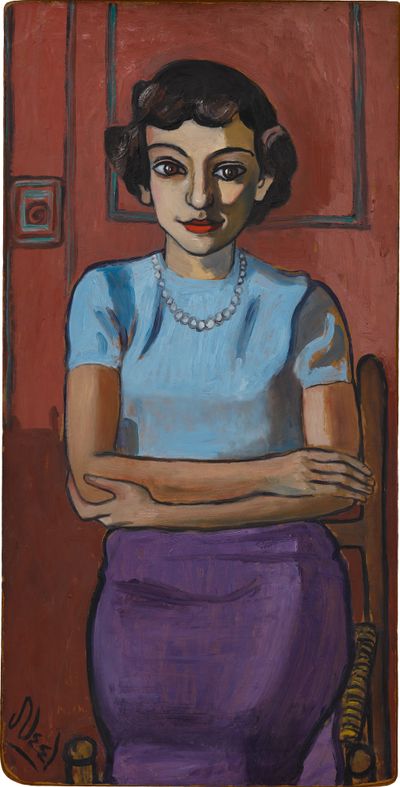
Alice Neel‘s Mady at Victoria Miro
Described as a sensitive soul prone to anxiety, Alice Neel found solace in painting as a means to engage with the world and connect to the people around her.
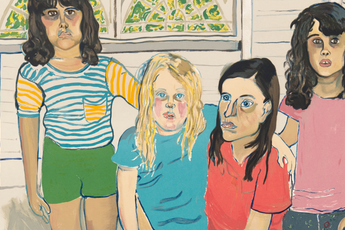
This is evident in Mady (1948), her portrayal of Mady Brody, the daughter of her lover and friend, Sam Brody. Neel’s remarkable talent for capturing frankness shines through in this portrait, revealing the complex ways her life and those of her subjects are intertwined.
In the painting, Mady exudes self-awareness and maturity. Her appearance is poised, with sophisticated clothing. With her direct gaze and slight smile, she embodies quiet confidence.
Showing at Victoria Miro, the painting epitomises Neel’s bold, humanist approach to painting, depicting her subjects with unflinching honesty.
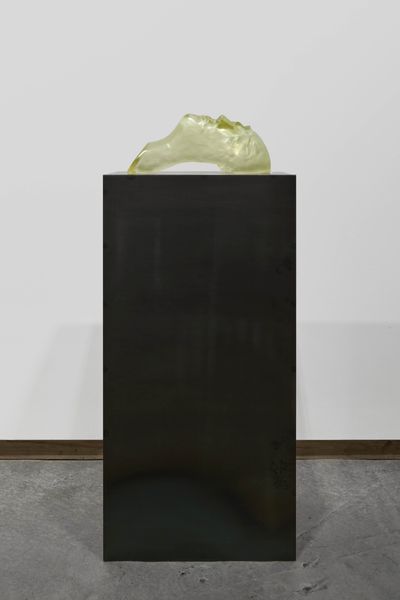
Thomas Schütte‘s Me 24 at Frith Street Gallery
Depicting an ethereal and melancholic face in a state of eternal repose, Thomas Schütte’s glass sculpture Me 24 (2018) unsettles and intrigues.
Crafted from Murano glass sourced from the Venetian island in Italy, Schütte’s sculpture resembles a mask-like face that appears to melt and morph. Its imperfect surface texture—smooth yet lumpy, irregular, and distorted—creates a grotesque visage, with features that alter as the light passes through.
Despite the autobiographical title, Me, the identity of the face is ambiguous, inviting reflection on identity, perception, and the nature of representation in art.
In autumn, a major retrospective of Schütte’s work will open at MoMA in New York, running from 29 September 2024 to 18 January 2025.
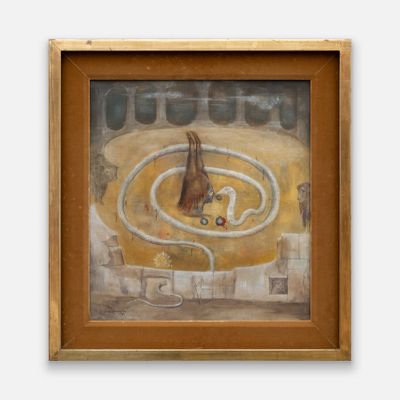
Leonora Carrington‘s Forbidden Fruit at Gomide&Co
Gomide&Co’s booth brings together work by artists who are in different ways marginalised.
A leading Surrealist artist in 1920s Paris, Leonora Carrington (1917–2011) fled to Madrid during the Nazi occupation. Escaping from a sanatorium there, she made her way to New York before settling in Mexico City.
Surrealist art showed Carrington the flaws and absurdities of human nature, inspiring her to create wonderfully bizarre nonhuman beings. Her paintings feature cloaked antelopes, masked hyenas, and hybrid figures that are half-human, half-animal, sometimes humorous and sometimes frightening.
In Forbidden Fruit (1969), a white snake with a beak for a nose encircles a floating head with furry paws sprouting from static hair. The British-born painter’s exploration of temptation unfolds like a strange dream, where the consequences of indulging in forbidden desires emerge in a fantastical universe.
Carrington recently received a new auction record at the Sotheby’s Modern Evening Sale in New York, where her painting, Les Distractions de Dagobert (1945), sold for U.S. $28.5 million.
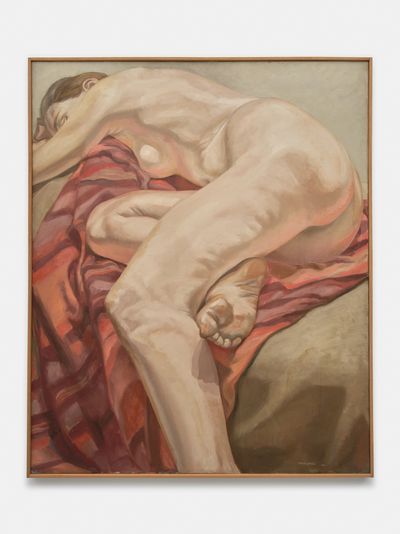
Philip Pearlstein‘s Reclining Model on Striped Cloth at Bortolami
In the early 1960s, American painter Philip Pearlstein (1924–2022) shifted from gestural landscapes to painting nude models from life. During a period ruled by abstract expressionism, his sharply lit nudes marked a departure in American painting, embodying what he called ‘hard-realism’.
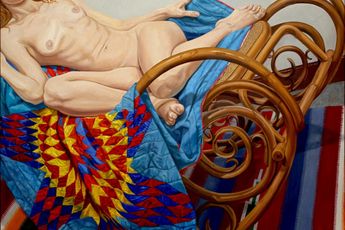
Reclining Model on Striped Cloth (1966) shows a nude female model, slouched and relaxed, her face hidden but her body fully exposed. The harsh lighting casts shadows on every crease, curve, and blemish. Although not a flattering painting, it is an intriguing one.
Unambiguous and unromantic, the painting resists interpretation. As with much of his work, Pearlstein presents the naked human figure as it is—a bold move in an era defined by the emotion and drama of action artists like Mark Rothko and Jackson Pollock.
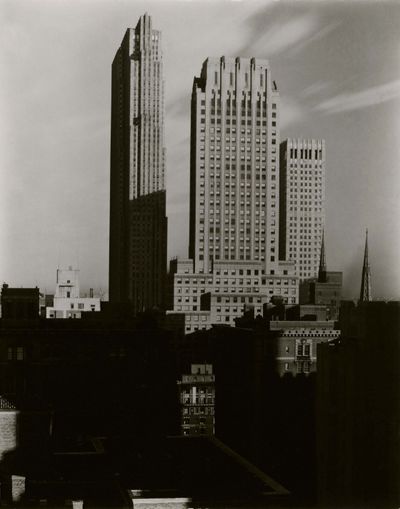
Alfred Stieglitz‘s New York, from the Shelton at Edwynn Houk Gallery
American photographer Alfred Stieglitz (1864–1946) was instrumental in elevating photography to an art form. He challenged the prevailing notion of his era, that photographs amounted to documentation, asserting that the medium could be as expressive as painting or sculpture.
Fascinated by New York’s evolving skyline, Stieglitz photographed it from his midtown high-rise, which he shared with his wife, Georgia O’Keeffe. Throughout the 1930s, he captured Manhattan’s dramatic transformation as skyscrapers emerged from streets bustling with horse-drawn street trolleys ferrying goods below.
New York, from the Shelton (1935) juxtaposes old and new, dark and light. The Rockefeller Center towers over the spires of St. Patrick’s Cathedral, alongside other bright, modern skyscrapers rising dramatically from the darkness.
Stieglitz’s photographic experimentations offer timeless imagery of New York, starkly depicting the city’s evolution through high contrast, black-and-white compositions.
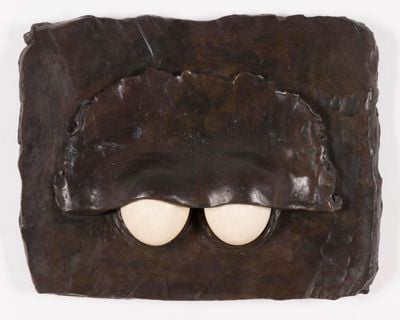
Erika Verzutti‘s Boyfriend (2014) at Fortes D’Aloia & Gabriel
Erika Verzutti creates playful sculptures exploring themes of reproduction, fertility, and procreation. The Brazilian artist’s inventive handling of materials like bronze, plaster, and papier-mâché, results in tactile works.
Fortes D’Aloia & Gabriel feature Boyfriend (2014), a sculpture made from a pair of ostrich eggs nestled under a cast bronze blanket.
In Verzutti’s art, ordinary objects often symbolise aspects of the body. In this work, the eggs suggest breasts or testicles, or perhaps a couple tucked up in bed. The bronze blanket brings an intimacy to the bright white ovaloids, while drawing attention to an imperfect, textured surface.
Verzutti is in residence at LUMA in Arles until July 2024, where she is presenting the exhibition The Life of Sculptures and an accompanying film project shot on-site.
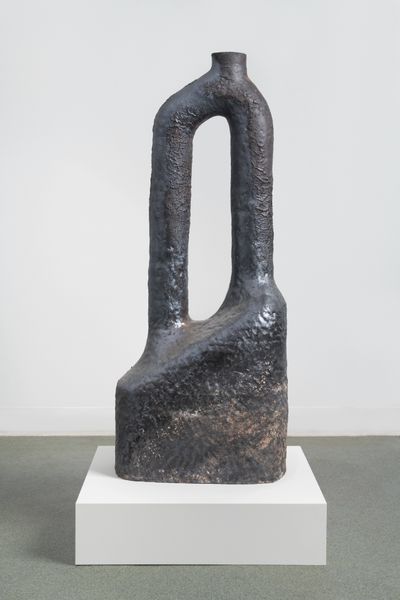
Theaster Gates’ Untitled (Black Vessel) at GRAY
Theaster Gates’ high-fired ceramic vessels are multilayered and majestic reflections on art history, social empowerment, and cultural reclamation.
Gates, who trained as a potter, spent 2004 in Tokoname, Japan, honing his skills, an experience that profoundly influenced his aesthetic and concepts.
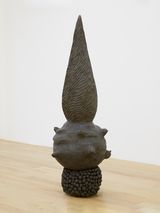
Untitled (Black Vessel) (2023) features an unusual shape that mimics the converging of industrial metal pipes. Its craggy surface, cracked and blistering, offers a variety of tones and textures that delight the eye.
Gates’ presentation at the fair coincides with his institutional exhibition, The Gift and The Renege (17 May–20 October 2024), at the Contemporary Arts Museum Houston.
Related Artworks


A respected voice in contemporary art discourse.
Focusing on ambitious storytelling and insightful art-world commentary. Ocula Magazine publishes in-depth interviews, critical essays and timely analysis on the artists, exhibitions and ideas driving the global art world.
Learn more about Ocula Magazine
Showcasing the best of the art world.
Ocula partners with galleries from around the world to highlight their artists, artworks and exhibitions. Gallery membership is by application and invitation, with each member vetted by an independent panel.
Learn more about Ocula Membership
Specialises in the sale of major artworks.
Led by a team with deep ties to the world’s leading auction houses, galleries and collectors. Ocula’s advisory team offers bespoke services to high-net-worth clients from around the world who are looking to acquire the best of contemporary and modern art.
Learn more about our team and services