





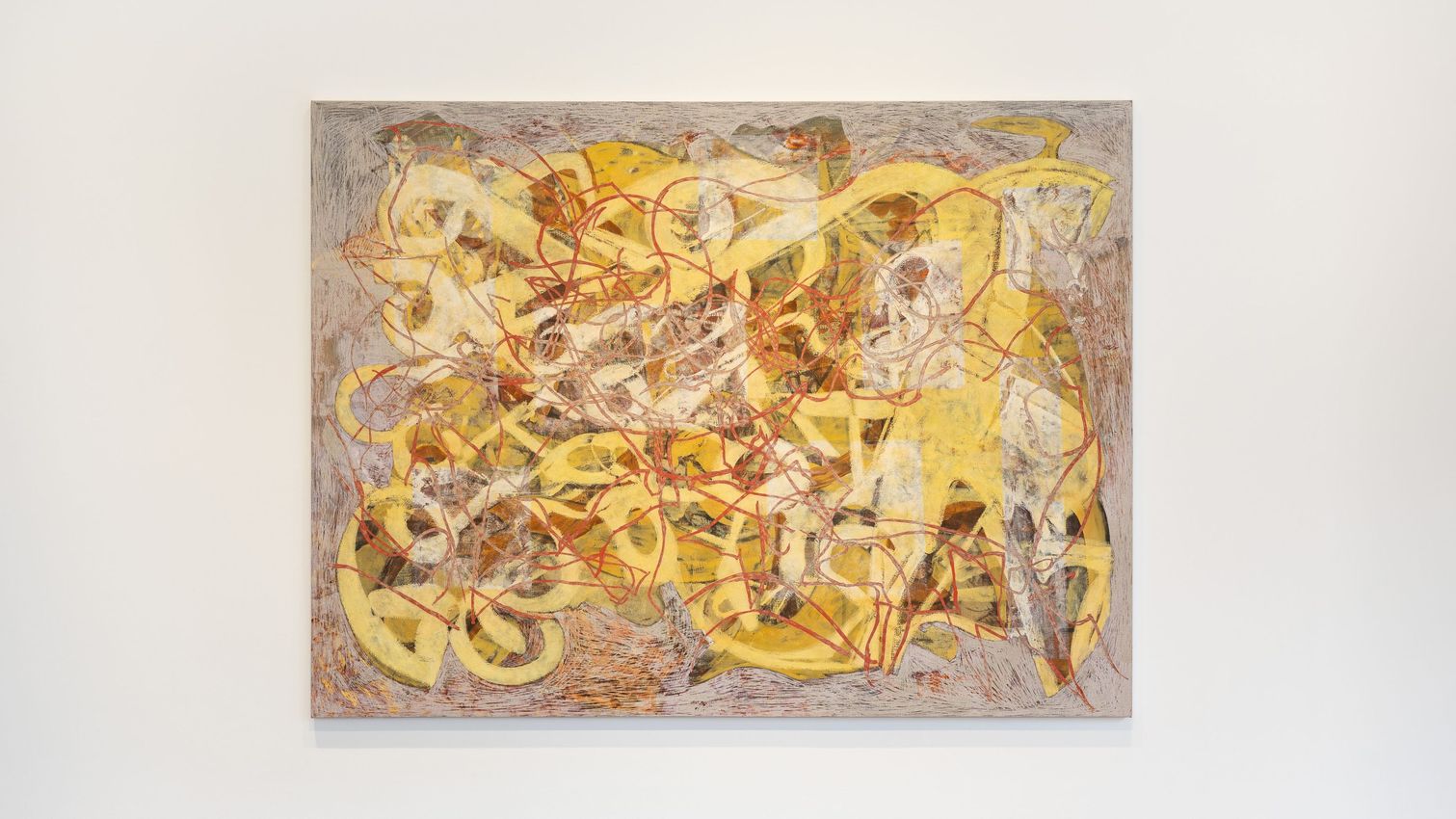
Tim Stoner Paints at His Own Pace
For Tim Stoner, painting is both a measure of time and an opportunity for rediscovery. Ocula met with the artist ahead of his solo show at Pace Gallery in London. Save to My Ocula
When Tim Stoner feels lost in the studio, he turns to music. He finds clarity in the way that Detroit techno DJs from the 1980s, such as Jeff Mills and Carl Craig, talk about their process and he admires their independent creativity—‘They don’t give a shit what anybody else thinks of what they’re doing.’
The British artist has been painting since the 1990s. After attending London‘s Royal College of Art—where he was a contemporary of Chris Ofili—Stoner relocated to Amsterdam to study at the Rijksakademie. Further moves followed, to Rome and Spain, as he sought proximity to his painterly heroes: from the artists of the Northern Renaissance to Spanish greats, such as Diego Velázquez and Pablo Picasso.
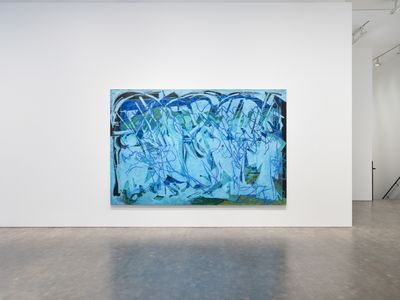
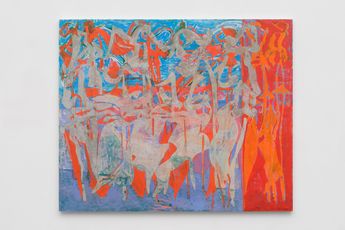
While Stoner makes it clear to me that he sees no distinction between figuration and abstraction—‘Is a Rembrandt any more real than a [Piet] Mondrian?’—the works in his latest exhibition, Negative Space at Pace Gallery (5 March–12 April 2025), are devoid of the suggestions of heads, arms, or ears we’ve seen in previous shows. Rather, Stoner has filled the Mayfair gallery with an exhibition of new large-scale paintings and smaller works on paper, developed through weaving loops and ropes of colour into webs of overlapping and intersecting lines. Shuddering next to claggy islands of paint are shallow pools of pigment—elements he has unearthed through deliberately deconstructing his imagery.
Importantly, these paintings—like the work of the unapologetic musicians he plugs into—were created for himself. Recent health complications saw Stoner put his practice under the microscope. It prompted him to consider what he truly enjoyed about painting, rather than what a gallerist might expect of his work. Instead of attempting to cater to a collector’s taste, he envisioned canvases he himself would want to live with.
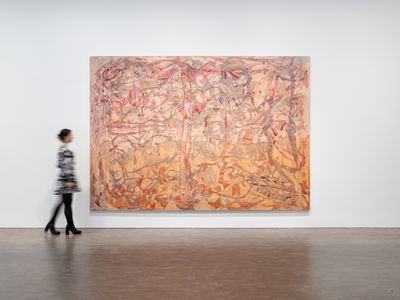
The latter must have been a welcome development for Stoner, who often works on—and consequently lives with—a single painting over a number of years. Persian Red (2009–2024), for instance, whose faded russet hues and calligraphic forms bear a resemblance to a sun-drenched Persian wall-hanging, was started 15 years ago. It wasn’t until Pace Gallery invited him to present a solo show that Stoner returned to the roll of canvas parked on a shelf in his studio in Andalucia.
It’s this distance that allows space for rediscovery—not only in relation to the artwork but also as an artist. When Stoner revisits a piece, he submerges the original painted canvas in a swimming pool, pouring dissolving chemicals on them. He then uses tools such as scalpels, pressure hoses, and palette knives to excavate the original rendering, revealing the colours, movements, and textures of its past life.
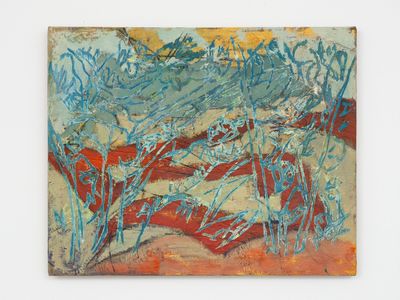
‘I remember using that tube of King’s Blue Light in 2009,’ he tells me, gesturing towards a series of light-blue scars on Persian Red. ‘Only now, having erased sections, have they come back into the 2024 version of the painting.’ Elsewhere in the show, Stoner highlights his joy at the shapeshifting nature of colour—how a dominant pool of blue in Reflection (Caribbean Blue) (2021–2024) can morph into a cooler, violet tone when an orange-hued stroke is added half a decade later.
At 54, Stoner finds himself reflecting on those early artistic instincts. ‘I’m looking at paintings I made in 1989 and asking: What’s my point? What really drove me when I was a spotty kid listening to The Smiths in my bedroom in east London? That’s the best place to be—when you’re the artist you want to be.’ —[O]
Tim Stoner: Negative Space is on view at Pace Gallery in London from 5 March through 12 April 2025.
Main image: Tim Stoner, Cave (2020–2024). Oil and gouache on linen. 205.5 × 274 cm. © Tim Stoner. Exhibition view: Negative Space, Pace Gallery, London (5 March–12 April 2025). Courtesy the artist and Pace Gallery. Photo: Damian Griffiths.





A respected voice in contemporary art discourse.
Focusing on ambitious storytelling and insightful art-world commentary. Ocula Magazine publishes in-depth interviews, critical essays and timely analysis on the artists, exhibitions and ideas driving the global art world.
Learn more about Ocula Magazine
Showcasing the best of the art world.
Ocula partners with galleries from around the world to highlight their artists, artworks and exhibitions. Gallery membership is by application and invitation, with each member vetted by an independent panel.
Learn more about Ocula Membership
Specialises in the sale of major artworks.
Led by a team with deep ties to the world’s leading auction houses, galleries and collectors. Ocula’s advisory team offers bespoke services to high-net-worth clients from around the world who are looking to acquire the best of contemporary and modern art.
Learn more about our team and services