





The Asia Pacific Triennial’s Fly-Eye Approach to Contemporary Art
Now in its 11th edition, QAGOMA’s enduring survey show looks out through the eyes of some 70 artists and collectives spanning a vast and diverse part of the world. Save to My OculaNow in its 11th edition, QAGOMA‘s enduring survey show looks out through the eyes of some 70 artists and collectives spanning a vast and diverse part of the world.
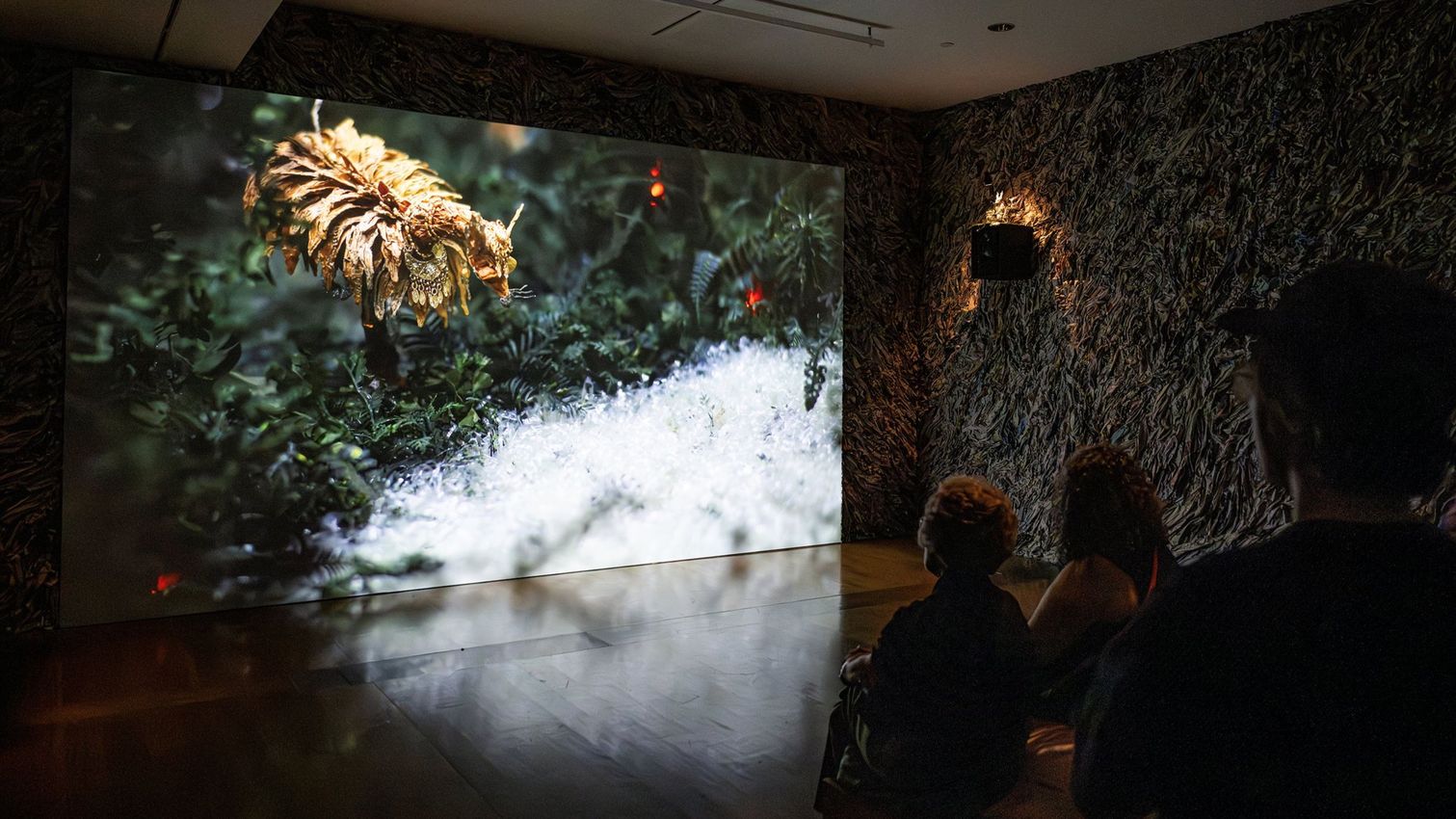
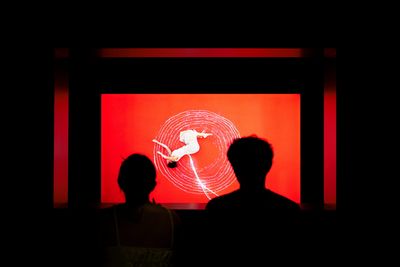
A fly buzzes through the jungle pursued by a dragon dancer in a mouse-deer-fox costume in Taiwanese artist Zhang Xu Zhan’s magnificent stop-motion animation Compound eyes of tropical (2020–2022/2024). The fly’s way of seeing—combining images from all directions gathered by thousands of receptors called ommatidia—represents enlightenment in the work, but it’s also a metaphor for the way the same story, wherein a prey animal outwits a predator, is seen differently by different cultures.
It’s a savvy inclusion in the 11th Asia Pacific Triennial of Contemporary Art (APT) (30 November 2024–27 April 2025), which presents paintings, videos, ceramics, weavings, and much more throughout the Gallery of Modern Art (GOMA) and much of the Queensland Art Gallery (QAG), both just south of the Maiwar (Brisbane River), where there are no crocodiles, but where, when the sun is out, water dragons—some the size of house cats—bask on low concrete walls.
Since its first edition in 1993, the Triennial has elected not to have a theme, instead preferring to look in all directions—this time stretching from Uzbekistan and Saudi Arabia in the west to Japan and Tonga in the east—at art being made across cultures and traditions. This survey features more than 500 works from over 30 countries.
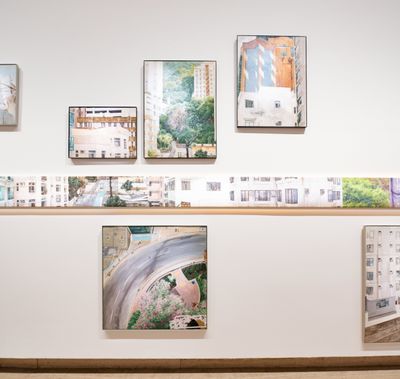
Many of the artists were present at the exhibition’s opening, a real celebration after only four joined the launch of APT 10 in December 2021 due to Covid-19 lockdowns. (QAGOMA curator Ellie Buttrose described the Triennial to me, coincidentally, as ‘taking the temperature’ of artmaking in the region.) The pandemic informed several works in this year’s show, including Yeung Tong Lung’s wonderful 18-panel 360°+ (2021–2023), which was displayed along one wall inside the QAG. Painted from the windows of his studio in Kennedy Town, Hong Kong, the work features four panoramas looking out in all compass directions, and 14 vignettes that document the days of mask-wearing and balcony haircuts. One of them teleports us to a bombed-out room in Ukraine, establishing TVs, laptops, and smartphones as other windows through which we watch, increasingly anxiously, the world outside.
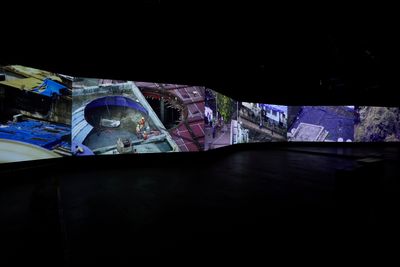
Changing orientations, Indian collective CAMP looks from top to bottom through the lens of a remote-controlled CCTV camera located on the 35th floor of a Mumbai high-rise in their work Bombay Tilts Down (2022), a seven-channel video installation projected on six screens accordioned side by side along one wall of GOMA.
It shows views of the city that slowly descend from skyscrapers to subjects below, including an ad for the new Trump Tower targeting ‘Mumbai’s glitterati’, cats picking their way over the blue tarps and rusted corrugated iron roofs of densely packed slums, and a lush but empty lawn. Accompanied by ominous music and a pounding beat, the work evokes different kinds of social decline including losses of freedoms in an age of surveillance technology, and increased poverty and inequality. Both poverty and inequality rose in India during the pandemic.
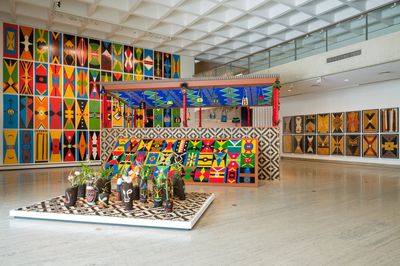
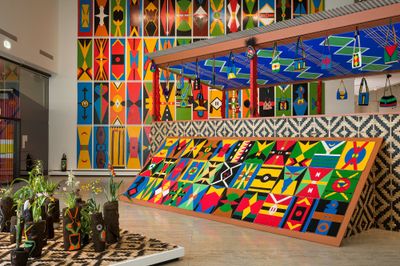
While Zhang, Yeung, and CAMP all look at the act of looking, what historically distinguishes the APT is its organisers’ efforts to include art-makers who might otherwise—for reasons including remoteness, lack of local art infrastructure, and racism—themselves be overlooked. This year is no different, with works including brightly coloured geometrical shield paintings by Papua New Guinea collective Haus Yuriyal, a video installation featuring the song and dance of the Solomon Islands’ KAWAKI women’s collective, and a giant kutu reed (Chinese water chestnut) weaving by Tongan artist ‘Aunofo Havea Funaki and the Lepamahanga Women’s Group. Augmenting the efforts of QAGOMA’s Asian and Pacific Art curatorial team, led by Tarun Nagesh, are co-curated sections spotlighting artistic activity from a number of countries, most prominently the Philippines and Nepal.
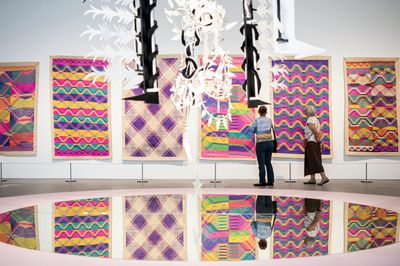
In the 1990s, the APT’s expansive approach was radical, but it’s since become trendy, as pointed out by Dean Kissick in his much-debated essay, ‘The Painted Protest’, which appeared in Harper’s magazine just days before the exhibition opened and was a talking point among curators, writers, and artists at the opening. After being hit by a bus on her way to see Unravel: The Power and Politics of Textiles in Art at the Barbican Art Gallery in London, Kissick’s mother asks him whether the show of textile art that Kissick said ‘might as well have dated from half a century ago, if not much earlier’ was worth losing her legs. That’s a ludicrously high bar for any exhibition but, to Kissick, who interned with Hans Ulrich Obrist in 2008, the question only hammered home how low art has fallen from a time when it was more focused on ideas than identity. While some argued that Kissick, at 41, is simply too old and jaded—an ad hominem, tellingly, focused more on who he is than what he thinks—it seems obvious that a healthy exhibition ecosystem should include treatment (excision of necrotic artistic modes and promotion of healthy new creative tissue) as well as the diagnosis (taking of temperatures) that the APT does so well.

Any misapprehension that an exhibition, or even a single artwork, is only about either ideas or identity is disabused by the works of Aotearoa New Zealand artist Brett Graham, which stretch from GOMA’s entry foyer to the River Room. His imposing doorless structures Grande Folly Egmont (2020), a white weatherboard lighthouse nearly seven metres tall, and O’Pioneer (2020), a white cement and fibreglass gun turret decorated with Victorian-era filigree, both contain loopholes—apertures from which not just to look out but also to fire bullets, force being one of the tactics used by the British Crown to take Māori land.
Though Graham’s sculptures draw from 19th-century events, they remain politically pertinent. Two weeks before the APT opened, some 35,000 people peacefully gathered on the grounds of Aotearoa New Zealand’s parliament as part of a hīkoi (march), in response to a proposed bill that would eliminate many rights afforded specifically to Māori under current law.

The legacy of colonialism in the Pacific is further explored in Jasmine Togo-Brisby‘s Copper Archipelago (2024), a boat-shaped pressed-metal ceiling that hangs over audiences in a dim room on GOMA’s third floor, level with the top of Graham’s tallest works. Lights positioned at the edges of the piece shine across its surface, bringing into relief symbolic details like portraits of family members, birds, and crops. Copper Archipelago references ‘blackbirding’, a term for the kidnapping of people from Pacific islands.
Two of Togo-Brisby’s great-great-grandparents were among 62,000 people coerced or forced onto slave ships bound for Australia. At age eight, one of her grandmothers was taken from Vanuatu to Sydney, where she worked for the Wunderlich family who produced pressed-metal panels for decorative ceilings. Standing beneath Copper Archipelago feels precarious even before imagining what the artist’s ancestors must have felt looking up from within the confines of a ship’s hold.
Unsurprisingly, given the APT’s ambit, there are many more great works to discover. Aside from the gentle insinuations of proximity, the exhibition does nothing to draw direct connections between presentations—there are no wall texts on themes—which can make it overwhelming given the number of cultures and histories referenced.
Around half of the works in the show have been acquired by QAGOMA, however, paving the way for more overtly themed exhibitions in the future. Another opportunity to connect artmaking practices in the Asia Pacific will come when works from the APT, dating back to its inaugural edition, will travel to London’s Victoria & Albert Museum in early 2026. —[O]
The 11th Asia Pacific Triennial of Contemporary Art (APT11) is on view at The Queensland Art Gallery | Gallery of Modern Art (QAGOMA) in Brisbane from 30 November 2024 to 27 April 2025.
Main image: Zhang Xu Zhan, Compound eyes of tropical (2020–24). Single-channel 4K video installation, colour, sound. 16 min. Exhibition view: 11th Asia Pacific Triennial of Contemporary Art, Queensland Art Gallery | Gallery of Modern Art, Brisbane (30 November 2024–27 April 2025). © Zhang Xu Zhan. Courtesy the artist and Project Fulfill Art Space, Taipei. Photo: C Callistemon.





A respected voice in contemporary art discourse.
Focusing on ambitious storytelling and insightful art-world commentary. Ocula Magazine publishes in-depth interviews, critical essays and timely analysis on the artists, exhibitions and ideas driving the global art world.
Learn more about Ocula Magazine
Showcasing the best of the art world.
Ocula partners with galleries from around the world to highlight their artists, artworks and exhibitions. Gallery membership is by application and invitation, with each member vetted by an independent panel.
Learn more about Ocula Membership
Specialises in the sale of major artworks.
Led by a team with deep ties to the world’s leading auction houses, galleries and collectors. Ocula’s advisory team offers bespoke services to high-net-worth clients from around the world who are looking to acquire the best of contemporary and modern art.
Learn more about our team and services