Press Release

Almine Rech Gallery is pleased to announce Genieve Figgis’s first solo exhibition at the gallery from November 21st to December 19th, 2015. The exhibition will be comprised of a selection of new paintings.

Barely more animated are the English conversation pieces where, if the adults have the stylised hauteur of fish in brilliant livery, the little ones of the family, arrested by the painter in playful or light-hearted moments, suggest the image of darting minnows among the motionless, intent, mature fish. And these aquariums are lighted by the eighteenth century sun which seemed fated never to set.

—Mario Praz

In 1785, John Adams was appointed the first Ambassador to the Court of Saint James. Adams, questioned by an associate as to whether he had any British relatives, replied: “Neither my father or mother, grandfather or grandmother, great grandfather or great grandmother, nor any other relation that I know of, or care a farthing for, has been in England these one hundred and fifty years; so that you see I have not one drop of blood in my veins but what is American.”[1] Regardless of the characteristic bluntness—some might say surliness—of his answer, Adams’s ambassadorship was a success. During his first meeting with King George III, his former sovereign, he nevertheless described himself as, “more fortunate than all my fellow Citizens in having the distinguished Honor to be the first to stand in your Majesty’s royal Presence in a diplomatic Character.” In his response to Adams the King concluded by saying, “ I will be very frank with you. I was the last to c onsent to the Separation, but the Separation having been made and having become inevitable, I have always said, as I say now, that I would be the first to meet the Friendship of the United States as an independent Power. . . let the Circumstances of Language; Religion and Blood have their natural and full Effect.”[2]

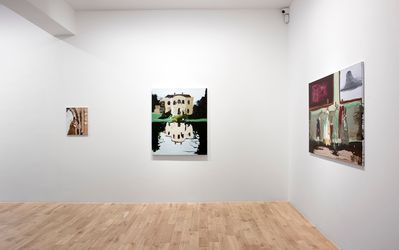
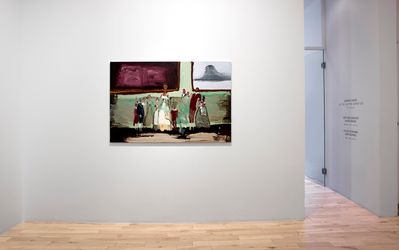
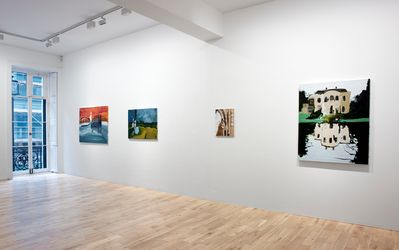
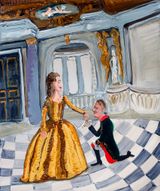
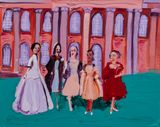
Genieve Figgis’ first exhibition at Almine Rech Gallery stands as an eloquent testimony to the monarch’s prophesy; in All the Light We Cannot See, she rewrites the fashionable mid-eighteenth-century painting genre of “conversation pieces,” in a language of clotted blood and mystical delirium which reconstrues the proposed narrative as one of dissolution suffused in luxury. In her “cover version” of Thomas Gainsborough’s famous canvas, Mr. and Mrs. Andrews (c.1750, National Gallery of Art, London), as well as more immediately topical works, viz., Royal Friends, Royal Gathering, Royal Group and House (all works acrylic on canvas, 2015), she transforms the genre’s representations of landed gentry, depicted in relatively informal poses, typically outdoors and upon estates where the atmosphere of ownership and permanence are illuminated by Praz’s “sun which seemed fated never to set.”[3] Gainsborough’s original painting, a double portrait of Robert Andrews and his wife, Frances Mary Carter (“not quite the girl next door, but probably the nearest marriageable girl of his own class”[4]) departs from the seeming informality of the conversation piece, and therein lies its uncanny effect, elevating it to a level of Masterpiece-Capital-M above such esteemed practitioners of the genre as Arthur Devis, Johann Zoffany, Philip Mercier, Francis Hayman, and the early William Hogarth. If the original portrait was designed to commemorate the subjects’ expanded properties through their recent marriage, Figgis relocates the couple to a landscape of endless dissolution, the beauty of her liquid pigments connects the luminous blues of a melting sky to vibrant ochre and black swaths of paint seemingly in constant motion. This is not a landscape that can be owned. The luminous pinks and whites of Andrews’s now skull-like visage benefit the painting and its viewer but not the sitter, whose painted identity has now dissipated as surely as his own earthly remains.

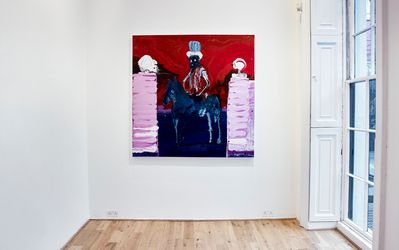
“Today the families descended from this favoured society are being forced to sell their pictures.”[5] The petal-pink gateposts which frame Figgis’s Gentleman on a Horse almost verge on solid forms, but they only serve as a counterpoint to the bloody volcanic force erupting behind the black hooded gentleman in top hat who sits calmly in front of the maelstrom.Living Room, invites us into a dissolving festive gathering posed against the luscious flowing yet coagulating crimson backdrop of a brain aneurysm.

“Let the Circumstances of Language; Religion and Blood have their natural and full Effect.” George III’s presentiment emerges in both the histories of Britain’s former colonies and in the darkling light of her paintings as the words of a blind clairvoyant. What concupiscent irony that separated by centuries and sensibilities, the Mad King George can welcome Figgis to his dead and living court, the assembly bedazzled by the light we cannot see.

—David Rimanelli

Read More

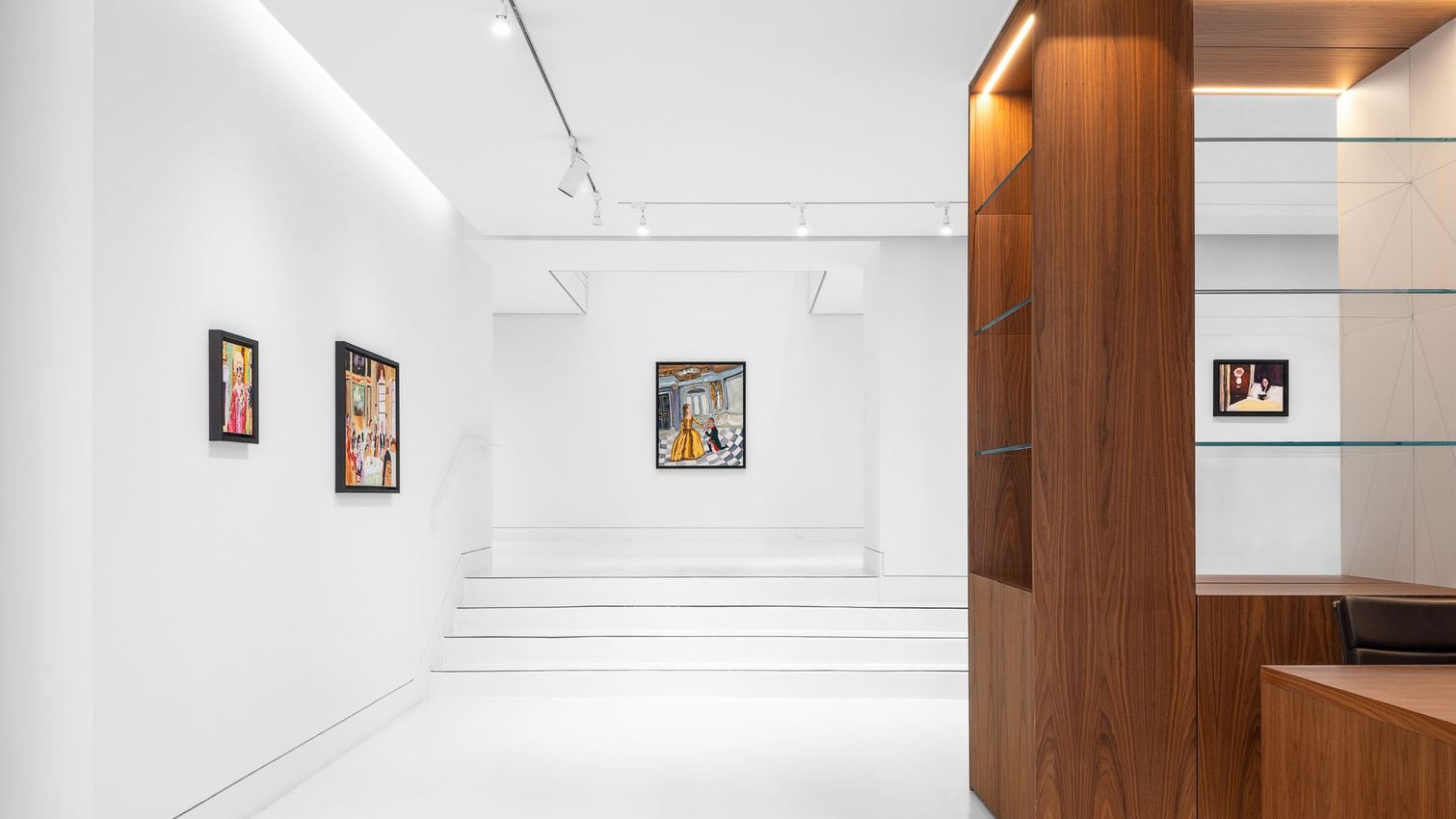
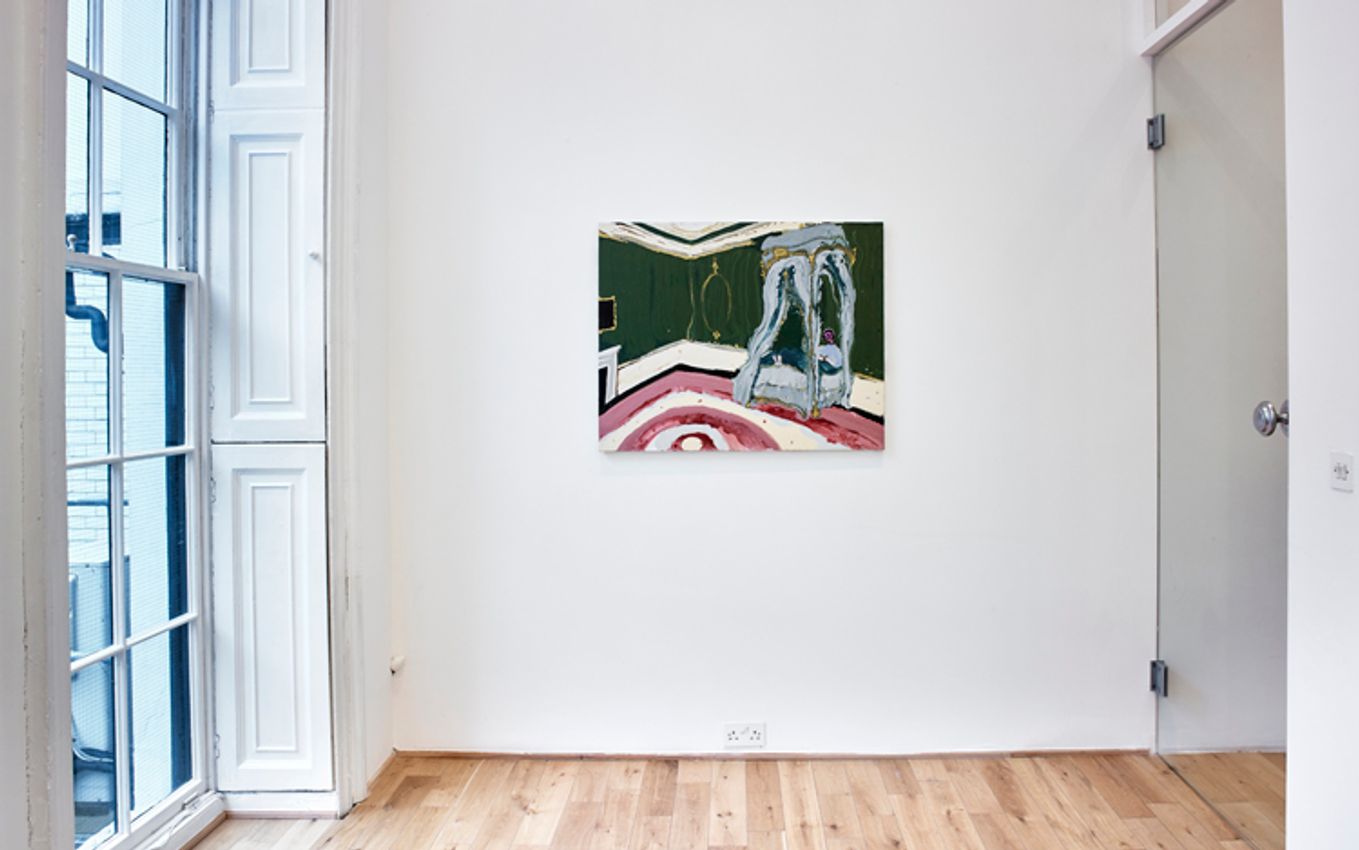
Installation Views

About the Artist

Genieve Figgis’ paintings share a similar dramatic bent as some Irish-English literature subjects from Edgar Allan Poe to Oscar Wilde, as well as acknowledged Old Masters such as Goya. Her scenes depicting bourgeois homes, traditional portraits, or landscapes are often haunted by spectral figures and leering creatures with canes and top hats. A sense of the charmingly macabre emerges from Figgis’ combination of an apparent pictorial banality with dreamlike qualities.

View Artist Profile

Also Exhibiting

About the Gallery
Almine Rech opened its doors on April 1st, 1997 in the 13th arrondissement in Paris. The gallery was founded on a minimal and conceptual axis, representing artists such as James Turrell, John McCracken and Joseph Kosuth. In addition to its stable of internationally recognised, mid-career and emerging artists, it has always been the gallery’s mission to continually seek out and include new artists in its programme. The gallery has held longstanding relationships with artists like John McCracken and James Turrell and has since started working with and representing artists such as Günther Förg, Alex Israel, Jeff Koons, Richard Prince, Julian Schnabel, Taryn Simon and DeWain Valentine, among others. In 2006 the gallery moved to a larger two-floor space in the Marais district and in 2008 inaugurated a second 1,000 square metre exhibition space in Brussels. In March 2013, Almine Rech launched its new Paris space at 64 rue de Turenne. In June 2014, Almine Rech opened a gallery in London on Savile Row, Mayfair. In October 2016, the gallery moved from Savile Row to a larger space on Grosvenor Hill, Mayfair. The 400 square metre gallery opened with a solo exhibition by Jeff Koons. Almine Rech Gallery also opened in Manhattan’s Upper East Side—the gallery’s first exhibition space in the US—at the end of October, 2016. The New York gallery’s inaugurating exhibition was Calder and Picasso.
View Gallery Profile
Address
11 Savile Row, 1st Floor
Mayfair
London
United Kingdom
(1)
London 11 Savile Row, 1st Floor, Mayfair
Almine Rech
11 Savile Row, 1st Floor, Mayfair, London, United Kingdom
+44 207 287 3644
http://www.alminerech.com
The art world in focus