




BRIDGET RILEY
b. 1931, United KingdomBridget Riley is a British artist known as one of the early proponents of the Op art movement of the 1960s.
Education and Early Works
Riley studied at Goldsmiths in London between 1949 and 1952 and continued her education at the Royal College of Art in London from 1952 to 1955.
Her earliest works were semi-Impressionist figure paintings, followed, from around 1958, by pointillist landscapes. During the late 1950s and early 1960s, Riley held several teaching positions in the U.K., including at the Loughborough University School of the Arts, Hornsey College of Art, and Croydon School of Art. In 1960, she joined the J. Walter Thompson advertising agency.
Abstract Works
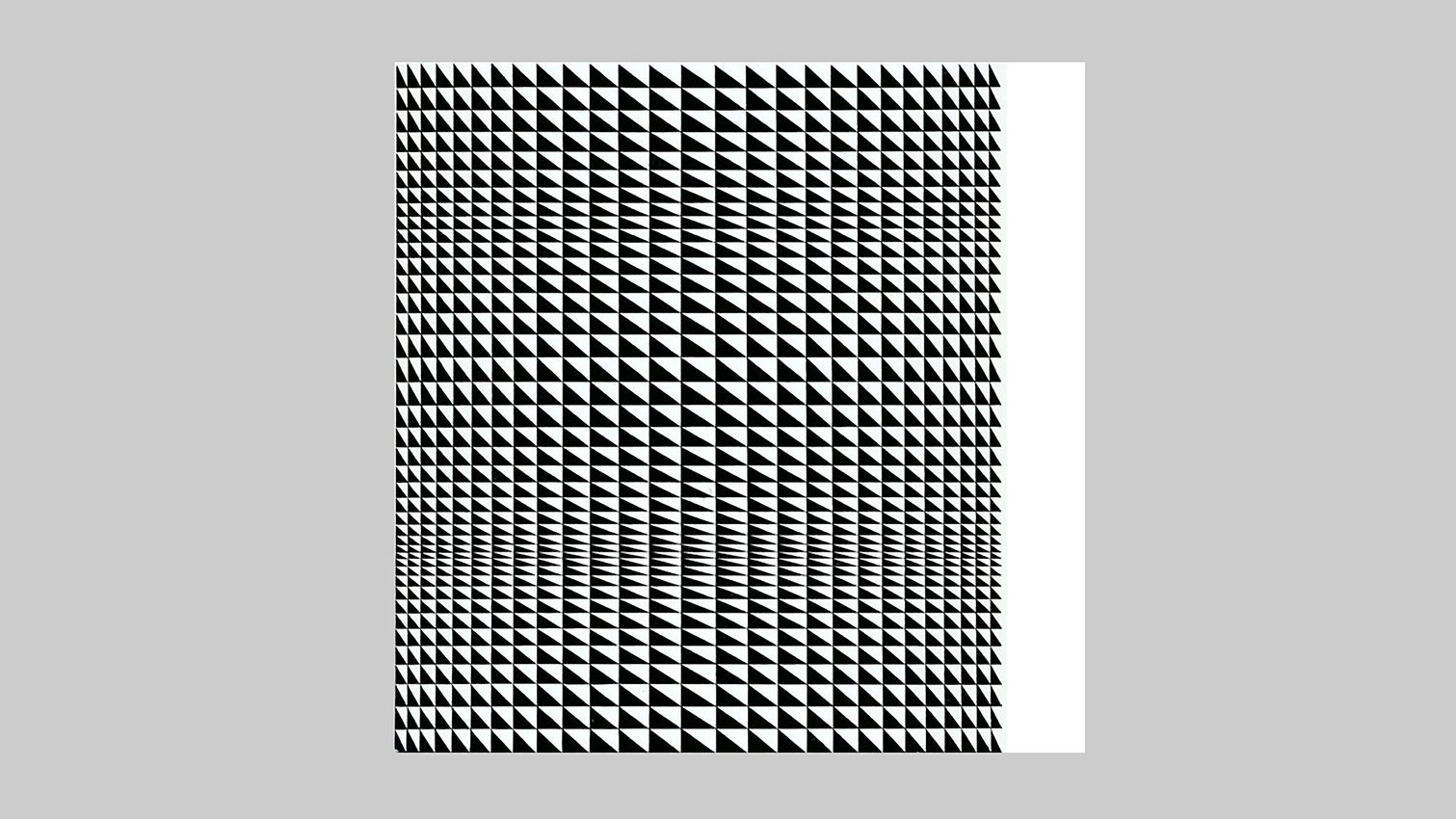
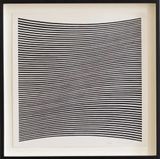
In the 1960s, Riley began to develop her trademark style, characterised by abstract geometric patterns in black and white, composed of curved parallel lines and dots, as well as checkers or triangles arranged in disorienting grid-like or spiral patterns. These combinations form impossible shapes that appear to move, pulsate and undulate before the viewer’s eyes, producing sensations of falling and wave-like motion. In 1961, she began working with assistants to create her work due to the increased scale and a need to maintain precision. Her first solo show was in 1962 at Victor Musgrave’s Gallery One.
Riley abandoned teaching and advertising in the mid-1960s as her art practice expanded. The 1965 Museum of Modern Art exhibition, The Responsive Eye, drew international attention to the work of Riley and other Op artists. Riley represented Op art to the world alongside artists such as Yaacov Agam, Richard Anuszkiewicz, Frank Stella and Op art’s earliest proponent, Victor Vasarely. Her work, Current (1964), made of synthetic polymer paint on an exhibition board, was featured on the catalogue cover.
Colour
Having freed form from its descriptive role through her black-and-white works, Riley turned to colour in 1967. It was a cautious foray at first, as a common perception of colour is that it does not disrupt stable elements in as crisp and orderly a manner as black and white. As exemplified in the canvas Cataract 3 (1967), she began using consistent, stable forms, such as the wavy line. She relied on the visual effect of groups of coloured lines (usually faint) in the spaces between to create the desired sensation of movement.
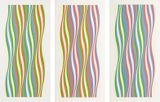
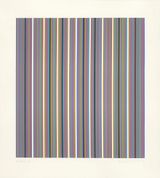
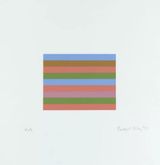
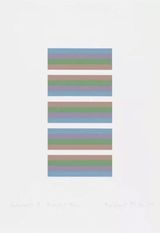
The response to colour became a central focus of Riley’s works in the 1970s. The works from this period are emotional yet peaceful. In the acrylic painting Zing 1 (1971), she introduced the theme of the colour twist, where twisted vertical stripes create horizontal bands. The colours are still muted in these twists, and grey is often included among them. Riley also adopted the principle of colour induction, which involves blending one colour into another. These elements led to a long series of vertical stripe paintings. By the mid-1970s, her curvilinear forms, both in horizontal and vertical formats, had become more prominent. Only her works after 1978, however, feature more than three colours.
A visit to Egypt in 1979–80 left Riley inspired by the colours of Egyptian art. She worked the colours into a composition of close, thin vertical lines in the ‘Ka’ and ‘Ra’ series. These images shimmer with intensity while marking her work’s expulsion of a sense of order or progression. She also worked outside the studio during this decade, the most notable project being the murals for the Royal Liverpool Hospital (1983), which utilised bands of blue, white, pink, and yellow to create a soft and relaxing atmosphere.
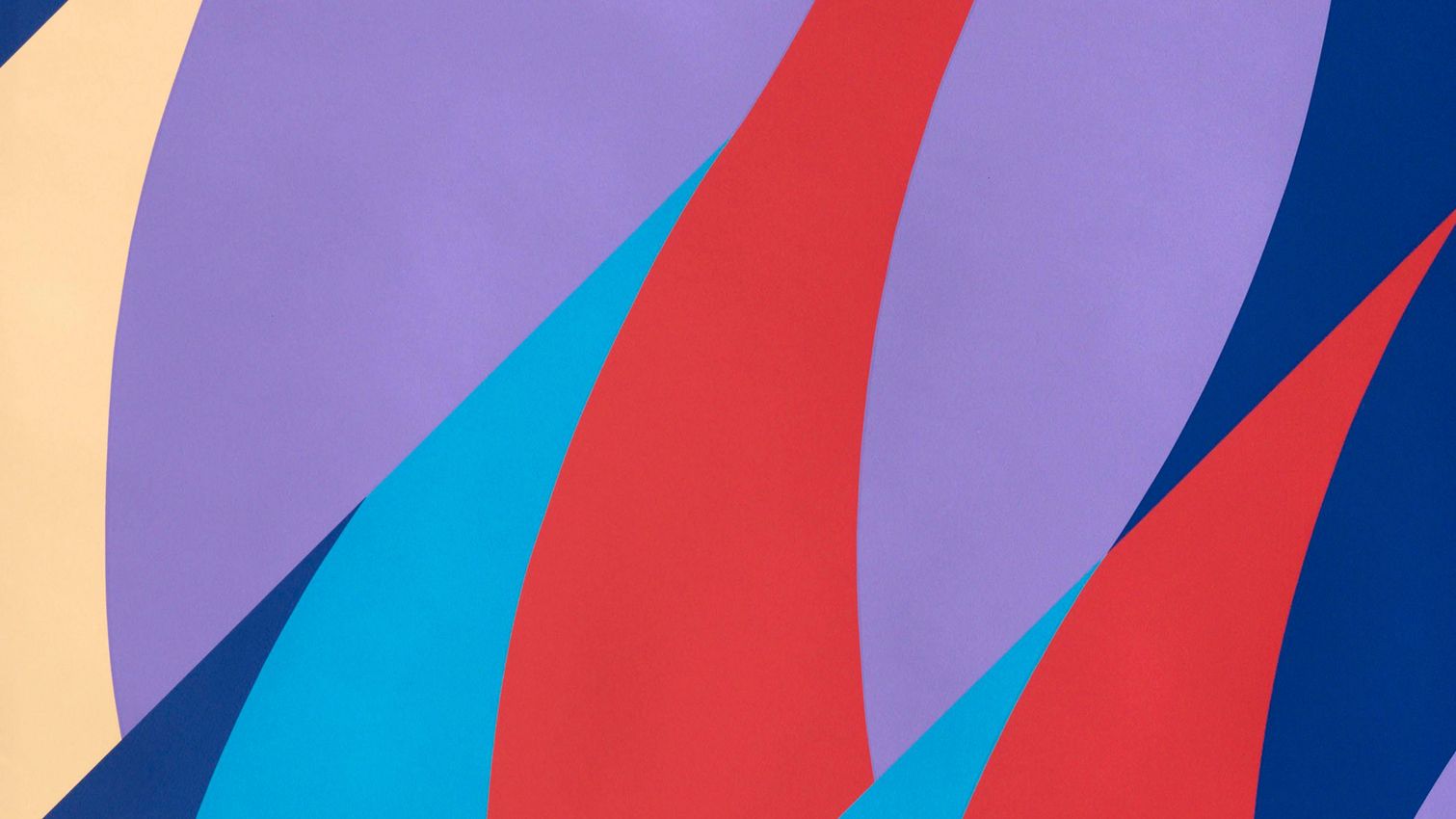
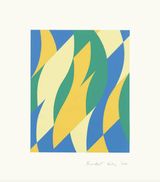
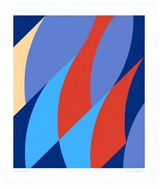
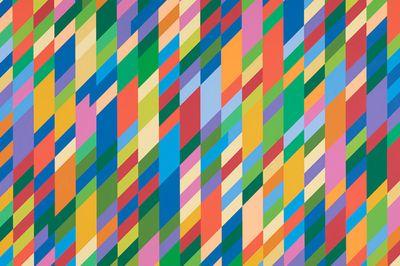
Between the mid-1980s and mid-1990s, Riley produced her most colourful and dazzling paintings. Works such as the screenprint To Midsummer (1989) and the oil painting From Here (1994) incorporate a diagonal element cutting from left to right across the verticals, creating an alternating rhythm by contrasting different vivid colours. This disruptive element softened in the late 1990s and early 2000s to become something more fluid and curvilinear, breaking out of the square format.
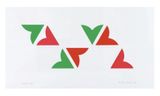
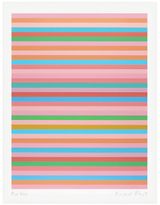
Riley has also revisited her horizontal and vertical line formats with new colour arrangements. She continues to develop and explore new motifs, such as the tessellating arrow forms of the Bagatelle (2015) and ‘Sonnet’ (2016) series of screen prints.
Exhibitions
Selected solo exhibitions include:
- Bridget Riley: Perceptual Abstraction, Yale Center for British Art, New Haven (2022)
- Bridget Riley: Past into Present, David Zwirner, London (2021)
- Bridget Riley: Messengers, National Gallery, London (2019)
- Bridget Riley, Scottish National Gallery, Edinburgh (2019); also Hayward Gallery, London (2019–2020)
- Bridget Riley, Chinati Foundation, Marfa, Texas (2017–2019)
Bridget Riley FAQs
Who is Bridget Riley?
Bridget Riley is a British artist celebrated for her pioneering contributions to Op art. Her abstract paintings use precise geometric patterns and colour arrangements to create dynamic optical effects that challenge visual perception.
What is Bridget Riley’s most famous work?
One of Riley’s most recognised works is Movement in Squares (1961), a black-and-white painting that exemplifies her early explorations into visual rhythm and spatial illusion. Her later colour works, such as Current (1964), further solidified her reputation as a key figure in post-war abstraction.
What influenced Bridget Riley’s art?
Riley’s practice has been shaped by her study of artists such as Georges Seurat and Piet Mondrian, as well as her interest in the psychology of vision. Her travels to Egypt in the 1980s also had a profound effect, inspiring her use of colour and exploration of visual sensation.
Where can I see Bridget Riley’s artworks?
Her work is in significant collections worldwide, including Tate, London; The Museum of Modern Art, New York; and Centre Pompidou, Paris. She has been the subject of major retrospectives, including her 2019–20 exhibition at the Hayward Gallery in London.
Has Bridget Riley received awards or honours?
Yes. Riley was awarded the International Prize for Painting at the 1968 Venice Biennale and has been appointed a Companion of Honour and a Commander of the Order of the British Empire (CBE) for her significant contributions to the art world.
Ocula | 2025



View Bridget Riley's Artworks


























Bridget Riley in Ocula Magazine










Explore and Follow Artists Shaping Contemporary Art
A respected voice in contemporary art discourse.
Focusing on ambitious storytelling and insightful art-world commentary. Ocula Magazine publishes in-depth interviews, critical essays and timely analysis on the artists, exhibitions and ideas driving the global art world.
Learn more about Ocula Magazine
Showcasing the best of the art world.
Ocula partners with galleries from around the world to highlight their artists, artworks and exhibitions. Gallery membership is by application and invitation, with each member vetted by an independent panel.
Learn more about Ocula Membership
Specialises in the sale of major artworks.
Led by a team with deep ties to the world’s leading auction houses, galleries and collectors. Ocula’s advisory team offers bespoke services to high-net-worth clients from around the world who are looking to acquire the best of contemporary and modern art.
Learn more about our team and services