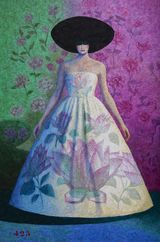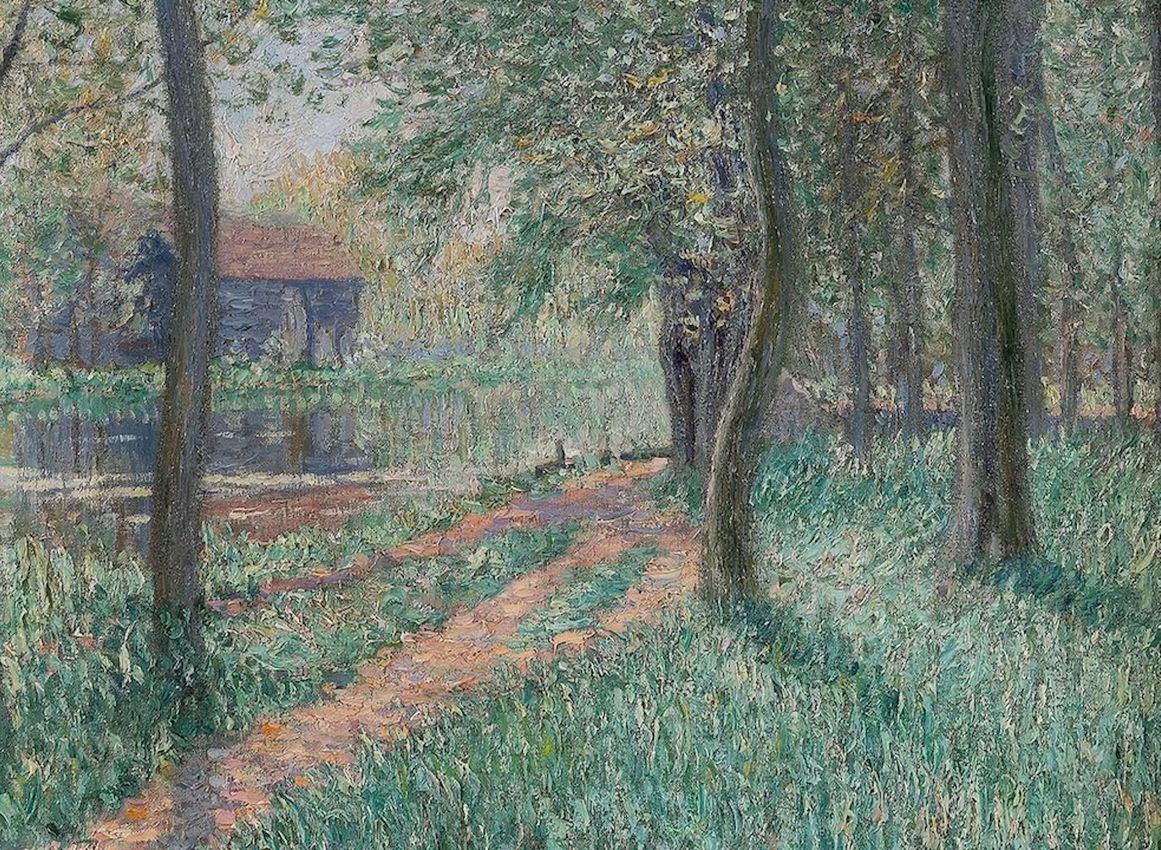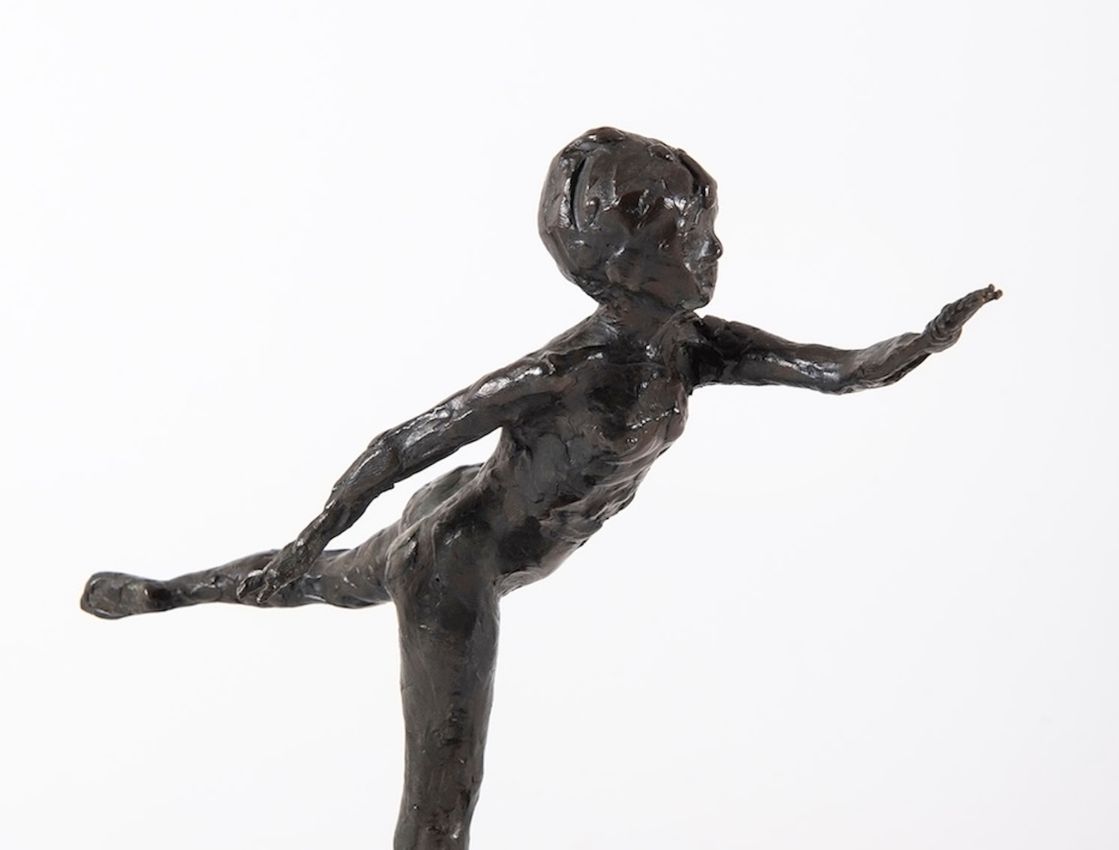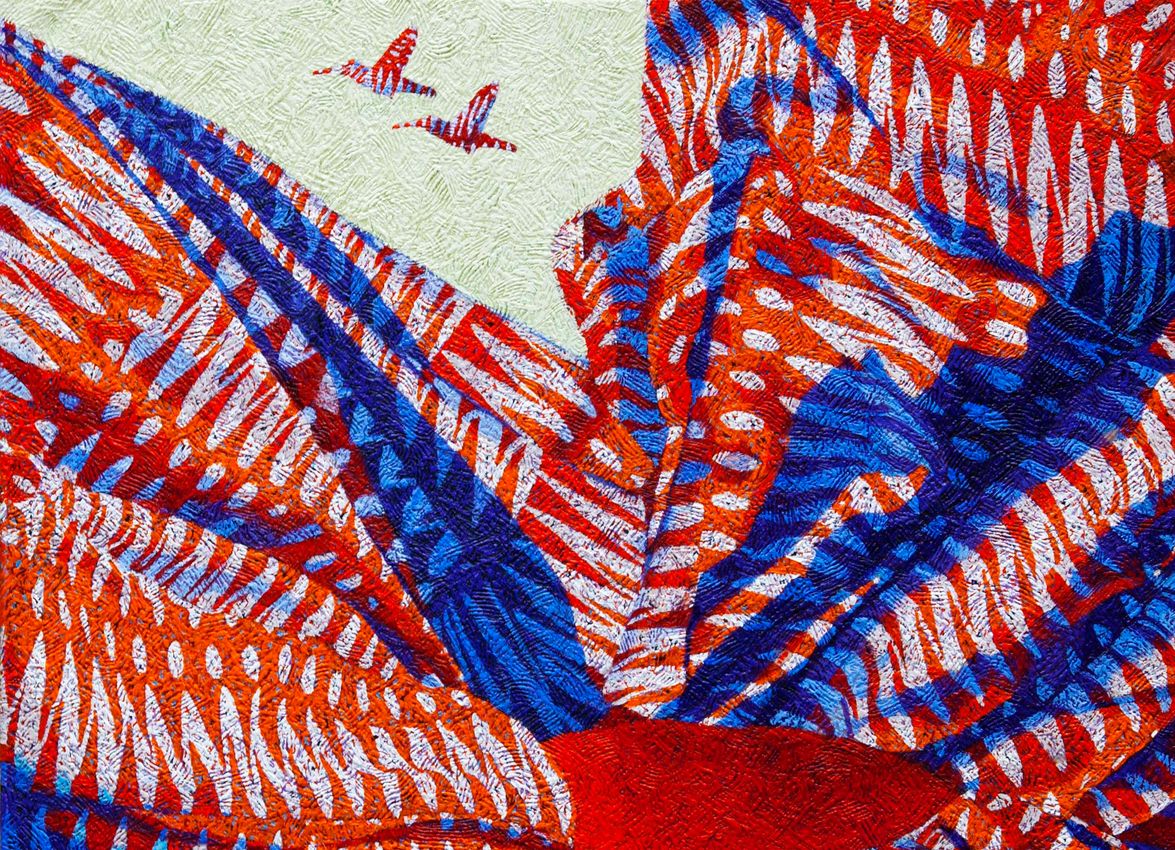
Yves Clerc (1947) enjoys combining styles, including pictures made by others, in his paintings, having his paintings embroidered or collaborating with fashion designers. His work is in different collections around the world, notably in the collection of famous fashion designers such as Leïla Menchari. Leïla Menchari is a scenographer for Hermes, who asked Yves Clerc to present twelve works in twelve windows of Maison Hermes at rue du Faubourg Saint Honoré in Paris. Yves Clerc also collaborated with Irina Vitjaz, a renowned stylist of high fashion in Moscow who asked Yves to simulate a museum, with his work, for a fashion show. Some paintings were printed in large formats and embroidered by ‘atelier Vitjaz’.
Yves Clerc is inspired and always flirting with the fashion industry, the theatre and dance, but also the Florentine Mannerists or the Baroque paintings of the Cuzco School, as well as from a more recent period works by Albers. He numbers his work chronologically; this number is both the title and the signature. This ‘numeric title’ is always situated in exactly the same place in all of his work: on a five-centimeter black band incorporated into the frame underneath the painting. It is a reference to Renée Magritte’s famous work: ‘This is not a Pipe’.
Clerc created and mastered a painting technique where he superposes multiple layers which result in the paintings having the appearance of texture and depth. It is reminiscent of pointillism, but instead of dots, it is an endless series of small dashes of paint. The artist is always delighted to see admirers getting up-close inspecting the intriguing texture and colors of his work. Nonetheless, conscious of the importance of the conceptual in today’s artistic environment, Yves Clerc abandoned the abstract in favor of the figurative. ‘To be frank, what I sought was a paradox: I was seeking something that was figurative, but at the same time other than figurative, something that was offbeat and entirely new; something that was realistic, but at the same time anything but real.’
Yves Clerc is a mannerist artiste, he does not wish to imitate what is real, but rather tries to represent a vision of the world, where his art is rendered apparent by elongated forms, the saturation of colors and the tension of postures. A painting is like a door, a place of passage between two worlds, the real world and the represented one. Freed from these constraints and following a very personal path Yves Clerc has explored a series of themes dealing with appearance and how appearance is presented, and in doing so, to some extent bring the idea of the figurative full circle.
The Bailly Gallery has a long-standing collaborative history with the artist, since 1990 the Bailly Gallery has held a regular exposition of the artists’ work in Paris and Geneva.
Yves Clerc first entered the world of picture through photography. He lives and works in Paris, Mexico, Geneva and he regularly travels to the USA.


A respected voice in contemporary art discourse.
Focusing on ambitious storytelling and insightful art-world commentary. Ocula Magazine publishes in-depth interviews, critical essays and timely analysis on the artists, exhibitions and ideas driving the global art world.
Learn more about Ocula Magazine
Showcasing the best of the art world.
Ocula partners with galleries from around the world to highlight their artists, artworks and exhibitions. Gallery membership is by application and invitation, with each member vetted by an independent panel.
Learn more about Ocula Membership

Specialises in the sale of major artworks.
Led by a team with deep ties to the world’s leading auction houses, galleries and collectors. Ocula’s advisory team offers bespoke services to high-net-worth clients from around the world who are looking to acquire the best of contemporary and modern art.
Learn more about our team and services