





HEINZ MACK
b. 1931, GermanyHeinz Mack is a German artist renowned for his pioneering contributions to light art, kinetic art, and the ZERO movement, which he co-founded with Otto Piene in 1957.
Mack’s work explores the interplay of light, space, colour and movement through a diverse range of media, including monumental outdoor sculptures, paintings, light-reliefs, and kinetic installations.
Heinz Mack’s Early Life and Education
Mack was born in Lollar (Hesse, Germany) in 1931. He studied at the Academy of Fine Arts in Düsseldorf from 1950 to 1953 and earned a degree in philosophy from the University of Cologne in 1956.
In 1957, with fellow German artist Otto Piene, Mack established the ZERO movement in Düsseldorf as a response to post-war artistic stagnation.
The ZERO Movement
The ZERO group of artists rejected the popular expressive, abstract painting of the time, and instead used light and motion to explore new modes of perception, and new aesthetic principles and ideas were developed. The movement later included Günther Uecker (who joined in 1961) and attracted international artists such as Yves Klein and Lucio Fontana. Artists Manzoni, Castellani, Tinguely and Schoonhoven are also associated with the ZERO movement. __ZERO represented a new beginning after the destruction of the Second World War.
In a 2014 interview with Ocula Magazine, Mack said of the artists involved with ZERO, ‘Each one of us worked alone, experimenting with colour and light, or, in my case, the concentration of space in its relation to the sculpture and vice versa. All this went along with recognitions, perceptions, ideas and some intellectual effort.’
In 2014, a major ZERO exhibition opened at the Solomon R. Guggenheim Museum, New York. It subsequently travelled to the Martin Gropius Bau, Berlin, the Stedelijk Museum, Amsterdam, and the Sakip Sabanci Museum, Istanbul, drawing a total of almost 700.000 visitors.
Though the ZERO group disbanded in the mid-1960s, that short period was critical for the development of Mack’s practice.
Heinz Mack’s Artistic Practice
Mack’s oeuvre is characterised by his innovative use of light as a central theme, and his experimentation with unconventional materials, likes and kinetics.
Sahara Project
In 1959, driven by an artistic desire to explore pure light in areas of unspoiled nature. Mack conceived the ‘Sahara Project’. From 1962 on, he installed his ‘artificial gardens’ in the African desert, consisting of sand-reliefs, wings, cubes, mirrors, sails, and monumental light-stelae, and the 1968 film, Tele-Mack, was born out of the related experiments.
In 1976, Mack realised his utopian projects in the Arctic, where he installed swimming sculptures of acrylic glass, light-flowers, prismatic pyramids, ice crystals and fire-rafts.
In 2022, the monograph Mack – Sahara was published by Hirmer.
’Steles’ series
Experimentations with unconventional materials, light and kinetics saw the birth of his kinetic ‘Steles’ series. Light played a central role in sculptures made such as Stele with 9 Lenses (1964), which used glass lenses. Artworks from the early ‘Stele’ group also included motors to generate movement and variations of light and shadow, for example the work Light Dynamo #2 (1966).
Painting and Chromatic Constellations
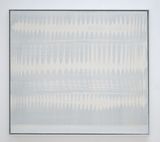
Mack also created paintings. His abstract painting style was informed by Mack’s interest in light and darkness. The monochromatic and graphic play with black-and-white resin lines on cloth in Vibration (1957–58) exemplifies his penchant for Minimalism.
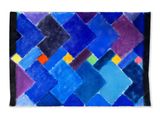
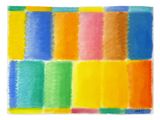
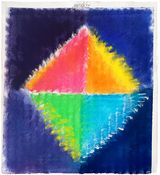
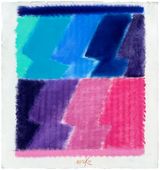
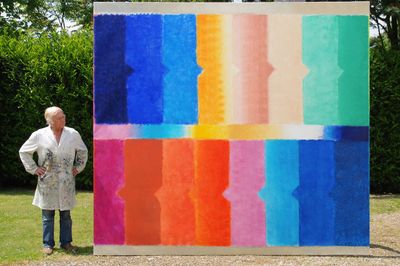
In the 1990s, Mack transitioned from monochromatic minimalism to vibrant color compositions termed ‘Chromatic Constellations’, painting in bright colours. Exemplary of this, the acrylic-on-canvas painting Empire Couleur (Chromatic Constellation) (2014) comprises stripes in a spectrum of colours and fragments that blend softly into one another at their edges. In such works, Mack creates different intervals, patterns, and sequences of colour that seem to float on constantly changing surfaces.
Heinz Mack’s Exhibitions and Legacy?
Mack has exhibited internationally since 1959 and his works are held in over 170 international public collections, including the Guggenheim Museum (New York), Tate Modern (London), and Centre Pompidou (Paris).
Mack’s influence extends across movements such as land art, minimalism, and conceptual art.
In his early career, he participated in the historic II. documenta (1959) and documenta III (1964), as well as representing the Federal Republic of Germany at the Venice Biennale of 1970. Throughout his career, his multi-faceted artwork has been presented in almost 300 solo exhibitions, while a number of books as well as two films have been made about his practice.
Mack Foundation
MACK FOUNDATION (2025): In February 2025, the MACK FOUNDATION was established on Mack’s historic Huppertzhof estate in North Rhine-Westphalia. The foundation preserves his extensive body of work and archives while fostering scholarly research. It complements the ZERO Foundation (co-founded by Mack in 2008) but focuses exclusively on his individual legacy.
Heinz Mack Solo Exhibitions include:
- Heinz Mack: Mouvement et Lumière/Movement and Light, Musée Théodore Monod d’art africain, Dakar (2019);
- Mack – Just Light and Color, Sakip Sabanci Museum, Istanbul (2016);
- Transit between Occident and Orient, Pergamon Museum Berlin (2006); Heinz Mack, Tehran Museum of Contemporary Art (2001);
- Heinz Mack, Liechtenstein State Art collection, Vaduz (1998); Mack, Musée d’art moderne de la Ville de Paris (1973).
Heinz Mack Group Exhibitions include:
- Action Reaction. 100 Years of Kinetic Art, Kunsthal Rotterdam (2018);
- ZERO. Countdown to Tomorrow, 1950s−60s, Solomon R. Guggenheim Museum, New York (2014);
- Berlin − Moskau/Moskau – Berlin, Staatliches Historisches Museum, Moscow (2003–2004);
- Deutsche Kunst 1945−1985, Neue Nationalgalerie, Berlin (1985);
- Prospect: Retrospect. Europa 1946−1976, Städtische Kunsthalle Düsseldorf (1976); The Responsive Eye, The Museum of Modern Art, New York (1965);
- Resonant Surface: The Intersection of Light, Color, and Space (December 2024–February 2025).
Awards and Recognitions
Mack has received numerous accolades throughout his career:
- Grand Federal Cross of Merit with Star (2011)
- Moses Mendelssohn Medal (2017)
- Honorary membership in Kunstakademie Düsseldorf (2015)
Heinz Mack FAQs
Who is Heinz Mack?
What is the ZERO movement?
The ZERO movement was an avant-garde art group founded in 1957 by Heinz Mack and Otto Piene in Düsseldorf, later joined by Günther Uecker. It sought to break away from traditional art forms and explore new beginnings through light, monochromatic aesthetics, and kinetic installations.
What are Heinz Mack’s most famous works?
Mack’s iconic works include the Sahara Project (1960s), where he installed reflective sculptures in desert landscapes to explore pure light, and kinetic sculptures like Light Dynamo #2 (1966). He is also known for his ‘Chromatic Constellations,’ a series of vibrant abstract paintings.
What materials does Heinz Mack use in his art?
Mack employs a variety of materials such as polished metal, mirrors, Plexiglas, and aluminum to manipulate light and create kinetic effects. His works often incorporate movement and reflective surfaces to engage with themes of luminescence and space.
Where can I see Heinz Mack’s artworks?
Mack’s works are featured in major public collections worldwide, including the Guggenheim Museum (New York), Tate Modern (London), Centre Pompidou (Paris), and MoMA (New York). Additionally, his pieces are frequently exhibited in galleries and museums globally.
What is Heinz Mack’s Sahara Project?
The Sahara Project was a groundbreaking series of installations by Mack in the 1960s that placed reflective sculptures in desert environments to explore the interaction between light and natural landscapes. This project is considered a milestone in land art.
What inspired Heinz Mack’s artistic philosophy?
Mack’s philosophy revolves around achieving “pure, grand, objective clarity” through art that avoids romantic or subjective expression. Influenced by existentialist thinkers like Nietzsche and Sartre, he views art as a personal yet universal exploration of light and space.
How did Heinz Mack contribute to kinetic art?
Mack is a pioneer of kinetic art, creating sculptures that incorporate motion to interact with light and space dynamically. Works like Light Ballet exemplify his innovative approach to blending technology with artistic expression.
What awards has Heinz Mack received?
Mack has been honored with numerous awards throughout his career, including the Grand Federal Cross of Merit with Star (2011) and honorary membership at Kunstakademie Düsseldorf (2015). These accolades recognise his contributions to modern art movements.
Ocula | 2025

Works at Beck & Eggeling International Fine Art















Explore and Follow Artists Shaping Contemporary Art
A respected voice in contemporary art discourse.
Focusing on ambitious storytelling and insightful art-world commentary. Ocula Magazine publishes in-depth interviews, critical essays and timely analysis on the artists, exhibitions and ideas driving the global art world.
Learn more about Ocula Magazine
Showcasing the best of the art world.
Ocula partners with galleries from around the world to highlight their artists, artworks and exhibitions. Gallery membership is by application and invitation, with each member vetted by an independent panel.
Learn more about Ocula Membership
Specialises in the sale of major artworks.
Led by a team with deep ties to the world’s leading auction houses, galleries and collectors. Ocula’s advisory team offers bespoke services to high-net-worth clients from around the world who are looking to acquire the best of contemporary and modern art.
Learn more about our team and services