Press Release

What kind of wedding gift can a gallery give to an artist it represents? One might gift a coffee machine for the newly established household, as might be expected—a joint trip, expensive tableware, a rare art book, perhaps even stocks. All of these are good and useful, but neither particularly purposeful for the artist nor the gallerist. Because in the art world, there is essentially nothing that isn’t part of that world. One doesn’t simply clock out at 5 p.m. and suddenly become a purely private individual. And so, the gallery gifts the artist an exhibition, and simultaneously, the artist gifts the gallery one—on the occasion of the festive wedding of Cristina Vasilescu and Christian Jankowski on June 7, 2025. The perfect Wedding Gift.

As is often the case in Jankowski’s work, it’s the transitions between the public and the private, the shared and the personal, society and the individual—and their respective roles and spheres of action—that the artist explores. This becomes apparent in the seriesI Was Told to go With the Flow (color and mixed media on crates, 2025), now on view at the gallery on the occasion of the exhibition, on the occasion of the wedding. It consists of altered transport crates for artworks. Placed on them: the hopeful, success- and love-promising titles of self-help books.

The Art of Doing Twice the Work in Half the Time is written in white letters on a large wooden box that once protected a Jankowski artwork during transport. Tied to it: the hope of the artist, the gallery, and all the others who are interdependent in the art ecosystem, that it might be sold at the respective art fair (Secrets of Closing the Saleis the title of another self-optimization book featured in the series), that the press will write favorably about it, that people will like it and understand it. More than just an artwork travels with the crate.

And so, the crates come with various instructions for use: “Fragile! Handle with Care” it says, among other things. The imperative could just as well apply to dealing with people in general, and especially those who give their hearts in marriage. People too are “fragile” and should be treated with “care.”

Within the crates slumbers something unexpected—perhaps even inexplicable—at the very least, they are filled to the brim with potential. Like genies in bottles, where the bottle’s only real purpose is to contain the spirit. And once again, the question arises: where does an artwork actually begin, and where does it end? Is there a clear boundary, or does it fray at the edges? The unknown contents leave room for everything that could be, if only one had read and understood all the guides properly. The underlying shortcut: had one read, understood, and applied them all, one would be rich, in love, and perhaps simply a better person altogether. The hope that art can transform its audience is not uncommon in the art world either.

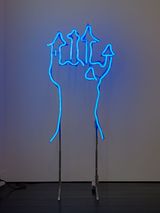
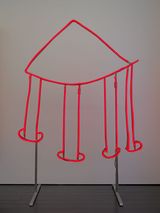
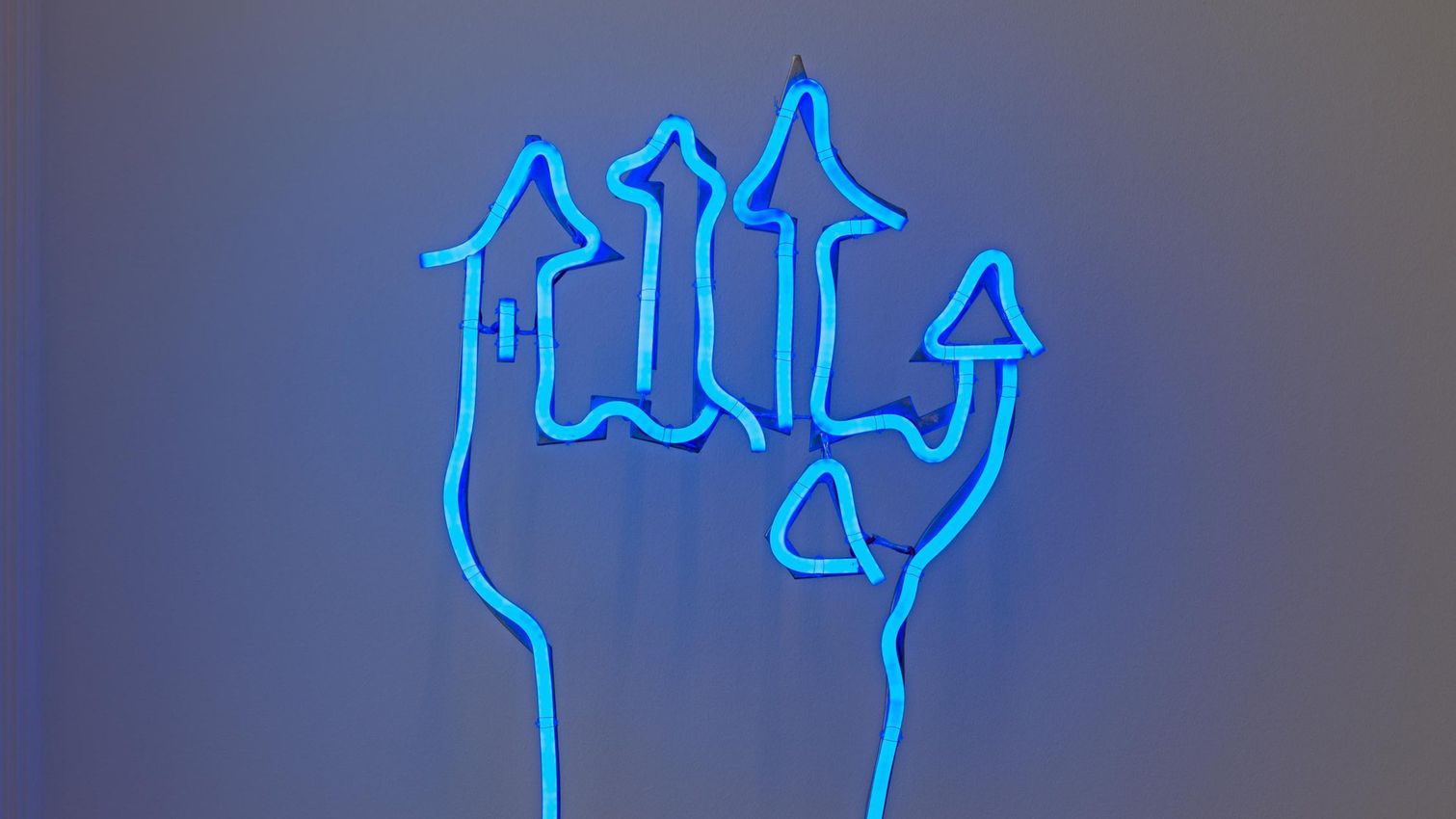
Fitting with the theme of the wedding—on the occasion of which these artworks now gather—are the neon pieces from the series Luftschlösser (Castles in the Air). People are known to dream them up—and it’s all the more beautiful when a few of them come true. When visiting construction sites of prestigious new buildings, Jankowski asks those practically involved in the building process to draw their dream castle for him on old plans and notes. Thus, for example, the private dream of the plasterer working on the Humboldt Forum merges with the dream of all those who financed and thereby made possible the construction of the controversial city palace (Luftschloss, Nagelsalon, 2025). The private meets the public. The collective meets the individual. Without mediation, these otherwise neatly separated actors encounter one another in Jankowski’s works and probe what is possible—where freedom begins, but also where it ends.

Andreas B., who worked on the construction of the new “Berlin Modern” museum, also sketched his idea of a dream castle: Greek columns under a circus tent. After all, one is still allowed to dream.

It wouldn’t be a true Jankowski-style loop if this very text weren’t also aWedding Gift. And just like that, Cristina and Christian dance in an endless loop in their wedding video, circle one another, fall into each other’s arms—during their first dance as a married couple, which will hopefully and certainly go on forever.

Courtesy Contemporary Fine Arts, Berlin/Basel. Text: Laura Helena Wurth.

Read More
About the Artist

In one thematic body of work, Jankowski explores the unique relationship between the artist, the gallery as “institution” and the viewer, which he refers to as a “magic circle”.

View Artist Profile

Also Exhibiting at Contemporary Fine Arts | CFA

About the Gallery
The gallery was founded in 1992 in Berlin, where it now resides in a 19th-century apartment house on two floors – a white cube–style storefront window on the ground floor and a salon-like space on the first floor. In 2023, Contemporary Fine Arts expanded to Switzerland and opened its first dependence in Basel’s Totengässlein. The gallery launched and co-launched the careers of artists like Cecily Brown, Sarah Lucas, Raymond Pettibon, Dana Schutz, and Dash Snow. While a couple of younger artists like Maja Ruznic, Emily Mae Smith, Tobias Spichtig, Angelika Loderer, Eliza Douglas, and Travis MacDonald have joined the roster recently, the gallery is also known for exhibiting established artists like Georg Baselitz and Leiko Ikemura. CFA also represents the estates of Christa Dichgans and Norbert Schwontkowski. Over the years, the gallery has staged museum-quality exhibitions, including Max Beckmann in Dialogue with Cecily Brown, Ella Kruglyanskaya and Dana Schutz, Kids, Café Pittoresque, and Hommage à Georg Baselitz, the latter marking the artist’s 80th birthday. Contemporary Fine Arts regularly publishes exhibition catalogues to accompany its shows.
View Gallery Profile
Address
Grolmanstraße 32/33
Berlin
Germany
Opening Hours
Tuesday – Friday: 10am – 6pm
Saturday: 12am – 6pm

SUMMER HOURS
6 July – 21 August
Monday – Friday: 11am – 5pm
Closed on Saturdays
Or by appointment
(1)
Berlin Grolmanstraße 32/33
Contemporary Fine Arts | CFA
Grolmanstraße 32/33, Berlin, Germany
+ 49 30 88 77 71 67
http://www.cfa-berlin.de

Opening hours
Tuesday – Friday: 10am – 6pm
Saturday: 12am – 6pm

SUMMER HOURS
6 July – 21 August
Monday – Friday: 11am – 5pm
Closed on Saturdays
Or by appointment
The art world in focus