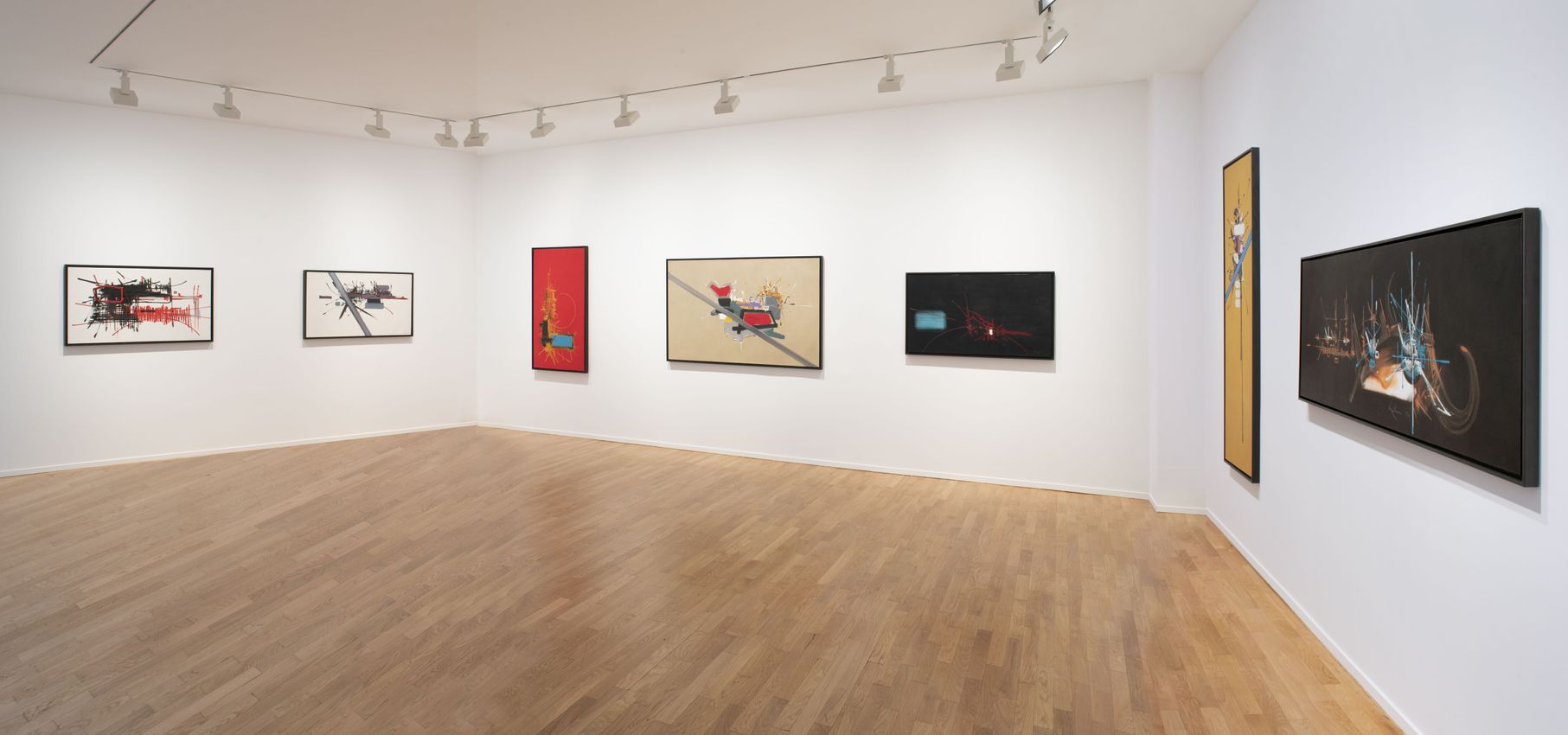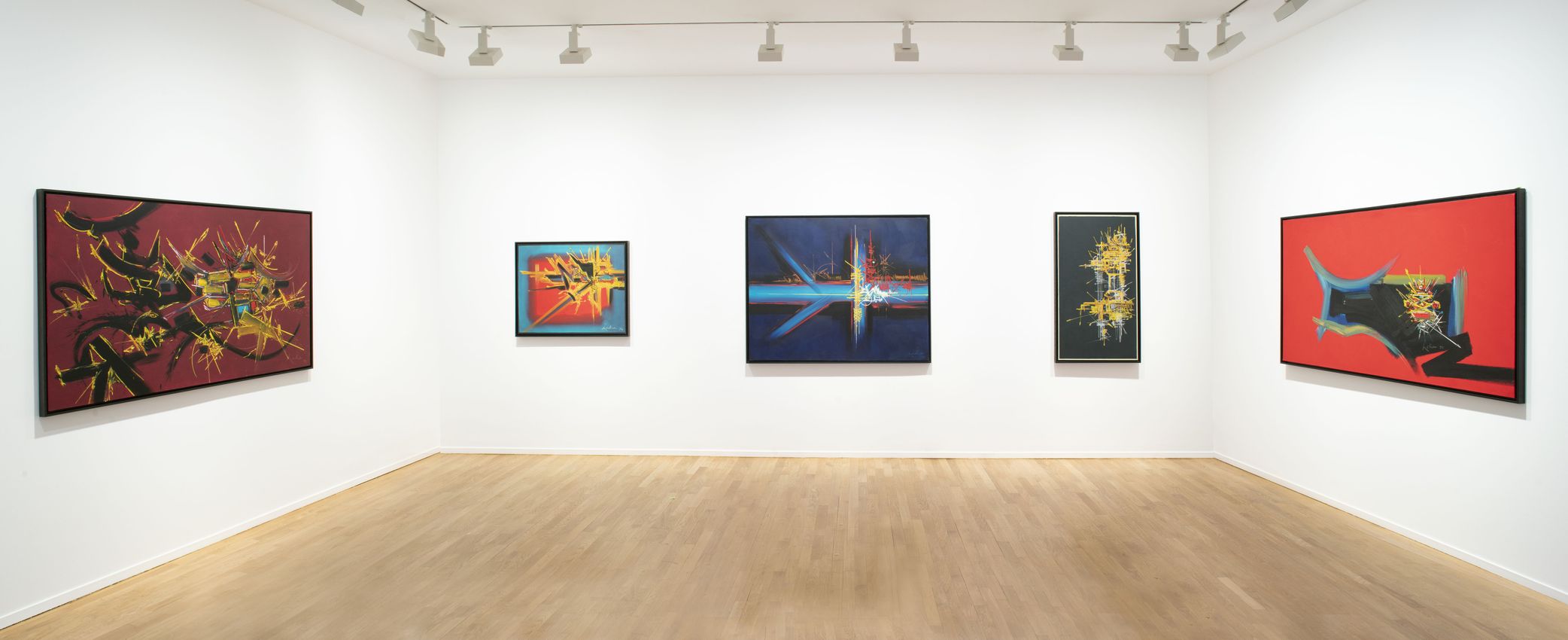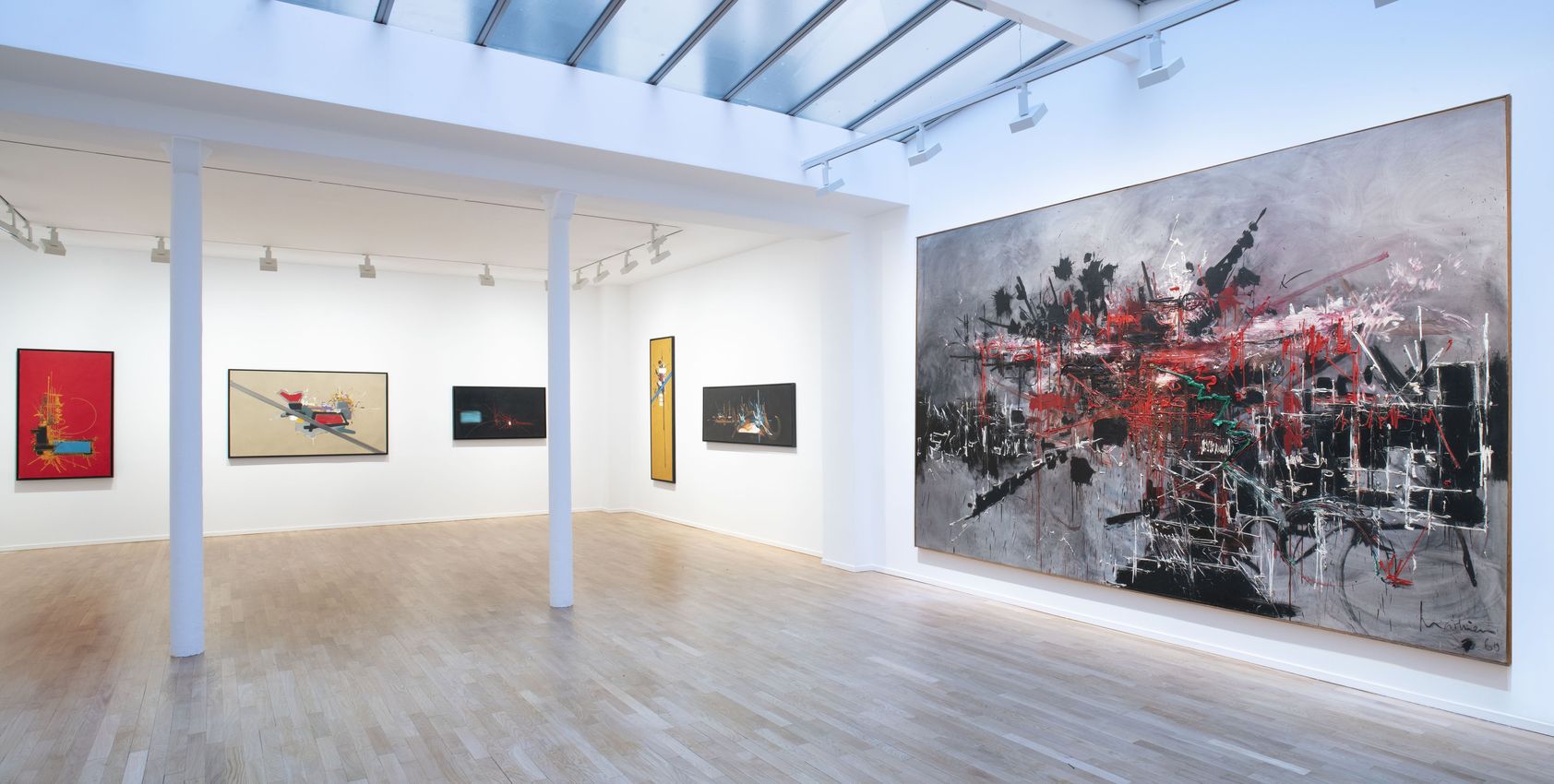
Galerie Templon’s new exhibition offers visitors the chance to rediscover one of the most singular and emblematic painters in French contemporary art: Georges Mathieu. The self-proclaimed founder of lyrical abstraction, Georges Mathieu shot to fame in the 1950s and 1970s before finding himself into purgatory until his death in 2012. The exhibition features around thirty paintings created between 1960 and 1979, demonstrating the significance and inventiveness of a body of work that left a lasting impression on French art and imagination.
The period covered by the exhibition represents Georges Mathieu’s work at its pinnacle. Pioneering a form of gestural abstraction that was close to performance, Georges Mathieu, with his dazzling brilliance, a famed-provocateur could be seen as the prototype of today’s star artist. In his quest to transcend the notion of the avant-garde, he developed a form of painting where speed and spontaneity became key. Sometimes working in front of the cameras, his work exhibited throughout the world, he was famed for his large-scale formats where the unadulterated paint spurts from the tube. He brought a new brand of freedom to the creative gesture, rooted in emotion, violence and subjectivity. Freedom that then gave birth to a brand new style, somewhere between esoteric sign, calligraphy and raw energy. The titles, often steeped in historical, musical and geographical references, add a poetic quality, both sophisticated and offbeat. In 1971, Pierre Dehaye said: ‘In the twenty years since lyrical abstraction began, never before has the artist attained this uniformity of luminosity and overall balance. Each painting is a celebration.’ In 1975, Georges Mathieu was elected to the Academy of Fine Arts. The 10-franc coin he created for the Paris Mint is in circulation. He designed the logo for the public television channel Antenne 2. His style was thus assimilated into daily life in France, making a profound impact on the collective imagination.
Daniel Templon often refers to the moment when he discovered Georges Mathieu’s Capétiens in 1965, a ‘real visual shock’ that triggered his desire to become a gallerist. Galerie Templon has published a catalogue to mark the exhibition, featuring texts by Edouard Lombard (president of the Comité Georges Mathieu) and American art historian AnnMarie Perl (Princeton) which analyse the importance of his historical contribution and the underpinnings of his international reception.
Georges Mathieu was born in Boulogne-sur-Mer, France, in 1921. A self-taught painter, he began his artistic career in 1942. Mathieu’s early abstract investigation consisted of amorphous shapes and experimentation with drip techniques. In 1947 he resettled in Paris, and quickly became attracted to the works of artists such as Camille Bryen and Alfred Otto Wolfgang Schulze, which he referred to as Lyrical Abstraction. Within his first year in Paris he had organized L’imaginaire at Galerie du Luxembourg to promote the Lyrical Abstraction movement. Mathieu’s own works were closely associated with Tachiste painters (from the French tache, meaning blot or stain), often squeezing paint directly onto the canvas and emphasizing the necessity of rapid execution to harness intuitive expression. He identified his work as aligned with abstract history painting, as many of his titles refer to events in French history. Mathieu’s artistic experimentation expanded into performance art, often executing large canvases before an audience.


The gallery was founded in 1966 by Daniel Templon, who was then only 21. It first opened rue Bonaparte, in Saint-Germain-des-Prés in Paris, before moving in 1972 to its current location, rue Beaubourg, in the Marais, close to the Pompidou Centre, which opened in 1977. Daniel Templon first gained recognition by exhibiting conceptual and minimal artists such as Martin Barré, Christian Boltanski, Donald Judd, Joseph Kosuth, Richard Serra. In the seventies and eighties, Daniel Templon was one of the pioneers of the contemporary art and introduced many important American artists to the French public: Dan Flavin, Ellsworth Kelly, Willem de Kooning, Frank Stella, Andy Warhol. The gallery quickly became one of the references in contemporary art in France. In 1972, Daniel Templon and Catherine Millet co-founded the monthly art magazine ART PRESS.

A respected voice in contemporary art discourse.
Focusing on ambitious storytelling and insightful art-world commentary. Ocula Magazine publishes in-depth interviews, critical essays and timely analysis on the artists, exhibitions and ideas driving the global art world.
Learn more about Ocula Magazine
Showcasing the best of the art world.
Ocula partners with galleries from around the world to highlight their artists, artworks and exhibitions. Gallery membership is by application and invitation, with each member vetted by an independent panel.
Learn more about Ocula Membership

Specialises in the sale of major artworks.
Led by a team with deep ties to the world’s leading auction houses, galleries and collectors. Ocula’s advisory team offers bespoke services to high-net-worth clients from around the world who are looking to acquire the best of contemporary and modern art.
Learn more about our team and services