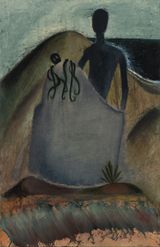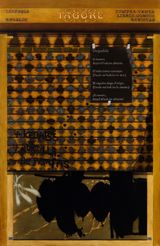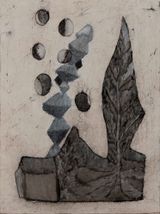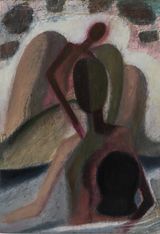
Painter Atul Dodiya, regarded as one of the greatest Indian artists of his generation, is showing in Paris a new series of canvases inspired by Bollywood classics.
In the early 1990s, while studying at the famous Sir J.J. School of Art in Mumbai, Atul Dodiya spent a year at the Paris École des Beaux Arts. The experience proved decisive in the career of an artist who has been building bridges between the history of Indian and Western art ever since. Passionate about literature and film, he uses a unique language, fluctuating between the figurative and the abstract, where he incorporates references to popular culture, poetry and modern art masters, from Matisse to Motherwell, Picabia to Mondrian. Atul Dodiya possesses an astonishing capacity to reinvent himself and his style, equally happy to draw on photorealism or symbolism. He paints on metal roller shutters, creates photographic assemblages and devises largescale installations combining object and painting. Embedded in his works is a reflection on the history of India and emergence of new political aspirations.
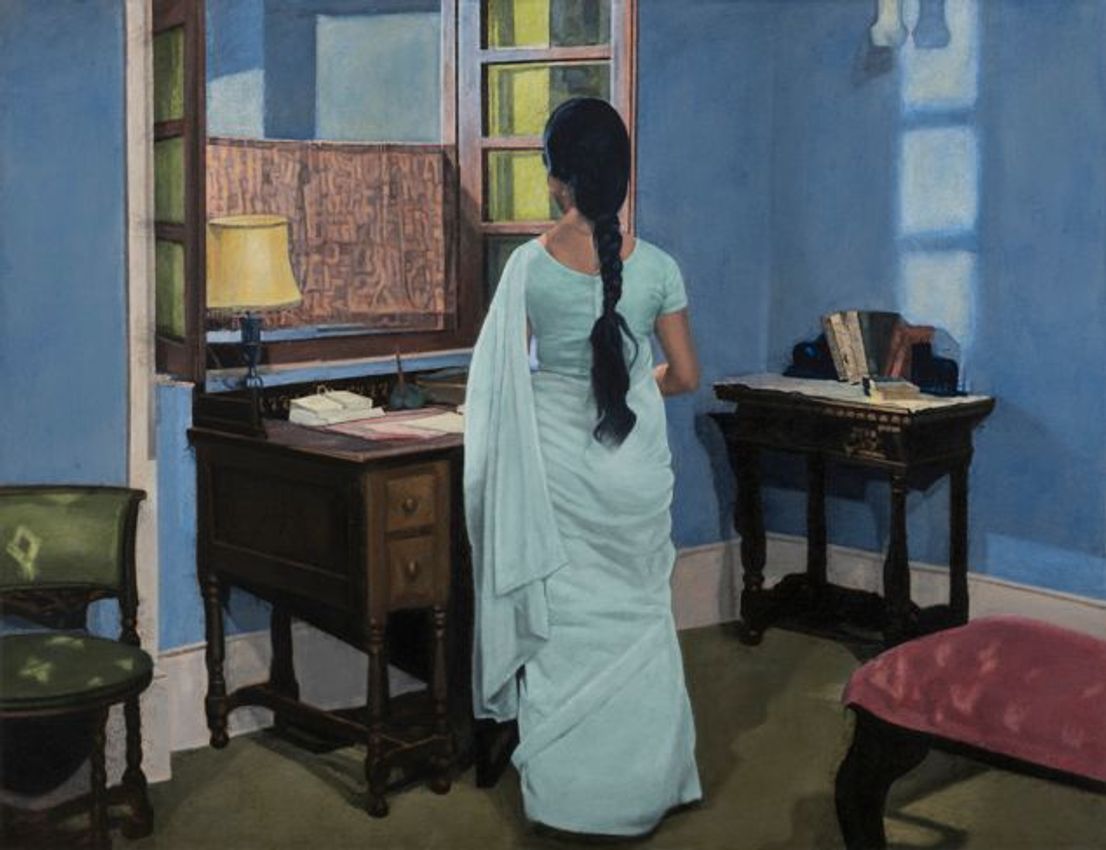
The exhibition’s entry point is the Mumbai movie world of the 1960s that marked the artist’s childhood. The title “I know you. I do. O’ stranger” is inspired by the film Charulata (1964) by Satyajit Ray. The deceptively ordinary chosen scenes are the fruit of complex compositions where the actor’s fame takes a back seat to anonymity. “A recurring theme in my cinematographic stories,” explains the artist, “the characters encounter each other just like strangers.”
Liberated from all narrative context, their mysterious beauty is revealed, leaving the viewer free to interpret their meaning. In the manner of a filmmaker, Atul Dodiya directs our gaze through space, from one canvas to the next.
Certain fragments of a roll of film seemingly pay tribute to the technical feats of cinema. Others highlight the emergence of a new consumer society, with hand-crafted movie sets becoming, in the artist’s hands, some sophisticated furnishings and interiors.
The outward appearance of an economy of means conceals a demanding and meticulous painting technique. Atul Dodiya transforms freeze frame photographs in a preliminary monochrome print. Projected onto the canvas, he goes over the scene in black and white until chiaroscuro transcends movement. He completes the image’s metamorphosis by covering it in translucent oil paint, swapping the vibrant palette favoured by Bollywood films for a pastel, almost ephemeral, colour range. This transformation of the image as it is filmed, photographed, illuminated and colourised becomes a metaphor for the impact of modernity and globalisation on perception and traditions. “In this very personal selection of moments frozen in time,” he continues, “the unreal becomes a new story, another truth.”
Atul Dodiya was born in 1959 in Mumbai where he lives and works. His work features in the collections of a host of international museums, including the Mnam-Centre Pompidou in Paris, Tate Modern in London and Philadelphia Museum of Art. He has taken part in most major exhibitions of Indian art held in the USA, Europe and Asia over the last twenty years: Atul Dodiya, Detroit Institute of Arts Museum, Detroit, USA (2020), After Midnight: Indian Modernism to Contemporary India at Queens Museum in New York (2015), India: Art Now at the ARKEN Museum of Modern Art in Denmark (2012), La Route de la soie at Tri Postal in Lille and Paris Delhi Bombay at the Centre Pompidou (2011), Inside India at Palazzo Saluzzo Paesana Turin and The Empire Strikes Back at the Saatchi Gallery in London (2010), and Indian Summer at the École des Beaux Arts in Paris (2000). He also participated in Documenta 12 in Kassel (curated by Roger Buergel) in 2007, the Gwangju Biennale (curated by Okwui Enwezor) in 2008, Moscow Biennale (curated by Jean-Hubert Martin) in 2009, Kochi-Muziris Biennale in 2012, and 7th Asia Pacific Triennial of Contemporary Art (APT7) in Brisbane in 2012.
In 2013, the National Gallery of Modern Art in New Delhi organised the first retrospective of his work in India (curated by Ranjit Hoskote). In 2014, Bhau Daji Lad in Mumbai paid tribute to his work with a major exhibition: 7000 Museums. In 2019, he was among the artists showcased at India’s Venice Biennale participation, with a largescale installation dedicated to Gandhi.
This is the fourth exhibition of Atul Dodiya’s work at Galerie Templon.
Press release courtesy Templon
Atul Dodiya was born in 1959 in Mumbai where he lives and works. One of the pioneers of contemporary Indian art, he builds bridges between the history of Indian and Western art. His references to popular culture, cinema and literature point to an underlying political analysis of the aspirations of the Indian middle class and the impact of globalisation on their traditions. Atul Dodiya uses a broad spectrum of media, from his early photo-realism to the works on metal shutters that sealed his international reputation.


The gallery was founded in 1966 by Daniel Templon, who was then only 21. It first opened rue Bonaparte, in Saint-Germain-des-Prés in Paris, before moving in 1972 to its current location, rue Beaubourg, in the Marais, close to the Pompidou Centre, which opened in 1977. Daniel Templon first gained recognition by exhibiting conceptual and minimal artists such as Martin Barré, Christian Boltanski, Donald Judd, Joseph Kosuth, Richard Serra. In the seventies and eighties, Daniel Templon was one of the pioneers of the contemporary art and introduced many important American artists to the French public: Dan Flavin, Ellsworth Kelly, Willem de Kooning, Frank Stella, Andy Warhol. The gallery quickly became one of the references in contemporary art in France. In 1972, Daniel Templon and Catherine Millet co-founded the monthly art magazine ART PRESS.

A respected voice in contemporary art discourse.
Focusing on ambitious storytelling and insightful art-world commentary. Ocula Magazine publishes in-depth interviews, critical essays and timely analysis on the artists, exhibitions and ideas driving the global art world.
Learn more about Ocula Magazine
Showcasing the best of the art world.
Ocula partners with galleries from around the world to highlight their artists, artworks and exhibitions. Gallery membership is by application and invitation, with each member vetted by an independent panel.
Learn more about Ocula Membership

Specialises in the sale of major artworks.
Led by a team with deep ties to the world’s leading auction houses, galleries and collectors. Ocula’s advisory team offers bespoke services to high-net-worth clients from around the world who are looking to acquire the best of contemporary and modern art.
Learn more about our team and services