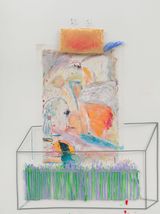
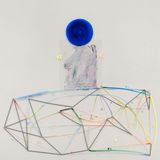
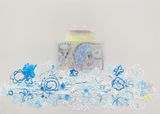
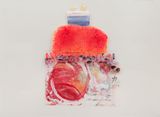
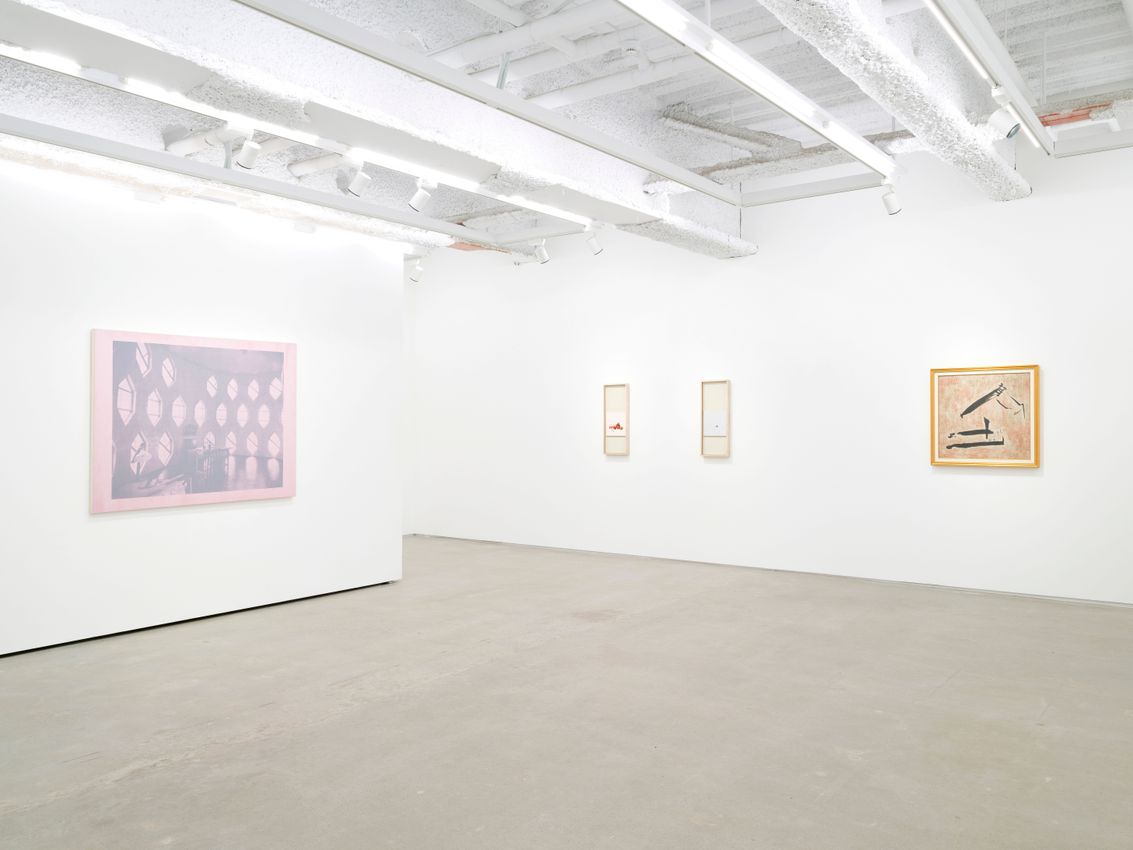
Each Modern is pleased to announce “Self-portrait”, the latest solo exhibition by Chinese artist Xu Jiong, will be on display beginning May 31st. A departure from his usual abstract black and white ink works, Xu Jiong has experimentally transposed his unique ink painting method into colored paints on the acrylic sheets, creating a series of self-portraits without portraits. Through tower-like forms, and old and new works fused together, Xu’s conceptual paintings reexamine the artist’s complex identity through multiple imagined perspectives. Xu uses the personal to lead viewers into contemplations on history and identity.
From Hangzhou, in Zhejiang Province, Xu Jiong’s solo exhibition “I saw Jia Dao” was presented at aura gallery taipei, the precursor to Each Modern, in 2017. The Tang Dynasty poet Jia Dao (779 – 843) served as a creative anchor in that particular series of abstract images and calligraphic words in black ink, serving as a kind of confrontation of the Self. 2019’s “Self-portrait” is more akin to a conceptual expression.
Xu Jiong’s self-portraits differ from those of established Western art history, which emphasize likeness and appearance. His works gaze beyond the face, and seek a deeper exploration of oneself. The portraits begin with an older series of works painted by Xu. These works are used as the bottom layer of the new work, which is covered with a layer of transparent acrylic upon which Xu has painted towers of varying sizes, which represent a mixture of philosophy, economics, culture, religion, power, and politics. Written in his rebellious hand, Xu Jiong paints his name, his identity, on these Chinese symbols of power. Xu avoids the dense and full compositions of traditional abstract expressionist paintings in lieu of sparse lines, text, and narrative on wide and expansive, nearly-blank canvases to depict a deconstructed and fragmented identity. The artist’s imagery suggests concepts beyond the self: calligraphy, flowers, Mother, the phallic, cross-strait relations, etc. Having broken through the conventions of self-portraiture and abstraction, Xu has also challenged the standards of traditional black ink painting, and even more so, self-expression. The acrylic surface shares a connection to Chinese ink painting in its permanence and performativity. Strokes cannot be undone. Under seemingly pleasing colors, Xu’s portraits express an intensity of the subconscious and a shifting identity.
Upon turning 31 years old, Xu produced the first layer of this series- a group of paintings that directly responded to his queer identity. In time, the fullness of the compositions seemed overly intentional, addressing only one facet of his psychology. When reencountered, these works serve as the basis of the new paintings, symbolizing the artist’s recognition of the past self; in the triptych “Poet II / Calligrapher / Killer” (2019), the artist reflects on his Chinese cultural education and his desire to rebel against it. In the “Archaeologist” (2019), Xu depicts the differences in regard for historical artifacts by archaeologists and tomb robbers: metaphysically an exploration in cross straight relations as well as the inevitability of history. After his sexual identity was accepted and supported by his family, Xu Jiong became aware of his mother’s great influence during his formative years. Xu in time became a feminist. “Enma” (2019) emphasizes the strength of his mother, using lines to link points that represent the artist’s and his mother’s age. Wu” (2019) pays homage to Wu ZeTian who ruled over male subjects. After visiting her mausoleum, Xu Jiong decided to smear off the initial text he wrote on Wu Zetian’s work, demonstrating the artist’s thinking process and the variability in his creation.
Xu Jiong’s faceless self-portraits reveal a complex and multi-layered state of mind. As the artist has stated, “the essence of the Self-portrait series is a passage”: a passage to share pieces of oneself, to allow viewers to enter and contemplate identity. Xu Jiong’s complicated identity narratives, though transparent and blank, seem to show us the possibilities and courageousness of selfexpression.
Xu Jiong has a painting practice which is informed by his formal training in Chinese painting and calligraphy. Over the years, Jiong’s style has evolved into experimental, expressive, and non-conformist works.
WE BELIEVE THAT ART GENERATES VALUE AND CONTINUES TO SHAPE THE FUTURE.

A respected voice in contemporary art discourse.
Focusing on ambitious storytelling and insightful art-world commentary. Ocula Magazine publishes in-depth interviews, critical essays and timely analysis on the artists, exhibitions and ideas driving the global art world.
Learn more about Ocula Magazine
Showcasing the best of the art world.
Ocula partners with galleries from around the world to highlight their artists, artworks and exhibitions. Gallery membership is by application and invitation, with each member vetted by an independent panel.
Learn more about Ocula Membership

Specialises in the sale of major artworks.
Led by a team with deep ties to the world’s leading auction houses, galleries and collectors. Ocula’s advisory team offers bespoke services to high-net-worth clients from around the world who are looking to acquire the best of contemporary and modern art.
Learn more about our team and services