






HIROSHI SUGIMOTO
b. 1948, JerseyHiroshi Sugimoto is a Japanese photographer, architect, and conceptual artist best known for rigorously composed black-and-white ongoing analogue photo series that consider time, memory, and the mechanics of vision. He has been the subject of major retrospectives at institutions including the Mori Art Museum in Tokyo, and the Hirshhorn Museum and Sculpture Garden in Washington, D.C., and his work is held in leading collections such as The Metropolitan Museum of Art, the Solomon R. Guggenheim Museum, and Centre Pompidou. His many accolades include the Hasselblad Foundation International Award in Photography, Japan’s Praemium Imperiale, the Mainichi Art Prize, and the Isamu Noguchi Award.
In 2026, Singapore Art Museum announced Hiroshi Sugimoto: Form is Emptiness (29 May–4 October 2026), the artist’s first major exhibition in Southeast Asia and his first large-scale solo show devoted to his practice in the region. Following this, Hiroshi Sugimoto: Extinction will open at The National Museum of Modern Art, Tokyo (MOMAT) from 16 June to 13 September 2026, presenting 13 photographic series from the 1970s to the present.
While widely recognised as one of the most significant artists working with the photographic medium today, Sugimoto’s multidisciplinary practice also extends to architecture, sculpture and art direction for performing arts productions.
Early Life and Career
Born in Tokyo in 1948, Hiroshi Sugimoto grew up in postwar Japan and first encountered photography through hobbyist cameras before studying at Rikkyo University. After travelling through the Soviet Union and Europe, he moved to Los Angeles in the early 1970s to study at the Art Center College of Design, California where he deepened his engagement with Marcel Duchamp and other conceptual and Surrealist artists. In 1974 he relocated to New York, exploring museums, cinema, and the city’s architecture as raw material for his work, while supporting himself as a dealer in Japanese antiquities in SoHo.
Early visits to the American Museum of Natural History led to his breakthrough Dioramas series, marking a pivotal shift from casual photography to a sustained conceptual practice. Sugimoto has described how closing one eye while looking at the animal displays made the scenes appear eerily real, a discovery that revealed to him “a way to see the world as a camera does” and set the course for his subsequent investigations of perception and representation.
Works, Series and Methods
Dioramas
Begun in the mid-1970s, Dioramas focuses on displays in natural history museums, photographed so that painted backdrops and taxidermy cohere into convincing visions of nature. Using a large-format camera and careful framing, Sugimoto removes visual cues that might reveal the scenes as artificial, allowing the image to oscillate between document and illusion while critiquing how museums construct knowledge. Later works such as Olympic Rain Forest (2012) extend this interest in representation to actual landscapes, shifting his attention from fabricated dioramas to living environments.
Theaters
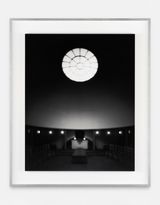
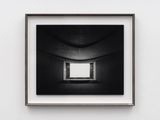
In the celebrated Theaters series (begun 1978), Sugimoto records entire films in a single exposure, leaving the shutter open for the duration of the screening so that the projected images condense into a glowing white screen framed by the auditorium’s architecture. Photographed in ornate movie palaces, drive-ins, and later opera houses and concert halls, these works transform narrative cinema into an abstract block of light and foreground the theater as a social and historical space.
Seascapes
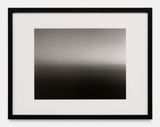
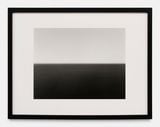
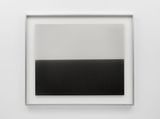
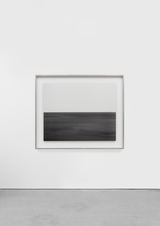
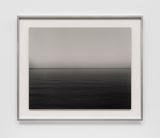
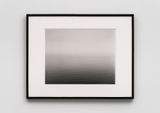
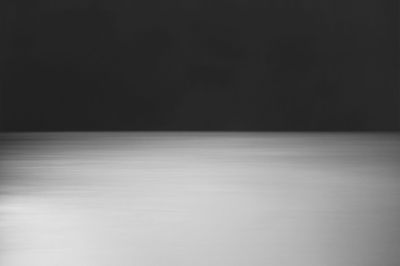
Since 1980, the ongoing Seascapes series has involved photographing oceans around the world with the horizon precisely bisecting the frame, reducing sea and sky to subtly modulated bands of tone. Shot with long exposures in locations ranging from the Arctic Ocean to the Tasman Sea, the images present the sea as a timeless constant, inviting viewers to imagine prehistoric or even primordial time. In 2009, U2 selected Sugimoto’s photograph Boden Sea, Uttwil (1993) from the series for the cover of their album No Line on the Horizon, underscoring the project’s wide cultural resonance.
Portraits and Sea of Buddha
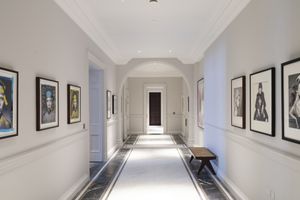
Sugimoto’s Portraits series (begun in 1999 as a Deutsche Guggenheim commission) comprises photographs of wax figures from Madame Tussauds and other collections, including replicas of historical rulers and cultural icons. Shot with lighting that carefully recreates that of Old Master paintings and printed at large scale, these portraits echo classical oil portraiture while revealing the uncanny status of wax effigies as both likeness and simulacrum.
Sea of Buddha (photographed in 1995 and first exhibited later in the 1990s) documents the 1,001 Buddhist statues at Sanjūsangendō (Hall of Thirty-Three Bays) in Kyoto under specially arranged conditions, with modern additions removed and natural morning light emphasized. Shot from elevated viewpoints and focused on the gilded bodhisattvas, the series transforms this historic devotional environment into a serial field of nearly identical figures, emphasizing repetition, stillness, and spiritual presence
Conceptual Forms and Scientific Instruments
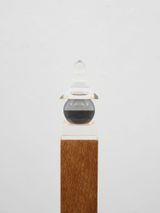
From the early 2000s Sugimoto has developed Conceptual Forms and related works based on mathematical models and scientific instruments. Photographing plaster and metal models in stark light, he renders complex equations and physical laws as sculptural forms, linking his interest in abstraction to histories of science and design. These works expand his investigation of how human intellect shapes the visible world.
Lightning Fields and camera-less photography
In Lightning Fields (2009), Sugimoto abandoned the camera, using a 400,000-volt Van de Graaff generator to apply electrical charges directly to large sheets of film. The resulting images of branching sparks and dense textures evoke both scientific experiment and natural phenomena, extending his exploration of light and time into the realm of camera-less photography.
Architecture, Pines and Landscape
Sugimoto’s Architecture series (1997) presents blurred images of iconic modernist buildings, produced by setting the lens-to-film distance to what he calls “twice-infinity” so that forms dissolve into spectral silhouettes. Earlier architectural commissions, such as large-format photographs of notable buildings for the Museum of Contemporary Art Chicago in the late 1990s, and the Joe series (2003) depicting Richard Serra‘s sculpture Joe at the Pulitzer Arts Foundation, extend his interest in how structures are experienced over time.
In landscape-based projects, including a series on famous Japanese pine sites (meisho) such as Miho no Matsubara, Matsushima, and Amanohashidate (photographed 2001), Sugimoto adapts the atmospheric style of Hasegawa Tōhaku’s Pine Trees (Shōrin-zu byōbu) screens (circa 1590) to photography, aligning his work with historical Japanese painting traditions.
Architecture Practice and Spatial Design
Beyond photography, Sugimoto founded an architecture practice in Tokyo, New Material Research Laboratory (est. 2008), to design museums, shrines, restaurants, and exhibition environments. Projects include the Shinto Go’o Shrine (Appropriate Proportion) for Naoshima Contemporary Art Center (opened 2002), the Glass Tea House Mondrian for Le Stanze del Vetro at the Venice Architecture Biennale (2014), and a sculpture and rock garden for restaurants in Tokyo and Yamanashi Prefecture. He has also undertaken major commissions such as Point of Infinity (2023), a nearly 70-foot stainless-steel needle that functions as a sundial on Yerba Buena Island in San Francisco Bay.
Themes and Context
Sugimoto uses photography to test the relationship between reality and representation, asking how images shape our understanding of history, nature, and collective memory. His work aligns with conceptual art in its emphasis on clear ideas and repeatable processes, yet it is also deeply informed by minimalism and Japanese aesthetics, particularly in the restrained compositions of Seascapes and the meditative repetition of Sea of Buddha.
Time is Sugimoto’s central material: long exposures and serial formats allow him to compress hours of cinema into a single frame, evoke geological or cosmic duration in ocean views, or register instantaneous electrical discharges in Lightning Fields. His interest in architecture and exhibition design situates his practice within broader conversations about how spaces frame perception, from the cinematic auditorium in Theaters to the carefully choreographed layouts of his own exhibitions and the dedicated Hiroshi Sugimoto Gallery at Benesse Art Site Naoshima (opened 2022). Throughout, his images maintain a cool, precise surface that encourages slow, contemplative looking rather than spectacle.
Major Institutional Exhibitions
Hiroshi Sugimoto’s institutional exhibitions include:
- Hiroshi Sugimoto: End of Time (2005–07), touring retrospective including Modern Art Museum of Fort Worth; Hirshhorn Museum and Sculpture Garden, Washington, D.C.; Mori Art Museum, Tokyo; and other venues.
- Hiroshi Sugimoto: Time Machine (2023–24), survey exhibition at Hayward Gallery, London; UCCA Center for Contemporary Art, Beijing; Museum of Contemporary Art Australia, Sydney.
- Hiroshi Sugimoto: Form is Emptiness (2026), Singapore Art Museum, 29 May–4 October 2026.
- Hiroshi Sugimoto: Extinction (2026), The National Museum of Modern Art, Tokyo, 16 June–13 September 2026.
Awards and Accolades
Hiroshi Sugimoto’s awards include:
- Mainichi Art Prize, Japan (1988).
- Hasselblad Foundation International Award in Photography, Gothenburg, Sweden (2001).
- PhotoEspaña Prize, Madrid (2006)
- Praemium Imperiale (Painting), Japanese Art Association (2009).
- Medal with Purple Ribbon, Government of Japan (2010).
- Officier of the Ordre des Arts et des Lettres, France (2013).
- Isamu Noguchi Award (2014).
Public Collections
Hiroshi Sugimoto’s work is represented in numerous institutional collections, including the following:
- The Museum of Modern Art, New York.
- The Metropolitan Museum of Art, New York.
- Solomon R. Guggenheim Museum, New York.
- San Francisco Museum of Modern Art (SFMOMA).
- The Art Institute of Chicago.
- Hirshhorn Museum and Sculpture Garden, Washington, D.C.
- Tate, London.
- Centre Pompidou, Paris.
- Museum of Contemporary Art Australia, Sydney.
- National Museum of Modern Art, Tokyo (MOMAT).
- Mori Art Museum, Tokyo.
- Benesse Art Site Naoshima, including the Hiroshi Sugimoto Gallery: Time Corridors.
Hiroshi Sugimoto FAQs
What is Hiroshi Sugimoto best known for?
Hiroshi Sugimoto is best known for his conceptual photographic series Dioramas, Theaters, and Seascapes, which use long exposures and precise composition to explore time and perception. These projects have become touchstones in contemporary photography for the way they transform museums, cinemas, and oceans into philosophical studies of reality and representation.
What themes does Hiroshi Sugimoto explore in his work?
Hiroshi Sugimoto’s work consistently explores themes of time, memory, and the constructed nature of vision, using photography to question how we see and believe images. He also engages with history, spirituality, and science, from natural history displays and historical portraits to Buddhist iconography and mathematical forms.
How does Hiroshi Sugimoto create his theater photographs?
For the Theaters series, Sugimoto places a large-format camera in cinema auditoriums and exposes a single sheet of film for the entire duration of a movie, so that every frame of the film accumulates into a blank, luminous screen. The surrounding architecture remains crisp and detailed, turning the photograph into a record of both elapsed time and the spatial context of viewing.
Where can I see Hiroshi Sugimoto’s work?
Hiroshi Sugimoto’s photographs are held in major museum collections including SFMOMA, the Metropolitan Museum of Art, the Solomon R. Guggenheim Museum, and institutions in Europe, North America, and Asia. His work has been regularly exhibited by galleries such as Lisson, Dellasposa Gallery, and Hunter Dunbar Projects, with recent shows in London, Los Angeles, New York, Beijing, Sydney, Taipei, and Tokyo. His work is often included in group shows in institutions and he has also been the subject of numerous surveys around the world, for example, in 2026, Singapore Art Museum announced a major survey show dedicated to the artist, as did The National Museum of Modern Art in Tokyo.
What is Hiroshi Sugimoto’s Seascapes series about?
Hiroshi Sugimoto’s Seascapes series presents oceans around the world with the horizon precisely centered, reducing each view to bands of water and sky that appear almost abstract yet remain recognisably specific. By photographing these sites with long exposures and without human presence, Sugimoto treats the sea as a timeless subject, suggesting a view shared across millennia.
Ocula | 2026



















Hiroshi Sugimoto in Ocula Magazine






Explore and Follow Artists Shaping Contemporary Art
A respected voice in contemporary art discourse.
Focusing on ambitious storytelling and insightful art-world commentary. Ocula Magazine publishes in-depth interviews, critical essays and timely analysis on the artists, exhibitions and ideas driving the global art world.
Learn more about Ocula Magazine
Showcasing the best of the art world.
Ocula partners with galleries from around the world to highlight their artists, artworks and exhibitions. Gallery membership is by application and invitation, with each member vetted by an independent panel.
Learn more about Ocula Membership
Specialises in the sale of major artworks.
Led by a team with deep ties to the world’s leading auction houses, galleries and collectors. Ocula’s advisory team offers bespoke services to high-net-worth clients from around the world who are looking to acquire the best of contemporary and modern art.
Learn more about our team and services