






JOHN CHAMBERLAIN
1927-2011, United StatesKnown for transforming crushed automobile parts into dynamic sculptures, John Chamberlain redefined the boundaries of contemporary art through a lifelong investigation into form, colour, and the unexpected poetics of industrial materials.
Early Years
John Chamberlain was born in 1927 in Rochester, Indiana, and grew up in Chicago. After serving in the U.S. Navy during World War II, he studied briefly at the School of the Art Institute of Chicago before enrolling at Black Mountain College in North Carolina—an avant-garde institution that fostered experimentation across disciplines.
While initially trained as a painter, Chamberlain’s practice quickly evolved toward sculpture. In the late 1950s, he began incorporating salvaged car parts into his works, inspired by Abstract Expressionism but drawn to the tactile and spatial possibilities of found materials. He later settled in Shelter Island, New York, where he lived and worked until his death in 2011.
Artworks
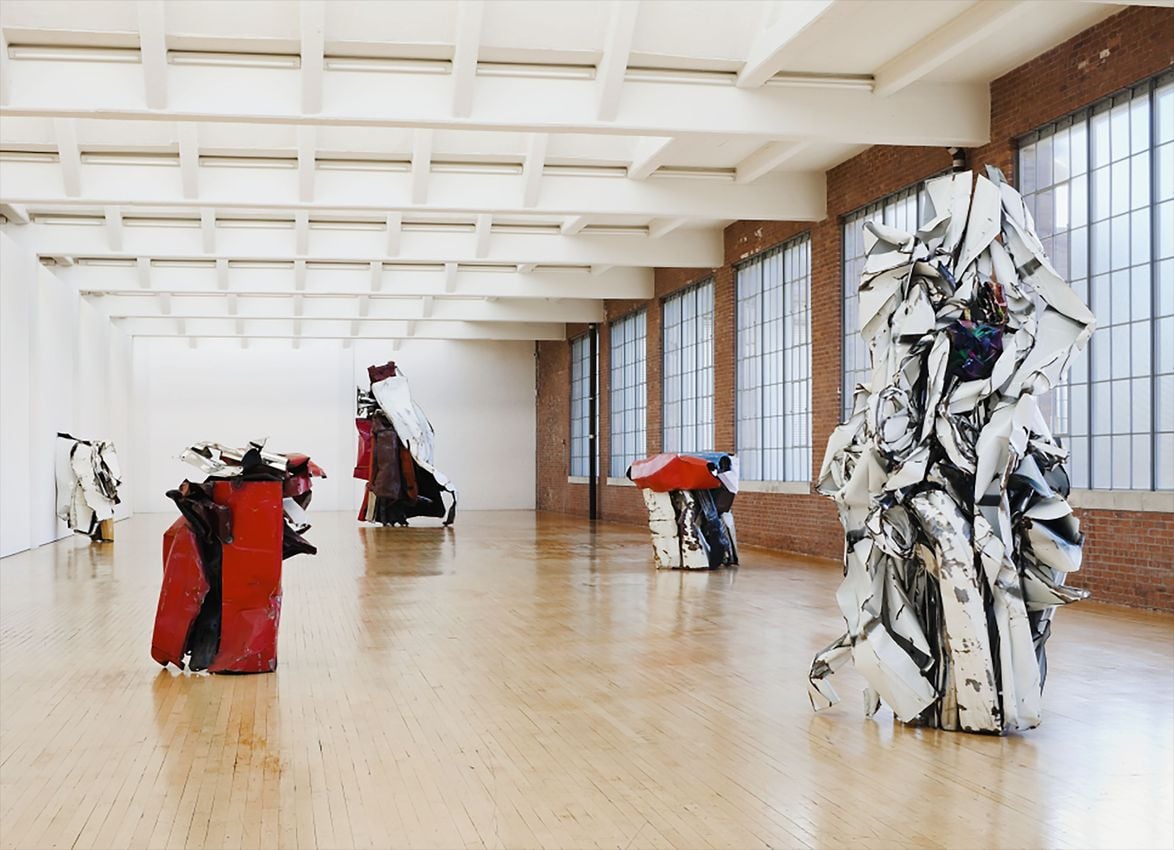
John Chamberlain’s artworks are defined by their collision of industrial force and expressive freedom, using salvaged materials to create abstract sculptures that blur the line between sculpture and painting, gesture and structure.
The Birth of a Language: Early Steel Sculptures
Chamberlain began experimenting with welded metal in the late 1950s, creating compact, abstract sculptures from scrap steel and automobile bumpers. Shortstop (1957) and Couch (1960) are among his earliest works to use discarded car parts—items he viewed not as detritus, but as pre-painted, pre-shaped sculptural elements. Influenced by Abstract Expressionism, these early sculptures transferred the painterly brushstroke into a three-dimensional format, redefining how gesture could be expressed in contemporary art.
These works also marked a radical break with traditional sculpture. Instead of carving or modelling, Chamberlain assembled and crushed materials, embracing improvisation and intuition over formal pre-planning. The spontaneity of his process brought a new physical immediacy to abstract sculpture.
Colour and Composition: 1960s–1970s
By the early 1960s, Chamberlain’s artworks became larger, more chromatically complex, and increasingly confident in their use of colour as a structural element. He retained the original paint on the auto parts, which gave each sculpture a pre-existing palette. Works like Dolled Up Sue (1962) and Miss Lucy Pink (1962) demonstrate Chamberlain’s ability to orchestrate colour, mass, and space in ways that recall the compositional strategies of de Kooning and Hofmann, while firmly occupying the realm of contemporary sculpture.
These sculptures were never simply assemblages—they were engineered collages in space. Despite their aggressive textures and contorted forms, they often exude a surprising grace, rhythm, and balance.
Expanded Materials: Foam, Plexiglass, and Photography
During the 1960s and ‘70s, Chamberlain temporarily moved away from metal and began working with materials like polyurethane foam, resin, and Plexiglass. These sculptural experiments—seen in the Penthouse and Foam sculptures series—offered new modes of tactility and transparency. Pieces like Penthouse #5 (1969) feature foam forms bound or compressed, hinting at the body, domesticity, and containment.
This period also saw Chamberlain delve into photography. Using a Widelux camera, he produced panoramic photos that mimic the visual chaos of his sculptures—cropped perspectives, flowing movement, and dislocated forms. Though often overlooked, this body of work underscored Chamberlain’s interest in manipulating space and perception across mediums.
Return to Steel and Monumentality: 1980s–2000s
Chamberlain returned to metal in the 1980s, producing ever-larger sculptures with complex titles and intensified colour play. The physical scale of works like Dolores James (1986) and The Privet (1989) spoke to the rise of monumental public art, but retained the expressive immediacy of his early practice.
Later works such as Papagayo (2007) and BAD RICARDO (2009) incorporate not only auto parts but also appliances, chrome, and industrial refuse. These pieces reveal a continued interest in rhythm, compression, and movement—even as the materials became heavier and the forms more complex.
Throughout his career, Chamberlain was unwavering in his belief that sculpture should be intuitive and immediate. His artworks are neither purely abstract nor fully representational. They resist categorisation, offering instead a visceral experience of form, energy, and space.
Public Commissions
- CHOXCARR, commissioned for the Getty Center, Los Angeles (2007)
- FISHSTORY FLAM, 1989, installed at the Seagram Building, New York (1989)
- SPHINXGRIN TWO, permanent installation at the Dallas Museum of Art (1986)
Awards and Accolades
- Lifetime Achievement Award, Guildhall Academy, East Hampton (2007)
- Lifetime Achievement Award in Contemporary Sculpture, International Sculpture Center, Washington DC (1993)
- Skowhegan Medal for Sculpture, Skowhegan (1993)
- Member of the American Academy and Institute of Arts and Letters, New York (1990)
Exhibitions
John Chamberlain has been the subject of both solo and group exhibitions at important institutions. A selection of important exhibitions are provided below.
Solo Exhibitions
- John Chamberlain: It Ain’t Cheap, Dan Flavin Art Institute, Dia Art Foundation, Bridgehampton, New York (2013)
- John Chamberlain: Choices, Guggenheim Museum, New York (2012)
- John Chamberlain: CURVATUREROMANCE, Pinakothek der Moderne, Munich (2011)
- John Chamberlain: Current Work and Fond Memories, Sculptures and Photographs 1967–1995, Stedelijk Museum, Amsterdam. Travelled to: Kunstmuseum Wolfsburg, Wolfsburg (1996)
- Wide Point: The Photography of John Chamberlain. Travelled to: The Parrish Art Museum, Southampton, NY; Tampa Museum of Art, Tampa; Indianapolis Museum of Art, Indianapolis (1994)
- John Chamberlain: Sculpture, 1954–1985, Museum of Contemporary Art, Los Angeles (1986)
- John Chamberlain: A Retrospective Exhibition, Solomon R. Guggenheim Museum, New York (1971)
Group Exhibitions
- Postwar: Art between the Pacific and the Atlantic 1945–1965, Haus der Kunst, Munich (2016)
- Black Mountain College: Experimenting with Power, Museo Nacional Centro de Arte Reina Sofía, Madrid (2002)
- The American Century: Art & Culture 1900–2000, Whitney Museum of American Art, New York (1999)
- 1987 Biennial Exhibition, Whitney Museum of American Art, New York (1987)
- New York Painting and Sculpture: 1940–1969, The Metropolitan Museum of Art, New York (1969)
- Sculpture from Twenty Nations, Solomon R. Guggenheim Museum, New York (1967)
Critical Reception
John Chamberlain’s work has been reviewed and celebrated in leading art publications including Artforum, Artnet, and The Guardian.
Website
John Chamberlain’s estate website can be found here.
John Chamberlain FAQs
What materials did John Chamberlain use in his artworks?
John Chamberlain is best known for using salvaged automobile parts—such as fenders, hoods, and bumpers—to create his abstract sculptures. He treated these discarded materials as if they were brushstrokes, welding and crushing them into expressive compositions. In addition to car metal, Chamberlain explored materials like polyurethane foam, Plexiglass, resin, and photography. His innovative use of found, industrial materials challenged conventional sculpture and elevated the aesthetics of wreckage, making him a pivotal figure in contemporary art and assemblage-based practices.
Why is John Chamberlain important in contemporary art?
John Chamberlain is a foundational figure in post-war American sculpture, renowned for bridging Abstract Expressionism and three-dimensional assemblage. He revolutionised the use of industrial materials in art, using crushed car parts to create dynamic, emotionally resonant forms that redefined sculptural language. His work anticipated conversations around material reuse and aesthetic transformation, influencing artists across movements from Minimalism to installation art. Chamberlain’s bold manipulation of space, mass, and colour helped reshape the boundaries of what contemporary sculpture could be.
What is John Chamberlain’s preeminent series?
John Chamberlain’s most acclaimed body of work is his series of sculptures made from crushed and twisted automobile parts, produced predominantly between the late 1950s and the 1980s. These works, often untitled or bearing whimsical names like Dolled Up Sue or Miss Lucy Pink, exemplify his signature style: gestural, vibrant, and architecturally complex. This series not only defined his career but also set a precedent for using industrial detritus in fine art, establishing him as a key innovator in 20th-century contemporary sculpture.
Ocula | 2025














Explore and Follow Artists Shaping Contemporary Art
A respected voice in contemporary art discourse.
Focusing on ambitious storytelling and insightful art-world commentary. Ocula Magazine publishes in-depth interviews, critical essays and timely analysis on the artists, exhibitions and ideas driving the global art world.
Learn more about Ocula Magazine
Showcasing the best of the art world.
Ocula partners with galleries from around the world to highlight their artists, artworks and exhibitions. Gallery membership is by application and invitation, with each member vetted by an independent panel.
Learn more about Ocula Membership
Specialises in the sale of major artworks.
Led by a team with deep ties to the world’s leading auction houses, galleries and collectors. Ocula’s advisory team offers bespoke services to high-net-worth clients from around the world who are looking to acquire the best of contemporary and modern art.
Learn more about our team and services