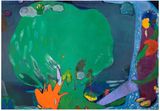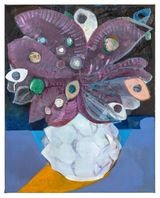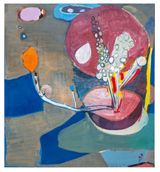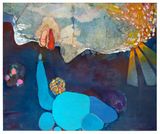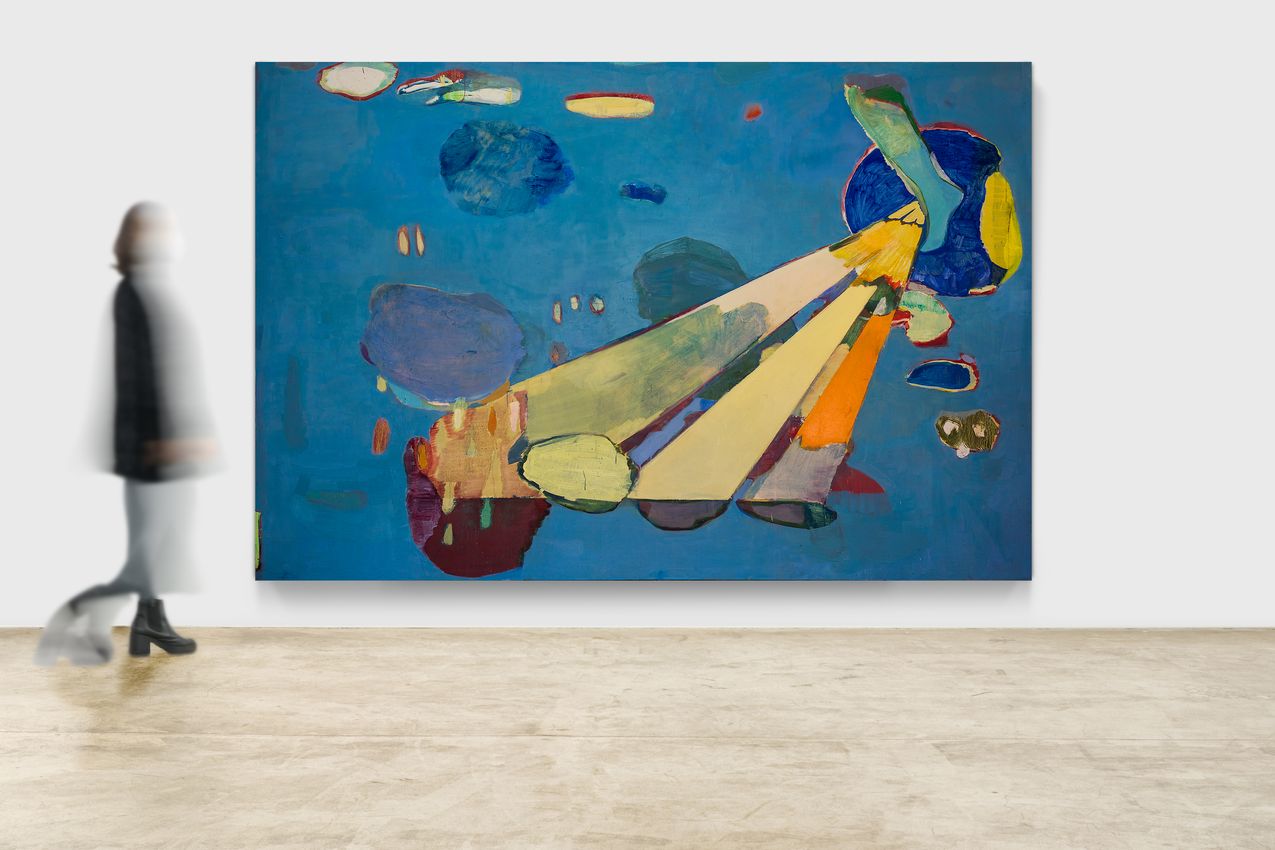
Nara Roesler New York is proud to announce a solo exhibition by Brazilian artist Cristina Canale (b. 1961, in Rio de Janeiro, Brazil), curated by Luis Pérez-Oramas. The exhibition opens on September 8, 2021, marking the artist’s first solo presentation in the US, and will showcase a selection of Canale’s most recent production.
The artist first rose to prominence in the 1980s as part of the iconic group from Rio de Janeiro known as Geração 80, which brought together young artists seeking to break away from inherited artistic practices. Since then, Canale has produced a robust oeuvre characterized by a ceaseless interrogation of painting’s potentialities, through elaborate compositions that blur the boundaries between the figurative and abstract. The exhibition delves into Canale’s most recent production, presenting a selection of works that reflect upon the intertwinement of portraiture and landscape, suggesting a new symbolist frontier in her production.
In the words of curator Luis Perez-Oramas, ‘The deliberate absence of vultus—that is, of facial expressivity—in Cristina Canale’s portraits is compensated by the painting’s complex chromatic apparatus, as if the architecture of form and colour that gives them presence on the painting’s surface could supplement their lack of expression. Prodigiously expressive in spite of their faceless faces these portraits remain an enigma that inquires us through the frontality of painting. It is painting that looks at us. Among Canale’s most recent works, there are some portraits of particular significance in that they feature a surprising—and novel—lateral dynamism. Faces depicted in profile emerge and mark the laterality of the pictorial field through their action, through their effect: it could be a cloud of breath, the smoke of a cigarette, a gaze that does not meet ours, but that nonetheless summons it. The fact that the portrait’s visages do not apprehend us frontally [...] define another dimension for the encounter, particularly activating the edges, their lateral resonance, their potential capability to determine space beyond its material limits.’
Cristina Canale’s works posit a dialogue with the tradition of painting by creating pieces that juxtapose and faint contradictions, and perhaps most importantly, propose a new form of unity. As with other artists represented by Nara Roesler, Canale has accomplished utmost success and institutional recognition in Brazil. The exhibition will offer the US audience an unprecedented opportunity to delve into the practice and universe of an important Brazilian painter whose work has continuously proposed new forms of challenging the pillars of her medium and is yet to be fully revealed in America.
Cristina Canale rose to prominence following her participation in the iconic group exhibition Como vai você, Geração 80?, at Escola de Artes Visuais do Parque Lage in Rio de Janeiro in 1984. Loaded with visual elements and thick layers of paint, her early paintings have material and textural characteristics that are reinforced by her use of contrasting and vivid colors. After moving to Europe in the early 90s, her compositions soon acquired a sense of spatiality, as she began to incorporate the use of planes and depth, while also adding greater fluidity to her use of colors. Cristina Canale’s work is often based on prosaic everyday scenes, sometimes extracted from advertising photography. Her paintings result in elaborate compositions that blur the boundaries between figurative and abstract.
Cristina Canale (b. 1961, Rio de Janeiro, Brazil) rose to prominence following her participation in the iconic group exhibition Como vai você, Geração 80?, at Escola de Artes Visuais do Parque Lage (EAV Parque Lage) in Rio de Janeiro in 1984. Like many of her colleagues from the so-called “Generation 80”, her early works reveal the influence of the international context as painting resurfaced, especially with that of German Neo-expressionism. Loaded with visual elements and thick paint, her early paintings have a material or textural characteristic that is reinforced by her use of contrasting and vivid colors. In the early 1990s, Canale moved to Germany to study in Düsseldorf under the guidance of the Dutch conceptual artist Jan Dibbets. Her compositions soon acquired a sense of spatiality, as she began to incorporate the use of planes and depth, while also adding greater fluidity to her use of colors.

Founded in São Paulo in 1989, Galeria Nara Roesler is a leading Brazilian gallery dedicated to showing the work of contemporary Brazilian and international artists. The gallery established another branch in Rio de Janeiro in 2014, followed by its first international outpost in New York City in 2015.

A respected voice in contemporary art discourse.
Focusing on ambitious storytelling and insightful art-world commentary. Ocula Magazine publishes in-depth interviews, critical essays and timely analysis on the artists, exhibitions and ideas driving the global art world.
Learn more about Ocula Magazine
Showcasing the best of the art world.
Ocula partners with galleries from around the world to highlight their artists, artworks and exhibitions. Gallery membership is by application and invitation, with each member vetted by an independent panel.
Learn more about Ocula Membership

Specialises in the sale of major artworks.
Led by a team with deep ties to the world’s leading auction houses, galleries and collectors. Ocula’s advisory team offers bespoke services to high-net-worth clients from around the world who are looking to acquire the best of contemporary and modern art.
Learn more about our team and services