Press Release

‘We have seen that, on the contrary, a mask does not exist in isolation; it supposes other real or potential masks always by its side, masks that might have been chosen in its stead and substituted for it. In discussing a particular problem, I hope to have shown that a mask is not primarily what it represents but what it transforms, that is to say, what it chooses not to represent. Like a myth, a mask denies as much as it affirms. It is not made solely of what it says or thinks it is saying, but of what it excludes.’—Claude Lévi-Strauss

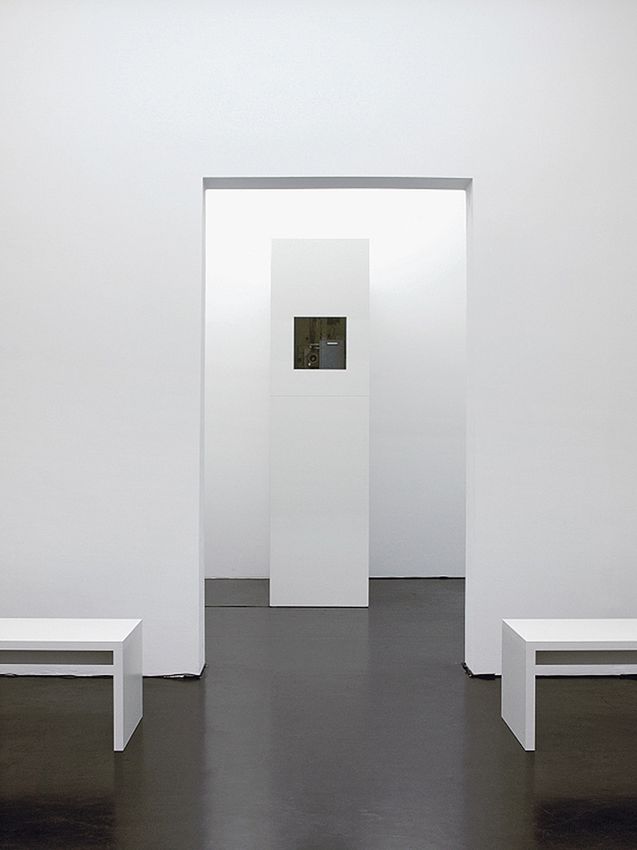
In his second solo exhibition at Galerie Daniel Buchholz, Los Angeles-based artist Mathias Poledna is showing his most recent film Crystal Palace (2006), as a first installation of this work in Europe.

In a series of three long, static shots Crystal Palace shows views of a mountain rainforest in the remote Southern Highlands Province of Papua New Guinea. The carefully selected, closely framed shots made using 35mm film are filled completely by the seemingly impenetrable, monochromatic patterns of the rainforest flora, and–with the exception of the obvious existence of a camera–do not evoke any kind of human presence. Slight changes in the light and occasional movements of the leaves are the only visual reference points indicating the passing of time. The soundtrack of the nearly half-hour film consists of a montage of recordings made on site and archival field recordings, scillating between distinctive isolated insect sounds and bird calls and an intense droning noise. These sounds seem to both synchronously accompany the film’s scenes and to unfold independently of them.

The title of the work recalls the monumental steel and glass pavilion of the same name that Joseph Paxton designed for the Great Exhibition in London’s Hyde Park in 1851, a structure that is regarded as an important precursor of modern architecture and serial, industrialized building techniques. The Crystal Palace Exhibition aimed to present the full range of products issuing from the industrialised nations, exhibiting them in ‘genuinely Capitalist form of presentation’ (Thomas Richards), embedded between exotic displays, flora and fauna. Another specific reference point for this project was ‘Sounds of a Tropical Rainforest’, an album produced in 1951 by the US label Folkways Records using in part staged field recordings from nature. The album was intended for use as acoustic backdrop for an exhibition on indigenous tribes living in the Amazon region at the American Museum of Natural History in New York.

Mathias Poledna’s work generates a complex tension between a specific place, its manifestation on film, and the many notions and historical concepts revolving around the tropical rainforest. While ‘Crystal Palace’ purports to be a fragmentary document of a place that actually exists and its particular history, the film shows us images of a tropical rainforest that, as far as we can tell, do not diverge at all from the general vision of what images of a tropical rainforest should or might look like. The near motionlessness of the images and the great depth of focus with which they were filmed, paradoxically only serving to make them appear flatter, furthermore lends the film a non-representational dimension that, in connection with the intense soundtrack, is akin to the physiological experience of abstract or structural films.

On view in the second room of the gallery is a table designed by Adolf Loos in collaboration with Max Schmidt of the Viennese company Friedrich Otto Schmidt. Known as the ‘Elephant Trunk Table’ due to its sculptural legs, this piece traces its origins to Anglo-Saxon and Chinese models and was used by Loos to furnish many of the homes he designed, usually as a cocktail table. In keeping with Loos’ view that it is not the architect’s job to design furniture, this object is instead an appropriation of an historical model that has been ‘modernised’, i.e. freed of its decorative elements. A number of different versions of the table were created. The eight-legged mahogany table on display was executed in 1910 and features a round tabletop with a square blue tile inlay and a border of polished brass, also echoed in the feet.

‘Crystal Palace’ was produced in cooperation with the Hammer Museum, Los Angeles, the Museum of Contemporary Art in Chicago and the New Museum of Contemporary Art, New York. The work debuted in Los Angeles in early 2007. It will be on view in Chicago in February 2008 and then in New York the following autumn. A catalogue was published to accompany the exhibition at the Hammer Museum in Los Angeles, with essays by the exhibition’s curator, Russel Ferguson, and Christian Kravagna. The Elephant Trunk Table is on loan from Galerie Erik Bausmann, Mainz.

Read More

Also Exhibiting at Galerie Buchholz

About the Gallery

Galerie Buchholz is an art gallery specializing in international contemporary art, with exhibition spaces in Cologne, Berlin and New York City. The gallery was founded in Cologne in 1986 by Daniel Buchholz, and today is run jointly with Christopher Müller.

View Gallery Profile
Address
Neven-DuMont-Str. 17
Cologne
Germany
Opening Hours
Tues - Fri, 11am - 6pm
Sat, 11am - 4pm
(1)
Cologne Neven-DuMont-Str. 17
Galerie Buchholz
Neven-DuMont-Str. 17, Cologne, Germany

Opening hours
Tues - Fri, 11am - 6pm
Sat, 11am - 4pm
The art world in focus