Press Release

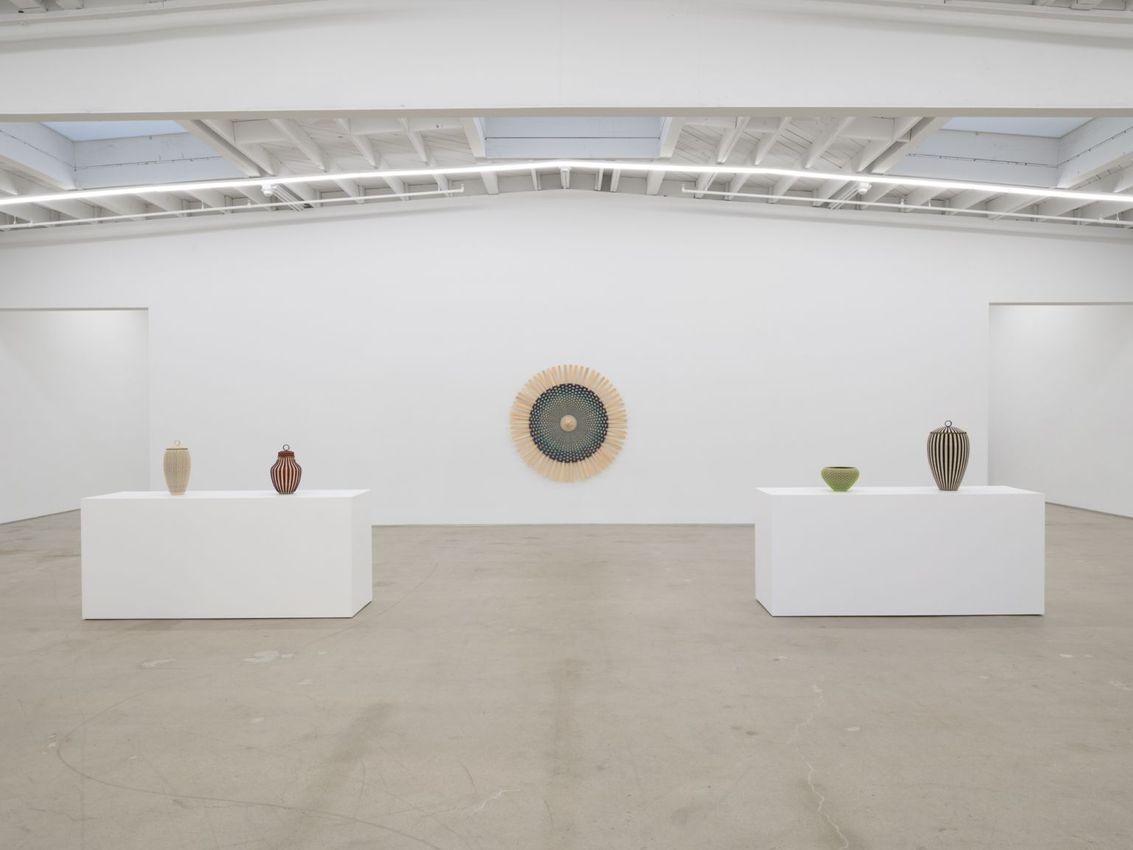
Karma presents Unbound, Jeremy Frey’s first solo exhibition in Los Angeles, open from November 9 to December 21, 2024, at 7351 Santa Monica Boulevard, Los Angeles.

Jeremy Frey is the foremost contemporary practitioner of Wabanaki basketry, a tradition that dates back more than 13,000 years and is the oldest continuously practiced art form in the area now known as Maine. Over more than two decades, Frey has honed techniques inherited from his ancestors while also inventing his own methods of weaving and dying the strips of wood that comprise his vibrant, patterned artworks. _Unbound _presents baskets alongside never-before-exhibited flat weaves and relief prints. These innovative ways of giving weaving new form—such as weaving flat, using his sculptures to make indexical prints, or turning to the moving image, as he did in his mid-career survey now on view at the Art Institute of Chicago—emerge from Frey’s desire to sustainably preserve both a natural material and an ancient cultural tradition.

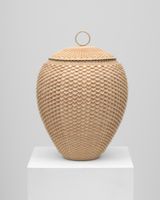
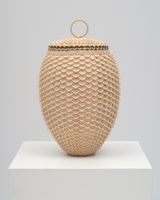
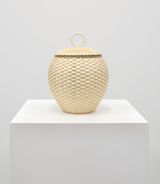
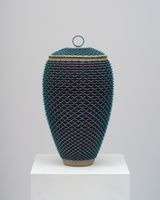
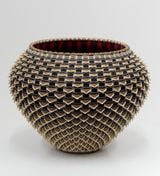
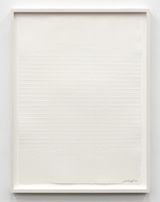
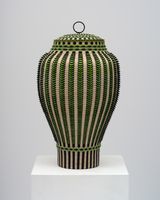
Frey’s baskets begin their lives as black ash trees, which he harvests by hand in the woods around his studio in Bangor, Maine, part of the Wabanaki territory known as the Land of the Dawn. The first step in transforming felled trees into finely-woven vessels is pounding the black ash—a tree species renowned for its flexibility—such that the growth rings separate into thin, springy sheaths. Frey then uses a knife to pare delicate lengths of material. _Fine Weave _(all works 2024) is made exclusively from these undyed black ash strips, as is typical in Wabanaki basketry; the subtle variations in hue in the untreated wood come through in this exceptionally intricate composition. Frey is responsible for revitalising fine weave basketry for the first time in around a century, as the amount of time required to interlock the threadlike strands made this style of weaving impractical for Wabanaki craftspeople who supported themselves by selling their wares at markets. While _Fine Weave _is monochromatic, Twilight, made in the traditional “urchin” style, displays the bold colours that are Frey’s signature. This low, wide, purple-and-turquoise vessel is modelled on the form of the sea urchin, which the Wabanaki people gather from local shores. Polarity, on the other hand, is far from orthodox: its double-walled design is Frey’s own invention. His baskets-within-baskets play with the contrast between exterior, here adorned with lime-green spikes, and interior, in this case woven from strips dyed red and black.

Care for the environment is implicit in the Indigenous practice of basketry, which depends on the flourishing of local black ash forests for its raw materials. Tragically, climate change and an infestation of invasive emerald ash borer beetles have radically depleted these forests and threaten the resource’s continued existence. The loss of the tree maps directly onto a loss of ancestral knowledge: in the Passamaquoddy creation story, the Wabanaki people are born directly from the ash tree. In response to this ecological and cultural crisis, Frey has developed a means of working with black ash that uses far less of the precious material. He initially conceived of the two-dimensional flat weaves as a means of creating relief prints. By running his woven creations through a printing press, he is able to preserve and share his techniques without using any endangered materials, indexically replicating his labor. The relief prints included in _Unbound _represent a new avenue for Frey, one in which an iterative process can carry with it a charged trace of the original act.

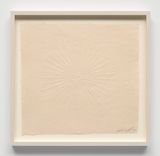
The flat weave Unbound, after which the exhibition is titled, is a stunning example of this novel format for basketry. With his two-dimensional flat weaves, which unlike his three-dimensional baskets are not woven around moulds, Frey is unbound by millenia of tradition. An ombre array of blue spikes spiral out from a raised centre, creating an optical illusion of rotating, intersecting circles. Undyed strips structure the circular composition, poking beyond the blue centre like the rays of the sun. Working within and through, “up and down, over and out,” the artist painstakingly weaves containers of loss, resilience, and grace.

Read More
About the Artist

Jeremy Frey’s intricate, striking baskets show that it’s possible to preserve traditional techniques without simply reproducing the works of previous generations. The Maine-based artist adapts Wabaniki methods, adding colour and embellishment to his baskets to produce unique forms. His works are held in several museums and institutions across the United States and in 2025 he was named a MacArthur Fellow.

View Artist Profile

Also Exhibiting

Address
7351 Santa Monica Blvd
Los Angeles
United States
Opening Hours
Tuesday – Saturday
10am – 6pm
(1)
Los Angeles 7351 Santa Monica Blvd
Karma
7351 Santa Monica Blvd, Los Angeles, United States
(310) 736-1367
https://karmakarma.org/

Opening hours
Tuesday – Saturday
10am – 6pm
The art world in focus