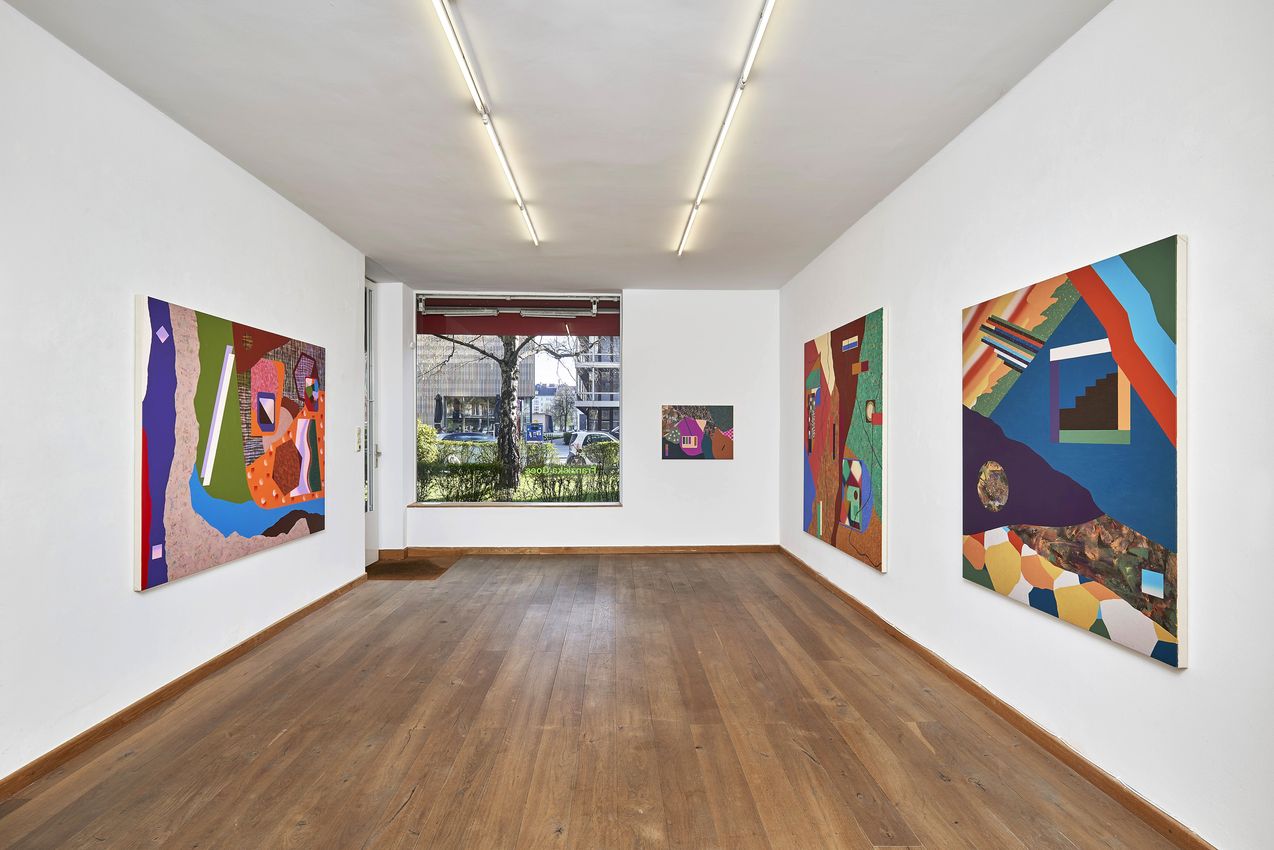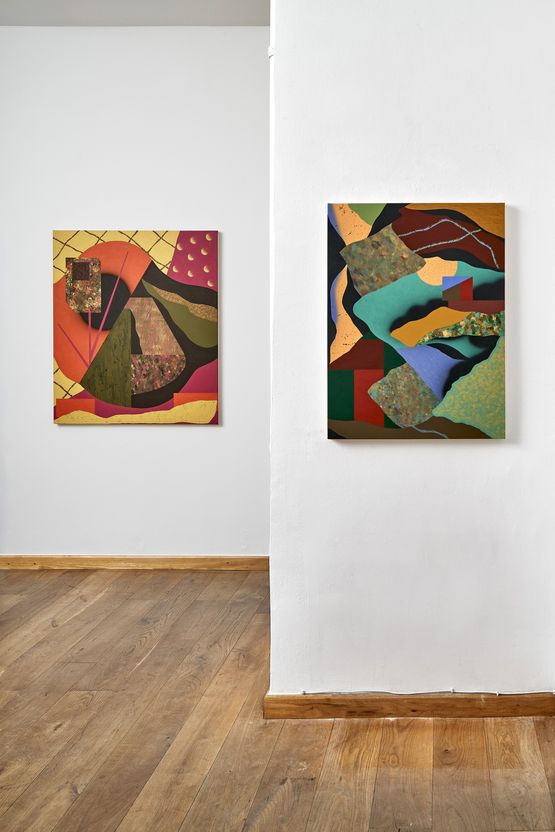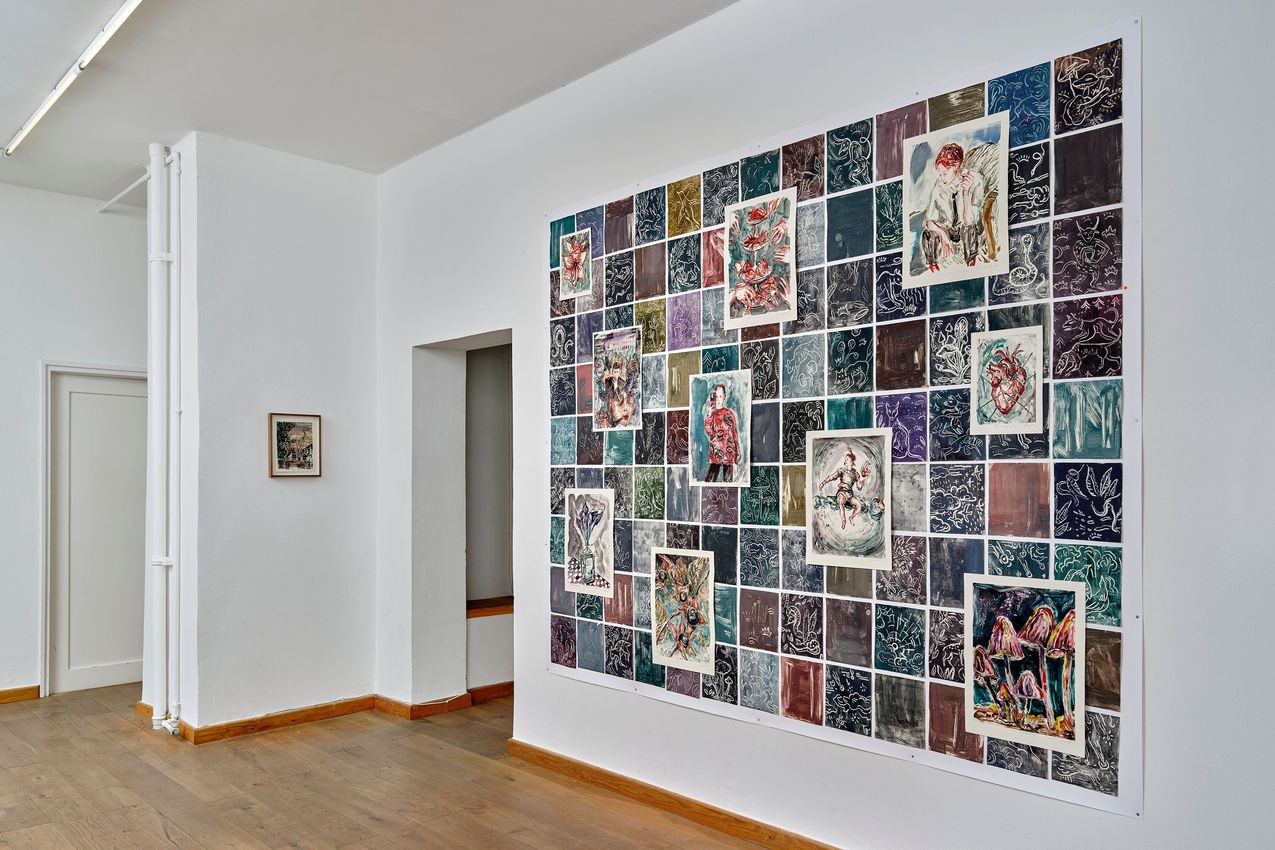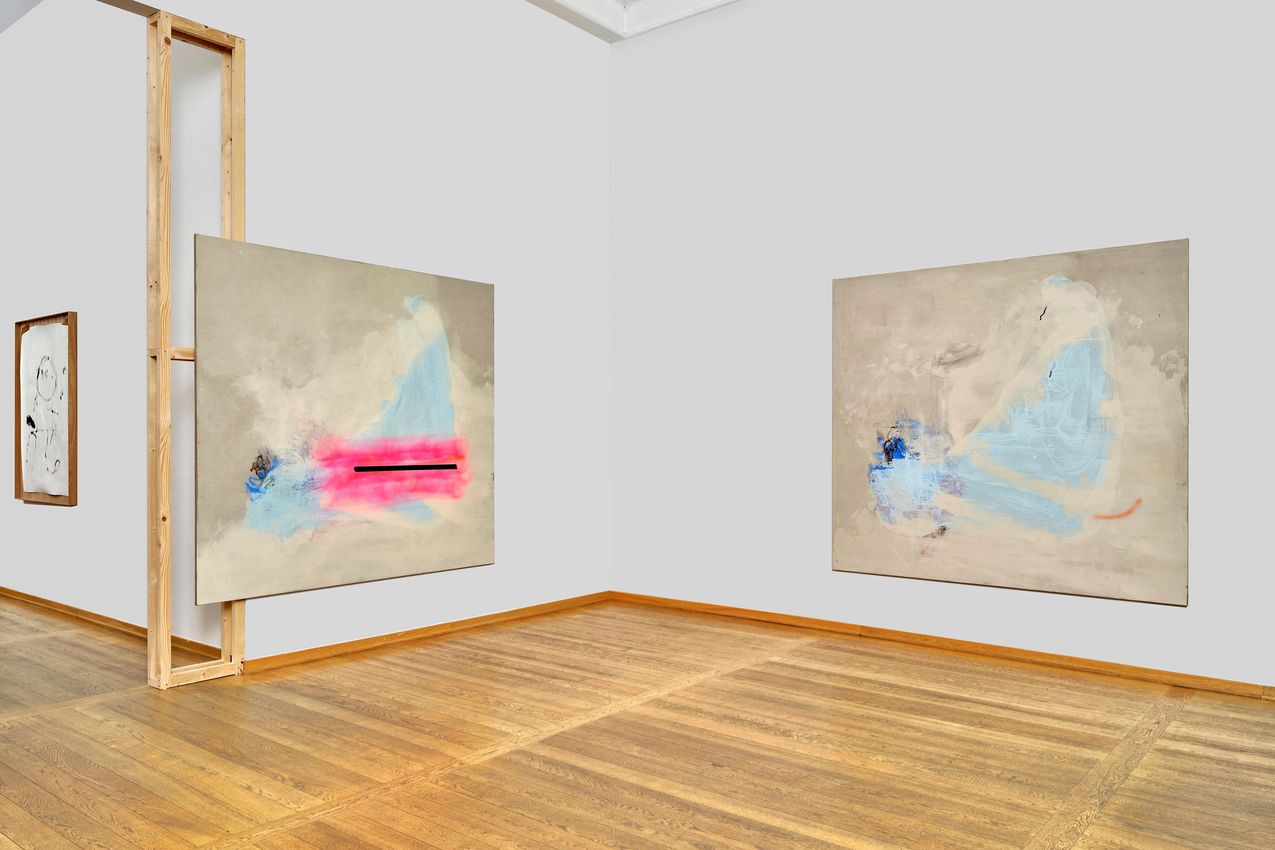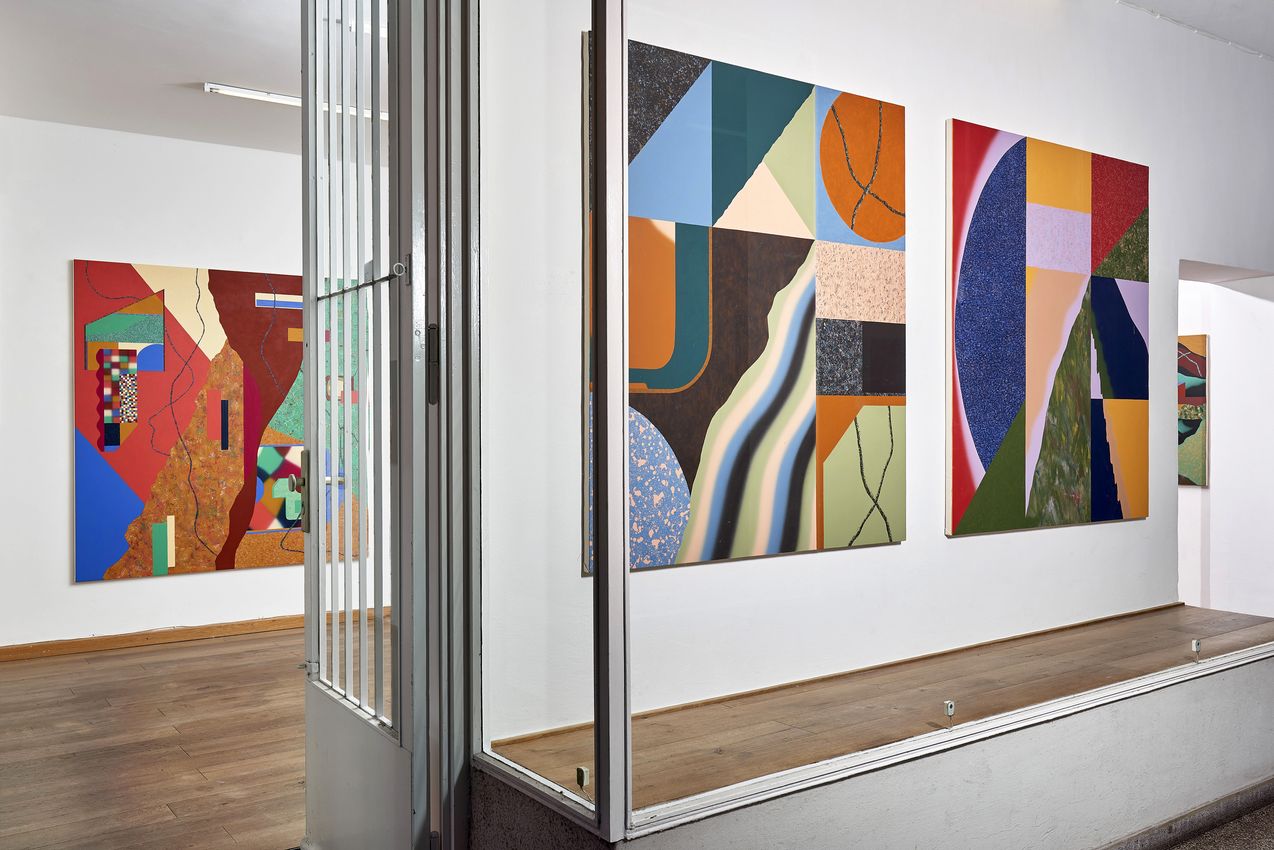
There is something synesthetic about Franziska Goes’s painting. Synesthesia describes the rare condition of experiencing one sense through another—connecting, for instance, colours to sounds or tastes to words. Or perhaps grids to sensation. The word has Greek roots that literally translate to ‘perceiving together’, which is also an apt mode of describing the manifold juxtapositions that comprise Goes’s work. She positions the picture plane as an occasion to perceive how a range of textures, shapes and colours interact. As these forms coalesce into a composite of discordant parts, they enact a playful friction between fragment and whole.
In works like warmer Schatten / Our Tools Shape Us, 2022, an array of shapes—a small rectangular band of yellow and blue with discernible brushstrokes, a hard-edged swathe of reddish pink applied with fastidious flatness, amorphous sections of mottled patterns, meandering lines that overlap all of this—puzzle together into an idiosyncratic constellation. Each aspect of the painting arises from a unique combination of technique, colour and form, but is also contiguous to other dimensions of the painting, so each part is perceived in dialogue with another.
A reflection on technology is also present in these hyper-flat, acrylic surfaces, as Goes often employs a screen-like blur as well as multicoloured pixels. While she remains wholly committed to painting as a medium, she integrates a kind of digital imagining into her process by manipulating her sketches or photographs of her paintings in a program that allows her to try out new configurations. Her practice is, on the other hand, emphatically tactile, as she employs a wide range of brushes, rolls and tools to create her works’ wide medley of textures.
It is telling that many of Goes’s titles are separated by a slash: In the Woods / Feeling Magenta, plus minus / blau gelb or botanische Ordnung / bräunliche Laubfarbe, as it’s often the tension of seeming opposition like that between nature and technology, contrasting colours or dissonant shapes, that drives her practice. The notion of a grid of sensation is another such dialectic. She is also closely attuned to the great freedom that can accompany constraint, a seeming paradox that she accesses by limiting her colours for a painting (or group of paintings) to a preselected palette. By limiting herself to roughly half-a-dozen, often vibrant colours, she allows herself to run the full gamut of atmosphere and tone with a real experimental verve.
— Camila McHugh
born 1971 in Berlin, Germany, lives and works in Berlin, Germany


Knust Kunz Gallery Editions was founded in 1982 under the name Galerie Sabine Knust. Continuous collaborations with artists like Georg Baselitz, Per Kirkeby, A.R. Penck, Markus Lüpertz, Jörg Immendorff, and Imi Knoebel formed an ongoing presentation of their print and graphic œuvre for over 30 years. In 1998 Matthias Kunz joined as partner.

A respected voice in contemporary art discourse.
Focusing on ambitious storytelling and insightful art-world commentary. Ocula Magazine publishes in-depth interviews, critical essays and timely analysis on the artists, exhibitions and ideas driving the global art world.
Learn more about Ocula Magazine
Showcasing the best of the art world.
Ocula partners with galleries from around the world to highlight their artists, artworks and exhibitions. Gallery membership is by application and invitation, with each member vetted by an independent panel.
Learn more about Ocula Membership

Specialises in the sale of major artworks.
Led by a team with deep ties to the world’s leading auction houses, galleries and collectors. Ocula’s advisory team offers bespoke services to high-net-worth clients from around the world who are looking to acquire the best of contemporary and modern art.
Learn more about our team and services