




ALIGHIERO BOETTI
1940-1994, ItalyItalian artist Alighiero de Boetti was a conceptual artist associated with the Arte Povera movement of the 1970s, with its exuberant humour and anti-industrial poetry of the commonplace. He participated in the Venice Biennale several times, and was the subject of a posthumous tribute at the 49th Venice Biennale in 2001.
Early Life
Boetti was self-taught, and by 17 he already had a deep interest in artists such as Lucio Fontana, Wols, and Nicolas de Staël. He had his first show with Galleria Christian Stein in Turin in 1967.
Boetti was passionate about non-western cultures, and he loved to travel to such places as Afghanistan, Pakistan, Sudan, Guatemala, and Ethiopia.
Alighiero Boetti Artworks
In the 1970s Alighiero e Boetti’s conceptually focused practice moved from low-key humorous actions to an interest in global issues. The nature of time was another preoccupation: its inevitability and how it changed perception of an artwork’s meaning.
World Maps
In 1971 Boetti started making his ‘Mappa’ (1971—1994) series of wall-sized woven maps of the world using Afghan and Pakistani craftspeople. The works had commentaries in the margins particular to the location of the production site, and the flags within each country’s shape reflected that unique global-political moment in time. He made 150 over 23 years, with the cartographic designs varying in proportion and continental shape.
Participation of Workers
Boetti liked to generate a wide range of complex projects, often subcontracting manual ‘craft’ tasks to chosen communities and allowing them some decision making. He would put the rudimentary structures in place, such as 10 x 10 grids for kilim rugs, and let those he employed fill in the processual detail.
Time Examined
Linked to the flags demarcating political entities—as another example of his interest in time and chance—is the Twelve Forms from June 1967 (1967—1971), a suite of 12 copper sheets. Each is etched with the shape of a country engaged in war, so that at the time the political finality of the contours could not be guaranteed. Libya, Israel, and Ireland were included.
A related example is the 1000-page book he published in 1973 entitled Classifying the Thousand Longest Rivers in the World. The planet has radically changed over the 50 years since, and Boetti’s sequencing via river length is likely to be questioned, for that was intended. It was never planned to be seen as an objective declaration of geographic data, but an examination of global change.
Postal Works
Sometimes his collaborations were made with unwitting partners—such as postal authorities—when postcards or envelopes bearing travel itineraries were sent to friends at fictitious addresses, but then subsequently returned by post to the artist, who then photocopied and resent them to the next (false) stop on the holiday route, and so on—working his way sequentially through the list of aberrant destinations. One example of this pioneer artform is Postal Voyages (1969—1970).
Exhibitions
Alighiero e Boetti has been featured globally in numerous important institutional solo and group exhibitions. Significant solo exhibitions include:
- Insecure Unconcerned, Sprüth Magers, New York (2024)
- Alighiero Boetti: Game Plan, Museum of Modern Art, New York, travelled to Tate Modern, London (2012)
- Alighiero e Boetti, Gagosian, New York (2001)
- Alighiero e Boetti, Whitechapel, London (1999)
- Alighiero Boetti: Mettere al mondo il mondo, Museum fϋr Moderne Kunst, Frankfurt (1998)
- Alighiero Boetti 1965—1994, Galleria Civica d’Arte Moderna, Turin (1996)
Significant group exhibitions include
- LEXICON, A group exhibition of text-based works, Gagosian, Paris (2016)
- Venice Biennale (2001)
- Global Conceptualism: Points of Origin, 1950s—1980s, Queens Museum of Art (1999)
- Contemporary Sculpture Projects, Westfälisches Landesmuseum, Munster (1997)
- Documenta 7, Kassel (1982)
- Conceptual Art, Arte Povera, Land Art, Galleria Civica d’Arte Moderna, Turin (1970)
- Live in Your Head: When Attitudes Become Form: Works-Concepts-Processes-Situations-Information, Kunsthalle Bern (1969)
- Arte Povera e Im spazio, Galleria La Bertesca, Genoa (1967)
His work is collected in the Archivio Boetti, Rome.
Alighiero Boetti FAQs
Where can I view Alighiero Boetti’s artworks in person?
Boetti’s works are held in major public and private collections worldwide. Notable institutions include the Museum of Modern Art (MoMA) in New York, the Tate Modern in London, and the Museo Nacional Centro de Arte Reina Sofía in Madrid. His works have also been exhibited at the Centre National d’Art Contemporain de Grenoble, the Museum of Contemporary Art (MoCA) in Los Angeles, and MoMA PS1 in New York.
What are Alighiero Boetti’s most notable artworks?
Boetti is renowned for several key series:
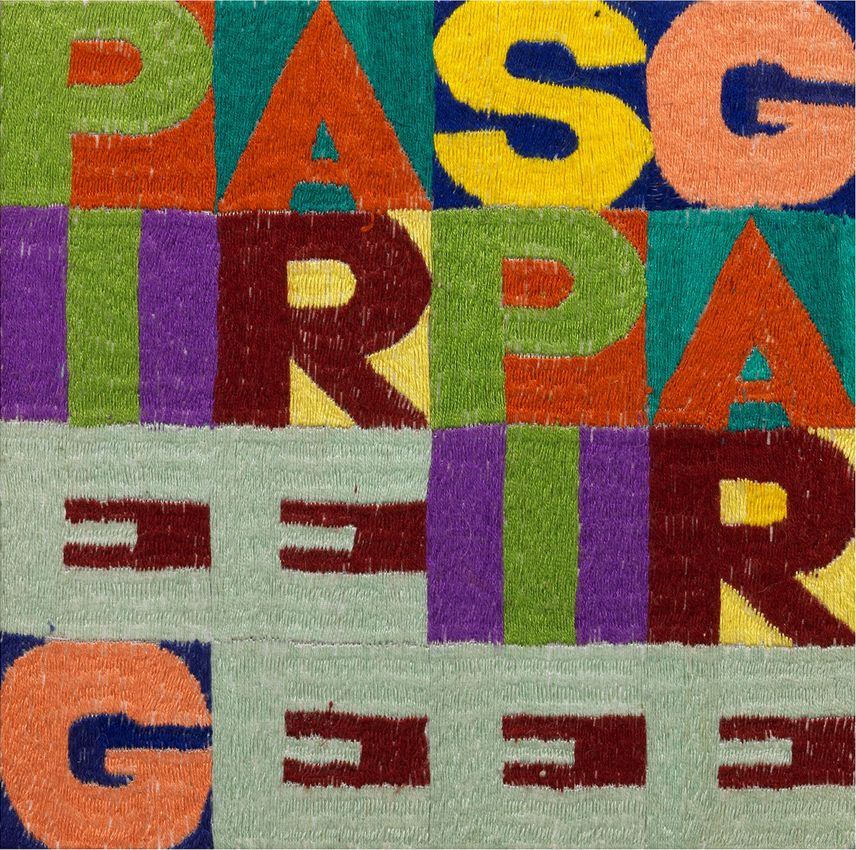
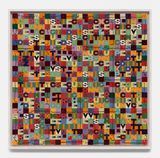
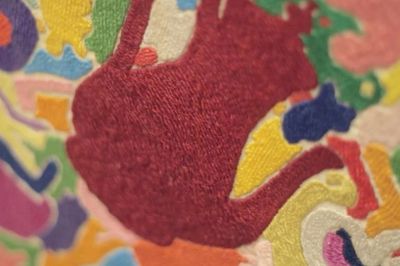
‘Mappa’ series (1971–1994): Embroidered world maps where each country is filled with its national flag, reflecting geopolitical changes over time. ‘Tutto’ (1980s–1990s): Vibrant tapestries composed of a multitude of images and symbols, representing the concept of ‘everything’. ‘Arazzi’: Embroidered works featuring colorful grids of letters forming phrases and sayings, often in Italian and Persian. ‘Biro Drawings’: Intricate works created using ballpoint pens, showcasing Boetti’s interest in repetition and collaboration.
What is the significance of the name “Alighiero e Boetti”?
In 1971, Boetti began signing his works as “Alighiero e Boetti” (Alighiero and Boetti) to emphasize the duality and multiplicity inherent in his identity and artistic practice. This concept of twinning reflects themes of order and disorder, individuality and collectivity.
How did Boetti’s travels influence his art?
Boetti’s extensive travels, particularly to Afghanistan and Pakistan, had a profound impact on his work. In Kabul, he collaborated with local artisans to produce his embroidered pieces, integrating Eastern craftsmanship with Western conceptual art. The geopolitical landscapes of these regions also informed his Mappa series.
What materials and techniques did Boetti use in his artworks?
Boetti employed a diverse range of materials and techniques, including embroidery, ballpoint pen, and everyday objects. He often delegated the execution of his works to others, embracing the concepts of collaboration and chance in the creative process.
Where can I find more information about Alighiero Boetti’s work?
For more information, you can visit the official website of the Archivio Alighiero Boetti at archivioalighieroboetti.it. Additionally, his works and exhibitions are featured on the websites of galleries representing him, such as Gagosian and Ben Brown Fine Arts.
Ocula | 2025








Alighiero Boetti in Ocula Magazine







Explore and Follow Artists Shaping Contemporary Art
A respected voice in contemporary art discourse.
Focusing on ambitious storytelling and insightful art-world commentary. Ocula Magazine publishes in-depth interviews, critical essays and timely analysis on the artists, exhibitions and ideas driving the global art world.
Learn more about Ocula Magazine
Showcasing the best of the art world.
Ocula partners with galleries from around the world to highlight their artists, artworks and exhibitions. Gallery membership is by application and invitation, with each member vetted by an independent panel.
Learn more about Ocula Membership
Specialises in the sale of major artworks.
Led by a team with deep ties to the world’s leading auction houses, galleries and collectors. Ocula’s advisory team offers bespoke services to high-net-worth clients from around the world who are looking to acquire the best of contemporary and modern art.
Learn more about our team and services