Press Release

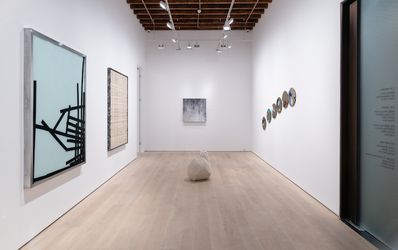
Following a successful exhibition, Human/Non Human/Broken/Non Broken, at collector David Chau’s Cc Foundation in 2017, this is Ryan Gander’s second solo show in Shanghai and features work in a variety of media, from time-based animation and a holographic piece, to free-standing sculptures and portrait paintings created since 2016. The exhibition’s title I see you’re making progress reflects Gander’s constantly evolving practice and career trajectory, while the works also display this evolutionary process–from the confines of the artist’s mind and studio, towards the boundless possibilities to learn and develop from the outside world.

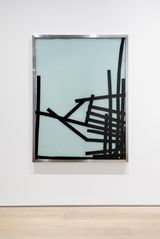
A new work from 2019, View from the studio window (8th November 2017), depicts a hazy view of the world outside his workspace as it transitions from day to night throughout a 24-hour cycle. The animated screens behind the frosted glass approximate the exact light conditions and changing weather of that time and place–not to mention the gently swaying silhouettes of trees and the shadow of a chain link fence–all now transposed, seemingly impossibly, to an interior-facing gallery wall in Shanghai. Another windowpane appears in this show, this time one that has been white-washed and smashed, obscuring a hidden artwork never to be revealed, while also creating a new visceral abstract composition through the use of haphazard duct-taping.

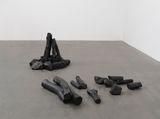
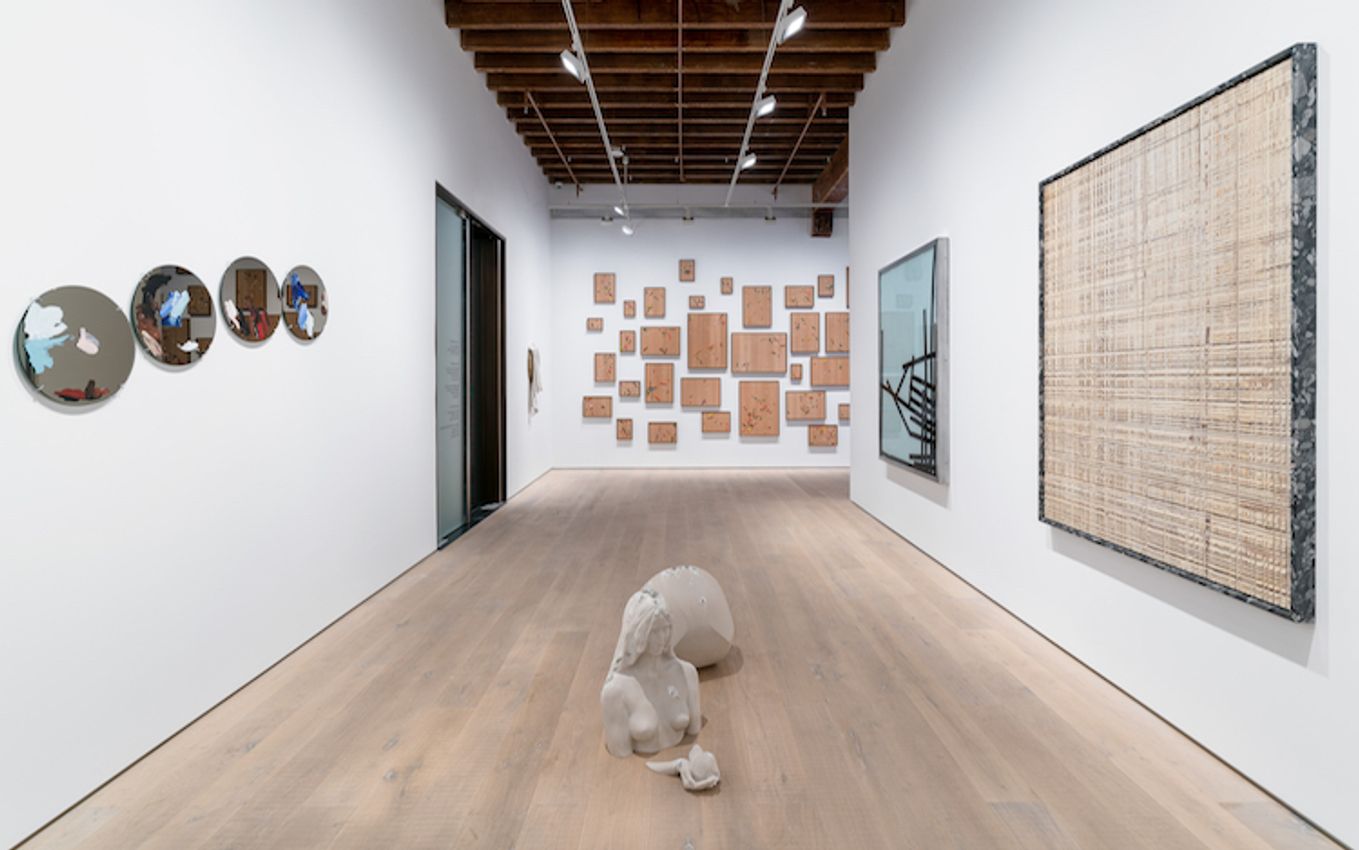
As well as gazing out of the window–with all the Romantic notions this inspires, from the paintings of Caspar David Friedrich to Henri Matisse–Gander is also concerned with the missteps, failures and cul-de-sacs of art production: those notorious opponents of progress. A forlorn ice cream sits half smashed on the floor (actually a bronze replica), while a virtual gift, in the shape of a holographic egg wrapped up in a bow, offers a video game prize or bonus power-up that will forever remain impossible to grasp.

The largest work in the show, entitled This is Creative Play, This involves some Risk Taking – Auto Abstraction (2016) is made up of 44 individual compositions made using a simple children’s mathematical aid, devised by Maria Montessori, one of the most important educators of the 20th century. Coloured wooden rods, normally used to add, subtract and teach fractions, are here employed as examples of free-associative play, mirroring workshops that Gander has run in schools, or in this case, with his own children.

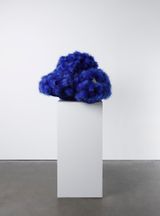
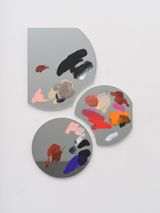
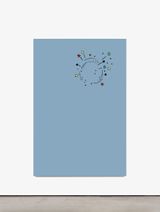
Collaboration and empathy are also evident in Gander’s on-going series of portraits that he makes of acquaintances, before he discards the paintings and exhibits only the palettes of mixed pigments, as conceptual likenesses of a now forgotten grouping or photograph. The final deterioration of all things is suggested by one of Gander’s recent flip-dot boards–animated signs that continuously generate randomly forming drips that rain down each panel, programmed according to an algorithm set by the artist, again suggesting progress, but only in slow and painful increments.

Read More

Installation Views

About the Artist

Ryan Gander’s complex and unfettered conceptual practice is stimulated by queries, investigations or what-ifs, rather than strict rules or limits. For example, what if a child’s den of sheets were remade in memorialising marble (Tell My Mother not to Worry (ii), 2012)? What if all the pieces in a chess set were remade in Zebra Wood, so that neither side was entirely black nor white (Bauhaus Revisited, 2003)? Gander is a cultural magpie in the widest sense, polymathically taking popular notions apart only to rebuild them in new ways – perhaps by refilming the same ten-second clip 50 times over, as in Man on a Bridge (A study of David Lange), 2008. Language and storytelling play an overarching role in his work, not least in his series of Loose Association lectures or in his attempt to slip a nonsensical, palindromic new word, ‘mitim’, into the English language. Occasionally his ludic concepts drift into more bodily, relational challenges, especially in This Consequence of 2006, that involved the unsettling presence of a gallery owner or invigilator dressed in an all-white Adidas tracksuit, with an additional sinister red stain embroidered into the fabric. Invitation and collaboration are also at the heart of Gander’s fugitive art – whether he’s exchanging fictionalised newspaper obituaries with an artist-friend or taking pictures of people looking at pictures at an art fair – although arguably every solipsistic action he takes merely holds up yet another mirror to his ceaselessly voracious mind.

View Artist Profile

Also Exhibiting at Lisson Gallery

About the Gallery

Established in 1967 in London, Lisson Gallery is one of the most well-known galleries operating globally. Boasting an influential and continuing legacy, including playing a pivotal role in the careers of many pioneers of historically important art movements, the gallery works with some of the most significant contemporary artists today.

View Gallery Profile
Address
2/F, 27
Huqiu Road
Huangpu District
Shanghai
China
Opening Hours
Tues - Sat, 11am - 6pm
And by appointment
(1)
Shanghai 2/F, 27, Huqiu Road
Lisson Gallery
2/F, 27, Huqiu Road, Huangpu District, Shanghai, China
+44 207 724 2739
http://www.lissongallery.com

Opening hours
Tues - Sat, 11am - 6pm
And by appointment
The art world in focus