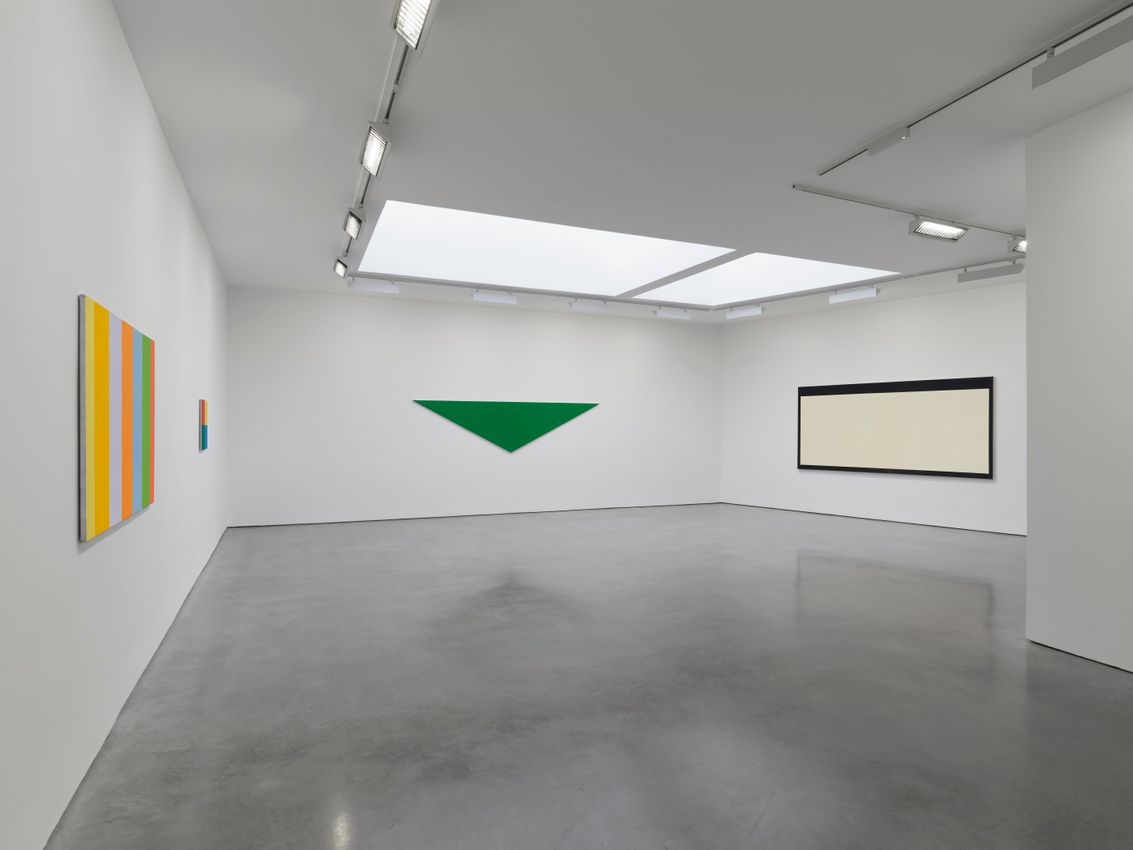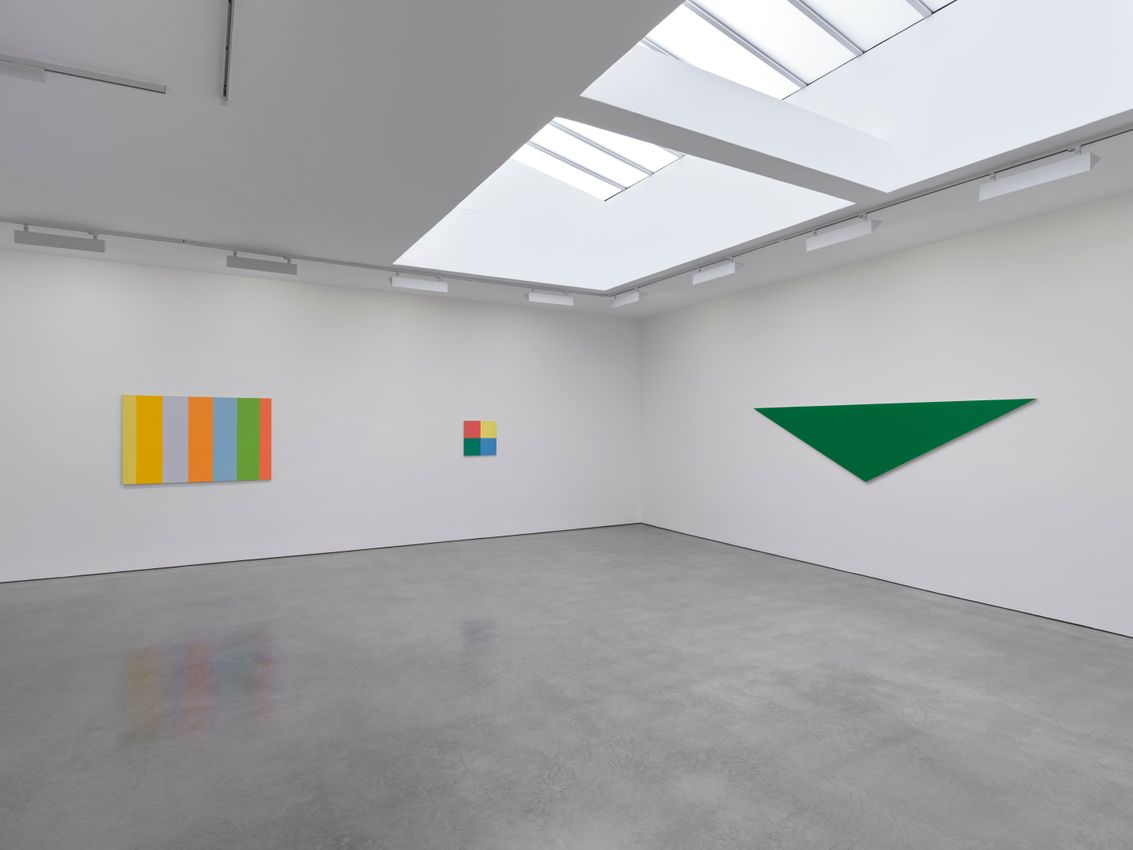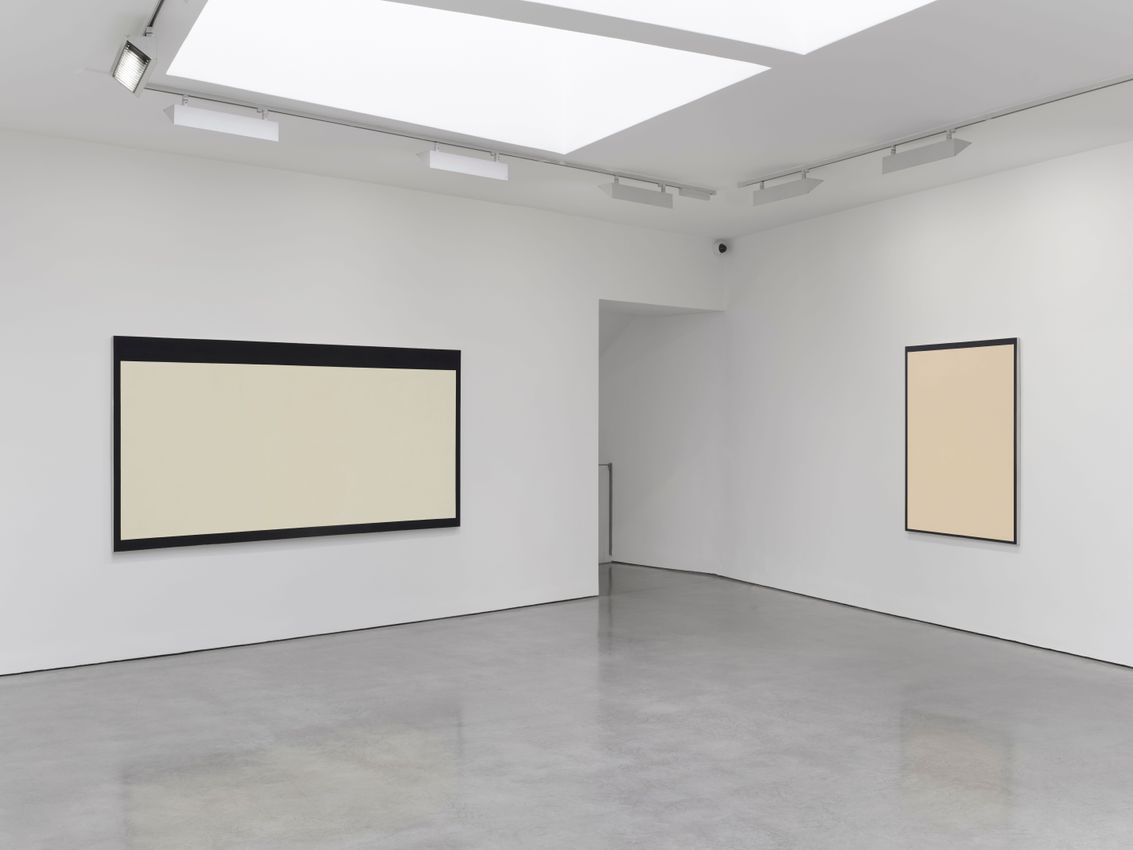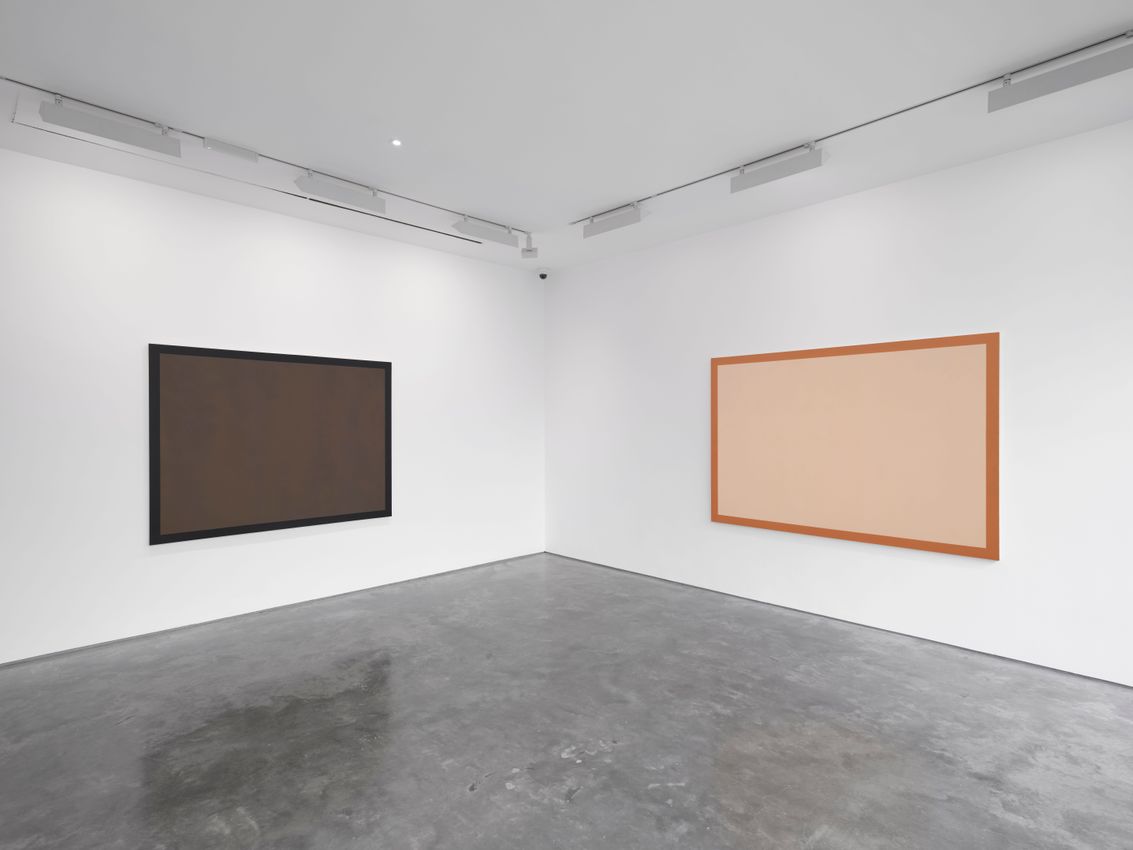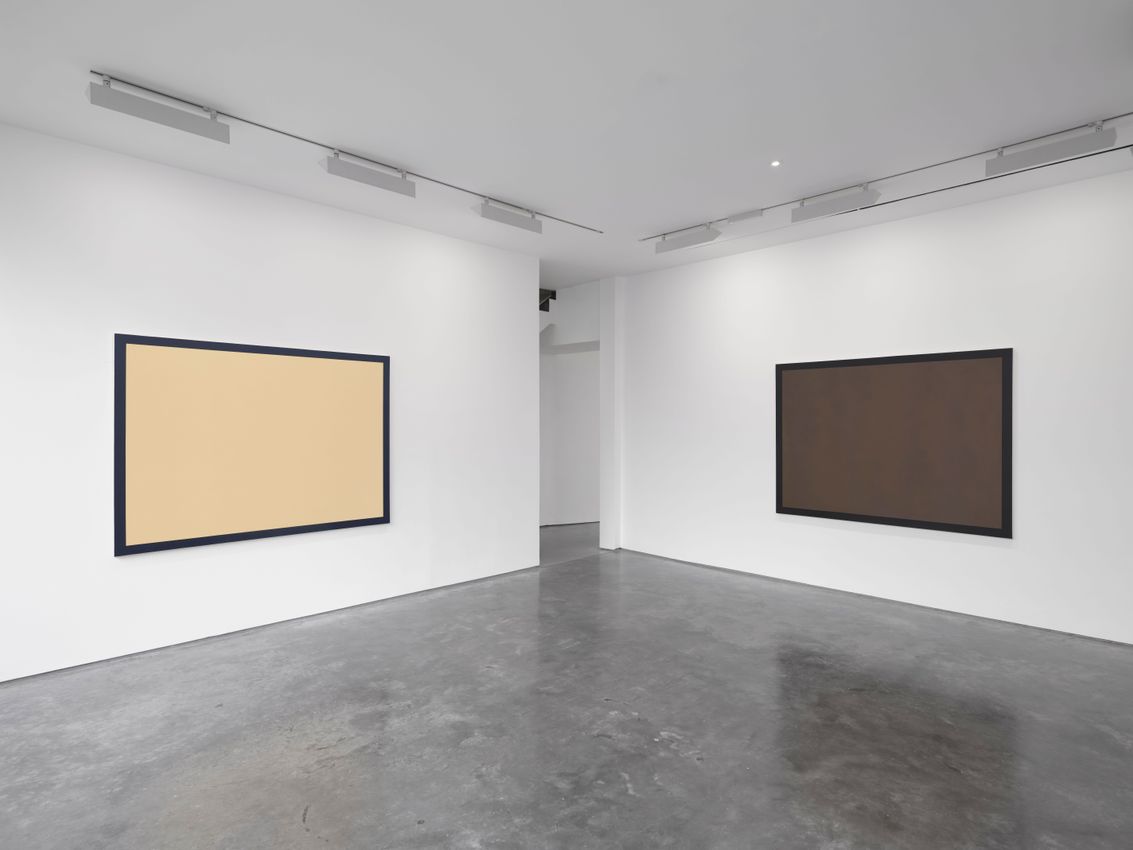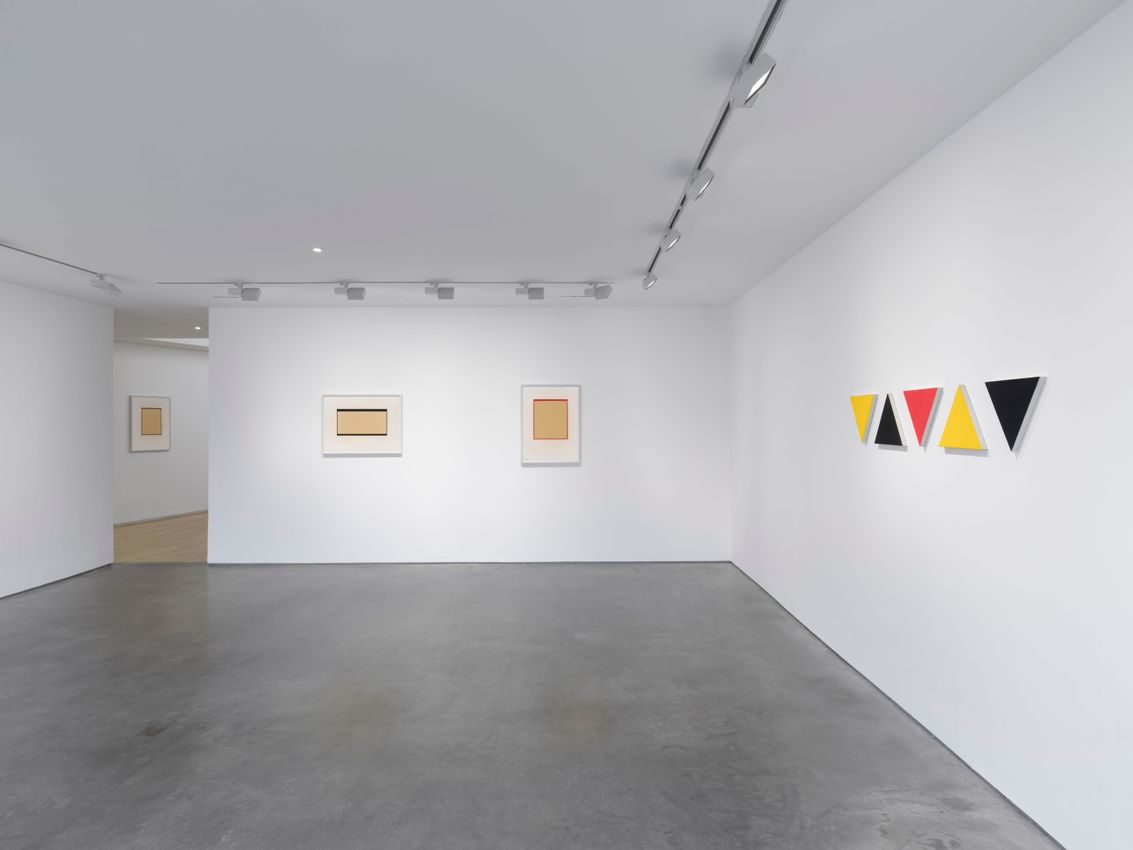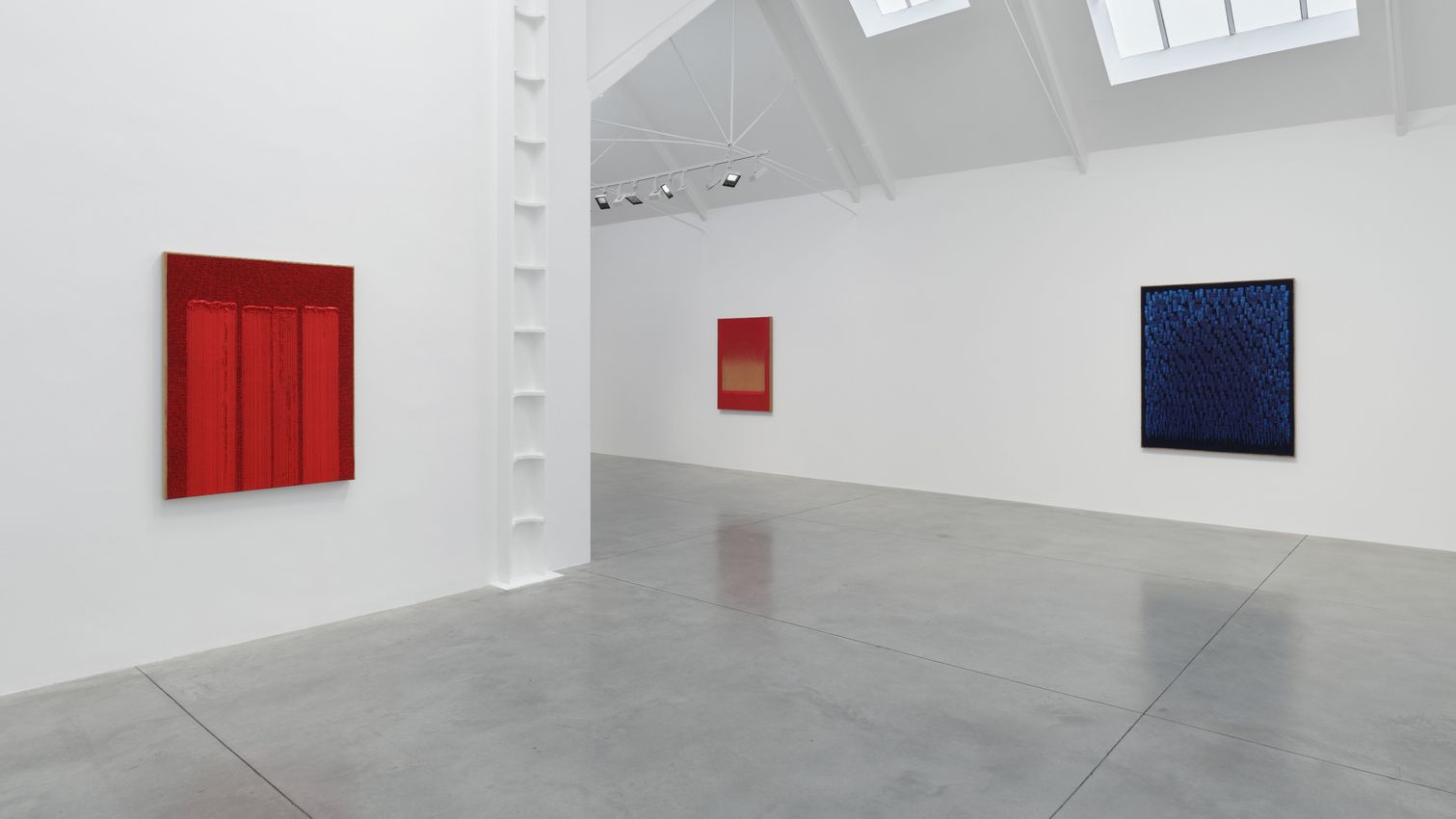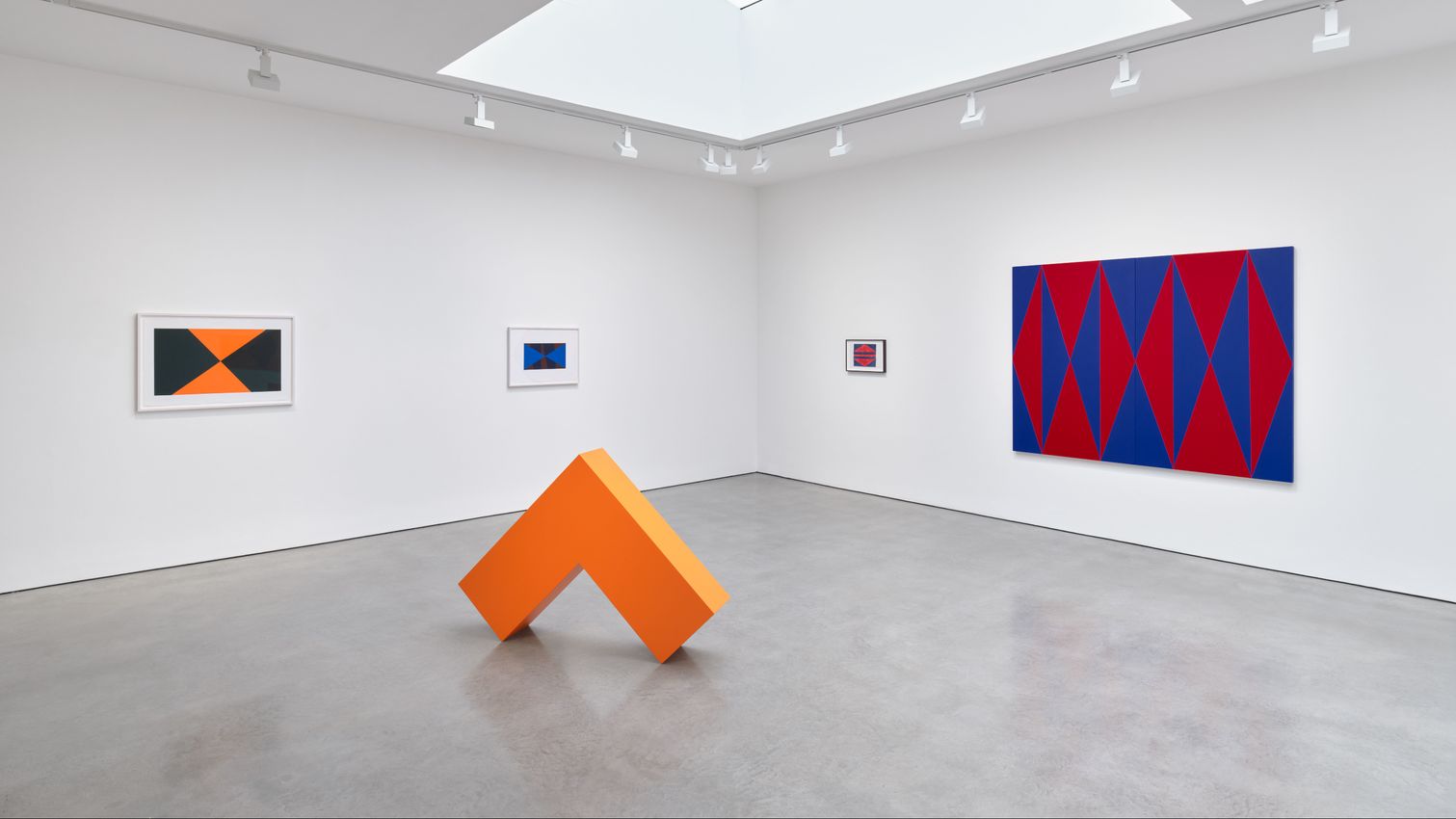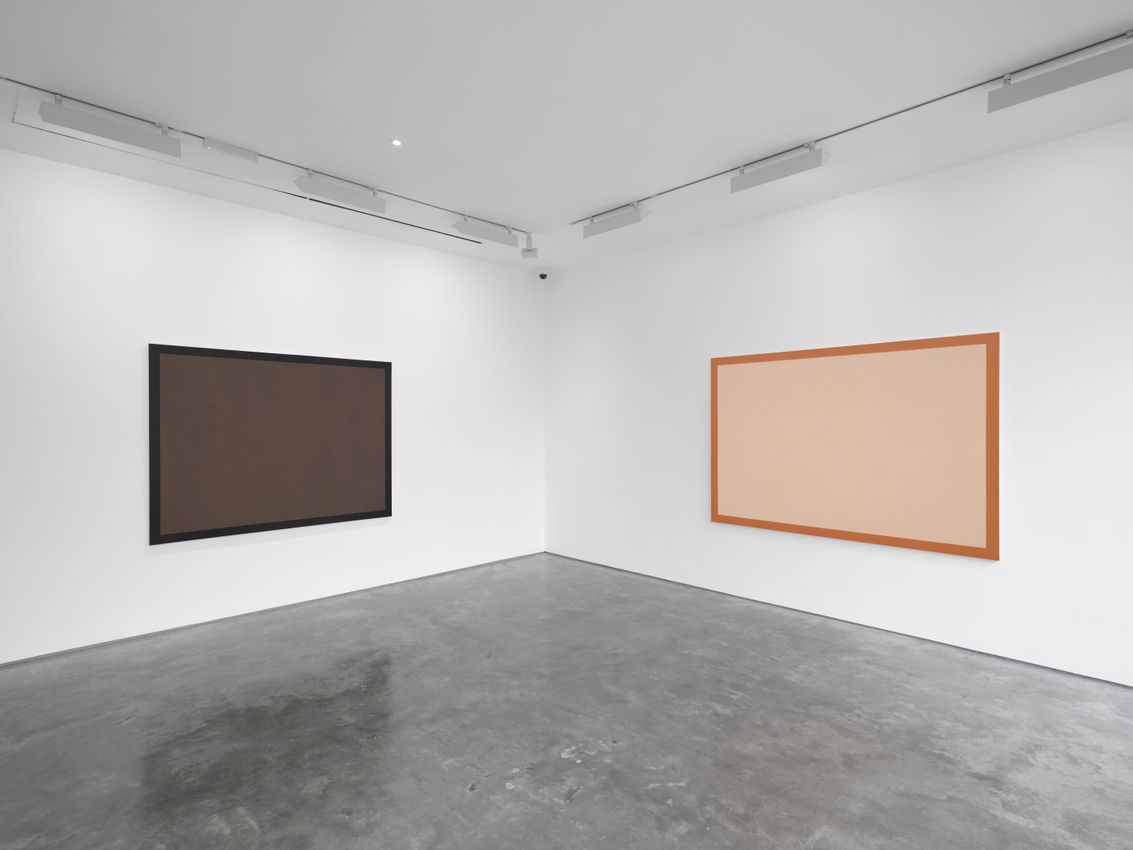
British painter Peter Joseph‘s 17th solo exhibition with Lisson Gallery presents a selection of early and rare works from the 1960s and ‘70s that track Joseph’s development from vividly coloured, geometric compositions and shaped canvases through to the muted rectangular and square paintings that would define the following decades of his career. Spanning the years from 1964 to 1978, the exhibition features 12 paintings, as well as previously unseen sketchbooks, which chart Joseph’s experiments with colour and form. The presentation journeys from earlier paintings that focus on vibrant primary colour and performativity – for which he received wide critical and institutional acclaim, including exhibitions at Camden Arts Centre and Kenwood House in 1966 – to his Cinema Paintings which pre-figure Joseph’s signature Border paintings of the 1980s and 90s.
From his transition to painting full-time in the early 1960s after a career in graphic design, Joseph emerged as a key figure in contemporary art, seeking to challenge the boundaries of abstraction, drawing influence from the Italian Renaissance through to modernist movements. Influenced initially by the approach to large-scale he observed in the work of the American abstract expressionists, and then in artists such as Ellsworth Kelly and Kenneth Noland, he subsequently rejected the ‘public scene’ of contemporary art for a renewed focus on older painting, eventually leaving London for Gloucestershire in the early 1980s. Early works such as the 30ft painting Colour Continuum (1966) captivated audiences with their immersive engagement with colour and light, while the monumental 70ft Yellow Wall, made for Camden Art Centre in 1969, completely transformed a traditional gallery space into a meditative environment, garnering Joseph critical and institutional acclaim. These works embodied the artist’s philosophy of art as a “real situation”, prioritising the viewer’s experience of presence and introspection.
The show’s chronology centres around a pivotal event in 1970 from which Joseph’s Cinema Paintings were born. When the projector broke down during the screening of a Luis Buñuel film the artist found himself bathed in the pure residual light of the projector on the silver screen and sat staring at this blank space for some time; the flickering central zone of light of the empty screen edged by a darker border delineating the cinematic frame. Inspired by the nuanced relationship of these two elements, the artist set about devising paper collage studies to produce equivalent effects. This experience would come to define his oeuvre for many decades to come, containing what he described, in conversation with Hans Ulrich Obrist, as “a delicacy about it. It wasn’t just a simple tone or colour. And I realised that this, to me, had more possibility in it for what I could only call a reflection.”
Through presentations at Lisson Gallery, Peter Joseph’s work has been paired among a diverse array of artists – including Derek Jarman, Raymon Ginghofer and Keith Milow in 1967 (the year of the gallery’s opening), and a two-person presentation with Carmen Herrera in 2006 – but he chose his own path, opting for subtle shades and pared back compositions, rather than boldly coloured architectural compositions.
Joseph’s work remains distinguished for its emotional depth and resonance; he was fascinated by exploring the phenomenology of space, focusing on the way in which his work was experienced. As Joseph himself expressed, his paintings are “not so much to show as to live with,” offering viewers an experience of both immediacy and timelessness. The exhibition celebrates Peter Joseph’s enduring impact on contemporary art, showcasing his dedication to creating spaces of quiet transformation through the power of light and colour.
Peter Joseph has, over the course of decades, dedicated his practice to seeking the potential in constraint. He rose to critical acclaim in the 1970s for his meditative, two-colour paintings, which set one rectangle within a frame of a darker shade. These early works are characterized by perfect symmetry, where every decision about colour and proportion can be seen to be redolent of time, mood or place. While comparable to the work of Mark Rothko and Barnet Newman, Joseph’s is an anomalous strain of Minimalism: his allegiance lies as much with Renaissance masters as with his contemporaries, he says. More recently his format has departed from his established ‘architecture’ to divide the canvas into two planes, horizontally or vertically, wherein loose brushwork, natural tones and patches of exposed canvas tap into new feeling. As Joseph says: ‘A painting must generate feeling otherwise it is dead’.


Established in 1967 in London, Lisson Gallery is one of the most well-known galleries operating globally. Boasting an influential and continuing legacy, including playing a pivotal role in the careers of many pioneers of historically important art movements, the gallery works with some of the most significant contemporary artists today.

A respected voice in contemporary art discourse.
Focusing on ambitious storytelling and insightful art-world commentary. Ocula Magazine publishes in-depth interviews, critical essays and timely analysis on the artists, exhibitions and ideas driving the global art world.
Learn more about Ocula Magazine
Showcasing the best of the art world.
Ocula partners with galleries from around the world to highlight their artists, artworks and exhibitions. Gallery membership is by application and invitation, with each member vetted by an independent panel.
Learn more about Ocula Membership

Specialises in the sale of major artworks.
Led by a team with deep ties to the world’s leading auction houses, galleries and collectors. Ocula’s advisory team offers bespoke services to high-net-worth clients from around the world who are looking to acquire the best of contemporary and modern art.
Learn more about our team and services