



MCARTHUR BINION
b. 1946, United StatesMcArthur Binion is an American abstract painter based in Chicago whose work combines the language of Minimalist grids with an intensely personal archive of documents and photographs. Binon is best known for his mixed-media paintings that typically layer dense, hand-drawn fields of oil-based paint stick over collaged photocopies of materials such as his birth certificate, address book pages, and images of the house where he was born, turning geometric abstraction into a vehicle for autobiography.
Binon’s work has been exhibited at institutions including the Contemporary Arts Museum Houston and the Venice Biennale, and with galleries such as Lehmann Maupin, Richard Gray Gallery, Xavier Hufkens, and Massimo De Carlo.
Early Life and Career
Binion was born in rural Mississippi and moved with his family to Detroit in 1951, a shift from agricultural work in the South to the automobile industry in the urban North. He received a BFA from Wayne State University and an MFA from Cranbrook Academy of Art, where he became the first African American to earn an MFA in painting. In Detroit and later New York, he encountered the work and ideas of Minimalist and post-Minimalist artists while developing an abstract vocabulary of his own.
In the early 1970s Binion relocated to New York, where he lived for two decades and exhibited in the city’s evolving downtown art scene. In 1991 he moved to Chicago, taking up a teaching position at Columbia College Chicago, where he was a professor of art from 1993 to 2015. During this time, he continued to paint while teaching, gradually deepening a practice that would receive broader institutional recognition in the 2010s.
Works, Series and Methods
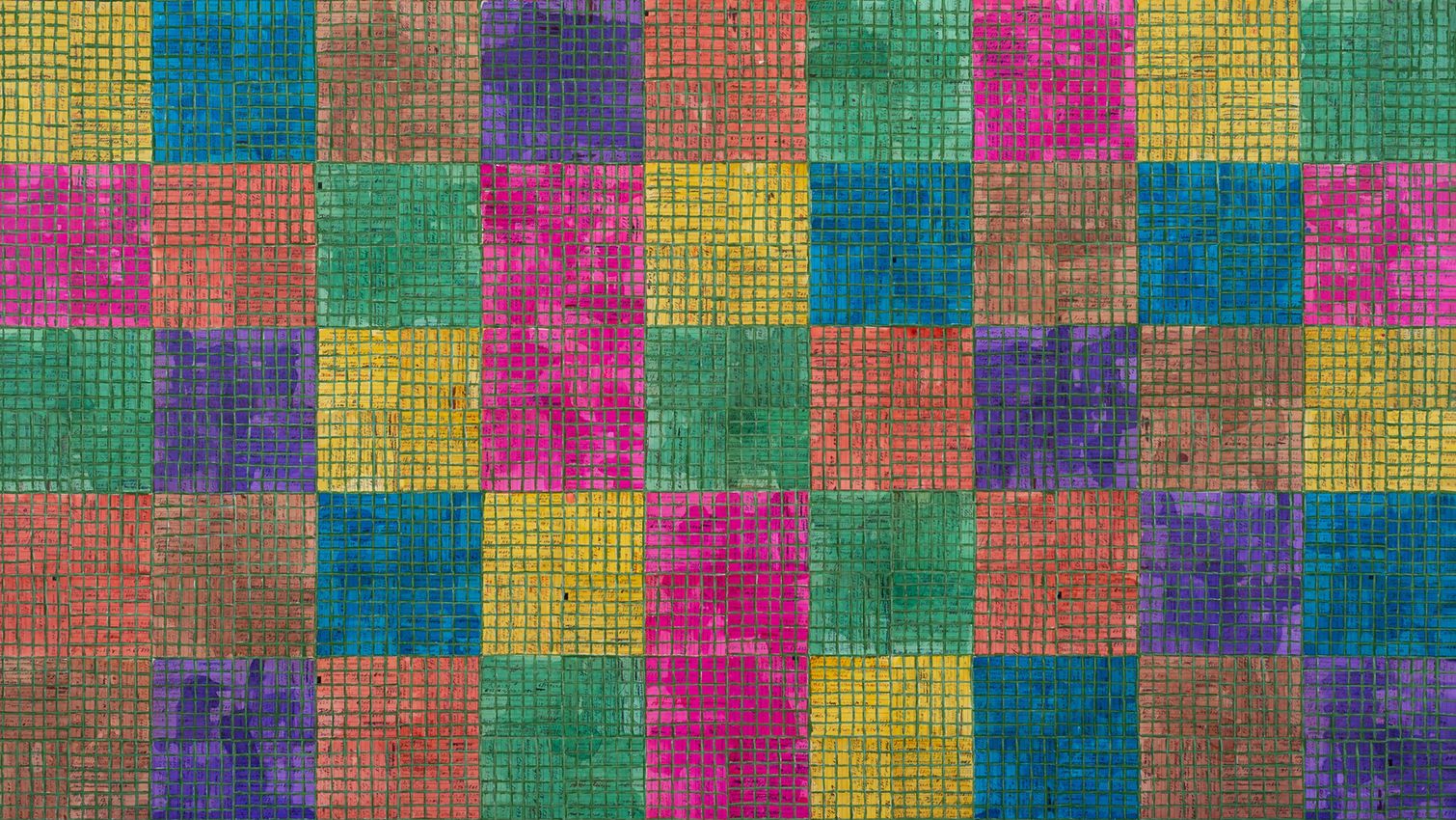
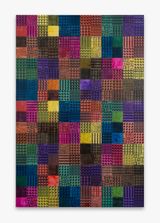
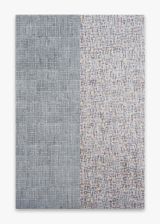
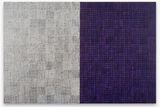
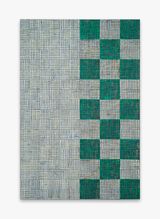
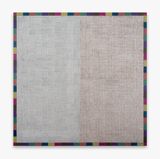
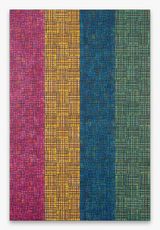
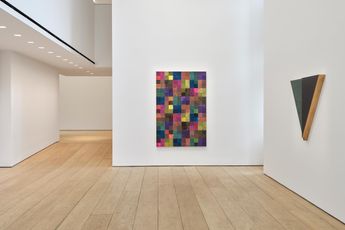
Binion’s mature paintings are built on what he describes as an “under surface” of tiled documents and images, over which he draws and redraws with oil-based paint stick, ink, and graphite. Seen from a distance, these works present as gridded fields of colour that resonate with Minimalism and hard-edge abstraction; up close, fragments of type, numbers, and photographs reveal a substratum of personal history. The use of his birth certificate, address book, ID cards, and photographs of significant houses anchors the work in specific times and places while remaining formally non-figurative.
The “DNA” paintings, begun in the 2010s, exemplify this approach. In these works, Binion collages photocopied documents onto a panel and then covers them with tightly structured, hand-drawn grids of colour. The resulting surfaces resemble woven or quilted textiles, with glimpses of the underlying material intermittently visible through the layered mark-making.
Themes and Context
Binion’s work foregrounds the relationship between abstraction and identity, particularly Black experience in the United States. By embedding records marked by race—such as a birth certificate labelled “colored”—and other personal documents into his paintings, he challenges the idea that the grid is neutral or detached from the social world. His practice sits within a lineage of Black abstraction in which artists use non-figurative vocabularies to address questions of visibility, history, and self-definition without resorting to direct representation.
Process and labour are also recurring themes. The repeated, hand-driven application of paint stick across the surface underscores the physical investment of time and effort, aligning studio work with broader histories of work and endurance. At the same time, the paintings’ layered structure—documents below, colour and geometry above—signals a tension between what is revealed and what remains obscured, mirroring the partial legibility of personal and collective histories in the public sphere.
Exhibitions, Collections and Recognition
Binion’s work has been increasingly recognised by institutions and biennials since the early 2010s. Solo exhibitions of his work have been organised at Georgetown University Art Galleries, Washington, DC, USA (2025); Peter Marino Art Foundation, Southampton, NY, USA (2024); Museo Novecento, Florence, Italy (2020); the Cranbrook Art Museum, Bloomfield Hills, MI (2018); the Contemporary Art Museum, Houston, TX (2012). In 2017 he participated in the 57th Venice Biennale, and he is the recipient of the Cranbrook Academy of Art’s Distinguished Alumni Award.
Binion’s work is held in major public collections including the Whitney Museum of American Art, the New Orleans Museum of Art, and the Studio Museum in Harlem, among others. His work has been shown by galleries such as Lehmann Maupin, Richard Gray Gallery, Xavier Hufkens, and Massimo De Carlo, which have presented solo exhibitions across the United States and Europe.
Modern Ancient Brown Foundation
In 2019, Binion founded the Modern Ancient Brown Foundation in Detroit, Michigan, to support interdisciplinary and “anti-disciplinary” creative practitioners. Drawing on his own experience across visual and literary arts, the foundation provides funding, residencies, and workspaces for emerging artists and writers of colour, helping them develop their practices at the intersection of critical studies, creative writing, and visual culture.
McArthur Binion FAQs
What is McArthur Binion best known for?
McArthur Binion is best known for abstract paintings that combine dense, hand-drawn grids with collaged photocopies of personal documents, a strategy he calls “autobiographical abstraction.” The “DNA” series epitomises this approach, embedding birth certificates, address book pages, and other records beneath fields of oil-stick colour.
What themes does McArthur Binion explore in his work?
Binion’s work explores memory, identity, and African American experience through the lens of abstraction. By layering personal documents under Minimalist-style grids, he addresses how histories of race and place can be present in painting without overt imagery.
How does McArthur Binion make his ‘DNA’ paintings?
In the “DNA” paintings, Binion arranges photocopied documents—such as his birth certificate or address book pages—on a panel, then systematically applies oil-based paint stick, ink, and graphite in intersecting strokes to form a grid. Portions of the underlying material remain visible, making the surface both an abstract composition and an archive of personal records.
Where has McArthur Binion exhibited?
Binion has exhibited at institutions including the Contemporary Arts Museum Houston and the 57th Venice Biennale’s Viva Arte Viva, curated by Christine Macel. His work has also been shown in solo and group exhibitions with galleries such as Lehmann Maupin, Richard Gray Gallery, Xavier Hufkens, and Massimo De Carlo.
What recognition has McArthur Binion received?
In 2017 Binion received the Distinguished Alumni Award from Cranbrook Academy of Art and was featured in the central exhibition of the 57th Venice Biennale. His paintings are held in the collections of the Whitney Museum of American Art, the New Orleans Museum of Art, the Studio Museum in Harlem, and other major institutions.
Ocula | 2026















Explore McArthur Binion's Exhibitions









Explore and Follow Artists Shaping Contemporary Art
A respected voice in contemporary art discourse.
Focusing on ambitious storytelling and insightful art-world commentary. Ocula Magazine publishes in-depth interviews, critical essays and timely analysis on the artists, exhibitions and ideas driving the global art world.
Learn more about Ocula Magazine
Showcasing the best of the art world.
Ocula partners with galleries from around the world to highlight their artists, artworks and exhibitions. Gallery membership is by application and invitation, with each member vetted by an independent panel.
Learn more about Ocula Membership
Specialises in the sale of major artworks.
Led by a team with deep ties to the world’s leading auction houses, galleries and collectors. Ocula’s advisory team offers bespoke services to high-net-worth clients from around the world who are looking to acquire the best of contemporary and modern art.
Learn more about our team and services