




HENRY MOORE
1898-1986, United KingdomHenry Moore was an influential British sculptor known for his semi-abstract wooden or marble carvings and cast bronze sculptures of reclining human figures. In various evolving and overlapping styles, Moore also created volumetric crayon and ink wash drawings and tapestries.
Education and Early Career
A coal miner’s son, Moore first showed artistic talent at Castleford Secondary School. In 1919, after fighting and being injured in the First World War, he got an ex-serviceman’s grant to enrol at Leeds School of Art. There, Moore became friends with another modernist sculptor, Barbara Hepworth. In 1921, they received scholarships to study at the Royal College of Art (RCA) in London. On their visits to the British Museum, Moore often examined the ethnographic collection.
In 1924, he began teaching at the RCA while making commissions and working in his studio. Five years later, he married Irina Radetsky, a painting student, and moved his studio to Hampstead Heath. The Moores’ neighbours included Hepworth, her husband Ben Nicholson, artists Naum Gabo and Roland Penrose, and critic Herbert Read.
In 1932, Moore took up a post at the Chelsea School of Art. That same year, he met art historian Kenneth Clark, who began championing and commissioning his work. With Clark’s encouragement, he also produced drawings of coal miners and—during the war—families in underground tube stations sheltering from the Blitz.
Henry Moore’s Artworks
In 1924, Moore was granted a six-month travelling fellowship to Northern Italy and Paris. At Paris’ Trocadero Museum, he encountered a plaster cast of a reclining stone Chac Mool figure, a pre-Columbian Mayan sculpture that astounded him and which he had seen two years earlier reproduced in a book on Mexican Art. From it, he developed a formally rectangular, blockish structure in which a carved figure was positioned, such as Reclining Figure (1929) or Reclining Woman (1930). In the late thirties, these became more abstract, elongated with holes, such as the elmwood Reclining Figure (1939).
The Human Form
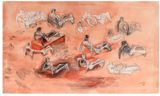
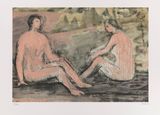
Reclining or seated figures (or standing mothers and children) were a dominant theme in his sculptures and distinctive drawings using crayon, chalk, watercolour, and gouache. A good example is the bronze Draped Seated Woman (1956-7).
Abstract Sculptures
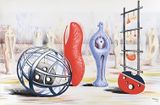
Moore’s sinuous abstract sculptures were influenced by the works of earlier and contemporary artists, including Picasso, Jean Arp, Joan Miró, and Constantin Brancusi. Also significant were elements of nature, particularly the austere rotund hillforts of his native Yorkshire. Often, the body parts were disconnected and separated to accentuate the geological as curvilinear abstraction. Examples include Composition (1931) and Two Large Forms (1969).
Surrealism
Moore’s friendship with Surrealists like Roland Penrose and admiration for other artists, like Picasso, led him to explore bronze casting and fluid and figurative anthropomorphic forms wrapped around or ‘framing’ holes. It enabled large sculptures to be positioned outside. In works such as Reclining Figure (1938) and Ideas for Sculpture in Metal (1939), Moore investigated the expressive possibilities of apertures while retaining the same tuber-like quality for his figures with a reduced head and rubbery, writhing torso or limbs.
Tapestries
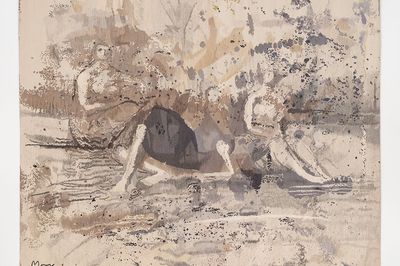
In the mid-seventies, Moore executed a small series of ink and watercolour figure drawings intended to be made into tapestries by five master weavers at Tapestry Studio, West Dean College. Moore was so fascinated by the results and the process of ‘translation’ where the weavers picked the colours, dyes, types of wool and quality of greatly enlarged lines and stains that he did seven more. The Victoria and Albert Museum purchased several, which have since been exhibited worldwide. In 2021, art gallery Hauser & Wirth presented tapestries from the late 1970s in Hong Kong.
Exhibitions and Legacy
Henry Moore exhibited internationally during his lifetime, with solo presentations including his representation of the United Kingdoms at the 24th Venice Biennale, for which he was awarded the Sculpture Prize (1948), Sculptures and Drawings of Henry Moore, Tate, London (1951); and Henry Moore, Forti di Belvedere, Florence (1972).
The Henry Moore Foundation, established in 1977 by the artist, preserves his legacy while supporting contemporary sculpture projects and programmes.
Solo exhibitions following the artist’s death in 1986 include
- Moore and Malaparte: Rhythm and Form, Gagosian, Paris (2025)
- Henry Moore and Greece, Gagosian, Athens (2024)
- Georgia O’Keeffe and Henry Moore, Museum of Fine Arts, Boston (2024)
- The Sculptor’s Drawing: Henry Moore, Museo Novecento, Florence (2021)
- The Power of Nature: Henry Moore in Poland, The Centre for Polish Sculpture, Four Domes Pavilion, and National Museum, Poland (2019)
- Henry Moore: Myths and Poetry, Hauser & Wirth, Zürich (2017)
- Henry Moore, Tate Britain, London (2010)
- Henry Moore, National Gallery of Art, Washington, D.C. (2002)
Henry Moore FAQs
Who is Henry Moore?
Henry Moore (30 July 1898–31 August 1986) was a British artist who was celebrated for his large-scale sculptures, which often explored the human figure through abstracted, organic forms. He is regarded as one of the most influential sculptors of the 20th century.
What is Henry Moore’s most famous work?
Moore’s ‘Reclining Figure’ series is among his most significant achievements. His sculptures, such as Reclining Figure: Festival (1951), created for the Festival of Britain, have become iconic examples of modern public art.
What influenced Henry Moore’s art?
Moore’s early encounters with non-Western art, particularly pre-Columbian sculpture and African carvings, profoundly shaped his approach to form and material. His experiences during the Second World War, when he served as an official war artist, also deeply informed his themes of resilience and shelter.
Where can I see Henry Moore’s artworks?
Moore’s sculptures are in major public collections worldwide, including Tate Britain in London, the Art Gallery of Ontario in Toronto, and the Henry Moore Foundation in Hertfordshire, which houses a significant body of his work.
How did Henry Moore impact contemporary art?
Through his pioneering use of abstraction and his focus on public commissions, Moore redefined the role of sculpture in modern society. His emphasis on placing art in accessible outdoor environments inspired generations of artists in public art and monumental sculpture.
Ocula | 2025

























Explore and Follow Artists Shaping Contemporary Art
A respected voice in contemporary art discourse.
Focusing on ambitious storytelling and insightful art-world commentary. Ocula Magazine publishes in-depth interviews, critical essays and timely analysis on the artists, exhibitions and ideas driving the global art world.
Learn more about Ocula Magazine
Showcasing the best of the art world.
Ocula partners with galleries from around the world to highlight their artists, artworks and exhibitions. Gallery membership is by application and invitation, with each member vetted by an independent panel.
Learn more about Ocula Membership
Specialises in the sale of major artworks.
Led by a team with deep ties to the world’s leading auction houses, galleries and collectors. Ocula’s advisory team offers bespoke services to high-net-worth clients from around the world who are looking to acquire the best of contemporary and modern art.
Learn more about our team and services