



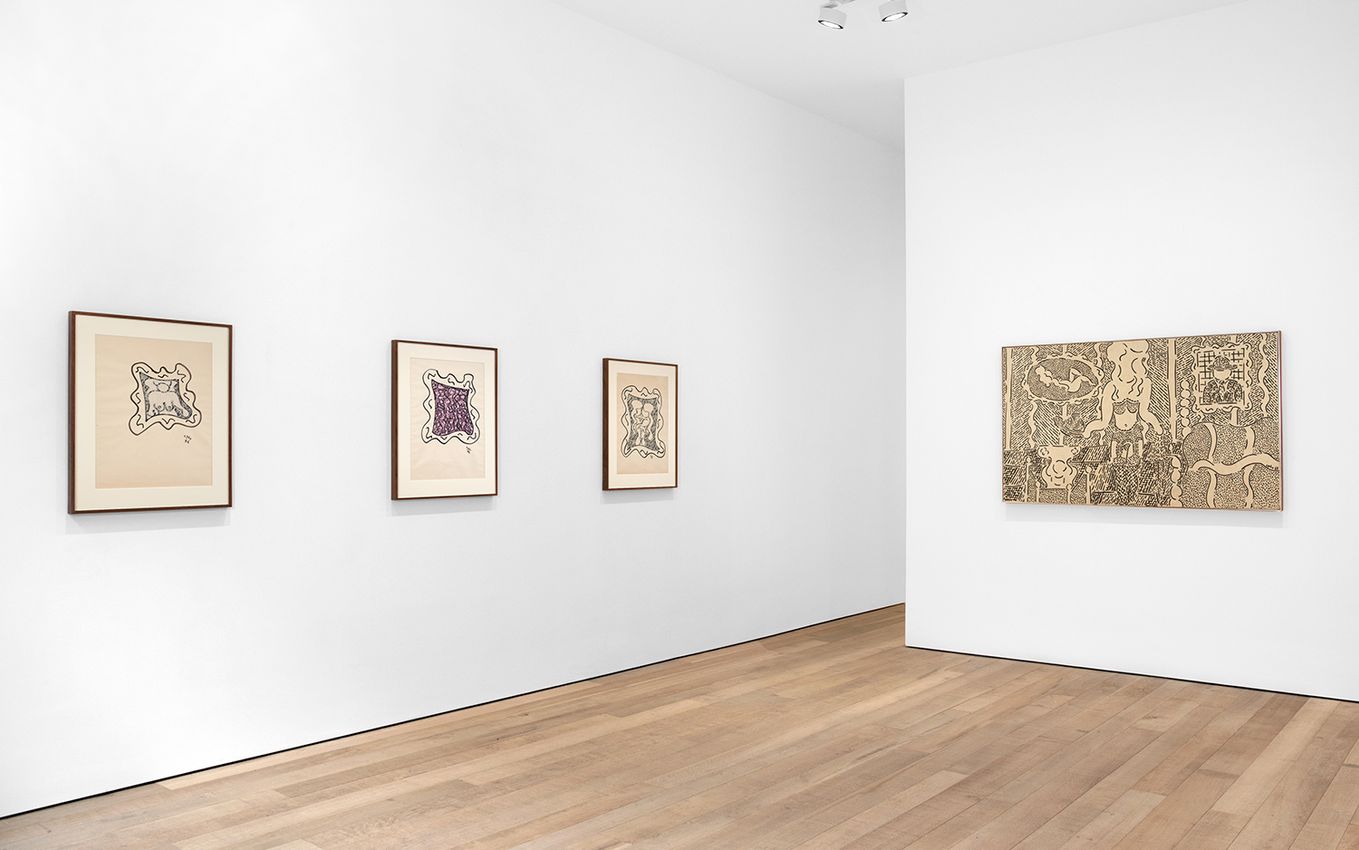
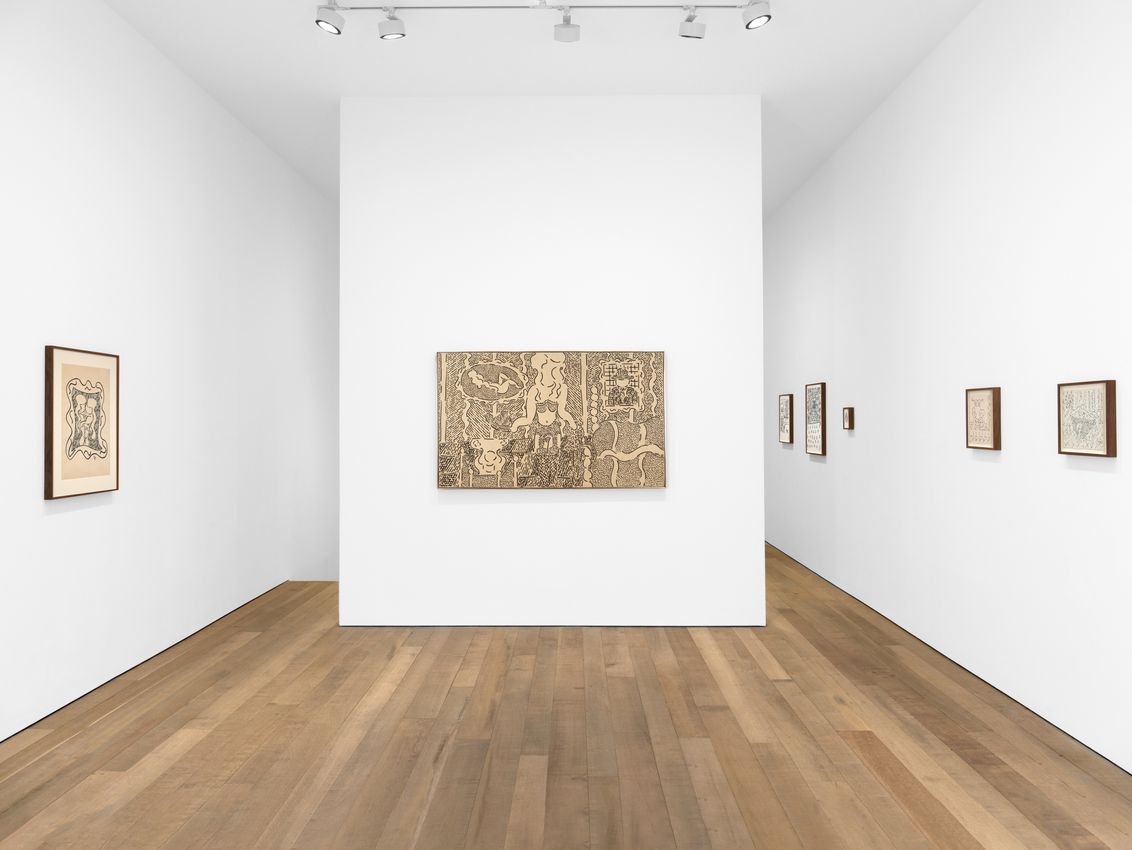
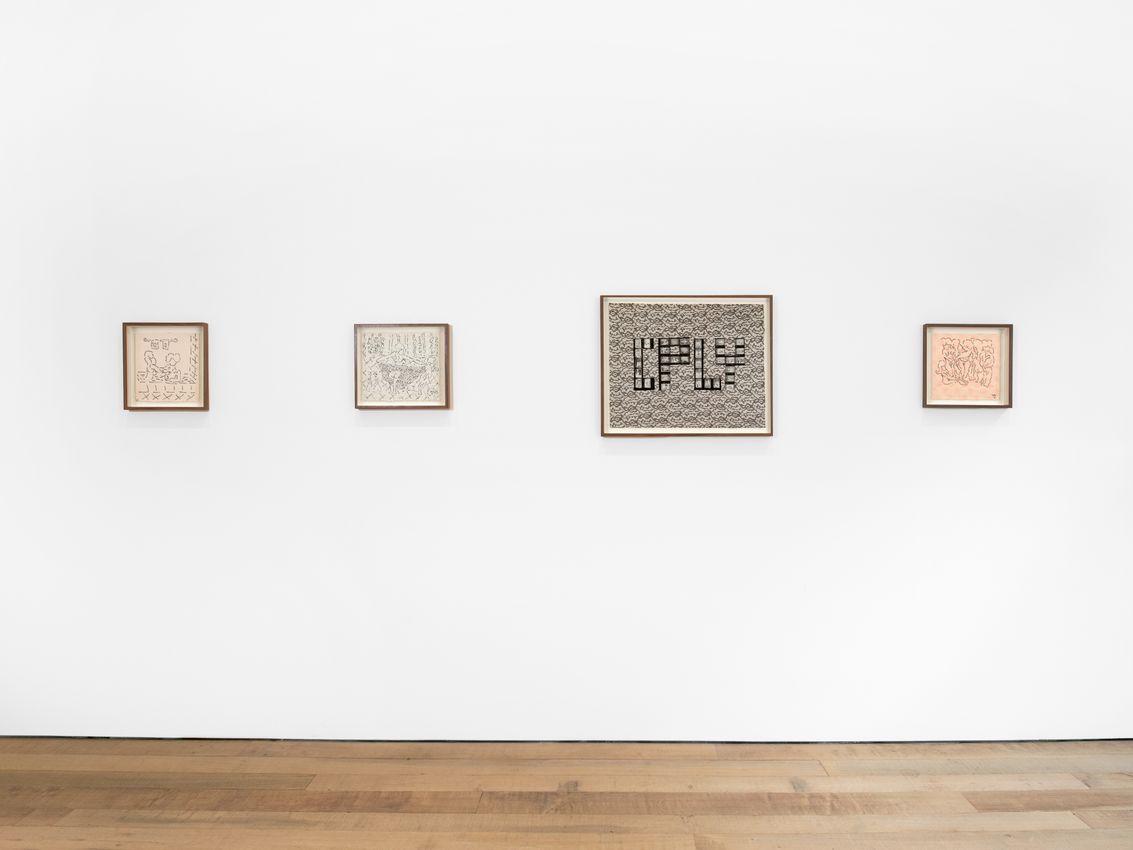
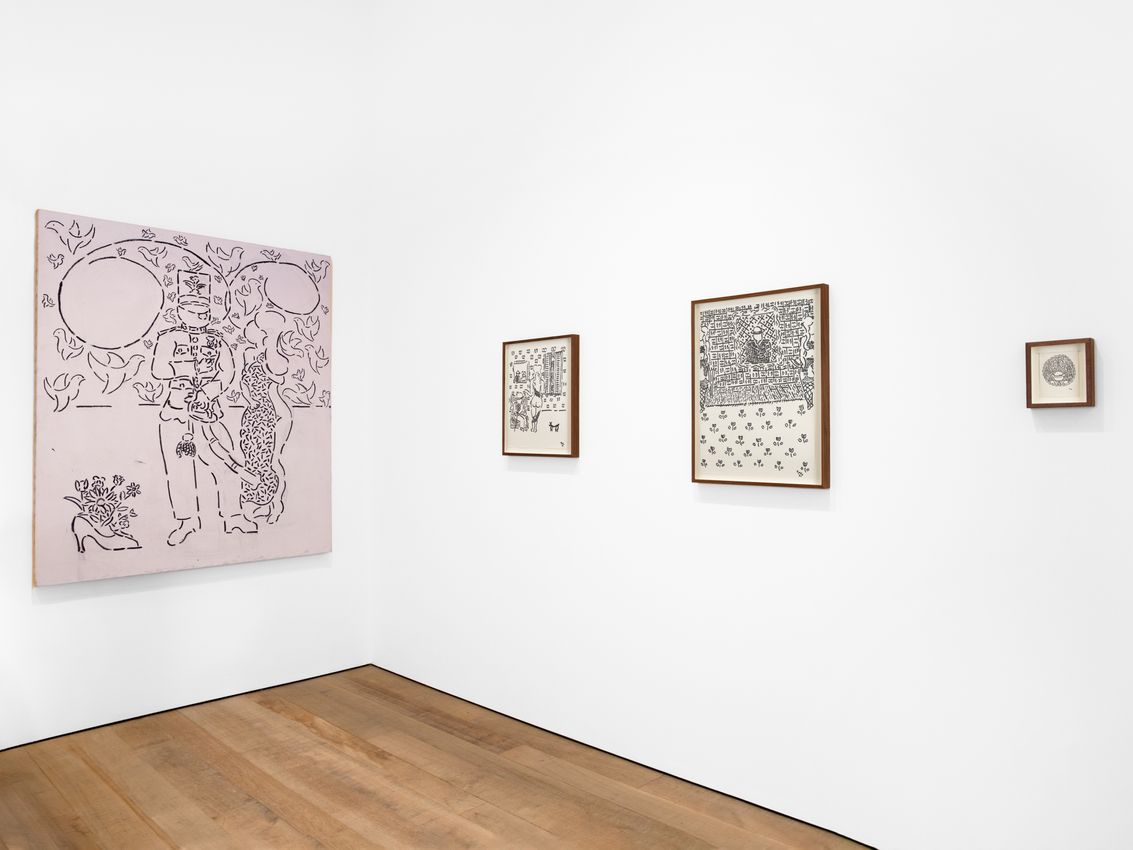
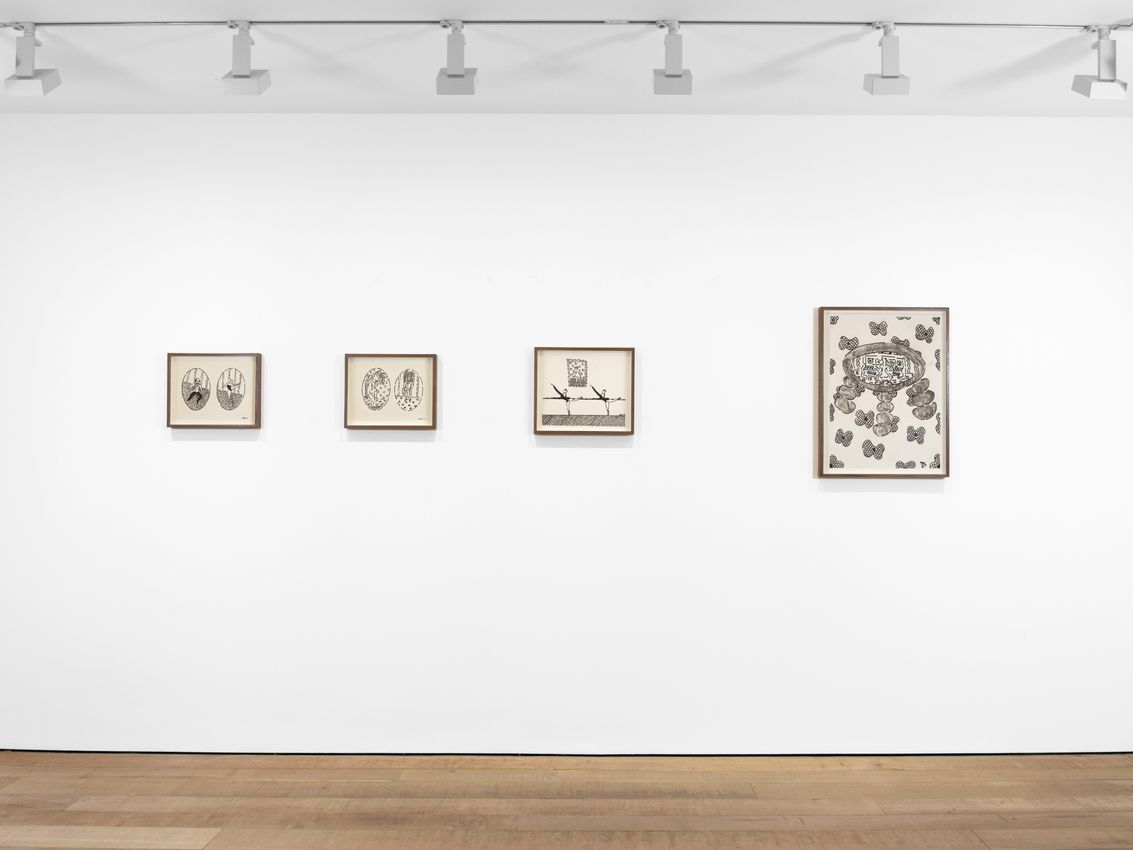
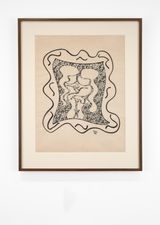
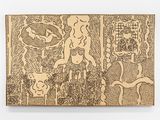
This May, Sadie Coles HQ presents a solo exhibition of drawings by William N. Copley, marking the first presentation of his works on paper in the UK to date, along with a seminal painting from 1965, Philosophie dans le boudoir. Dating primarily from the 1980s and early 1990s–the final decade of his life–the works on paper mark the zenith of Copley’s drawing practice, reanimating ideas and motifs that he began to employ in the 1950s and 1960s.
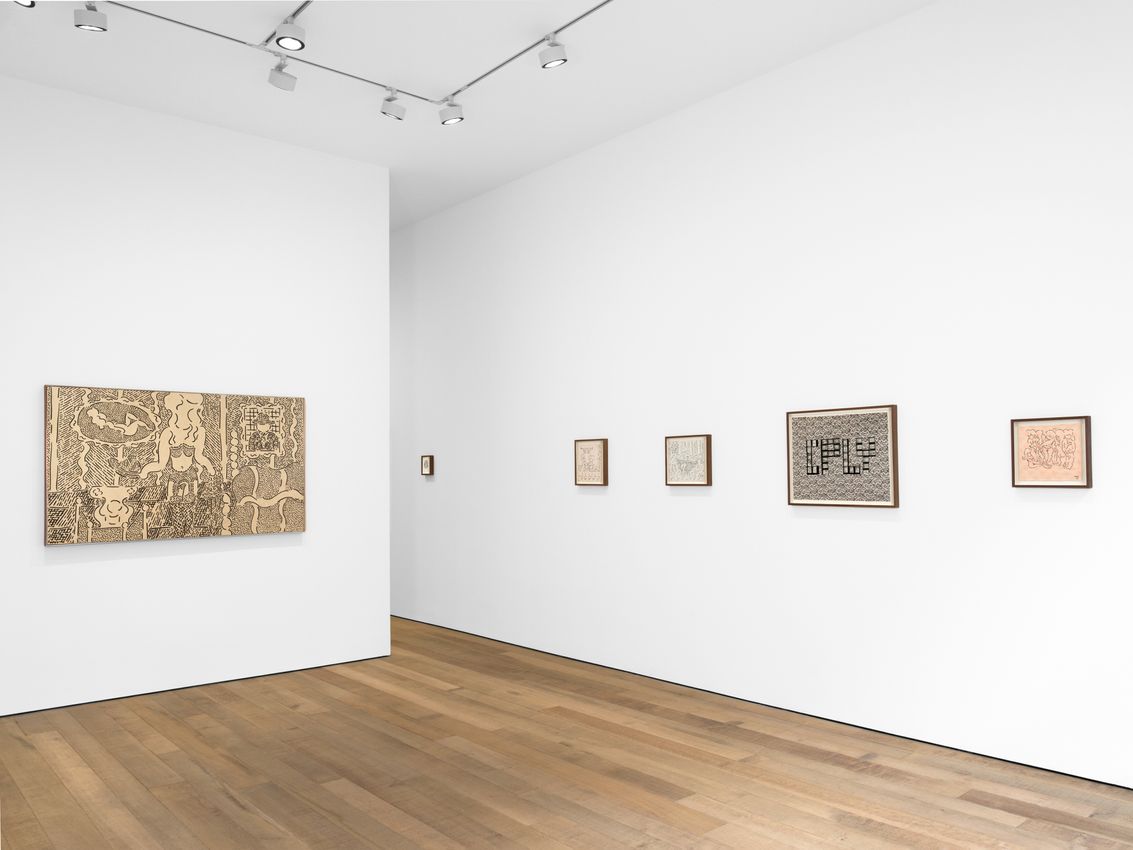
In Philosophie dans le boudoir, Copley translated the bold linear style of his drawings into acrylic paint on canvas. Originally one of a series of monochrome paintings shown at Alexander Iolas, New York, in 1966, the painting depicts a woman at the centre of a patterned room. The figure is radically simplified–her face a mannequin-like blank, her hair and swivelling body described by arcing lines–except for the detailing of her brassiere and trousers. On the wall behind her, two framed pictures contain similarly schematic images of a reclining female model and a bowler-hatted man.
Philosophie dans le boudoir bears witness to a significant shift in Copley’s work: in the mid ‘60s, his imagery became more playful, and his style both freer and more assured. The painting condenses the key compositional elements of Copley’s practice over the following three decades–a dense accumulation of pattern; a use of linear marks (curved, hatched or broken); a flattening of space; a schematic rendering of the human figure; and the recurring motif of an inset image–or ‘picture within a picture’.
While Copley’s paintings draw voraciously upon artistic and pop-cultural sources, his drawings were the direct products of his imagination, expressions of what he called his ‘private mythology’. The works in the exhibition attest to the fact that drawing was a vital testing ground, throughout his career, for the generation of ideas. Writing to the collector Arturo Schwarz in 1965, Copley stated: ‘These extended periods of drawing seem to help me more than anything.’
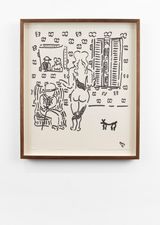
Echoing Philosophie dans le boudoir, a drawing from 1991 features a central female figure, this time turned away and conspicuously undressed. The girl’s reflection, and that of a bowler-hatted onlooker, appear inside a frame on the wall. The man in the bowler hat is a revenant throughout Copley’s drawings–an homage to the artist’s friend René Magritte, and an exemplar of the bourgeois life that both Copley and Magritte renounced in post-war France. The artist Anne Doran has referred to this character as a ‘nattily dressed and deeply ridiculous Everyman in mad pursuit of liberty, poetry, and sex.’1
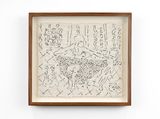
The influence of Copley’s twelve years living in Paris, between 1951 and 1963, is instantly traceable, meanwhile, in his evocation of cabaret–the showgirl, the risqué costume, and the ribald ambience–among other kinds of performance. In another work from 1991, two oval shapes contain images of male and female figures, each appearing to dance on raked floorboards: the battle of the sexes is staged as a dance-off.
In a work from 1982, Copley collaged photographs of his own drawings into a design that spells CPLY–the moniker with which he signed all his paintings. The drawings derive from his celebrated X-Rated series of the early 1970s, a cycle of paintings and charcoal drawings inspired by images from pornographic magazines that he picked up from 42nd Street and Times Square stores. ‘I am seriously concerned with the distinction between pornography and eroticism,’ Copley said at the time. ‘For me, it’s a very simple thing, pornography has to do with repression, and eroticism with fantasy ... I am trying to break through the barrier of pornography into the area of joy.’2 The photographic collage extends the idea of fantasy through a miniaturised anthology of the earlier project, arranged as a signature over an expanse of lace.
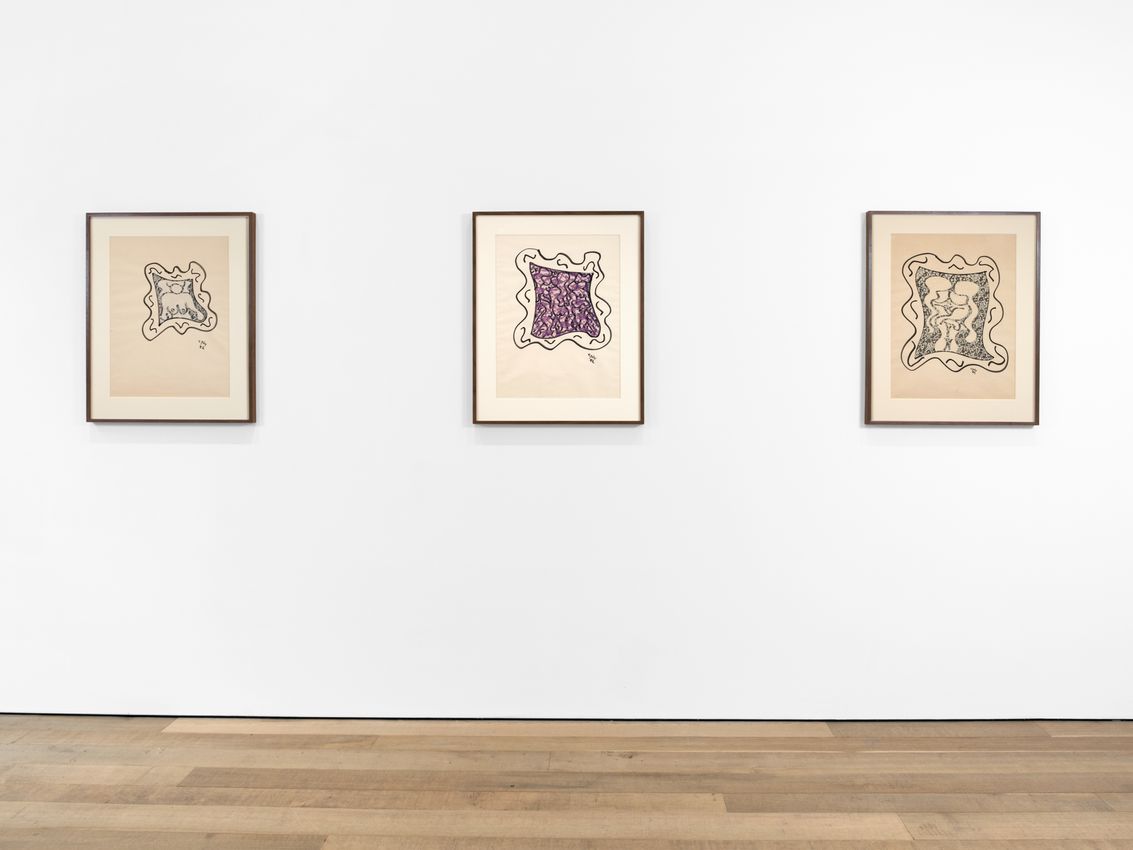
In numerous drawings, Copley used collaged lace to create a patterned gauzelike overlay through which the image appears as a flickering outline. In a sequence of works from 1982, a cartoonish frame contains an image of a single naked body or multiple cavorting bodies–interpretable either as mirror reflections or as paintings–screened by a mesh of lace. Obscuring and revealing by turns, the lace becomes a metaphor for the dimension of flirtation–an embrace of sexiness offset by an air of demurral–that came to characterise Copley’s work; he stated in 1973 that surrealism was ‘repressive and romantic at the same time and had to be expressed in that ambivalent way’.3 The use of lace reflects a fascination, evident in many paintings, with feminine accoutrements and garments (the material appealed, he once stated, for its ‘poetic connotation’).4 That fascination went beyond the merely erotic, to consider the nature of the body as an armature –the ways in which the body is staged, framed, and spectacularised.
As in his paintings, Copley’s drawings invoke art-historical precursors: an ink piece from 1991, overlaid by lace, depicts a female figure undressed and holding a garment–or possibly a towel–around her, in an echo of the nineteenth-century formula of the ‘woman at her bath’. A cluster of nude women from the same year–their linear forms simplified to the brink of abstraction and overspread by pink lace–likewise carries echoes of the grand canvases of the Renaissance and after, in which women in mythological guises appear in various states of undress. Here, the precedent has been stripped of its dignified trappings, invoking–in the words of critic Peter Schjeldahl– ‘the bumptious charm of the comic strip.’5
1 Anne Doran, ‘The French Connection’, in William N. Copley: X-Rated, exh. cat. (New York: Paul Kasmin Gallery, 2010), p. 15.
2 William N. Copley in interview with Sam Hunter, in CPLY: X-Rated, exh. cat. (New York: New York Cultural Center, 1974).
3 William N. Copley in interview with Sam Hunter.
4 ‘Excerpts from Oral History Interview with William Nelson Copley’, in William N. Copley, Selected Writings, ed. Anthony Atlas (Cologne: Walther König, 2020), p. 146.
5 Peter Schjeldahl, ‘An Artist Who Can Make a Corkscrew His Own’, The New York Times, 24 January 1971.
William N. Copley was a painter, writer, gallerist and publisher, along the way charting a vital link between the European Surrealist and the American Pop Art movements. Recent exhibitions include William N. Copley, Drawings (1962 - 1973) at Paul Kasmin Gallery, Finally We Laugh at Galerie Linn Luhn, Düsseldorf, and a retrospective at Museum Frieder Burda in Baden Baden. His work is collected both in private and public collections worldwide. The work of CPLY has been the subject of numerous single artist shows and a traveling retrospective at the Kunsthalle Bern, Centre Georges Pompidou, Paris, and the Stedelijk Van Abbemuseum, Eindhoven, and has been exhibited in several important group exhibitions, including documenta 5 and documenta 7.


A respected voice in contemporary art discourse.
Focusing on ambitious storytelling and insightful art-world commentary. Ocula Magazine publishes in-depth interviews, critical essays and timely analysis on the artists, exhibitions and ideas driving the global art world.
Learn more about Ocula Magazine
Showcasing the best of the art world.
Ocula partners with galleries from around the world to highlight their artists, artworks and exhibitions. Gallery membership is by application and invitation, with each member vetted by an independent panel.
Learn more about Ocula Membership

Specialises in the sale of major artworks.
Led by a team with deep ties to the world’s leading auction houses, galleries and collectors. Ocula’s advisory team offers bespoke services to high-net-worth clients from around the world who are looking to acquire the best of contemporary and modern art.
Learn more about our team and services