

Press Release
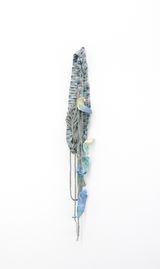
— Featuring a sound collaboration with composer Huw Hallam and soprano Frederica Cunningham. Crochet by Judith Ussher

Aphrodite—‘foam-born.’ She was the ancient Greek goddess of desire, fertility and procreation, love and beauty. Some say she was born when Cronus cut off the genitals of Uranus and threw them into the sea nearby the island of Cythera where they gestated, the goddess consequently emerging from the foam. When Aphrodite first stepped ashore, her very footsteps blossomed, leaving a trail of flowers and grass in her wake. Still today, seafood is regarded as an aphrodisiac throughout the Mediterranean region. Foam-born, Hesiod interpreted Aphrodite as having risen from Chaos, dancing on the sea. Other ancient Greek myths, such as that of the heavenly Sirens, who lured sailors to their death-by-shipwreck and feature in Homer’s Odyssey, establish a more destructive affiliation between the feminine and the watery body.

The images, myths and archetypes that subtend Michelle Ussher’s exhibition Is it your body I hold in my arms or the sea? concern the symbolic relationship between woman and water. Woman qua water—as chaos, as uncontained, shapeless and shape-shifting, leaking. As having the capacity to make something or someone float, or drown. (This liquidity inheres in the medium of paint itself, which is, of course, fluid when applied to a surface.)

Surrounding the series of paintings and ceramic sculptures in Is it your body I hold in my arms or the sea? is a score by composer and collaborator Huw Hallam. The score is a combination of field recordings—waves, water lapping at a port, the sound of urine hitting a porcelain bowl, a tap dripping—and operatic vocals by the female soprano, Frederica Cunningham. Hallam’s composition is based on the libretto written by Ussher, which was, in turn, based on six passages from British writer Ann Quin’s 1969 novel Passages, to which the artist ‘responded.’ At one point, Cunningham trills:

Go around what you cannot go through

Remain formless, flow,

Choose who

Floats who

Drowns

The score becomes the invisible support mechanism in which the exhibition’s physical objects are nested; it is the artist’s effort to ‘hold’ the show together—to contain it. Naturally, though, the sounds of Hallam’s composition are edgeless and cannot be contained—they spill throughout the gallery, the sonic frequencies rush into the bodies of viewers, at times overwhelming them, at other times seeming to lie dormant, barely perceptible.

Many of the images that surface in the paintings of this exhibition stem from a research trip that Ussher made to Greece in 2013, and therefore refer directly to the familiar postures, myths and figures of classical antiquity. In Greece, she viewed an exhibition of objects salvaged from a first-century BCE shipwreck off the coast of the Greek island of Antikythera. In 1900, divers discovered numerous coins and statues dating back to the fourth century BCE on the ocean floor, many of which had formed curious and seemingly decorative patinas from decay, due to their long-term submersion in salt water.

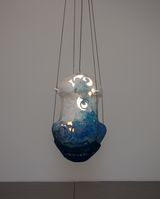
Also in 2013, Jonathan Glazer released his film Under the Skin to the applause of many critics who lauded it as a strong feminist science-fiction story, and to the annoyance of Ussher, who viewed it as yet another rehashing of misogynistic stereotypes on screen. Glazer’s film traces the story of a sexless alien beamed down to earth who then promptly adopts the highly sexualised body of one Scarlett Johansson. For whatever unknown reason, the alien hunts down men off the street whilst driving a large white van, she seduces them, and then kills them through their sex act by a miraculous, supernatural form of drowning followed by rapid evisceration. Ussher related the film to the medieval English myth of Viviane, the Lady of the Lake, who seduced the sorcerer Merlin in order to purloin his spells. Once she had extracted them, Viviane dispensed with Merlin—trapping him in a cave, under a rock, or in the stump of a tree, depending on which story you read. Merlin’s head is represented in one of the hollow, white and blue–painted porcelain vessels. Light and sound drift through the perforated bust, no longer a whole.

Combined with the images and myths of antiquity that drift on the surfaces of Ussher’s canvases in Is it your body I hold in my arms of the sea? are more contemporary images—made possible only by Photoshop. In processing her irritation with Under the Skin, Ussher Googled “Scarlet Johansson porn,” looking for images in which Johansson’s face had been stitched onto pornographic actresses’ bodies. She focused on an images of “Scarlet Johansson” in water scenes. The willingness of people to cut up the digital body of Johansson (to behead her) and splice it with other, less renowned actresses reflects the violence enacted on her character in the second half of Under the Skin, where whatever was supposedly triumphantly feminist about the first half of the film is utterly and traumatically inverted. In the second half of the film (N.B., spoiler imminent), Johansson abandons her alien connection in search of a human, female identity, only to become—in a reversal of the first half of the film—an all- too-familiar female victim, who is, in turn, hunted down, becomes the victim of an attempted rape, before being burnt alive.

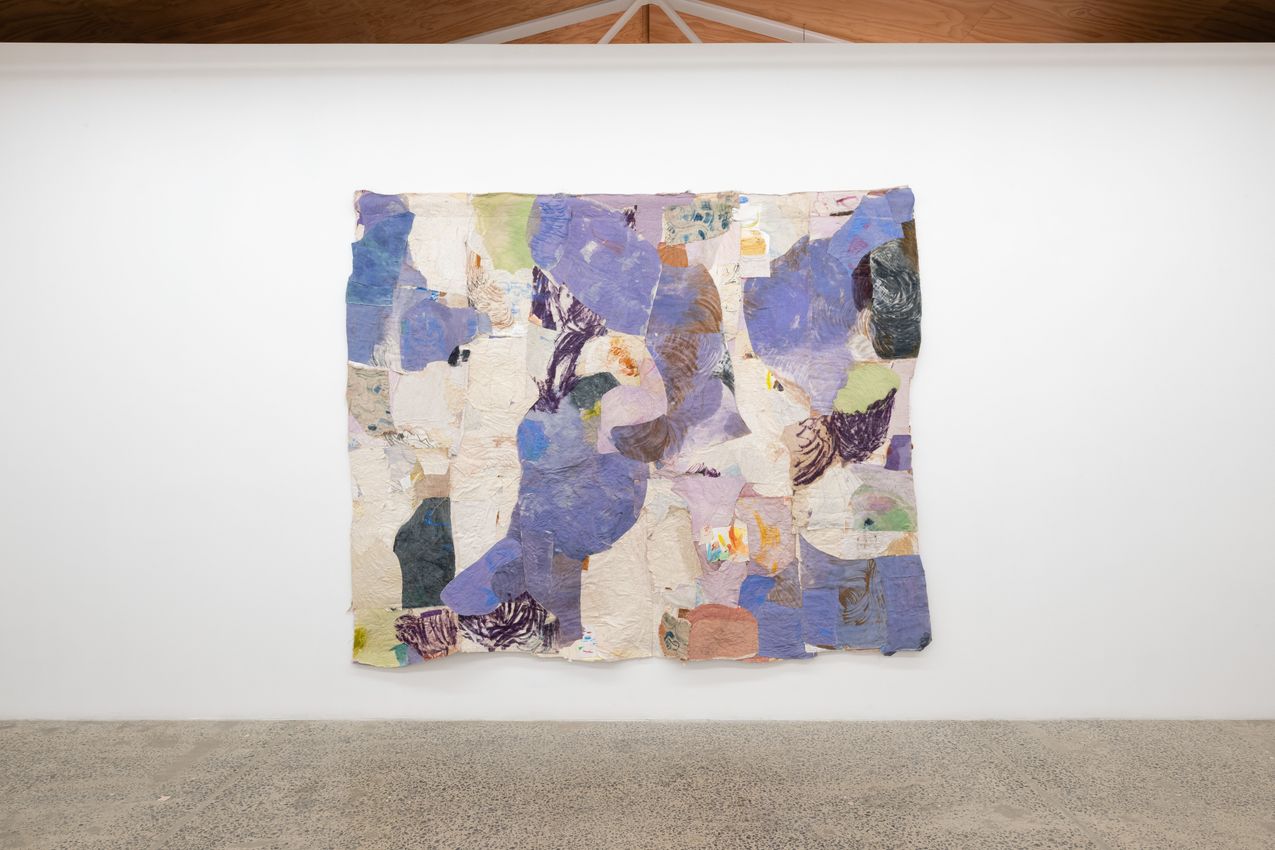
In Washing Machine Headlock of 2015, the detached head of Johansson—complete with ‘lobotomy-look’—stares up from the canvas, her body twisted at an impossible angle, curving around the perimeter of the canvas, interpenetrated by circular swells of cool, blue paint. A secondary face, eyes closed, appears to breathe-in water, or perhaps breathe-out a bubble of water, a sack of amniotic fluids.

The paintings, sounds and ceramics—a series of pools. Sites and surfaces for receiving and projecting images and objects and narratives, which float, sink and rotate. Infinitely shallow and infinitely deep.

— Helen Hughes

Also Exhibiting at STATION

About the Gallery

Established in Melbourne in 2011, with a second space opened in Sydney in 2019, STATION is dedicated to presenting an engaging, conceptually-driven exhibition program, with the aim of fostering rigorous, critically-engaged contemporary art practices. STATION represents a broad stable of established and emerging Australian and international artists. We are committed to bringing Australian contemporary art practices to international audiences and presenting opportunities for our artists to be positioned within a broader global dialogue.

View Gallery Profile
Address
9 Ellis Street
South Yarra
Melbourne
Australia
Opening Hours
Tuesday – Saturday
10am – 5pm
(1)
Melbourne 9 Ellis Street, South Yarra
STATION
9 Ellis Street, South Yarra, Melbourne, Australia
+61 3 9826 2470
http://stationgallery.com

Opening hours
Tuesday – Saturday
10am – 5pm
The art world in focus