

Press Release
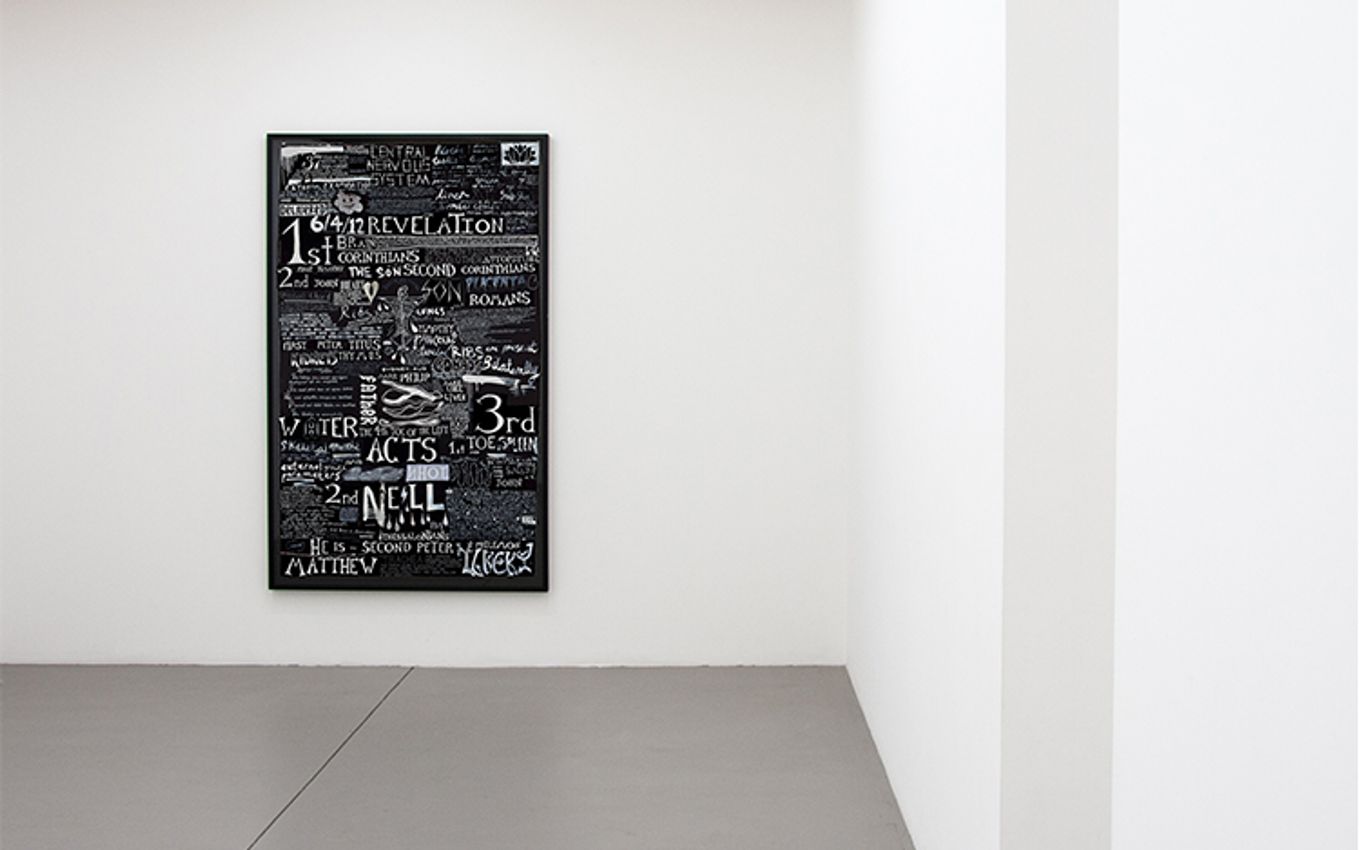
So many words here, so much writing. A bloody welter of phrases, titles, signs; fragments, text covering the entire surface of the painting. As if writing it, and reading it, in many different ways, over and over again, can finally make one fact irrefutably real. All these words to nail what words can barely express. That THE FIRSTBORN IS DEAD.

What sort of sense does this concatenation of tumbling words make? Each one makes up a piece of the larger puzzle. A multitude of different scripts articulates a proliferation of discourses — medical, musical, Biblical, local, personal — taking up all the available space, each clamouring for attention. The particulars of the autopsy, when you piece them together, cohere into a certain kind of account, if not an explantation; the names of the Epistles of Saint Paul - Timothy, Corinthians, Titus, Romans - speak of the consolations of companionship and loving kindness. Actually, Nick Cave and the Bad Seeds spoke it first, in the title of their second studio album in1985, singing about Elvis Presley’s stillborn twin, Jesse, and Tupelo, Mississippi, their birthplace.

Maybe this musical source that makes the painting so percussive? Thrumming humming rhythms course through its black and white. AC/DC is there, too, even a Marshall amp, though smudged and muted, and a snare, which might a drum. These rhythms play through restless variations in the sizes and styles of the texts— cursive, punkish, gothic, outlined — in their urgent crowding, and in their occasional horror-show melting. Which takes me to a smiley emoji, and the state of New South Wales’s official graphic waratah, and pictograms of shocking frankness, and the rebus, and all the ways that writing and pictures co-mingle, in life as well as art. This slip-sliding between text and image is happening all over the painting. It manifests the struggle to articulate enormity. And the artists’s name, near the bottom, is weeping salty tears. Or blood.

The furious energies of these scripts drives we viewers to an unusual amount of activity: we are made to read, to scan, to search; to move up, across, down, sideways. To the corners, to the extreme edges of this proclamation. Saccadic movements of the eye respond to staccato changes in size and pace in the scripts: there is no one place to come to rest. This suggests the deliberately disjunctive styles and size of scripts used on historical broadsheets, or theatre bills, where the layout tells of many matters, and each element cries out to be noticed. The great New Zealander Colin McCahon has shown us this way, with text paintings speaking of the land and the Lord and heartache. Here the structure of the work voices agitation, or rather action, driven activity. No one script will do. All of them are necessary.

Yet with these multiple utterances actively dispersed across the painting, there is also a strict bodily architecture embedded in it, a sort of skeleton. The painting is large enough to encompass our bodies, since it is scaled to the height and arms’ reach that this first born will never inhabit. In this way, it is like a shroud. On it texts are laid out before us for scrutiny, with a dispassion that is almost forensic; nothing is hidden, there is legibility, of a sort. The structure is bilateral, like the human body: one scans down the centre from the proclamation of the ‘central nervous system’ at the very top, through Revelation, past the brain, to Corinthians. At the heart centre is a surrogate, the famous second century Roman graffito of the crucified man from Puteoli, the ancient port where the Apostle Paul landed on the Italian peninsula on his way to Rome. Yet this schematic body no longer exists in its lived wholeness — we already know about its dissection. The bilateral logic of the human body is now pulled apart: elements like gonads and kidneys and the 4th toe of the left foot can now be specified, individually, for our consideration.

In its insistence on noting every one of these small details,THE FIRSTBORN IS DEAD is, in a sense, incantatory. It sings in many parts, it summons a strong contrapuntal principle. What looks at first glance to be excessive loquacity, or the babbling incoherence of logorrhoea, turns out instead to be a strenuous and disciplined lament. Each word inscribes pain, loss, sadness. (The name of this first born himself is there, too, if you know where to look). Writing is how we come to know what we think, so it follows that painting out these words is one way to arrive at understanding. This is necessary work. Shout it out, I say. Speak and sing grief. It owns its place in the world. That does not make it any less painful, yet there is help at hand: in song, in scripture, in knowing that others have passed this way before.

The stark black and white texts on the painting carry the irrefutable letters of the various laws that govern life and death. But the bowl accompanying it is golden. It is small, and it is empty. Well, almost, there is a single dead blowfly. It recalls both the famous fecundity and the mortality of the fly, which was celebrated by the ancient Egyptians; in this country it partners us in the great Australian salute. (Nell tells me the Zen poet Issa said ‘Where there are humans, you’ll find flies.’) Ironically, while we can see that the painting groans and howls and screams, this silent empty vessel also resounds. The little glowing bowl rings and sings. Of loss, and sorrow, but also of the potentiality of love. In his beautiful first letter to the Corinthians, Saint Paul, the Christian forever associated with love, tells us that ‘Love never fails’.

THE FIRSTBORN IS DEAD, that is a fact. But it is not the end of this story.

- Julie Ewington

Also Exhibiting at STATION

About the Gallery

Established in Melbourne in 2011, with a second space opened in Sydney in 2019, STATION is dedicated to presenting an engaging, conceptually-driven exhibition program, with the aim of fostering rigorous, critically-engaged contemporary art practices. STATION represents a broad stable of established and emerging Australian and international artists. We are committed to bringing Australian contemporary art practices to international audiences and presenting opportunities for our artists to be positioned within a broader global dialogue.

View Gallery Profile
Address
9 Ellis Street
South Yarra
Melbourne
Australia
Opening Hours
Tuesday – Saturday
10am – 5pm
(1)
Melbourne 9 Ellis Street, South Yarra
STATION
9 Ellis Street, South Yarra, Melbourne, Australia
+61 3 9826 2470
http://stationgallery.com

Opening hours
Tuesday – Saturday
10am – 5pm
The art world in focus