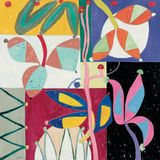




Gillian Ayres (1930 - 2018) was an influential English painter renowned for her large, vividly coloured abstract works and prints, characterised by thick layers of pigment that draw from diverse styles and movements. Ayres viewed abstract painting as a vital language reflecting the energy of the 20th century and its evolving relationship with nature and society. Rather than depicting figures or landscapes, she explored the materiality of painting, often placing the canvas on the ground to engage with the physicality of her work. This approach allowed her to experiment with shapes, colours, and textures that convey a spectrum of emotions.Her early works featured thin vinyl paint in simple shapes, while her later oil paintings became more exuberant and colourful, created with thick layers of paint. Titles were often assigned post-creation, resonating more with the work’s mood than its content. Ayres also produced ambitious prints using various techniques, including etching and woodcut, culminating in a significant body of graphic work in her later years.
Central to her art was a desire to touch on something beyond control, seeking to express what she termed ‘the end of the line,’ which mutates visually in expansive colours and shapes. While influenced by American Abstract Expressionism and Colour Field Painting, her work also reflected her admiration for artists like Henri Matisse.
Ayres maintained a deep connection with natural elements drawn from her experiences in England and travels abroad. She preferred to let her creativity flow organically, stating, ‘I like to let things happen and to be overwhelmed by the intensity of the experience.’ Using her fingers and various tools, she emphasised the physicality of painting, contrasting with the heroic gestures of Action Painting.
Ayres entered Camberwell School of Arts and Crafts at sixteen and participated in the first Young Contemporaries exhibition in 1949. Her first solo show was at Gallery One in 1956, and she later enjoyed a long teaching career, becoming the first woman to head the art department at Winchester School of Art. After leaving education in 1981, she focused entirely on painting, leading to numerous exhibitions, including a retrospective at the Serpentine Gallery in 1983 and a recent show at the CAFA Art Museum in Beijing in 2017.
Statement from Sam Mundy, son of Gillian Ayres and curator of the exhibition:
‘Our late Mother Gillian Ayres always knew she wanted to be a painter. If she was not painting, she was thinking about painting. Her personality was intense, and art was that intensity.
She spent her life looking at a wide range of art, both in books and travelling to museums, galleries and archaeological sites. For my brother and I, this was simply a part of growing up, as was turning sideways to squeeze through the narrowing hallways of home which were used to store paintings by both of our parents.
Gillian was never comfortable with anyone watching her paint. It was not until 1990 in Jaipur, India, when she painted two large works in the Art School for the Indian Triennale the following year, did I watch her paint for the first time. Students came in and out all day and sat on the floor or on chairs and talked to her while she worked. From this point onwards we saw her paint (often standing on top of wobbly ladders reaching for the tops of large canvases) as she made the art that she thought ought to exist.
For much of her life Gillian held a great fascination for China and had always wanted to visit. She had an enormous love of the art and cultures of the country, and that extended to a love of its varied landscape and gardens. Being a keen gardener, she liked living in the South-West of England because the soil is similar to that of Sichuan Province, making it suitable for the many Chinese plants in her garden. By the time of her first exhibition in Beijing, at the Central Academy of Fine Arts (CAFA,) she was sadly unable to make the journey, however the reaction to the exhibition delighted her.
It is a great privilege that she has this, her first solo exhibition in Hong Kong, at the Tang Contemporary Art, and I am deeply honoured and grateful that they have asked me to be the Curator of this exhibition.’
Sam Mundy


Tang Contemporary Art was established in 1997 in Bangkok, later establishing galleries in Beijing and most recently Hong Kong. Tang Contemporary Art is fully committed to producing critical projects and exhibitions to promote Contemporary Chinese art regionally and worldwide and encourage a dynamic exchange between Chinese artists and those abroad.

A respected voice in contemporary art discourse.
Focusing on ambitious storytelling and insightful art-world commentary. Ocula Magazine publishes in-depth interviews, critical essays and timely analysis on the artists, exhibitions and ideas driving the global art world.
Learn more about Ocula Magazine
Showcasing the best of the art world.
Ocula partners with galleries from around the world to highlight their artists, artworks and exhibitions. Gallery membership is by application and invitation, with each member vetted by an independent panel.
Learn more about Ocula Membership

Specialises in the sale of major artworks.
Led by a team with deep ties to the world’s leading auction houses, galleries and collectors. Ocula’s advisory team offers bespoke services to high-net-worth clients from around the world who are looking to acquire the best of contemporary and modern art.
Learn more about our team and services