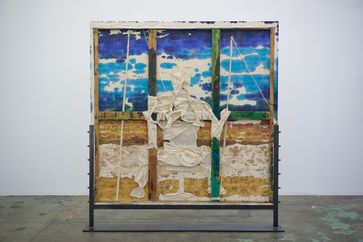
In this survey exhibition of paintings by Dona Nelson, Thomas Erben Gallery revisits and reconsiders the motivations of an artist widely regarded as one of the most vital, intellectually considered, aggressively tactile and physically inventive American painters of her generation. This is Nelson’s second exhibition with the gallery following her critically acclaimed solo, Brain Stain, in 2006.
The trajectory of Nelson’s artistic development is as multi-faceted as it is focused. A true ‘painter’, her insistence on the primacy of this art form goes hand-in-hand with her refusal to slow her exploration of the medium’s potential by resting upon a single style or form.
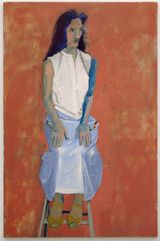
In small-scaled, minimal works from 1973, we see already inclinations in Nelson’s work to what is self-described as the ‘surreal real’. In particular No title, 1976, reproduced in Heresies, illustrating Nelson’s 1977 essay Growing up a Painter), unveils the tension between abstraction and figuration which remains a productive source for the artist to the current day. Doretta, 1983, the only portrait on view, is perhaps the most deceptive; being an evocation of cubism with its concern for two-dimensional space while reimbuing the female figure with a sense of presence and identity.
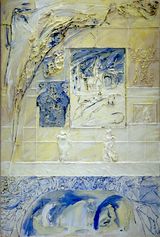
As Brooks Adams wrote in 2003 on the exhibited Pennsylvania Nativity, 2001:
‘Nelson uses a humble if more emotionally remote source; a faded colour postcard reproduction of an anonymous folk-art rendition of that holiday-season perennial. Here a pale, almost marmoreal appearance of the cheese-cloth construction, inflected by graphite shading and acrylic medium in-fill, greatly amplify the postcard’s wan, second-hand image of what appear to be a Greek Revival temple and the figures of the Three Wise Men, somehow seeming to bring us closer to some original devotion.
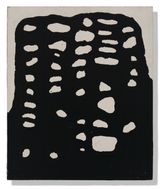
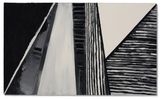
In Southwestern New Jersey, September, 2003 and April, 2008, the most recent works included, painting bleeds into sculpture and performance most fully. Arising spontaneously through staining and water-hosing the canvases from the ‘back’ the result is a two-sided painting, in which both sides are given equal conceptual weight. The experientially physical manner through which Nelson develops her work, pushes our viewing habits beyond the use of signifiers–occasionally present–as an intermediary, towards the dissolution of the classical distinction between mind and body. Depicting all experiences as inherently physical and therefore subjective, Nelson leaves space for us to enter each work imaginatively yet corporeality is implied.
Over the years, Nelson’s work has received extensive critical support including numerous reviews in the New York Times, Art in America, The New Yorker, The Village Voice, and Artforum. Her work has been favoured and discussed by many notable curators and historians such as Lucy Lippard, Klaus Kertess, Lisa Liebman, and Sanford Schwartz. The Metropolitan Museum of Art, the Weatherspoon Art Museum, the Guggenheim Museum and other notable institutions as well as private collections have included Nelson’s work in their holdings.


Dona Nelson is a painter who often works both sides of a stretched canvas, staining and washing it with acrylic paint and water, using a spatula to mark the canvas with the first image, an image of the stretcher bars. Sometimes she glues strips of fabric on to the canvas, allowing them to be a constructed element or ripping them off them off to establish a drawn line through the paint. Nelson prefers to exhibit her two sided paintings on steel stands or wooden constructions, out on the gallery floor rather than parallel to the wall. For forty years, Nelson has made series of different kinds of paintings, distinguished by a variety of approaches to both image and material.

Established in 1996, Thomas Erben Gallery focuses on rediscovering and introducing artworks that expand or deviate from the media usually associated with an artist.

A respected voice in contemporary art discourse.
Focusing on ambitious storytelling and insightful art-world commentary. Ocula Magazine publishes in-depth interviews, critical essays and timely analysis on the artists, exhibitions and ideas driving the global art world.
Learn more about Ocula Magazine
Showcasing the best of the art world.
Ocula partners with galleries from around the world to highlight their artists, artworks and exhibitions. Gallery membership is by application and invitation, with each member vetted by an independent panel.
Learn more about Ocula Membership

Specialises in the sale of major artworks.
Led by a team with deep ties to the world’s leading auction houses, galleries and collectors. Ocula’s advisory team offers bespoke services to high-net-worth clients from around the world who are looking to acquire the best of contemporary and modern art.
Learn more about our team and services