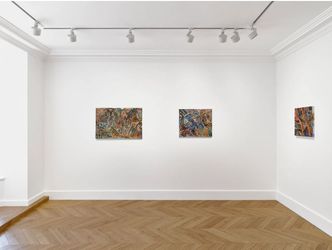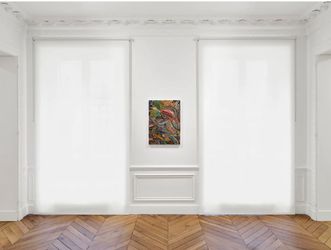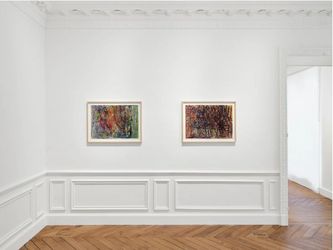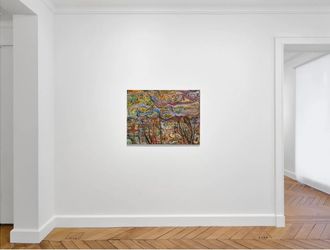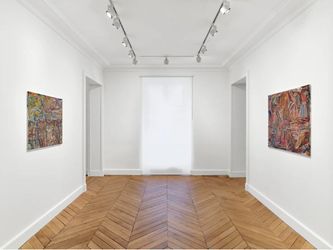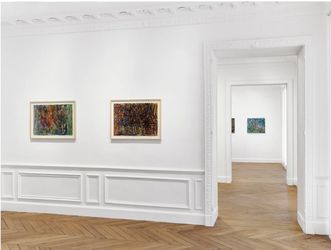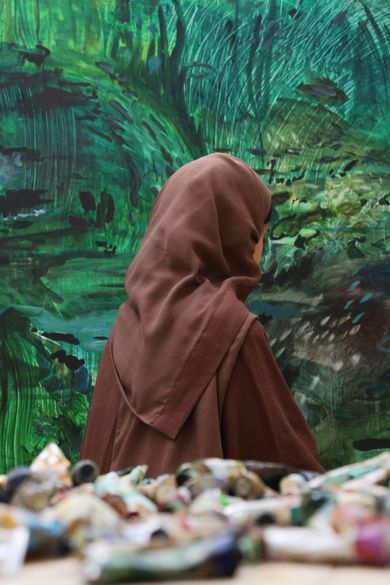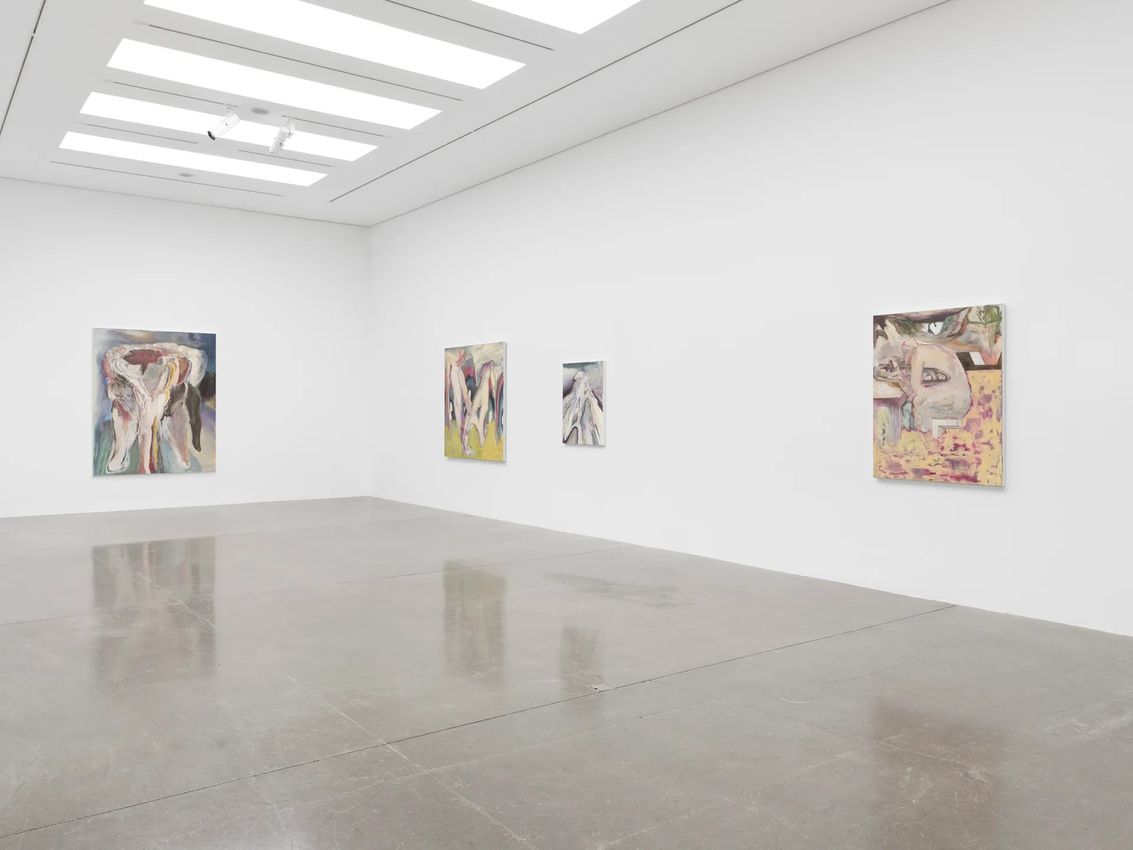




White Cube Paris is pleased to present Saudi Arabian painter Alia Ahmad’s first solo exhibition in Europe. Inspired by the industrialised desert of Riyadh, the colours of Sadu textiles and forms of calligraphy, Ahmad creates placid dreamscapes that excavate the connections between memory, time and space.
Exploring movement as a framework for understanding place and belonging, the artist narrates the convergence of landscape and memory, negotiating the vital role of change, adaptation and remembrance in the migratory rituals of the Bedouin and the environmental and industrial fluctuations of her home city, Riyadh. Deriving its name from the Arabic word ‘garden’, Ahmad finds potent visual and symbolic expression in the vast compendium of plant life to be found in Riyadh’s arid desert zone – thriving in spite of the inhospitable terrain.
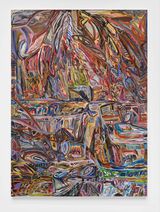
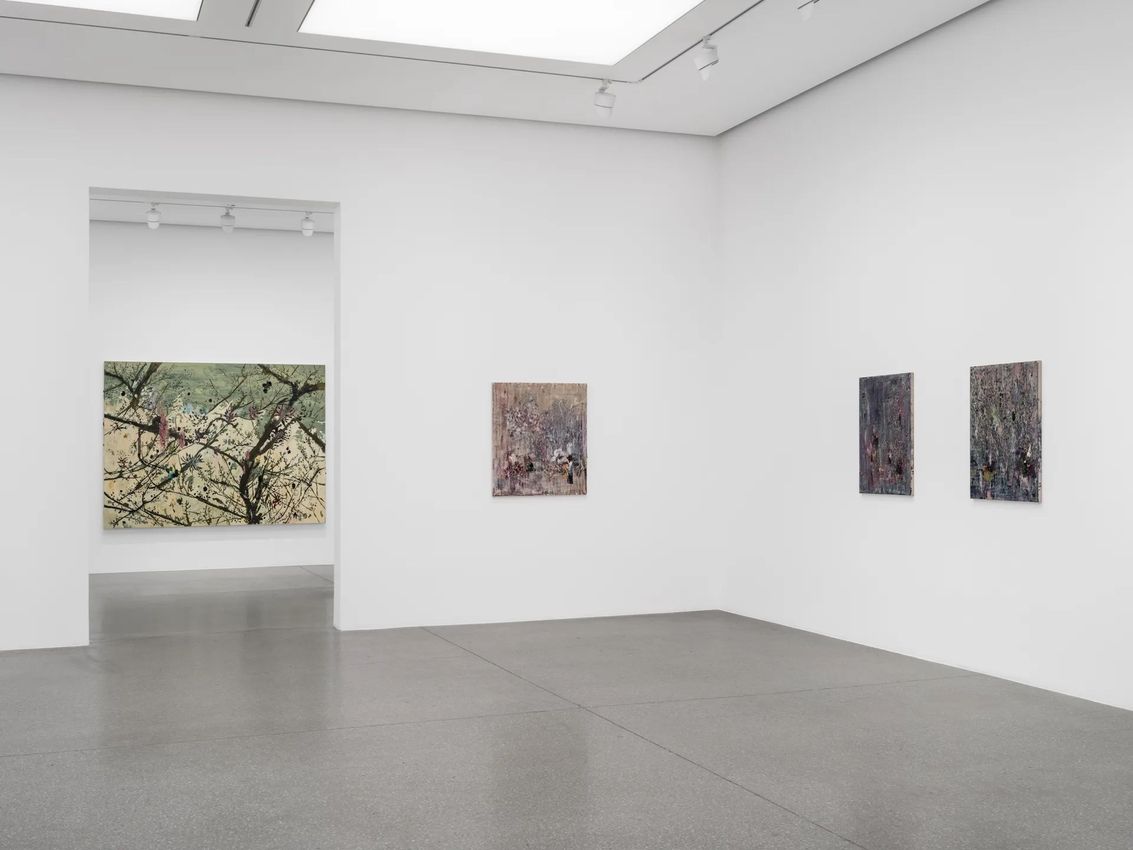
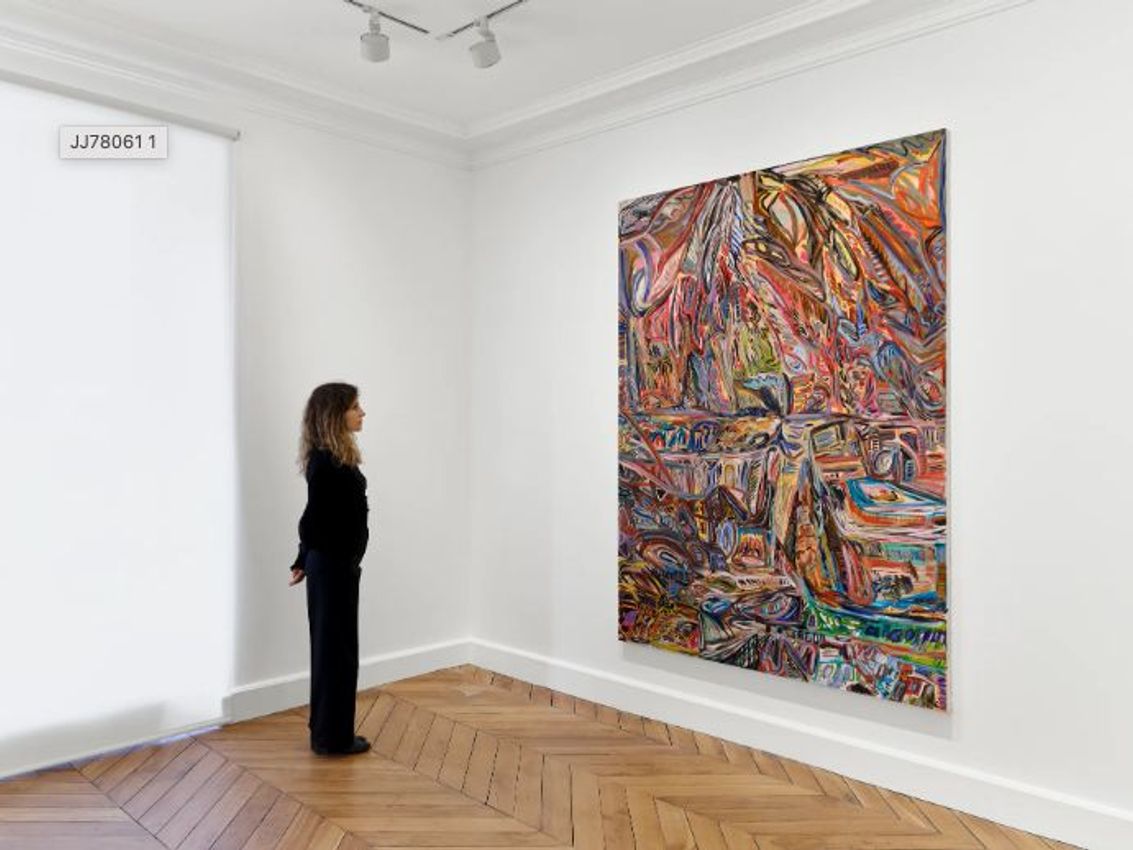
Characterised by bold, Fauvist colour, Ahmad’s paintings fuse aggregated space with restive, gestural abandon, within which more intentional structural traceries emerge. Sinewy, linear markings, created through finer impressions of white pastel, charcoal and ink, trace the vegetal patterning of foliage and flora native to the region, naturally segmenting compositions into gestural and tonal zones, where interactions of light and shade and layered impasto colour playfully combine. Through her controlled, directional brushwork, Ahmad’s paintings assume layered meaning, immersing the viewer within deep enclaves of lush foliage, which in turn resonate with the traditional practices of the Bedouin tribe, who migrate into the desert during the rainy winter season when the land is at its most abundant.
Drawing both from real life as well as memory, Ahmad aligns her practice with Bedouin approaches to temporality, rejecting the four-season meteorological paradigm in favour of a more intuitive reliance on daily observations of weather, vegetation and pasture. Adopting this alternative model of time, the artist tethers experiential moments to a localised, more variable temporal structure. In her compositions, seasonal and diurnal cycles appear to merge into one, within which foregrounded areas of verdant growth yield to entropy and decomposition, and light and shadow oscillate between the framed spaces – such as in _Noodh (Reflection of light) _(2023), whose rippled striations of viridescent green jostle for space within a nocturnal colour palette of mahogany and ink black. Marked by a sense of fluid dissolution, as though envisioned through the haze of desert heat or dense veils of rainfall, Ahmad’s paintings trace shifting moments – fusing scenes at once intuited, abstracted and remembered.
The glyphic lyricism of Ahmad’s work references wider art forms integral to Saudi culture, notably traditional Al Sadu weaving. Crafted by Bedouin women using locally sourced fibres, Al Sadu textiles are woven in a horizontal style, lending an attuned symmetry to the repetitive, colourful patterning that evoke the rich colour tones of the desert landscape and connect threads of identity, locale and history into each design. Primarily executed on small-scale canvases, Ahmad develops her compositional frameworks much like a weaver setting up their skeleton of threads, beginning with gridded patterning and foundational forms, such as the triangle and diamond, from which to build her abstract designs.
Suspended within narrative realms inspired by Bedouin poetry and folklore, Ahmad’s gestural marks convey a distinctly calligraphic quality, evoking the cursive beauty of Arabic script, which is characterised by its leftward slant and diacritic markings that decorate the written word. A nuanced and versatile language, continually evolving in vocabulary, the artist imbues her paintings with a similar openness to interpretation – one rooted in Saudi culture and tradition while remaining flexible to collective and personal memory, the shifting currents of contemporaneity and the immediacy of the felt moment.
As a witness to her changing surroundings, Ahmad’s paintings occupy a notable place within the contemporary milieu. Emulating the heightened colours and flattened perspectives found in digital graphics, a subject the artist studied prior to painting, Ahmad builds new, imaginary landscapes, informed by the modern world while also summoning the movements undertaken by the people and natural landscapes of her homeland – the voyage of the clouds.
Press release courtesy White Cube


Blending Islamic art traditions with dreamlike figuration, Alia Ahmad creates contemporary artworks that explore cultural identity, spirituality, and the poetics of everyday life.
An international art powerhouse, White Cube was established in 1993 in London by art dealer Jay Jopling. In its space on Duke Street, it served as the early exhibition venue for many now internationally acclaimed British artists, including Tracey Emin, Gilbert & George, Rachel Kneebone and Antony Gormley, who still show with the gallery today.

A respected voice in contemporary art discourse.
Focusing on ambitious storytelling and insightful art-world commentary. Ocula Magazine publishes in-depth interviews, critical essays and timely analysis on the artists, exhibitions and ideas driving the global art world.
Learn more about Ocula Magazine
Showcasing the best of the art world.
Ocula partners with galleries from around the world to highlight their artists, artworks and exhibitions. Gallery membership is by application and invitation, with each member vetted by an independent panel.
Learn more about Ocula Membership

Specialises in the sale of major artworks.
Led by a team with deep ties to the world’s leading auction houses, galleries and collectors. Ocula’s advisory team offers bespoke services to high-net-worth clients from around the world who are looking to acquire the best of contemporary and modern art.
Learn more about our team and services