



Press Release

‘I want a painting to be able to read like a poem or a nightmare, to evoke a young lifetime’s worth of cultural gunk, great paintings, friction, disillusionment, jubilation, heartache... I want a painting that I can be totally consumed by...’ – Danica Lundy.

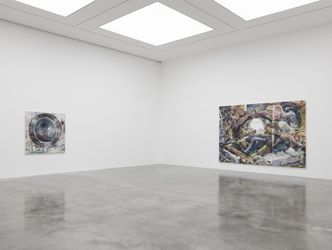
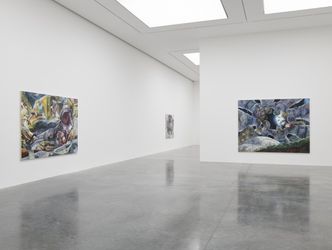
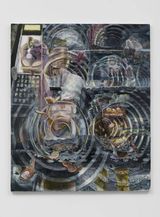
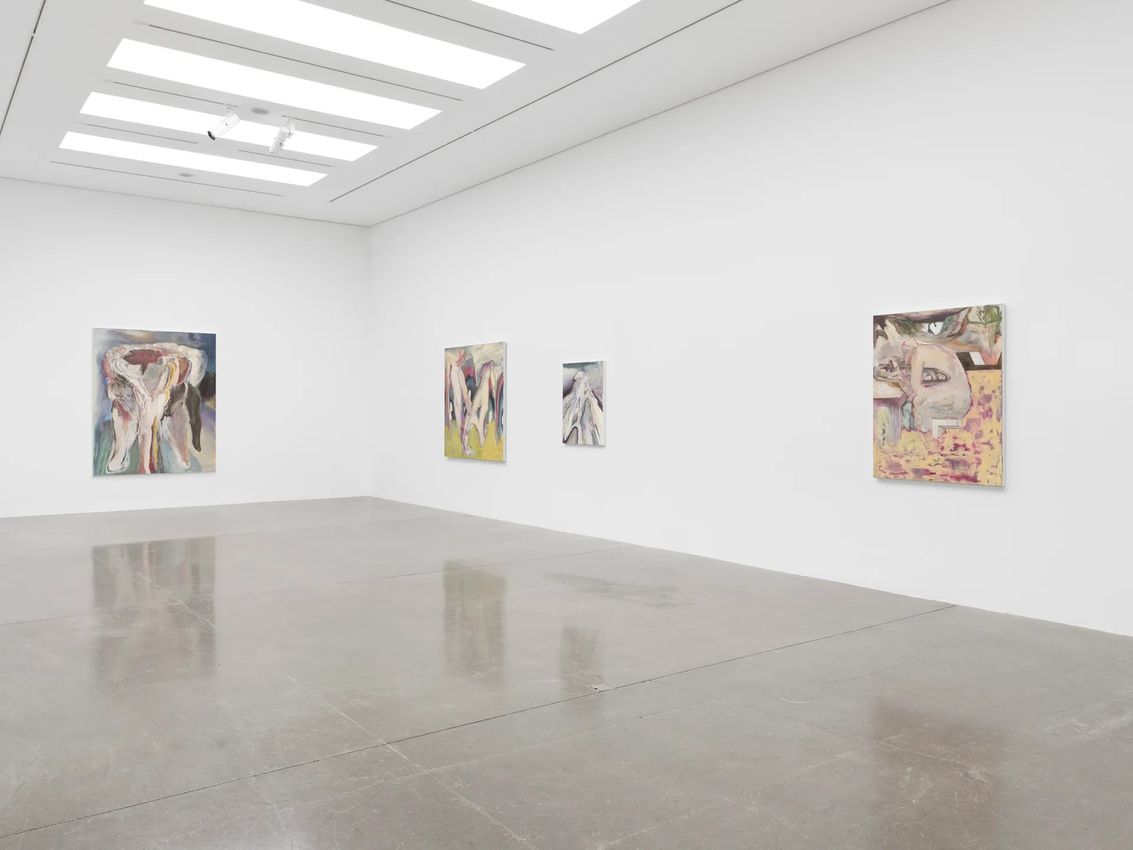
White Cube is pleased to present Stop Bath, Danica Lundy’s first solo exhibition in London. Featuring a group of monumental paintings made during the past year, the exhibition demonstrates Lundy’s particular visceral figuration; a sensorial and visionary form which the artist describes as a ‘hyper-reality that shows everything at once’.

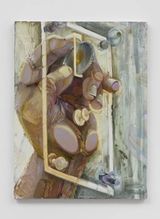
Lundy’s paintings are compositionally complex and slow to reveal their nature. Alive with incident, autobiography yields to larger themes in these polyphonic narratives that reflect the varied theatre of human life: from the epic to the banal, and the torrid to the ecstatic. Lundy exploits painting’s potential for panoptical vision, using multiple perspectives and hybrid forms to evoke sensations, sights, smells and sounds in her vast tableaux of colliding realities.

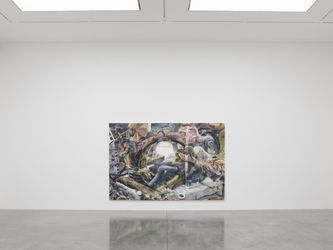
Produced in the shadow of the death of her father, a photographer for a local newspaper, Lundy’s choice of title for the exhibition is both a tribute to him and a metaphor. Referring to the last stage in photographic development, where a fixing agent is used to secure the final image, Stop Bath suggests a vision arrested, as well as a memory preserved. One of the largest paintings in the exhibition, Chamber (2022), melds personal memories with technical erudition in a scene framed by the parts of a dis-assembled camera. The lens forms a circular aperture in its centre, within which the artist’s ailing father reclines on a hospital bed flanked by two young women. Surrounded by a mass of interlocking, layered motifs – wheels, cogs, cords, medical equipment, mirrors, brass and metal knobs and bolts – the ensemble suggests a musing on photography in relation to the painted image and modes of seeing and depicting, as well as a statement on the role of the camera within her father’s life.

In works such as Overtime and Romancing the Sink (both 2022), the artist revisits the subject of adolescence. Depicting these youths using a range of painterly techniques, from loose washes to built-up passages of paint, the physical terrain of her paintings themselves suggests the abrupt shifts, accelerated growth and important changes that make up the teenage years and the journey towards self-realisation. Addressing how it feels to inhabit a body and how this inflects our perceptions, Lundy makes an explicit connection between emotional uncertainty and bodily discomfort. She uses her subjects as ‘receptacles for chaos and danger, improvisation, risk and ecstasy’, as a means to reflect and embrace an overwhelming sense of abandon.

Mechanical, David Cronenberg-like motifs crowd her paintings, and cars often feature as intimate spaces in which to frame events. In Baby can you see through the tears (2022), a woman is shown behind the wheel, seen from floor up, as if we are lying at her feet. Statuesque, the car seat behind her a boxy, glittering throne, the subject’s face is expressionless, her gaze towards the road ahead. Floating in the foreground of the painting, an oversized ignition key, smouldering cigarettes stuffed into a soda can and other detritus suggest the enclosing shell of the vehicle, while as if in x-ray vision, there is a cutaway view of her femur in the cross-section of her thigh.

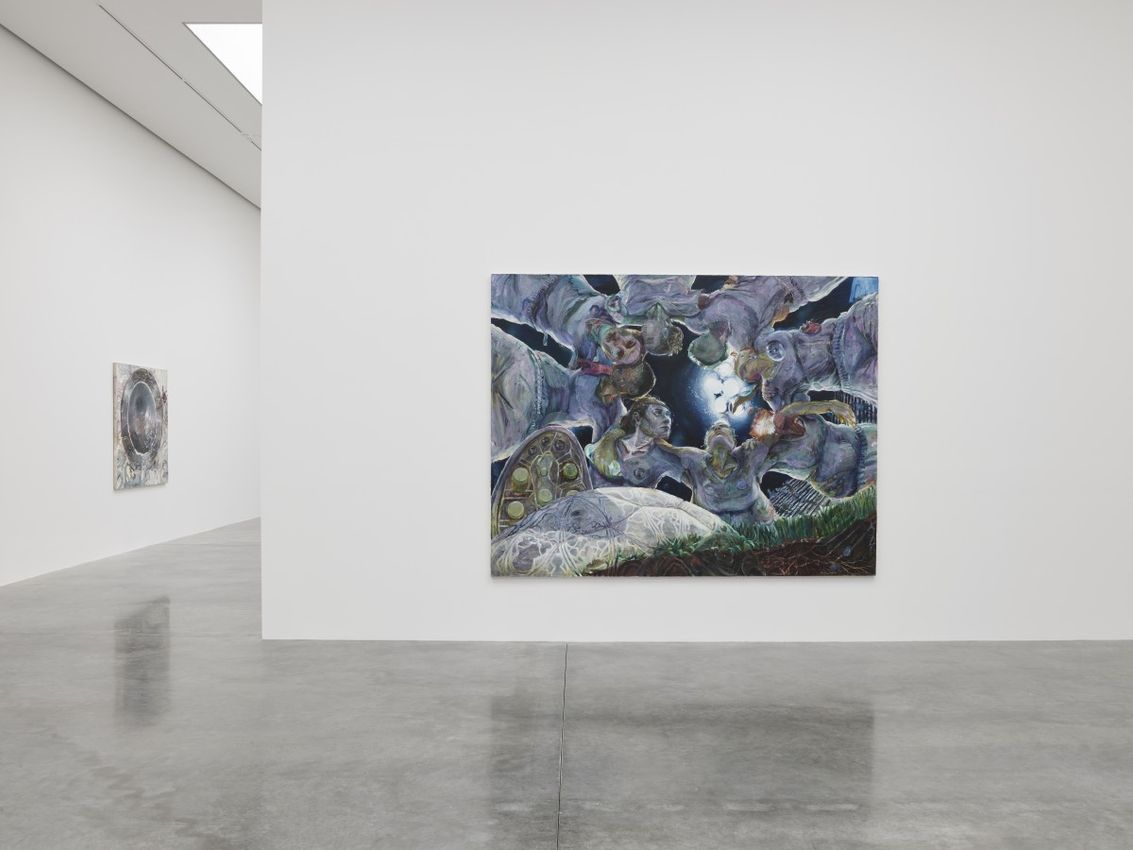
Lundy is drawn to the complex conceits and vivid metaphor of Metaphysical poetry and certain lines of John Donne were in her mind as she created these paintings. ‘License my roving hands and let them go / Before behind, between, above, below’ he writes in an address to his mistress, that Lundy takes instead as grounds for the painter’s roving attention. Her space-expanding compositions make, to quote Donne, ‘each little room an everywhere’. After the manner of early Netherlandish painting, where windows and apertures frame distant landscapes, Lundy offers glimpses beyond the confines of these worlds. Apertures, holes and openings create formal connections by the repetition of circular forms, and transfixing shafts of light are a recurring motif. In Cut (2022), for example, we look down into the vortex of a sink drain while in Overtime (2022), we gaze up into the tightly bound form of a sports huddle, the bodies creating a rhythmic enclosure, echoed above by the celestial-like ring of lights of the stadium.

Attentive to cinema’s influence on how we experience and read imagery, Lundy remarks: ‘The idea of ‘behind the scenes’ (a peek at the artifice) is a well understood mechanism. Most of my paintings point out the fact that there’s a life beyond the set, that the boom’s just out of sight. That there’s a director, a crew, a trail of their debris left behind.’ Actively drawing us in, sometimes even including her own watchful eyes in a reflection, we occupy the viewpoints of surgeons, sportsmen, partygoers, or bystanders, made aware of the mechanics of seeing and the exchange that accompanies looking and being seen.

Danica Lundy (b. 1991, Salt Spring, Canada) lives and works in Brooklyn, New York. She received her BFA from Mount Allison University, Sackville, and completed her MFA at the New York Academy of Art, where she concentrated on painting and was awarded the Leipzig International Art Programme Residency and the Chubb Post-Graduate Fellowship. A three-time Elizabeth Greenshields Foundation Grant recipient, Lundy has exhibited internationally, with solo shows in Canada, Italy, Germany, and the United States. Her work is in the public collections of Dallas Museum of Art, Institute of Contemporary Art Miami and Sydney Modern Project, New South Wales.

Read More

Installation Views

About the Artist

Danica Lundy’s sensorial, figurative paintings are compositionally complex and slow to reveal their nature. Describing her language as ‘a visceral hyper-reality that shows everything at once’, she exploits painting’s potential for panoptical vision, using multiple perspectives, hybrid forms and differing scales in her complex tableaux. ‘A painting can become a poem, a nightmare, a construction site; a lived-in arena for testing out the limits of one’s own power’, she has stated.

View Artist Profile

Also Exhibiting at White Cube

About the Gallery

An international art powerhouse, White Cube was established in 1993 in London by art dealer Jay Jopling. In its space on Duke Street, it served as the early exhibition venue for many now internationally acclaimed British artists, including Tracey Emin, Gilbert & George, Rachel Kneebone and Antony Gormley, who still show with the gallery today.

View Gallery Profile
Address
25–26 Mason's Yard
London
United Kingdom
Opening Hours
Tuesday - Saturday
10am – 6pm
(1)
London 25–26 Mason's Yard
White Cube
25–26 Mason's Yard, London, United Kingdom
+44 207 930 5373
http://whitecube.com

Opening hours
Tuesday - Saturday
10am – 6pm
The art world in focus