





LYNDA BENGLIS
b. 1941, United StatesLynda Benglis is a Greek American sculptor and contemporary artist whose poured latex, foam, and metal works have redefined the relationship between painting and sculpture since the late 1960s.
Known for her bold feminist stance and material experimentation, Benglis makes biomorphic, energetic forms that engage gravity, surface, and movement while challenging Minimalism’s rigid formalism. She lives and works between New York, Santa Fe, Kastellorizo, Greece, and Ahmedabad, India.
Early Life and Education
Born in 1941 in Lake Charles, Louisiana, Benglis was the eldest of five children in a household shaped by Southern spirituality, Greek heritage, and entrepreneurial pragmatism. Her father managed a building-materials company; her mother, the daughter of a Mississippi preacher, instilled independence and moral fortitude. Childhood trips to Greece with her widowed grandmother—a figure of unusual self-sufficiency—established what Benglis later called ‘a standard’ for female agency, quietly informing her feminist perspective.
She studied ceramics and painting at McNeese State University and earned a BFA from Newcomb College, Tulane University, in 1964. After briefly teaching third grade, she moved to New York that same year, immersing herself in the city’s postwar art scene. She trained at the Brooklyn Museum Art School, where she met Scottish painter Gordon Hart, whom she married in part to help him avoid the draft. Working as an assistant at the Bykert Gallery and later at Paula Cooper Gallery, she encountered leading figures including Andy Warhol, Donald Judd, Eva Hesse, and Helen Frankenthaler. ‘I wanted to know those artists who were part of what I considered art history’, she later told Stephanie Bailey for Ocula.
In 1979, during a visit to Ahmedabad, India, she met Anand Sarabhai, her lifelong partner from a family deeply involved in modern design and education. Their relationship reflected her openness to cross-cultural exchange. Sarabhai died in 2013.
Artworks and Style
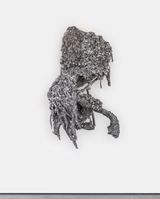
Benglis’s work is defined by sensuous surfaces, poured and knotted forms, and an insistence on bodily presence. Using latex, wax, polyurethane foam, metal, ceramics, video, and water, she exploits gravity, gesture, and material limits while resisting categorisation. She seeks ’pieces that have a presence in sculpture that goes beyond the formal attitude’, foregrounding affect, sensuality, and humour alongside structure.
Early Pours and Anti-Form, 1960s–1970s
In the late 1960s, Benglis began pouring pigmented latex directly onto gallery floors, invoking Pollock while collapsing painting into sculpture. Documented in a 1970 Life profile, these poured works soon expanded to polyurethane foam cascading into corners or against walls, solidifying into frozen gestures of movement.
Alongside the pours, she produced glitter-encrusted reliefs and radical video works critiquing gender and the ‘art-star system’. Her 1974 Artforum advertisement—a confrontational self-portrait holding a dildo—became a landmark of feminist art, satirising masculine bravado while asserting authorial control. Benglis described these works to Anna Dickie as ’sexual mockeries’ parodying how artists commodify their image.
Material Innovation and Feminist Critique, 1980s–2000s
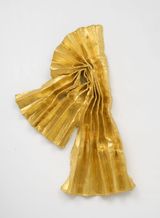
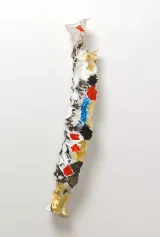
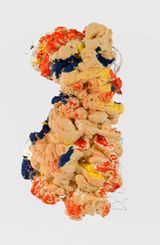
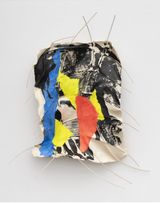
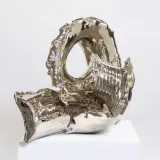
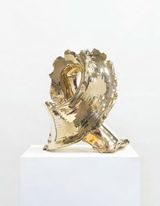
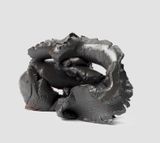
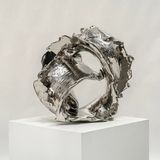
From the 1980s, Benglis cast earlier foam and latex forms in bronze, aluminium, and zinc, creating works that balance apparent fluidity with structural permanence. She also worked in papier-mâché and ceramics, challenging hierarchies between sculpture and craft. Her practice consistently refused Minimalism’s restraint, embracing excess, colour, and sensual surface.
Fountains and Global Projects, 2000s–2020s
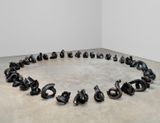
From the late 1990s, Benglis developed fountains integrating water, light, and sculptural form in public and landscape settings, extending her engagement with liquidity into architectural space. Recent work includes paper abstractions, bird-like forms such as Ohkay Owingeh (2012), and ceramics like Choctaw (2013). As she told Dickie, ’most artists prefer not to be categorised, as they believe themselves to be ever-changing. I certainly think of myself like that.’
Awards and Honours
Awards and honours include:
- 2017 – Lifetime Achievement in Contemporary Sculpture Award, International Sculpture Center, USA.
- 2014 – Anonymous Was A Woman Award, USA.
- 2010 – Honoured with a major European touring retrospective organised by the Irish Museum of Modern Art, Dublin, travelling to Le Consortium, Dijon; Museum of Art, Rhode Island School of Design; New Museum, New York; and other venues.
Exhibitions of Lynda Benglis
Lynda Benglis has exhibited widely across museums and contemporary art galleries in the United States, Europe, and beyond, with key solo retrospectives and curated group exhibitions cementing her status as a leading sculptor of her generation.
Select solo exhibitions
- 2026 – Encounters: Giacometti × Lynda Benglis, Barbican Centre, London.
- 2025 – WHAT IF?, Xavier Hufkens, Brussels.
- 2025 – Lynda Benglis: Beyond Boundaries: The Multi-Dimensional Art of Lynda Benglis, Gavlak Gallery, West Palm Beach.
- 2024 – Lynda Benglis: Recent Sculptures, Turner Contemporary, Margate.
- 2023 – Lynda Benglis, Thomas Dane Gallery, London.
- 2022 – Frozen Gestures, Mendes Wood DM, São Paulo.
- 2015 – Lynda Benglis, The Hepworth Wakefield, Wakefield.
- 2010 – Lynda Benglis (touring retrospective), Irish Museum of Modern Art, Dublin; Le Consortium, Dijon; Museum of Art, Rhode Island School of Design, Providence; New Museum, New York.
- 2009 – Lynda Benglis, Le Consortium, Dijon.
- 1993 – Lynda Benglis: From the Furnace, Auckland City Art Gallery, Auckland.
Select group exhibitions
- 2023 – Bravo, Contemporary Day Auction (works included in major secondary-market exhibitions reflecting ongoing institutional and collector interest), Sotheby’s, New York.
- 2019 – Unravelled (with works by Benglis among others examining sculpture and textile processes), City Gallery Wellington Te Whare Toi, Wellington.
- 2013 – Various group exhibitions documented by Thomas Dane Gallery and Paula Cooper Gallery, including institutional shows addressing Post-Minimalism, feminist art, and process sculpture.
- 1969 – Anti-Illusion: Procedures/Materials, Whitney Museum of American Art, New York, one of the first major exhibitions to foreground process and anti-form, in which Benglis was the only woman included.
Lynda Benglis FAQs
Who is Lynda Benglis?
Lynda Benglis is an American contemporary sculptor born in 1941 in Lake Charles, Louisiana, known for her poured latex, foam, and metal works that challenge the boundaries between painting and sculpture. Over more than five decades, she has developed a materially inventive practice that engages gravity, surface, and movement while interrogating gender, representation, and the conventions of modern sculpture.
What type of art does Lynda Benglis make?
Lynda Benglis makes abstract, materially driven sculptures, reliefs, fountains, and videos that emphasise process, gesture, and sensuous surface. Her best-known works include floor-bound latex pours, polyurethane foam pieces, knotted and cast metal forms, and fountains that extend her interest in liquidity and movement into public space.
Why is Lynda Benglis important in contemporary art?
Lynda Benglis is important in contemporary art for redefining sculpture through process-based poured works and for her outspoken feminist interventions in the 1970s. Her challenge to Minimalist austerity and her use of her own image in works she once called ‘sexual mockeries’ have made her a key figure in discussions of gender, media, and the politics of form.
Where can I see work by Lynda Benglis?
Work by Lynda Benglis can be seen in major museum collections including the Museum of Modern Art, New York, among others, as well as in exhibitions at international contemporary art galleries such as Pace Gallery and Paula Cooper Gallery. Public fountains and large-scale sculptures by Benglis are also installed in outdoor and institutional settings in Europe and the United States, reflecting her interest in works that ‘stand alone in nature’.
How does Lynda Benglis relate to feminist art?
Lynda Benglis is closely associated with feminist art because of her confrontational use of her own body and persona to critique gender norms, most famously in her 1974 Artforum advertisement. In conversation with Anna Dickie, she framed these works as studies in the objectification of the self and as parody of male posturing, positioning her practice within debates on gender performativity and representation.
What influences Lynda Benglis’ work?
Lynda Benglis’ work is influenced by Abstract Expressionism, Greek heritage, craft traditions, and an enduring interest in the physical behaviour of materials such as latex, foam, wax, clay, and metal. She has cited her desire to let sculpture ‘speak on its own terms’ and her fascination with buoyancy, movement, and the interplay between control and chance as key motivations in her practice.
Ocula | 2026
Explore Lynda Benglis' Exhibitions On Now


View Lynda Benglis' Artworks





















Lynda Benglis in Ocula Magazine






Explore and Follow Artists Shaping Contemporary Art
A respected voice in contemporary art discourse.
Focusing on ambitious storytelling and insightful art-world commentary. Ocula Magazine publishes in-depth interviews, critical essays and timely analysis on the artists, exhibitions and ideas driving the global art world.
Learn more about Ocula Magazine
Showcasing the best of the art world.
Ocula partners with galleries from around the world to highlight their artists, artworks and exhibitions. Gallery membership is by application and invitation, with each member vetted by an independent panel.
Learn more about Ocula Membership
Specialises in the sale of major artworks.
Led by a team with deep ties to the world’s leading auction houses, galleries and collectors. Ocula’s advisory team offers bespoke services to high-net-worth clients from around the world who are looking to acquire the best of contemporary and modern art.
Learn more about our team and services