Xavier Hufkens is delighted to present American artist Lynda Benglis’ (b. 1941) first solo presentation with the gallery. For over six decades, Benglis has consistently challenged artistic conventions to produce an oeuvre that is unrivalled in its formal range and material richness. Latex, polyurethane, beeswax, glass, ceramics, paper, bronze, aluminium and lead, as well as film, video and photography, are all mediums to which she frequently returns. She gained recognition through her poured latex sculptures in the late 1960s/early 1970s and for subverting the gender stereotypes of the era, most notably through the groundbreaking advertisement she took out in the November 1974 issue of Artforum.
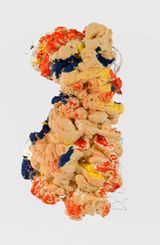
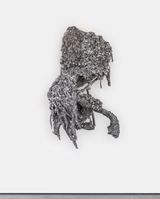
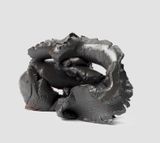
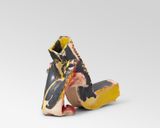
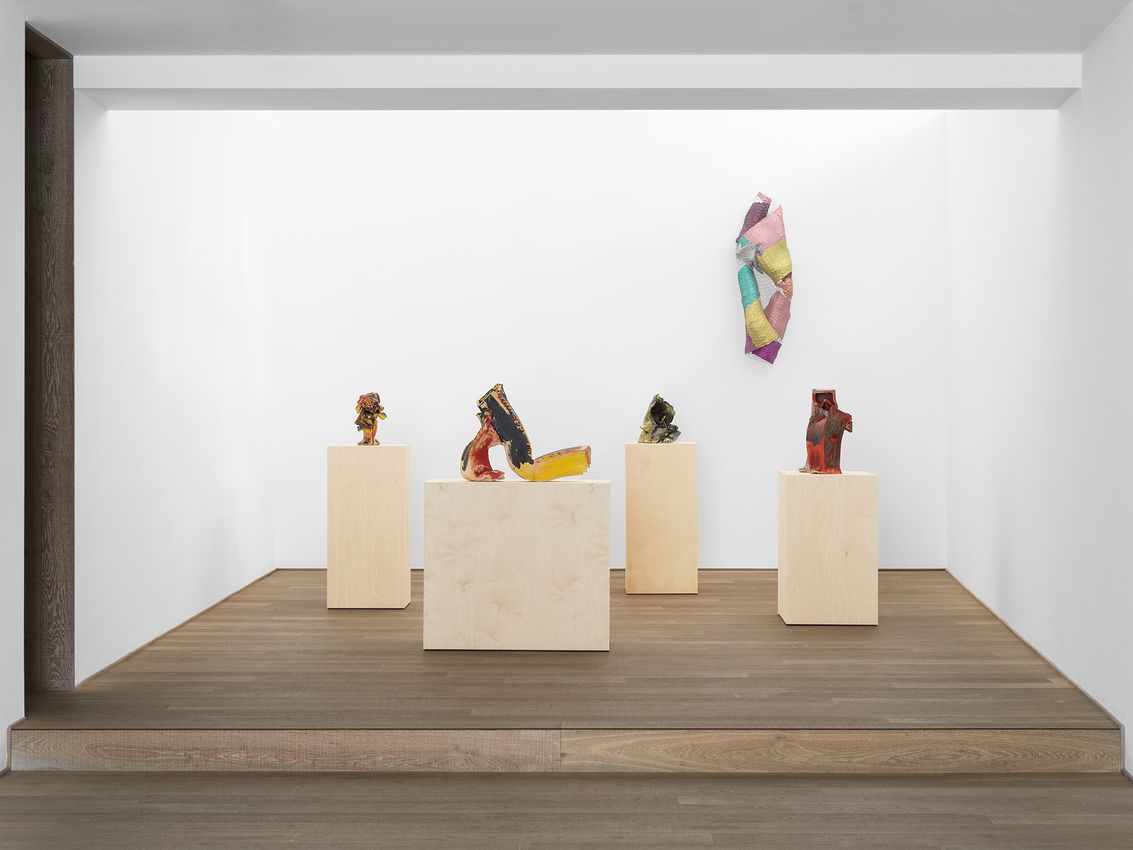
In this presentation, a series of recent wall-mounted ‘sparkle paper’ sculptures are shown in conjunction with a group of ceramics. Although seemingly incongruous in terms of scale and technique, the works on view share interesting similarities of approach and are consummate examples of the artist’s radical take on materials and processes.
The glitter-saturated sculptures exemplify Benglis’ instinctual approach to form and colour. To create these works, she moulds sheets of wet, glitter-soaked paper around a metal armature made from chicken wire. Once dry, the works are sometimes augmented with expressive gestures in black tempera made with coal dust. Wire, glitter and paper are not new materials to Benglis, who first started experimenting with such media in the early 1970s. The columnar form is also a recurring motif. Tactile, refractive and alive with movement, the surfaces of the works express the principal leitmotiv in Benglis’ oeuvre, namely the visual representation of material in action, or what is often termed ‘the frozen gesture’. Benglis smooths the sensual and malleable paper—as fragile as human tissue—around the armatures like a skin; a process that she likens to ‘fleshing the form out.’ The duality of the works is even reflected in the creative process, which involves brute physical force (two people to manipulate the wire) and manual dexterity (shaping the paper).
Benglis uses a similar combination of techniques to create her ceramics, which are partially made using an industrial extruder (which produces uniform circular or squared tubes of clay) but also by hand, with the artist shaping, bending, tangling and collapsing the forms before painting and glazing them in a rich palette of evocative and painterly hues. As with the paper sculptures, physical contact with the object is paramount. Benglis says: ‘With ceramics, I feel a need to kind of wrestle with the material and be integrated with the form and the surface.’ In these free-standing works—which can simultaneously be read as sculptures, ceramics and paintings—Benglis demolishes the traditional divisions between artistic disciplines, as well as that between ‘art’ and ‘craft’, to create what art historian Bibiana Obler calls ‘antivessels’. As Benglis herself explains: ‘My work is an expression of space. What is the experience of moving? Is it pictorial? Is it an object? Is it a feeling? It all comes from my body. I am the clay; I have been extruded, in a sense. How to tie it together? ...I am the form...They are pictorial. This is as near to painting as I’ve been.’
Lynda Benglis (b. 1941, Lake Charles, LA, USA) lives and works between New York, Santa Fe and Greece. Recent solo exhibitions include: Lynda Benglis: In the Realm of the Senses, Museum of Cycladic Art, Athens, Greece (2019); Lynda Benglis, Locks Gallery, Philadelphia, PA, USA (2019); Lynda Benglis: Secrets, Bergen Assembly, KODE Art Museums of Bergen, Norway (2016); Cuerpos, Materia y Alma: Las Esculturas de Lynda Benglis [Bodies, Matter and Soul: The Sculptures of Lynda Benglis], Museo International del Barroco, Puebla, Mexico (2016); Lynda Benglis, Hepworth Wakefield, Wakefield, West Yorkshire, UK (2015); Lynda Benglis: Water Sources, Storm King Art Center, New Windsor, NY, USA (2015). Her work is represented in museum collections around the world including MoMA, Tate Modern, Whitney Museum of American Art, Los Angeles County Museum of Art and the Guggenheim.


Lynda Benglis (b. 1941, Lake Charles, Louisiana) is recognised for an oeuvre that has consistently challenged art-historical and technical conventions while treading new and experimental ground. Driven by an inventive and interrogative approach to both the physical and aesthetic properties of her chosen materials, she works in a broad range of media including beeswax, latex, polyurethane, glitter, luminous paint, plaster, metal, glass, porcelain and paper. With sculpture as a primary focus, Benglis creates pure, abstract works that are typically inspired by natural and organic forms. She often combines an element of visual seductiveness—reflective or sparkling surfaces, transparency, vivid hues—with atypical shapes, challenging the relationship between painting and sculpture and their respective modes of presentation. As a young artist in the mid-1960s, Benglis explored such issues by throwing brightly-coloured liquid latex onto the floor to create large ‘poured’ works that expanded the prevailing discourse around minimalism and the legacy of abstract expressionism. Working in photography and video primarily in the 1970s, Benglis created radical images that sought to undermine gender stereotypes and discrimination against women artists within male-dominated artistic circles. More recently, she has harnessed technology to arrest waves of polyurethane foam in mid-air, thereby transforming them into solid, three-dimensional objects and continuing her exploration of the ‘frozen gesture’.


A respected voice in contemporary art discourse.
Focusing on ambitious storytelling and insightful art-world commentary. Ocula Magazine publishes in-depth interviews, critical essays and timely analysis on the artists, exhibitions and ideas driving the global art world.
Learn more about Ocula Magazine
Showcasing the best of the art world.
Ocula partners with galleries from around the world to highlight their artists, artworks and exhibitions. Gallery membership is by application and invitation, with each member vetted by an independent panel.
Learn more about Ocula Membership

Specialises in the sale of major artworks.
Led by a team with deep ties to the world’s leading auction houses, galleries and collectors. Ocula’s advisory team offers bespoke services to high-net-worth clients from around the world who are looking to acquire the best of contemporary and modern art.
Learn more about our team and services