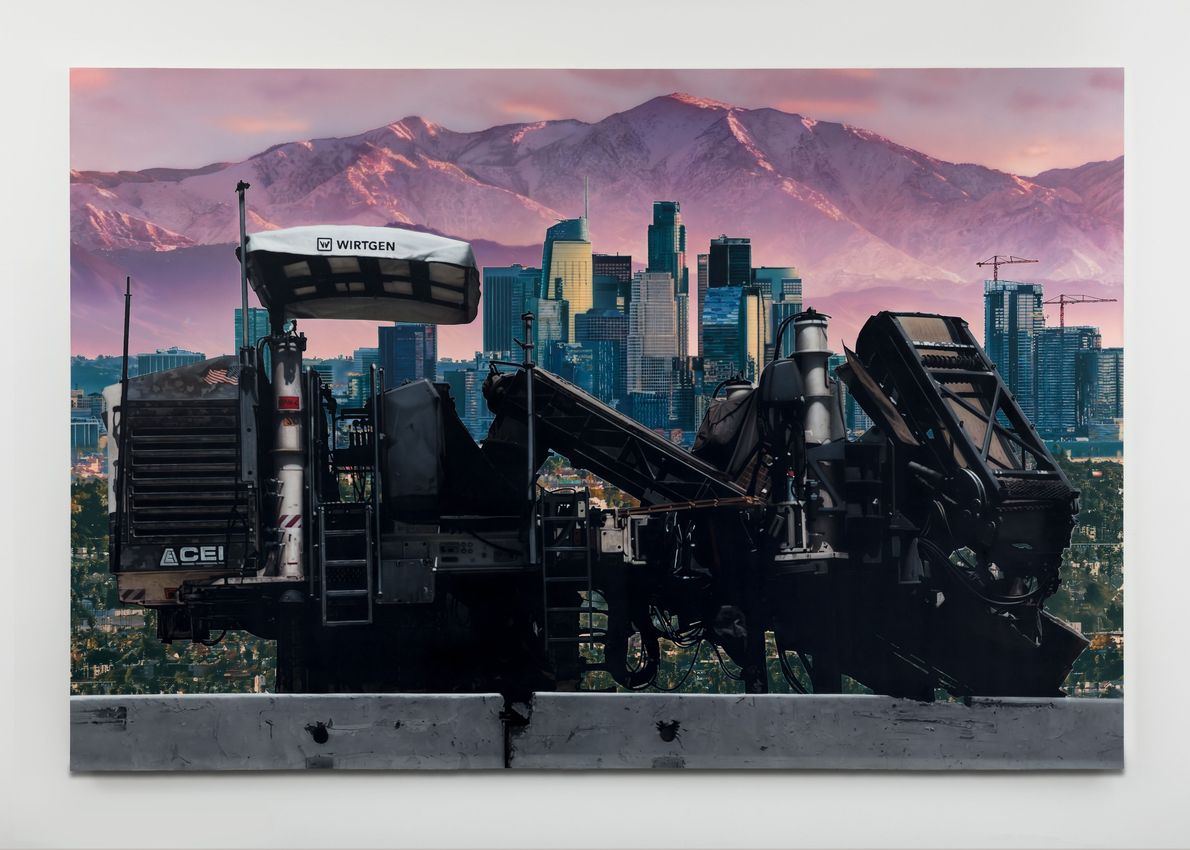
In Heaven ‘N’ Earth, his second exhibition at Xavier Hufkens, the Los Angeles-based artist Sayre Gomez continues traversing the image-worlds of Southern California’s urban space. Gomez devotes his attention to the physical and cultural survival techniques of those left behind in the wake of capitalist development, with a sincere commitment to documenting traces of lived experience in the ruins of deindustrialisation. At the same time, his art acknowledges that any such realist project in the twenty-first century will inevitably be mediated by the hyperreality of technologised spectacle. The works in the show stage a clash between discrepant temporalities and ontological conditions: between products of the culture industry and their appropriation in obscure subcultural codes; between surface and depth; between the time of the image, the time of nature, and the time of the human organism.
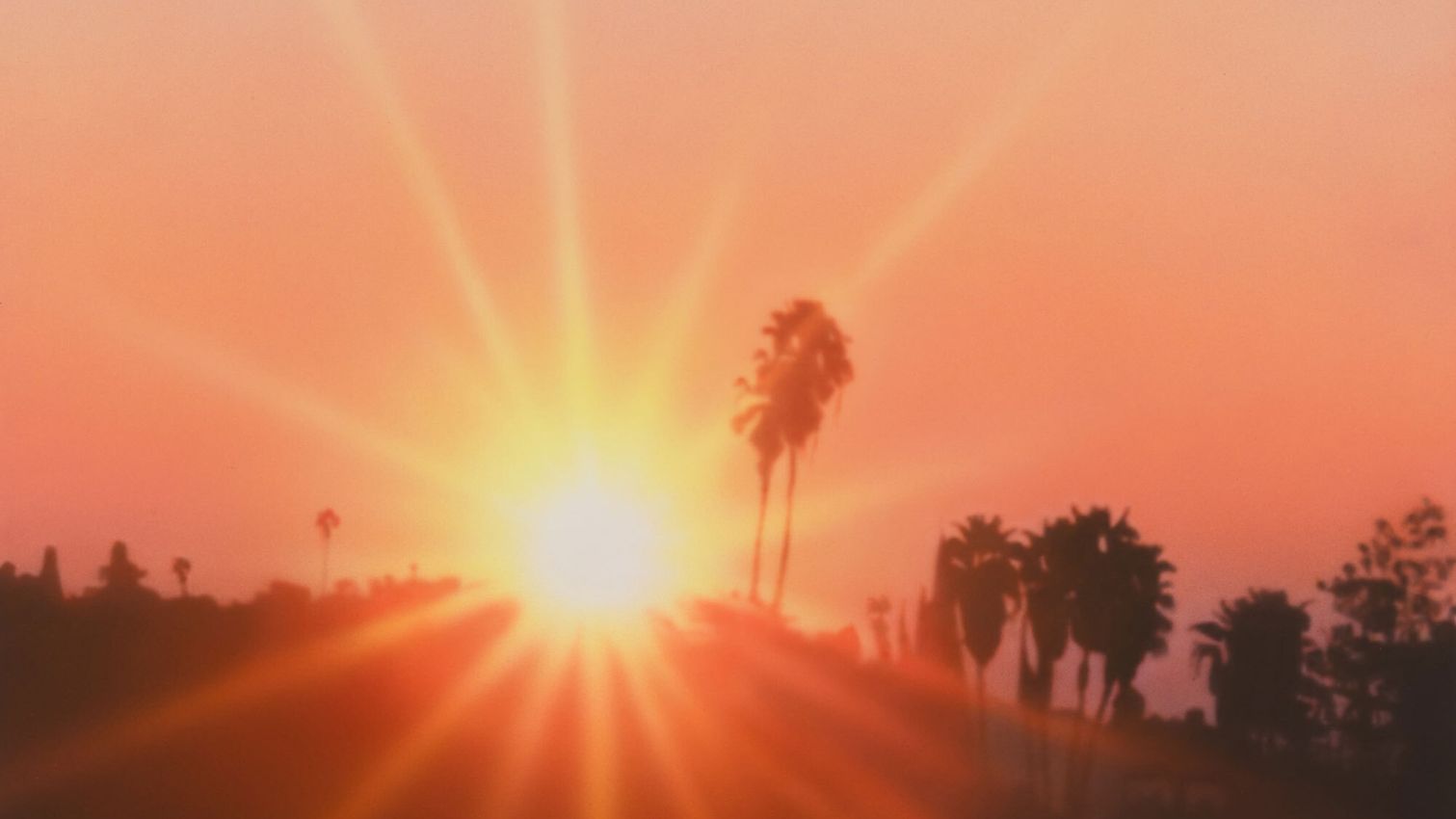
True to its title, the exhibition progresses from “heaven” on the gallery’s uppermost level to “earth” (or perhaps even something below it) at the bottom. Discrete bodies of work in painting, sculpture, and video are distributed across all four floors of the gallery. Starting from the top, a skylight in the uppermost space casts natural light on a mixed-media sculpture, Scale Replica of the Past, Present, and Future (Peabody Werden House), installed in the center of the room (all works 2023). The Peabody Werden House is a Victorian bungalow that was constructed in the Boyle Heights neighborhood of Los Angeles in 1895. By then decrepit and facing demolition, in 2016 it was moved to an empty lot across the street following an outcry from preservationists. In subsequent years, however, funding for the house’s restoration dried up, leaving it a decaying hulk still sitting on its nominally temporary jacks. Once again suspended in limbo in the form of Gomez’s three-dimensional reproduction, the house emblematises the persistence of history in a working-class, but now gentrifying, neighborhood of Los Angeles—a city often erroneously described as being devoid of history altogether. Facing the sculpture on the four surrounding walls are luminous paintings of sunsets. Their compelling realism is ironised by exaggerated photographic lens flare effects. This arrangement ensures that, from whatever angle the house is viewed, a picture-perfect Californian backdrop is close at hand.
One floor below, the gallery contains a group of simulacral acrylic renderings of glass doors paired with Totem 3, a reduced-scale representation of a telephone pole. The door paintings are hung touching the ground, as if they were actual portals through the room’s architecture. The effect is to produce a ghostly evocation of a run-down strip mall. Also in this gallery are two paintings, titled after the thrash bands Slayer and Municipal Waste, which represent badly corroded advertisements for 99-cent grocery deals—a cruel irony, perhaps, in this new era of inflation. The ephemera of commerce thus survive its actual disappearance. All of these pictures are minutely detailed, registering the material degradation of plastic, paper, and metal as these substances mingle with ephemeral reflections. The door paintings are all titled That Which I Should Have Done I Did Not Do, in reference to a painting of a door by the Chicago magical realist painter Ivan Albright dating from 1931-41. Though seemingly stylistically distant, given their photographically realistic technique, Gomez’s canvases have a similarly hallucinatory maximalism. In one of his door paintings, the Warner Bros. character Taz, the Tasmanian Devil, swings from a vine, as if about to burst through the glass into the viewer’s space.
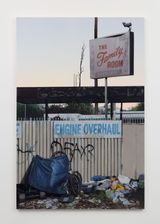
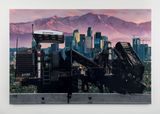
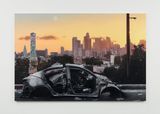
The ground floor features large new paintings of urban scenes, such as Progress Maker, which depicts a construction (or demolition) machine against an uncannily idealised skyline. Kernels poses toy versions of horror film antiheroes—Hollywood products who have long since become part of collective mythology—against another lurid cityscape. A sequel, Kernels (2), shows the vernacular appropriation of commodities in a more tender, not to say sentimental light: a teddy bear inscribed “feel better” has been left along an overgrown chain-link fence. Lights, Camera, Action brings viewers closer still to the inhabitants of this zone of social exteriority. A tent presumably inhabited by someone experiencing homelessness glows with an inner light. Gomez’s title knowingly alludes to his art’s dialogue with the representational technologies of the entertainment industry, which shares Los Angeles with tens of thousands of unhoused people. Other pictures, such as We Pay Cash and Family Room, document the chaotic mess of what remains of the public sphere in late capitalism. Heaven and Earth itself takes matters one step further by transferring refuse to an unpleasant-looking beach—thus desecrating the ultimate site of Californian hedonism. Here, we have certainly descended from heaven to earth.
A smaller presentation in the gallery’s lower level suggests what might remain from all this entropy. The windows of the room are tinted an infernal orange. Installed under an enclosed stairwell is The Promise, a bronze sculpture of a melted electric vehicle charger—as if the device had been engulfed in the flames of the very fossil fuel it was designed to supplant. A video mounted on the sculpture shows a pixelated Prius scrolling past a cityscape. The room also contains the paintings Daily Mail and Page 6, each of which depicts a shopping cart on fire. Like the ruined automobiles that show up elsewhere in the exhibition, these images represent a sort of endpoint of the calamitous entanglement of consumer capitalism, post-welfare state social degradation, and petrochemical nihilism that is the signature of the present world order. Oil has to be pumped up from deep under the ground. Here in Gomez’s basement, perhaps we, too, have descended not just from Heaven to Earth, but down to Hell itself.
Sayre Gomez (b. 1982, Chicago, USA) lives and works in Los Angeles. Recent solo exhibitions include Enterprise at Sifang Art Museum, Jiangsu, China (2022); and Renaissance Collection at Fondazione Sandretto Re Rebaudengo, Turin, Italy (2022), among others. Gomez’s works are held in the public collections of the Los Angeles County Museum of Art, Los Angeles; Hammer Museum, Los Angeles; Whitney Museum of American Art, New York; Art Gallery of New South Wales, Sydney; Institute of Contemporary Art, Miami; mumok, Vienna.
Sayre Gomez has risen to prominence in recent years with his semi-fictionalised and photorealistic paintings known as X-scapes. Executed in a wide range of techniques, including trompe l’oeil, airbrushing, stencilling and those used to paint Hollywood sets, his work is inspired by the urban landscape of Los Angeles. Many of his paintings feature the housing, road signs, billboards and landmarks that form the backdrop to long car rides around the city. Gomez will often combine sumptuous natural phenomena with industrial and commercial elements that reflect an altogether grittier side of life, thereby lending his work a temporal aspect. His paintings can simultaneously touch on the beauty of nature (vivid sunsets, sumptuous palms), the passage of time, urban decay and commercial nostalgia (signs, colours and lettering often evoke bygone days) and contemporary life (graffiti, cell phone masts). Gomez synthesises his observations into hyperreal images that challenge our ability to differentiate between authenticity and simulation: a cityscape that feels true-to-life might just as easily be an artificial construction. In this way, he explores the increasingly tenuous link between our everyday surroundings and a digital culture that is relentlessly driven by enhanced and manipulated images. The flawless execution and even luminescence of Gomez’ canvases, as well as the shifts between hard and sharp focus, can be seen as painterly reflections on the digital flattening and blurring of life and culture through screen-based technology. Openings and barriers, such as windows, doors, gates, shutters, walls and fences, are recurrent metaphors in his oeuvre that suggest Los Angeles is a city of promise and freedom, but also one of broken dreams and destitution. Gomez also explores these themes through other mediums, including sculpture, installation and video.

A respected voice in contemporary art discourse.
Focusing on ambitious storytelling and insightful art-world commentary. Ocula Magazine publishes in-depth interviews, critical essays and timely analysis on the artists, exhibitions and ideas driving the global art world.
Learn more about Ocula Magazine
Showcasing the best of the art world.
Ocula partners with galleries from around the world to highlight their artists, artworks and exhibitions. Gallery membership is by application and invitation, with each member vetted by an independent panel.
Learn more about Ocula Membership

Specialises in the sale of major artworks.
Led by a team with deep ties to the world’s leading auction houses, galleries and collectors. Ocula’s advisory team offers bespoke services to high-net-worth clients from around the world who are looking to acquire the best of contemporary and modern art.
Learn more about our team and services