



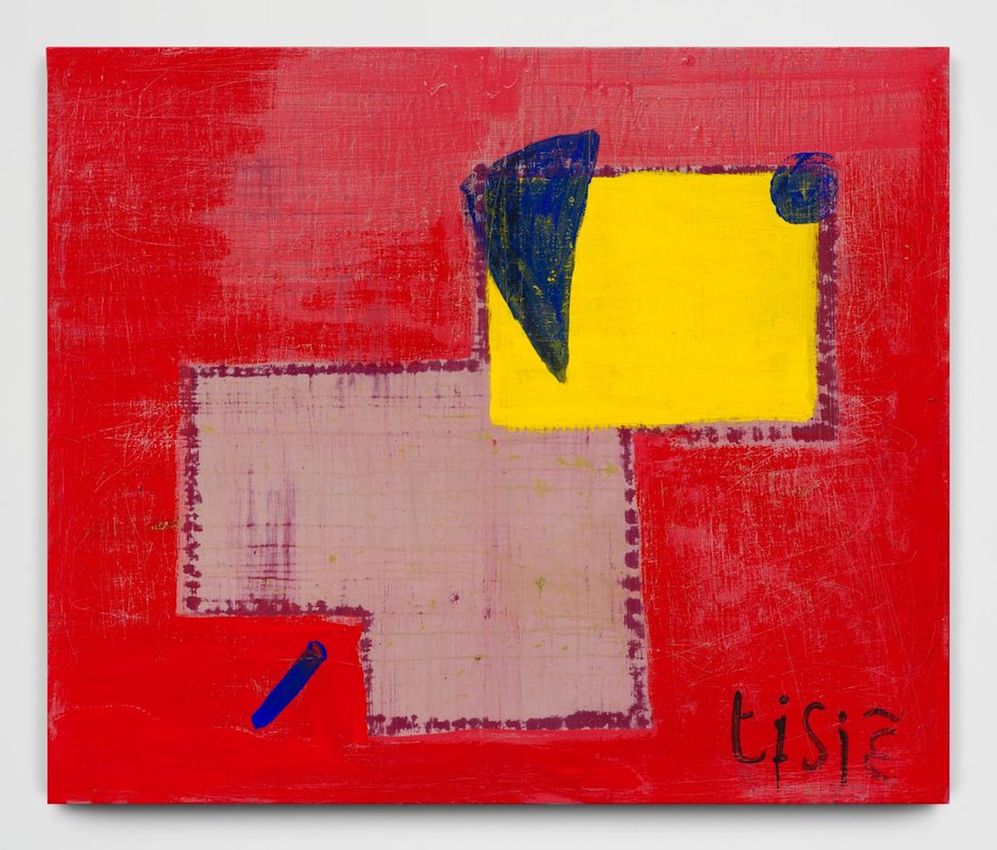
Xavier Hufkens is pleased to announce the opening of an exhibition of new paintings by Walter Swennen.
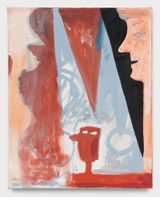
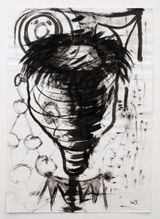
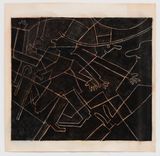
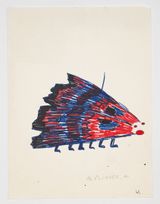
A painting by Walter Swennen always comes as a surprise. It might contain an intriguing combination of words or an isolated letter of the alphabet, a fractured message or a semi-recognisable phrase. Perhaps it will be figurative, abstract, or something in-between. Then there are the textures: opaque or transparent, rough or smooth, glossy or matte. Not to mention the techniques: brush, palette knife, sgraffito and impasto, and endless fluctuations and combinations thereof, not to mention a wealth of less orthodox methods. Finally, and last but not least, there are the colours: vivid, evocative and always beautiful. Look carefully at a work by Walter Swennen and you will discern — either instantaneously or over time — some or all of these qualities. These material aspects of the work reveal the many and varied layers of its construction. In short, they disclose ‘how’ the painting was made.
But the questions that immediately arise are related to the ‘what’ and the ‘why’. What is this painting about? Why is it so? Walter Swennen’s paintings are not necessarily ‘about’ anything: they are a form of visual poetry, the result of chance encounters between the artist and the things that surround him, the funny things he discovers, random found objects and a myriad of other possible influences, ranging from jazz music, philosophy and drawings (both his own and those of others) to language, advertising and humour. And art itself, of course. If Swennen’s paintings had a meaning, it would be, in the words of the writer Hans Theys, ‘in a material sense, not in the form of a code that needs to be deciphered.’ This is a large part of their mystery and allure. Swennen, by his own admission, paints the most difficult subject of all: anything and everything, a form of creative ‘whatsoever’. But always in an indeterminate time-frame and space, devoid of perspectival elements, uncoupled from reality and the material world, free of all conventional associations. Which is liberating and means that neither the work, nor the artist, is compelled to express or prove anything, be it emotion or narrative. But on the other hand, the paintings allude to universal truths: about what it means to be a painter, and what to paint and how. Swennen paints every day, but many of his works, for all their apparent simplicity and spontaneity, are the result of a never-ending process of catalytic consequences and chain reactions: one thing leads to another, this colour suggests that, the unpremeditated actions of the artist giving rise to unexpected results that, in turn, set fresh ideas in motion. Each canvas is thus an exercise in painting, and every work can be seen as a living, multi-dimensional space: a place where ‘the artist simultaneously moves, thinks and acts’. Swennen’s works are akin to thought processes writ large, a stream of consciousness that is given material form through deceptively simple means: paint and canvas, colour and texture. And thus the painting becomes both object and subject: a material entity unto itself in which the ‘how’ determines the ‘what’ and becomes the hic, haec, hoc .
This exhibition coincides with the publication of two new, comprehensive books on Walter Swennen’s work by Hans Theys: Hic Haec Hoc (published by Xavier Hufkens, English, 240 p.) and Ne Quid Nimis (published by Zonder titel, Dutch, French, 304 p.).
Walter Swennen was born in 1946 in Brussels. Recent solo exhibitions include: Ein perfektes Alibi, Kunstverein für die Rheinlande und Westfalen, Dusseldorf, Germany (2015);Continuer, Culturgest, Lisbon, Portugal (2013); So Far So Good, WIELS, Brussels, Belgium (2013) and Garibaldi Slept Here, Kunstverein Freiburg, Germany (2011).
Walter Swennen is known for his radical, experimental and associative approach to painting, which is perhaps best summarised as a belief in the total autonomy of the artwork. For Swennen, a painting does not need to be ‘emotive’ or ‘understood’: the primary goal of painting is, quite simply, painting. Everything – form, colour, subject – comes from the outside. A poet before he became a painter, it is perhaps no coincidence that Swennen perceives painting to be an act of translation and that language plays a vital role in his practice. In the early 1980s, Swennen stopped writing poetry and switched to painting as his primary means of expression. Although his oeuvre varies greatly in scale, style and materials, it can be construed as an on-going exploration into the nature and problems of painting (its potential and limitations), the fundamental question of what to paint (subject matter), and how (technique). Often working on supports made from found objects, such as sheets of old plastic or salvaged wood, Swennen allows his chosen imagery to float loosely atop a background made up of more allusive elements, such as blocks of colour, dripped paint or unusual textures. The images he deploys are often derived from popular culture, advertising and magazines, or take the shape of everyday objects such as wine bottles or bicycles. The way that he handles motifs – he takes them as he finds them, high or low, and manipulates them at will – is akin to a kind of visual poetry that harks back to his early career as a writer. Freely associative, and above all humorous, Swennen’s paintings explore the relationship between symbols, legibility, meaning and pictorial treatment.

A respected voice in contemporary art discourse.
Focusing on ambitious storytelling and insightful art-world commentary. Ocula Magazine publishes in-depth interviews, critical essays and timely analysis on the artists, exhibitions and ideas driving the global art world.
Learn more about Ocula Magazine
Showcasing the best of the art world.
Ocula partners with galleries from around the world to highlight their artists, artworks and exhibitions. Gallery membership is by application and invitation, with each member vetted by an independent panel.
Learn more about Ocula Membership

Specialises in the sale of major artworks.
Led by a team with deep ties to the world’s leading auction houses, galleries and collectors. Ocula’s advisory team offers bespoke services to high-net-worth clients from around the world who are looking to acquire the best of contemporary and modern art.
Learn more about our team and services