Press Release

Ames Yavuz is pleased to present old gods, new city, a group exhibition bringing together works by Rocky Cajigan, Bjorn Calleja, Is Jumalon, Kaloy Sanchez, Carina Santos, Derek Tumala and Yeo Kaa. Exploring the reinvention of mythologies within contemporary Filipino culture, the exhibition considers how ancestral beliefs, folklore and collective memory interact with popular culture and urban life, shaping new narratives and systems of meaning.

The living is suffused with mythologies. They are the ancient undercurrents that gently mold our communal understandings of the natural world, a means to negotiate the unknown and make sense of the human condition. Transformed by centuries of colonial influence, cultural erasure and social change, these belief systems continue to surface in contemporary life. Spirits, supernatural beings, ancestral knowledge and traditional narratives persist not merely as remnants of the past, but as living frameworks through which the present is understood and reimagined.

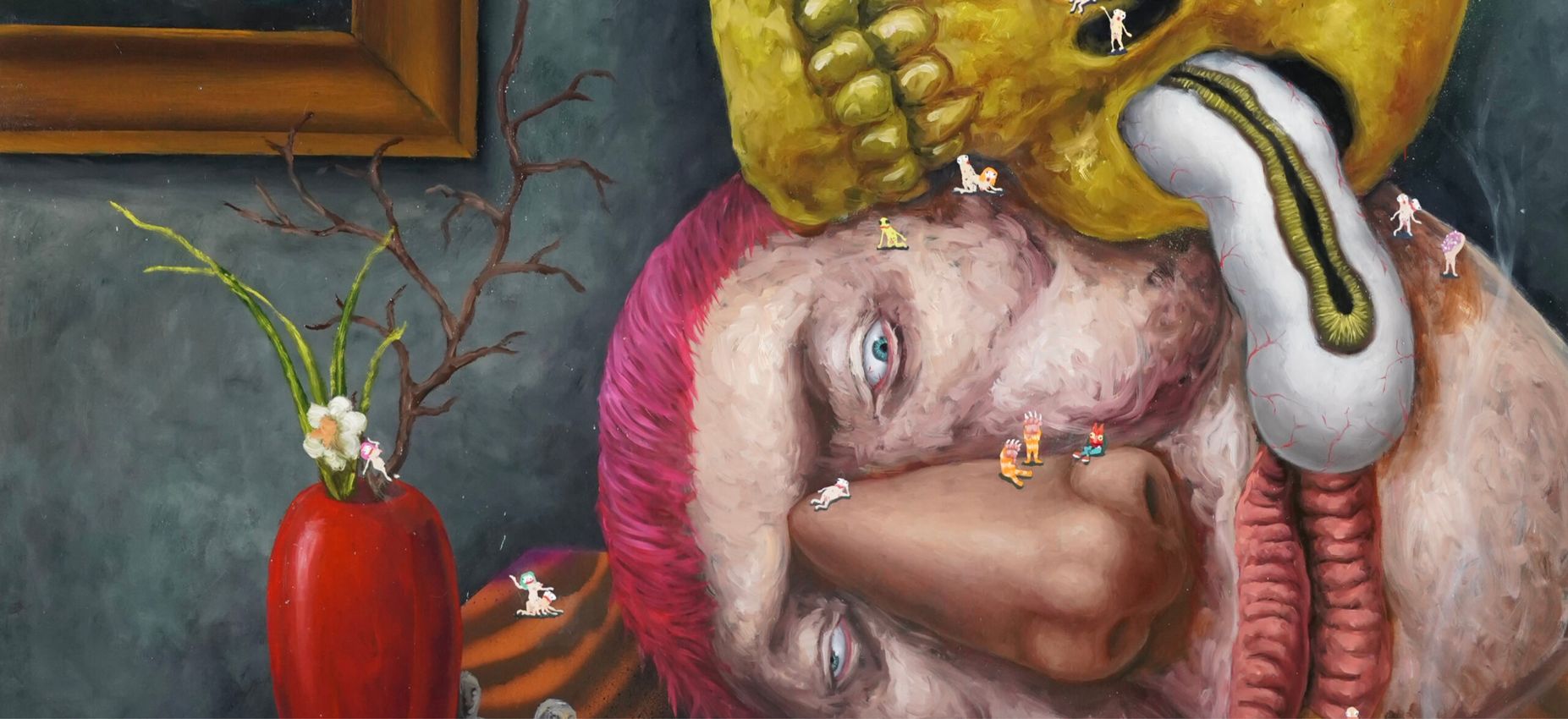
In Bjorn Calleja’s paintings, the relationship between the human, the sacred and the imagined is explored through figures that draw from precolonial animistic traditions. The Apotheosis sees a solitary figure being carried by a dense crowd of peculiar humanesque beings, implying a ritual of obscured purpose. The work considers the invention of divinity through collective belief, questioning whether the sacred exists independently of humanity or emerges from an innate need to give meaning and authority to powers beyond ourselves. Tao, meanwhile, turns inward, contemplating the coexistence of the body, skeleton and spirit within an ordinary domestic setting. Life and death occupy the same plane without conflict or ceremony, suggesting that the supernatural may be less extraordinary than we have come to believe.

Rocky Cajigan draws on personal memory and psycho-biography to confront the legacies of colonialism, recurring forms of neo-colonialism and the continuing feudal structures that shape the country. His work, Come, Follow Me, and I Will Make You Fishers of Men II, brings together human hair, composite resin teeth, threads and textile materials in an assemblage that draws on the body as a site of identity, memory and cultural meaning. In using these visceral objects of human ephemera, Cajigan responds to the power relations and violence in our object culture, both historically and present.

Within Is Jumalon’s paintings, the familiar forms of ordinary plant life take centre stage. In these intimate renderings of branches growing from a single garden pot on Jumalon’s terrace, landscape is abstracted, with the attention instead poured into the forms, colours and structures found within the close-ups. Here, the seemingly unremarkable becomes an abundant source of inspiration and contemplation. Bathing its subject in a haunting light is the moon, a silent observer omnipresent and distant, alluding to perspectives beyond the limits of human experience.

Ang Manananggal and Ang Tikbalang sees Kaloy Sanchez reimagine the titular supernatural beings familiar to Philippine folklore, drawing out their human qualities and emotions. Rendered in acrylic and graphite, the figures are stripped of their conventional monstrous associations, instead appearing introspective, vulnerable and contemplative. By bringing these folkloric beings into a recognisably human register, Sanchez shifts attention from their supernatural abilities to their emotional and physical interiority. In doing so, his works humanise the monstrous, or otherwise reveal the enduring core of humanity in our mythological tales.

Despite having lived primarily in dense and frenetic capital cities, Carina Santos has found herself repeatedly drawn to landscape as a subject, approaching it through increasingly abstract forms. In her pour paintings, images take shape through the interplay of bodily gestures, gravity and colour, allowing the movement of materials to guide the process of creation. Santos describes these encounters as a form of divine intervention, reconsidering spirituality beyond the conventions of inherited faith. The works are thus a surrender to forces that transcend the self, where the physical act of painting becomes a ritualistic means of reaching for something past our immediate, tangible reality.

Derek Tumala revisits Philippine ethnoastronomy with an ongoing series that examines the intersections of mythology, scientific knowledge and traditional practices. Drawing on the constellation of Orion’s Belt and Sword, his work references Balatik—a constellation recognised in Philippine ethnoastronomy as a boar trap, used in traditional hunting and agricultural practices. His recent research in Palawan in Southwestern Philippines includes encounters with elders near the Tabon Caves who continue to use the ethnoastronomic method, bringing renewed attention to the knowledge systems embedded in indigenous relationships with the cosmos. By tracing the connections between celestial observation and lived experience, Tumala considers astronomy not only as a scientific discipline, but also as a cultural practice through which communities have historically understood and engaged with their environment.

Drawing from popular culture and everyday life, Yeo Kaa’s works playfully alchemise our benign day-to-day encounters with unsettling imagery to create contemporary mythologies. From anthropomorphised dumplings in Baby Food, to aswang of us which features a sea of recurring all-too-innocent cartoon characters foreboding in their repetition and uniformity, Yeo Kaa fabulates fantastical worlds that unnerve us with their manic, quasi-human tonality. Using humour, her signature kaleidoscopic palette and deceptively simple imagery, Yeo Kaa blurs the boundaries between innocence and the uncanny, reimagining folkloric associations through the imagery and anxieties of modern-day life.

Across these practices, the city becomes a terrain where the sacred and profane, ancient and contemporary and the familiar and fantastical coexist; where traditional beliefs encounter new technologies, social realities and popular imagery. old gods, new city asks what survives when inherited traditions encounter modernity, what forms of wonder and belief arise from the urban landscape, and how artists continue to make sense of the world through the stories we inherit, the realities we inhabit and the myths we create anew.

Read More

Artists Exhibiting

Also Exhibiting at Ames Yavuz

About the Gallery

Ames Yavuz embraces its diverse cultural background through a strong international focus and perspective. The gallery’s vision is underpinned by robust curatorial practices that form the core of our program and foster intercultural discourse on a global scale.

View Gallery Profile
Address
Gillman Barracks
9 Lock Road
#02-23
Singapore
Singapore
Opening Hours
Tuesday – Saturday
11am – 7pm
(1)
Singapore Gillman Barracks, 9 Lock Road
Ames Yavuz
Gillman Barracks, 9 Lock Road, #02-23, Singapore, Singapore

Opening hours
Tuesday – Saturday
11am – 7pm
The art world in focus