






ANA MENDIETA
1948-1985, CyprusAna Mendieta (Havana, 18 November 1948–New York, 8 September 1985) Ana Mendieta was a Cuban-American artist whose influential ‘earth-body’ works fused performance, sculpture, land art, film, and photography to explore identity, exile, feminism, and the relationship between the body and nature. Widely regarded as a pioneering figure in post-war contemporary art, Mendieta developed a singular practice that used organic materials and ephemeral gestures to connect personal history with broader spiritual and political concerns.
In 2026, her work is the subject of a major show at Tate Modern.
Early life and Background
Ana Mendieta was born in Havana and left Cuba for the United States as a child in 1961 as part of Operation Pedro Pan, an early dislocation that shaped her sustained engagement with exile, belonging, and cultural memory. Raised in Iowa, she studied at the University of Iowa, where a shift from painting to performance and Intermedia art in the early 1970s led her towards time-based, experimental practices.
During her studies she worked closely with artist and teacher Hans Breder, who encouraged cross-disciplinary approaches and documented many of her first performance pieces. In the 1980s Mendieta divided her time between New York and Rome, after receiving the prestigious Rome Prize in 1983, and began developing more permanent sculptural works while maintaining a focus on landscape and the female figure.
Ana Mendieta Artworks
Ana Mendieta’s artworks brought together performance, photography, film, sculpture, and site-specific installations, often using her own body and its trace in the landscape to address presence, absence, and transformation. Working with earth, water, fire, blood, and vegetation, Mendieta described her practice as a way to “re-establish the bonds that unite [her] to the Universe”, positioning art as both ritual and grounding.
‘Silueta Series’ and earth-body works
Between the early 1970s and 1980 Mendieta produced her seminal Silueta Series, more than 200 ‘earth-body’ works in which she impressed, carved, or burned a female silhouette into the land in Mexico, Iowa, and other locations. These silhouettes—formed from mud, sand, flowers, leaves, gunpowder, or fire—were documented through photography and film, emphasising both the fragility of the human figure and its cyclical merging with the natural world.
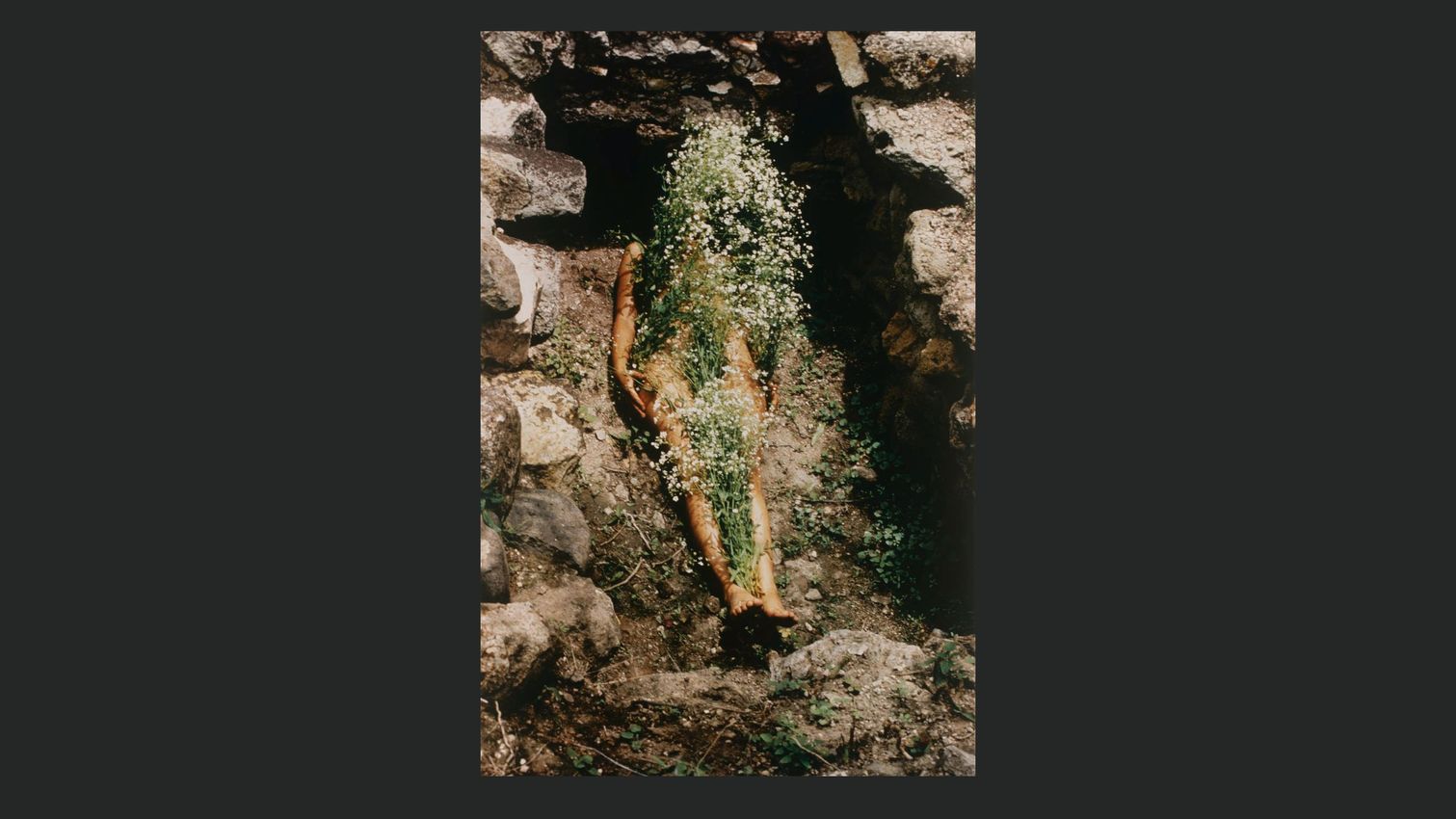
Key works associated with the series include Imagen de Yagul (1973), in which the artist’s nude body lies in a shallow rock cavity covered with white flowers, and later pieces such as Ánima, Silueta de Cohetes (Firework Piece) (1976), where her outline is momentarily illuminated by fireworks. These artworks engage with Afro-Cuban and Indigenous spiritual traditions, feminist concerns, and land art, while resisting commodification through their ephemeral nature and reliance on documentation.
Sculpture, Installations, and Later Practice
From the late 1970s and early 1980s, Mendieta extended her earth-body language into sculpture, floor works, and outdoor interventions using carved stone, sand, and soil, sometimes transported from sites such as Cuba, the Nile, and the Red Sea. Works like Figure with Nganga (1984) and related floor sculptures translate the female silhouette into low-relief forms that retain a ritual quality while occupying museum and gallery spaces.
During her time in Rome and New York she continued to experiment with drawing and photography alongside site-specific projects that inscribed female archetypes and cosmological symbols into the environment. Across these bodies of work, Mendieta’s art remained rooted in questions of origin, displacement, gendered violence, and the possibility of spiritual reconnection through the elements.
Upcoming Tate Modern exhibition, London
Tate Modern in London will present a major exhibition dedicated to Ana Mendieta from 9 July 2026 to 10 January 2027, situating her practice at the centre of global contemporary art narratives. The exhibition will bring together iconic earth-body works, newly remastered films, early paintings, and late sculptural pieces—many shown in the United Kingdom for the first time—offering a rare opportunity to experience the breadth of Mendieta’s career in one place.
Extending beyond the museum’s galleries, the show will incorporate outdoor elements that respond to Tate Modern’s riverside setting, reflecting Mendieta’s longstanding engagement with landscape and open-air environments. Positioned alongside parallel presentations of women artists such as Tracey Emin and Frida Kahlo in Tate’s 2026 programme, the exhibition underlines Mendieta’s enduring influence on performance, feminist, and land-based art practices.
Ana Mendieta Exhibitions
Ana Mendieta has been the subject of solo and group exhibitions at major museums and galleries worldwide, and her works are held in more than 120 public collections. Below is a selection of important exhibitions.
Select solo exhibitions
- Ana Mendieta, Tate Modern, London (forthcoming, 9 July 2026 – 10 January 2027)
- Ana Mendieta: Traces, Hayward Gallery, London (2013–2014)
- Ana Mendieta, Whitney Museum of American Art, New York (retrospective, 2004)
Select group exhibitions
- Silueta Works in Mexico, ICA Boston, Boston (collection and displays focusing on the Silueta works)
- Collection displays, Smithsonian American Art Museum, Washington, D.C.
- Collection displays, The Metropolitan Museum of Art, New York
Ana Mendieta FAQs
Who is Ana Mendieta?
Ana Mendieta was a Cuban-American contemporary artist known for ‘earth-body’ artworks that combined performance, sculpture, film, photography, and land art to explore identity, exile, feminism, and spirituality. You can follow Ana Mendieta on Ocula to learn more about her work, find out about art for sale, contact her gallery, and keep up to date with upcoming exhibitions.
What is Ana Mendieta known for?
Ana Mendieta is best known for her Silueta series and ‘earth-body’ artworks, in which she used her own silhouette, organic materials, and outdoor sites to connect the female body with the landscape. Her multidisciplinary practice—spanning performance, sculpture, painting, and video—has made her a key figure in post-war feminist and land art.
What is Ana Mendieta’s ‘Silueta’ series?
Ana Mendieta’s ‘Silueta’ series (1973–1980) comprises more than 200 works in which she formed or burned a female silhouette into earth, sand, stone, and vegetation in locations such as Iowa and Mexico, documenting them in film and photography. These artworks foreground themes of displacement, spirituality, and the cyclical relationship between the body and nature.
Where can I see work by Ana Mendieta?
Ana Mendieta’s artworks can be seen in major public collections including the Smithsonian American Art Museum in Washington, D.C., the Metropolitan Museum of Art in New York, and the ICA Boston, among others. You can follow Ana Mendieta on Ocula to receive alerts on upcoming exhibitions by the artist. In 2026, the Tate Modern will host a show of Ana Mendieta’s work.
Is Ana Mendieta in Tate Modern’s programme?
Tate Modern in London is staging a major exhibition dedicated to Ana Mendieta, bringing together iconic earth-body works, remastered films, and late sculptural pieces within its 2026–2027 programme. The exhibition highlights Mendieta’s influence on performance art, feminist art, and land art, and positions her alongside other landmark women artists featured at Tate.
Are there any lesser-known facts about Ana Mendieta?
A lesser-known aspect of Ana Mendieta’s practice is the scale of her Super 8 film production—she created nearly 100 short films between 1973 and 1981, treating film as a primary artwork rather than mere documentation. You can follow Ana Mendieta on Ocula to receive alerts on news about the artist.
What is a famous quote by Ana Mendieta?
Ana Mendieta is frequently quoted as saying, ‘My art is the way I re-establish the bonds that unite me to the Universe’, a statement that underscores the spiritual and cosmological dimensions of her earth-body works. The quote is often cited in museum wall texts and scholarship discussing her approach to art and nature.
Where did Ana Mendieta live?
Ana Mendieta was born in Havana, Cuba, and moved to the United States in 1961 through Operation Pedro Pan, growing up in Iowa. As an adult, she lived and worked primarily in New York and, after receiving the Rome Prize in 1983, spent significant time in Rome.
How is Ana Mendieta’s name pronounced?
Ana Mendieta’s name is commonly pronounced ‘AH-nah men-dee-EH-tah’, reflecting Spanish pronunciation of her Cuban heritage. This pronunciation is widely used by museums, galleries, and academic institutions when presenting her work.
Where can I buy Ana Mendieta’s work?
Ana Mendieta’s estate is represented by leading international contemporary art galleries, including Galerie Lelong & Co. and Marian Goodman Gallery, which handle sales and placements of her artworks. Ana Mendieta is represented by leading contemporary art galleries; you can explore Ocula to find out which Ocula galleries represent the artist and enquire directly about buying art by Ana Mendieta and follow them and their gallery to keep up to date. You can also get in touch with Ocula’s art advisory team to find out more about buying or selling work by Ana Mendieta.
Ocula | 2026









Ana Mendieta in Ocula Magazine






Explore and Follow Artists Shaping Contemporary Art
A respected voice in contemporary art discourse.
Focusing on ambitious storytelling and insightful art-world commentary. Ocula Magazine publishes in-depth interviews, critical essays and timely analysis on the artists, exhibitions and ideas driving the global art world.
Learn more about Ocula Magazine
Showcasing the best of the art world.
Ocula partners with galleries from around the world to highlight their artists, artworks and exhibitions. Gallery membership is by application and invitation, with each member vetted by an independent panel.
Learn more about Ocula Membership
Specialises in the sale of major artworks.
Led by a team with deep ties to the world’s leading auction houses, galleries and collectors. Ocula’s advisory team offers bespoke services to high-net-worth clients from around the world who are looking to acquire the best of contemporary and modern art.
Learn more about our team and services