





DIEGO RIVERA
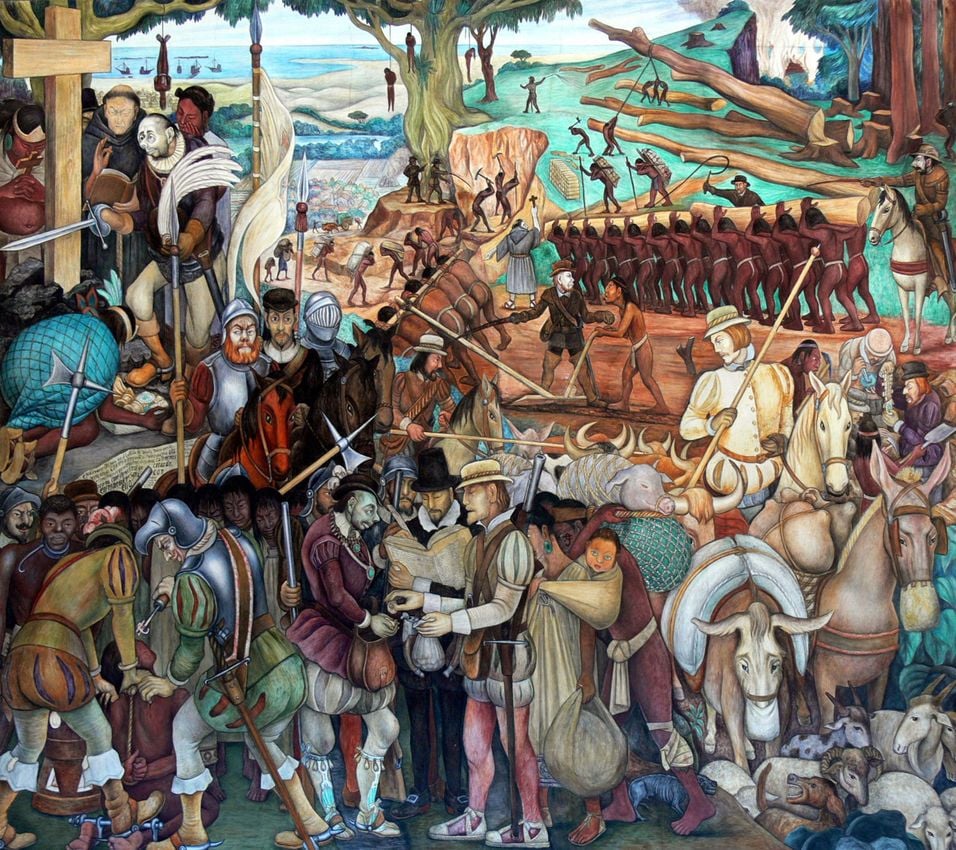
1886-1957, MexicoDiego Rivera (1886–1957) was a Mexican painter and muralist whose monumental frescoes helped establish the Mexican Mural movement as one of the most significant developments in 20th-century art. He is equally renowned for his complex personal and artistic partnership with fellow painter Frida Kahlo, with both often described as the most famous Mexican artists of the 20th century.
Rivera’s communist political beliefs and monumental public murals—particularly Detroit Industry and The History of Mexico—established him as one of the most influential artists in the Americas. Working primarily in fresco, Rivera addressed themes of social inequality, Mexican history, industry, and indigenous culture across public buildings in Mexico and the United States. His 1931 retrospective at the Museum of Modern Art in New York drew 57,000 visitors, setting attendance records, and his works have since been declared monumentos históricos by the Mexican government. Rivera lived and worked in Mexico City for much of his career, while he and Kahlo became central figures in the city’s vibrant artistic and intellectual circles.
Early Life and Education of Diego Rivera
Diego María de la Concepción Juan Nepomuceno Estanislao de la Rivera y Barrientos Acosta y Rodríguez was born on 8 December 1886 in Guanajuato, Mexico. His twin brother Carlos died at the age of two, and Rivera began drawing at three; his parents encouraged his talent by installing chalkboards and canvas on the walls of the family home. When Rivera was six, the family relocated to Mexico City, where he was enrolled in the Carpantier Catholic College.
By the age of ten, Rivera enrolled at the Academy of San Carlos in Mexico City, where he received rigorous training in traditional European techniques, including perspective, colour, and en plein air painting. With the support of the Governor of Veracruz, Teodoro A. Dehesa Méndez, Rivera was awarded a scholarship to study in Europe in 1906. He travelled first to Madrid to study with the Spanish realist Eduardo Chicharro, and then to Paris, where he became immersed in the avant-garde circles of Montparnasse alongside artists such as Amedeo Modigliani, Chaïm Soutine, and later Pablo Picasso.
Diego Rivera’s Famous Murals and Artistic Style
Diego Rivera’s artistic practice spanned easel painting, portable frescoes, and large-scale mural cycles, with his work evolving from academic realism through Cubism to a distinctive monumental style rooted in Mexican culture and social realism.
European Experiments and Cubism, 1907–1921
In Spain and Paris, Rivera absorbed influences from Doménikos Theotokópoulos (El Greco), Diego Rodríguez de Silva y Velázquez, Francisco José de Goya y Lucientes, and Paul Cézanne. From 1913 to 1917 he became a committed Cubist, producing works such as Zapatista Landscape — The Guerrilla (1915), which used Cubism’s fragmented forms to depict the Mexican revolutionary leader Emiliano Zapata. Rivera later described this painting as ‘probably the most faithful expression of the Mexican mood that I have ever achieved.’ Around 1917, inspired by Cézanne’s post-Impressionist landscapes, he shifted toward simplified forms and vivid colours. A grant to study in Italy exposed him to Renaissance and Byzantine frescoes, which proved decisive for his later mural practice.
Mexican Muralism and Major Mural Cycles, 1921–1940s
Returning to Mexico in 1921, Rivera joined the government-sponsored mural programme initiated by Minister of Education José Vasconcelos, alongside José Clemente Orozco and David Alfaro Siqueiros. His first significant mural, Creation (1922), was painted in encaustic at the National Preparatory School in Mexico City, combining Mexican, Judeo-Christian, and Hellenic motifs.
Rivera went on to paint 124 frescoes at the Secretariat of Public Education (1922–1928), developing a native style characterised by large, simplified figures, bold colours, and Aztec-influenced imagery. His mural cycles at the National School of Agriculture at Chapingo (1925–1927), the Cortés Palace in Cuernavaca (1929–1930), and the National Palace in Mexico City (1929–1945) are among his most celebrated works. The Detroit Industry fresco cycle (1932–1933) at the Detroit Institute of Arts, comprising 27 panels, is widely regarded as the finest example of fresco painting in the United States, depicting Detroit’s manufacturing base with exceptional detail and Aztec-inspired duality. Commissioned by Edsel Ford, then president of the Ford Motor Company, Rivera spent weeks observing Detroit’s factories before beginning the work, and the murals were designated a National Historic Landmark in 2014.
The Rockefeller Controversy and Later Works, 1933–1957
In 1933, Rivera’s mural Man at the Crossroads, commissioned for Rockefeller Center in New York, became the focus of a major scandal when Rivera refused to remove a portrait of Vladimir Lenin from the composition. Rivera offered to balance the image by adding a portrait of Abraham Lincoln, but the building’s management declined, paid his full fee of $21,000, and ordered the mural destroyed; workmen demolished it in February 1934. Rivera condemned the act as ‘cultural vandalism’ and later recreated the work in Mexico City as Man, Controller of the Universe (1934) at the Palacio de Bellas Artes.
In 1940, Rivera completed his last major American commission, Pan American Unity, a ten-panel mural for the Golden Gate International Exposition in San Francisco. His 1947 fresco Dream of a Sunday Afternoon in Alameda Park brought together three centuries of Mexican history in a single promenade scene and featured a fully elaborated La Calavera Catrina, transforming José Guadalupe Posada’s skeletal character into a nationalist icon now closely associated with the Day of the Dead.
Diego Rivera’s Most Famous Murals and Public Commissions
- 1922: Creation, National Preparatory School (Bolívar Auditorium), Mexico City
- 1922–1928: 124 frescoes, Secretariat of Public Education, Mexico City
- 1925–1927: Mural cycle including Tierra Fecundada, Chapel of the Chapingo Autonomous University of Agriculture, Chapingo
- 1929–1930: Mural cycle, Cortés Palace, Cuernavaca (commissioned by US Ambassador Dwight W. Morrow)
- 1929–1945: The History of Mexico mural cycle, National Palace, Mexico City
- 1930–1931: Murals for the San Francisco Stock Exchange and the California School of Fine Arts (now San Francisco Art Institute), San Francisco
- 1932–1933: Detroit Industry, 27 fresco panels, Detroit Institute of Arts, Detroit
- 1933: Man at the Crossroads, Rockefeller Center, New York (destroyed; recreated 1934 as Man, Controller of the Universe, Palacio de Bellas Artes, Mexico City)
- 1940: Pan American Unity, Golden Gate International Exposition, San Francisco (now at City College of San Francisco)
- 1947: Dream of a Sunday Afternoon in Alameda Park, Hotel del Prado, Mexico City (now Museo Mural Diego Rivera)
- 1951: Underwater mural and Tláloc Fountain, Cárcamo de Dolores, Chapultepec Park, Mexico City
Awards and Honours of Diego Rivera
- 1950: Premio Nacional de Ciencias y Artes (National Art Prize of Mexico).
- 1927: Appointed Master of Monumental Painting, Moscow School of Fine Arts.
- 1906: Scholarship to study in Europe, awarded by the Governor of Veracruz, Teodoro A. Dehesa Méndez.
Rivera’s works were posthumously declared monumentos históricos (national historical monuments) by the government of Mexico.
Exhibitions of Diego Rivera
Diego Rivera’s work has been the subject of landmark retrospectives and group exhibitions at major museums worldwide for nearly a century. His 1931 solo exhibition at the Museum of Modern Art in New York was only MoMA’s second monographic show and drew 57,000 visitors.
Select Solo Exhibitions
- 2025: Rivera’s Paris, Arkansas Museum of Fine Arts, Little Rock, 7 February – 18 May 2025.
- 2022–2023: Diego Rivera’s America, San Francisco Museum of Modern Art, 16 July 2022 – 3 January 2023; Crystal Bridges Museum of American Art, 11 March – 31 July 2023.
- 2021–2024: Pan American Unity: A Mural by Diego Rivera, SFMOMA, 28 June 2021 – 21 January 2024.
- 2011–2012: Diego Rivera: Murals for The Museum of Modern Art, MoMA, New York, 13 November 2011 – 14 May 2012.
- 2009: Diego Rivera: The Cubist Portraits, 1913–1917, Meadows Museum, Dallas.
- 2004–2005: The Cubist Paintings of Diego Rivera, National Gallery of Art, Washington, D.C., and Museo de Arte Moderno, Mexico City.
- 1986–1988: Diego Rivera: A Retrospective, Detroit Institute of Arts; Philadelphia Museum of Art; Museo del Palacio de Bellas Artes, Mexico City; Hayward Gallery, London.
- 1931–1932: Solo exhibition, Museum of Modern Art, New York.
Select Group Exhibitions
- 2020–2021: Vida Americana: Mexican Muralists Remake American Art, 1925–1945, Whitney Museum of American Art, New York.
Collecting Diego Rivera’s Work
Diego Rivera’s works remain among the most sought-after in Latin American art. His paintings command premium prices at auction, with the record sale of The Rivals (1931) achieving about $9.76 million in 2018, exceeding its high estimate by more than $2 million. The market for Rivera continues to strengthen, driven by increased global recognition, major museum exhibitions, and growing interest in Latin American modernism.
Rivera’s works are considered both prestige pieces and sound investments for collectors, with some analyses indicating strong long-term returns relative to traditional assets. Key trends include an increase in private sales, new emerging markets for Latin American art, and heightened scholarly attention that supports attribution and valuation. Because forgeries exist, authentication and provenance are crucial, and collectors typically work with established galleries, auction houses, and recognised experts when acquiring important works.
Legacy and Influence
Rivera is still among the most revered cultural figures in Mexico, celebrated for both his role in the country’s artistic renaissance and the re-invigoration of the mural genre. His concept of the artist as a craftsman in service to the community influenced public art programmes in the United States, including Franklin Roosevelt’s Federal Art Project under the Works Progress Administration (WPA).
With his socially and politically expansive vision, narrative focus, and use of symbolic imagery, Rivera inspired artists such as Ben Shahn, Thomas Hart Benton, and Jackson Pollock. He and Frida Kahlo together drew immense international attention to Mexican art, symbolism, and colour, reshaping how global audiences understood Mexican identity. Rivera’s murals today can be visited by millions of viewers annually in public spaces throughout Mexico and the United States, fulfilling his belief that art should be accessible to everyone.
Diego Rivera FAQs
Why is Diego Rivera so famous?
Diego Rivera is widely regarded as the most influential Mexican artist of the 20th century. He was a leading founder of the Mexican Muralist movement alongside David Alfaro Siqueiros and José Clemente Orozco, and his large-scale murals addressing social inequality, history, and the relationship between nature, industry, and technology brought him international acclaim.
What is Diego Rivera’s most famous mural?
Diego Rivera’s most famous mural is often considered to be Dream of a Sunday Afternoon in Alameda Park (1947), which brings together historic figures including Rivera, Frida Kahlo, and La Calavera Catrina in a single promenade scene. Other iconic works include Detroit Industry (1932–1933) at the Detroit Institute of Arts—widely regarded as the finest fresco cycle in the United States—and The History of Mexico (1929–1945) at the National Palace in Mexico City.
Was Diego Rivera a communist?
Yes, Diego Rivera was a committed leftist and member of the Mexican Communist Party. He was expelled from the party in 1929 for his support of Leon Trotsky but later sought readmission in 1952. Rivera’s murals frequently promoted socialist ideas and depicted themes of class struggle, workers’ rights, and anti-imperialism, which shaped both his fame and his controversies.
What happened to Diego Rivera’s Rockefeller Center mural?
In 1933 Rivera was commissioned to paint Man at the Crossroads for Rockefeller Center in New York, but the mural was destroyed after he refused to remove a portrait of Vladimir Lenin. Negotiations to move the mural to the Museum of Modern Art failed, and in February 1934 workmen demolished it, prompting protests and international debate about censorship and patronage. Rivera later recreated the composition in Mexico City as Man, Controller of the Universe (1934) at the Palacio de Bellas Artes.
What is Diego Rivera’s most expensive painting?
Diego Rivera’s paintings command high prices. One of the highest auction prices recorded for a work by Diego Rivera is about $9.76 million for The Rivals (1931), sold in 2018. The result exceeded its high estimate by more than $2 million and underscored the strength of the market for Rivera’s paintings.
What artistic style did Diego Rivera use?
Diego Rivera’s mature style combines lessons from European modernism—particularly Cubism and post-Impressionism—with imagery drawn from Mexico’s pre-Columbian and colonial heritage. Executed largely in fresco, his murals feature monumental figures, clear narratives, and symbolic allegories that make complex historical and political ideas legible to broad audiences.
What was Diego Rivera’s relationship with Frida Kahlo?
Diego Rivera and Frida Kahlo married in 1929, divorced in 1939, and remarried in 1940, maintaining a famously passionate and turbulent partnership until her death in 1954. Both had extramarital affairs, yet they remained deeply connected through their shared commitment to art and Mexican culture, and Rivera later called Kahlo ‘the most important fact of my life’. Their former home and studios in Mexico City now house the Museo Casa Estudio Diego Rivera y Frida Kahlo.
How did Diego Rivera die?
Diego Rivera died on 24 November 1957 in Mexico City, aged 70, from heart failure. His health had declined following cancer treatment abroad and complications including a stroke and phlebitis earlier that year. Rivera’s death came three years after Kahlo’s, which he described as the most tragic event of his life.
Where can I see Diego Rivera’s murals in Mexico City?
In Mexico City, major Rivera murals can be seen at the National Palace (The History of Mexico), the Palacio de Bellas Artes (Man, Controller of the Universe), the Secretariat of Public Education (124 frescoes), the Museo Mural Diego Rivera (Dream of a Sunday Afternoon in Alameda Park), and the Cárcamo de Dolores in Chapultepec Park (underwater mural and Tláloc Fountain). Important works outside Mexico City include the Detroit Industry murals at the Detroit Institute of Arts and Pan American Unity in San Francisco.
Ocula | 2026





Explore and Follow Artists Shaping Contemporary Art
A respected voice in contemporary art discourse.
Focusing on ambitious storytelling and insightful art-world commentary. Ocula Magazine publishes in-depth interviews, critical essays and timely analysis on the artists, exhibitions and ideas driving the global art world.
Learn more about Ocula Magazine
Showcasing the best of the art world.
Ocula partners with galleries from around the world to highlight their artists, artworks and exhibitions. Gallery membership is by application and invitation, with each member vetted by an independent panel.
Learn more about Ocula Membership
Specialises in the sale of major artworks.
Led by a team with deep ties to the world’s leading auction houses, galleries and collectors. Ocula’s advisory team offers bespoke services to high-net-worth clients from around the world who are looking to acquire the best of contemporary and modern art.
Learn more about our team and services