





ELIA NURVISTA
b. 1983, IndonesiaInterdisciplinary Indonesian artist Elia Nurvista focuses on the political, cultural and economic aspects of food. Using film, performance, fabric and other media, she spotlights where power lies in food production, the social implications of the agriculture of ingredient production and the roles of gender and ecology in global food manufacturing and consumption processes.
Early Years
Elia Nurvista was born in Yogyakarta in 1983. The roots of her interest in the politics of food may come from her heritage—she has spoken about how her father’s family came from Kalimantan, Borneo, and that while forest clearance was at its peak, the family grocery story profited from selling staples to the growing number of workers in the area. Nurvista earned a BFA in visual arts from the Indonesian Institute of Arts in Yogyakarta. She formed a collective with three other students that upcycled thriftes clothes into wearable garments while also working as an interior designer. In 2015 she was a co-founder of Bakudapan, a collective and study group that uses food as a gateway to discuss global issues. In 2025 she spent 10 months in Florence at Villa Romana.
Elia Nurvista: Artworks
Elia Nurvista’s works use food production and consumption as a frame to examine and understand labour, politics, culture and gender in a modern socioeconomic context.
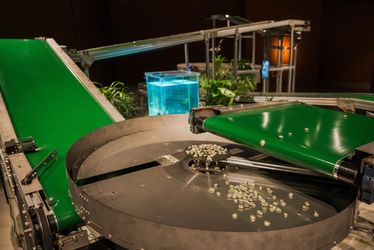
- In Sucker Zucker (2016–), she highlighted the resemblance between crystalline sugar and diamond and jewel stones—the extraction of both products has involved exploitation, labour and slavery. Her bright sculptures were displayed like jewels in a shop, and as the work has developed she added a video and a mural.
- Long Hanging Fruits (2024) connects colonialism and the modern economy using batik, embroidery and palm oil dye on fabric, while earlier iterations of the project used AI to make the images, calling into question whose labour is used in palm oil production.
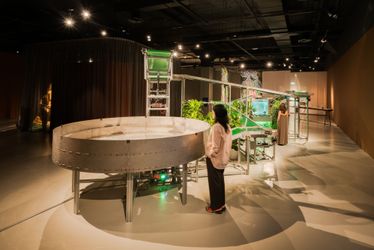
- Bodies in Penumbra: The Soft Machinery of Light (2026) is a sculpture examining what happens to the materials used in the extraction and production of food materials. Two figures appear like classical sculptures, but they are made of palm oil wax which appears to be slowly melting. Beside them, palm fronds are sculpted into tree-like forms, while a palm trunk reveals human faces.
- The work of labourers in plantations (and its co-existence with the environment) is a huge theme in Nurvista’s practice: for example, her first film, Plantation Tragedy (2026), plus her large-scale batik textile tableaus Cyborg (2026) and Exhausted (2026), made using palm oil wax and concentrating on women’s work on plantations.
Elia Nurvista: Exhibitions
Select Solo and Two-Person Exhibitions
- Nafasan Bumi—An Endless Harvest (with Bagus Pandega), Singapore Art Museum (2026)
- Shopping: Pineapple, Sauerkraut, Wasabi, Chickpea, Šopa Gallery, Košice (2023)
- Reconstructed Biotope (with Youngho Lee), Cemeti Institute for Art and Society, Yogyakarta (2021)
- Früchtlinge (with Andreas Pereira Paz), Frankfurt and Berlin (2019)
Select Group Exhibitions
- Like Leaves, Salonul de proiecte, Bucharest (2024)
- Municipal Kitchens, nGbk, Berlin (2024)
- See You at The Studio! Ten Years with Artists in Residence, Künstlerhaus Bethanien, Berlin (2023)
- At The Table, Garage Rotterdam (2023)
- Sharjah Biennial 15: Thinking Historically in the Present, Sharjah (2023)
- Disturbants of land, breath, sound: Aesthetics of Post-colonial culture, Space C (Coreana Museum of Art), Seoul (2022)
- Cast But One Shadow: Afro-Southeast Asian Affinities, UP Vargas Museum, Manila (2021)
- Singapore Biennale (2019)
Further reading
- Elia Nurvista’s website
- Conversation with Elia Nurvista in Ocula (2026)
- Elia Nurvista’s Instagram
- Interview with Melbourne Asia Review __(2025)
Elia Nurvista FAQs
What are the main themes in Elia Nurvista’s work?
Food is a main theme of Elia Nurvista’s work, but not as an object to be depicted. “For me it started with the personal, the domestic. I like to cook; I like to try recipes. The kitchen is my territory. So it started from there, but slowly I could see that the power, the access, this inequality of it all, wasn’t abstract any more,” she told Ocula in 2026. Nurvista examines how the ingredients of our food give us a way to analyse socioeconomic inequality and geopolitical ecosystems. “For me, food is always political,” Nurvista said in 2023. She is a founding member of the Yogyakarta-based transdisciplinary study collective Bakudapan, which examines the sociopolitical contexts of food and ingredients production in Southeast Asia.
What materials and techniques does Elia Nurvista use?
Elia Nurvista is an interdisciplinary artist. Her works include performance, video, sculpture and material, which she uses to highlight the global social and economic impact of food production.
What are Elia Nurvista’s influences?
Rather than looking back at a particular movement of collection of artists, Elia Nurvista is influenced by the global economy, particularly with regard to food production. Her work engages critically with modern agricultural practice, focusing on palm oil (from her home in Indonesia) and sugar. The work she carries out in the Bakudapan collective also acts as an ongoing point of inspiration.
Ocula


Representative Artworks
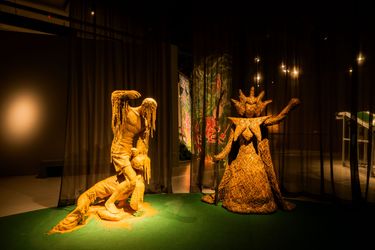
Installation view of Elia Nurvista's 'Bodies in Penumbra_ The Soft Machinery of Light' (2026) as part of 'Elia Nurvista and Bagus Pandega_ Nafasan Bumi ~ An Endless Harvest' at SAM at Tanjong Pagar Distripark. Image courtesy of Singapore Art Museum.
View story
View story
View story
View story
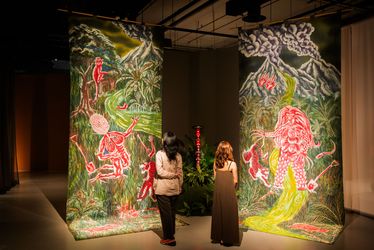
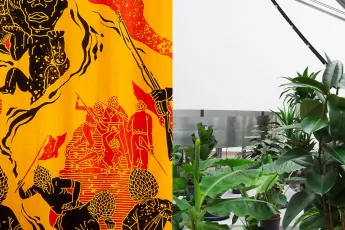
Installation view of Elia Nurvista’s 'Exhausted' (2026) and 'Cyborg' (2026) as part of 'Elia Nurvista and Bagus Pandega_ Nafasan Bumi ~ An Endless Harvest' at SAM at Tanjong Pagar Distripark. Image courtesy of Singapore Art Museum.
View story
View story





Explore and Follow Artists Shaping Contemporary Art
A respected voice in contemporary art discourse.
Focusing on ambitious storytelling and insightful art-world commentary. Ocula Magazine publishes in-depth interviews, critical essays and timely analysis on the artists, exhibitions and ideas driving the global art world.
Learn more about Ocula Magazine
Showcasing the best of the art world.
Ocula partners with galleries from around the world to highlight their artists, artworks and exhibitions. Gallery membership is by application and invitation, with each member vetted by an independent panel.
Learn more about Ocula Membership
Specialises in the sale of major artworks.
Led by a team with deep ties to the world’s leading auction houses, galleries and collectors. Ocula’s advisory team offers bespoke services to high-net-worth clients from around the world who are looking to acquire the best of contemporary and modern art.
Learn more about our team and services