The art world in focus
Subscribe to our newsletter for news and insights on artists, galleries and exhibitions.

Food is more than just nourishment for Elia Nurvista: the ingredients in what we eat offer a way of understanding complex geopolitical ecosystems and socioeconomic inequality. The Indonesian artist’s 2021 video installation The Maladies, for example, critiques the colonial histories and ecological impact of monocultural crops (in this case the banana), while her ongoing project Sucker Zucker (2016–present) explores the parallels between sugar production and gemstone mining. Nurvista is also a founding member of Bakudapan, a Yogyakarta-based transdisciplinary study collective focusing on the sociopolitical contexts in which food and primary products are produced in Southeast Asia.
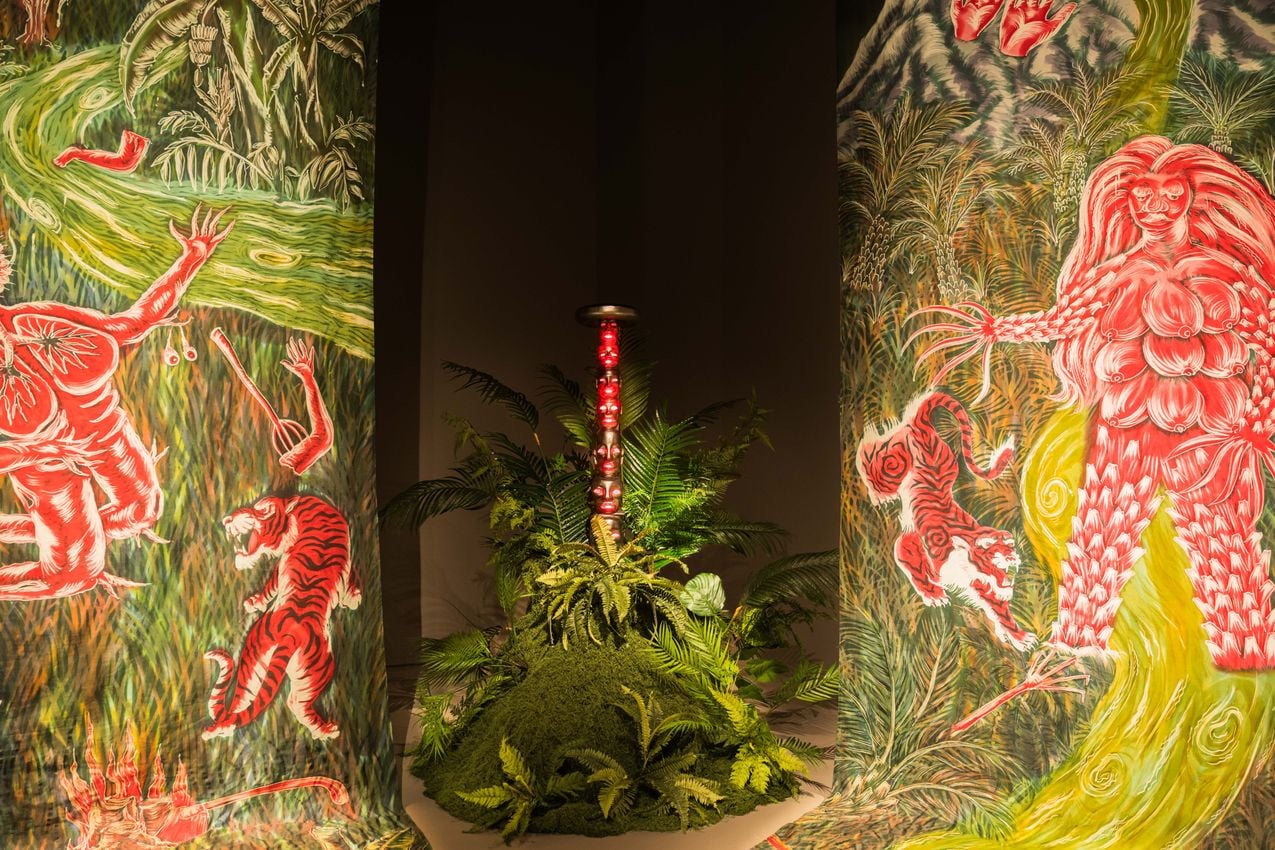
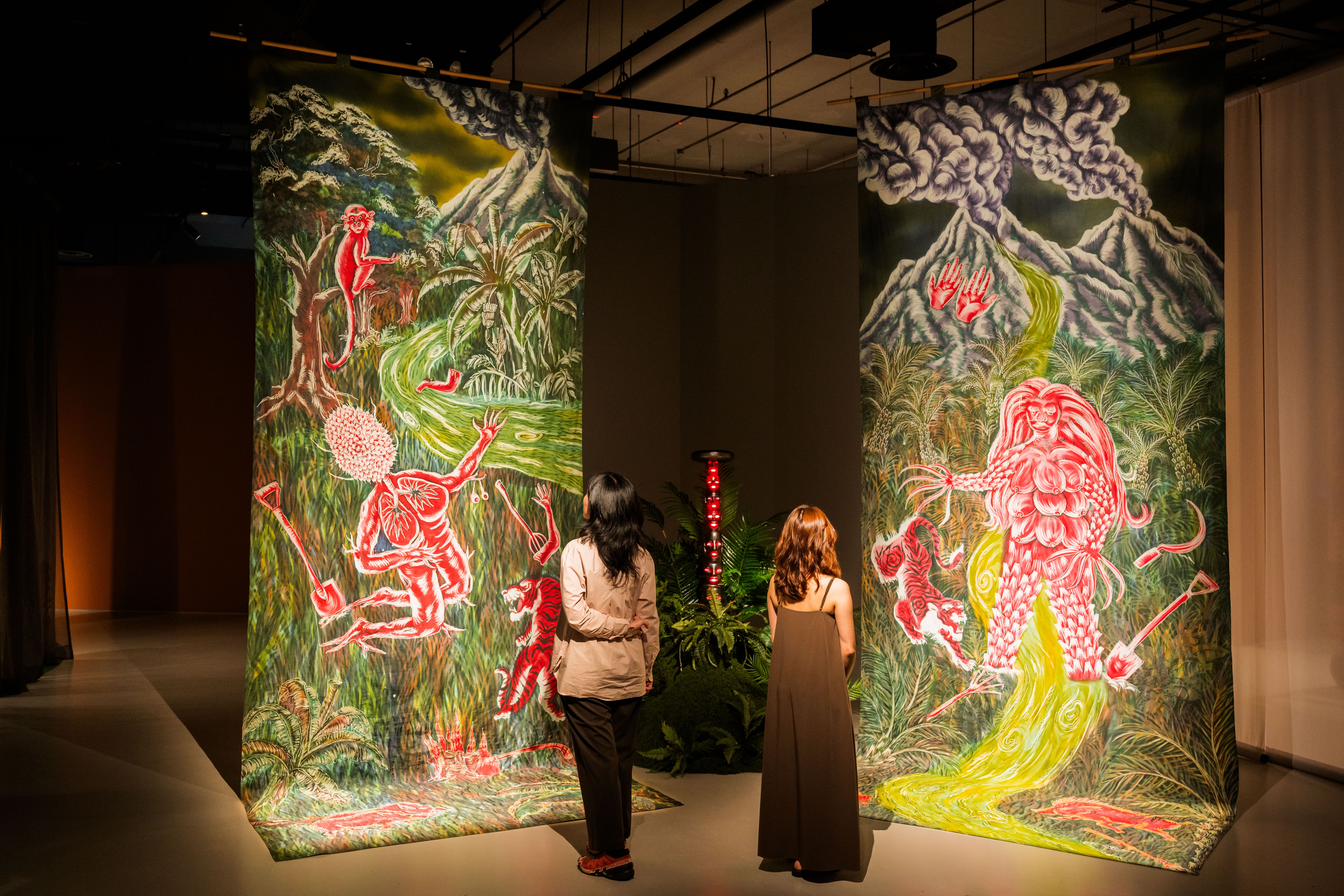
In her new show, Nafasan Bumi ~ An Endless Harvest, a joint exhibition with Bandung-based artist Bagus Pandega at Singapore Art Museum, Nurvista casts a critical eye towards the material politics of palm oil, considering how its production affects ecology and labour. Included in the exhibition is the artist’s first film, Plantation Tragedy (2026), along with Cyborg (2026) and Exhausted (2026), large-scale batik textile tableaus, made using palm oil wax, which explore women’s work on plantations, and Bodies in Penumbra: The Soft Machinery of Light (2026), life-sized figurative sculptures cast from palm oil.
When I speak to Nurvista via video call, she is back at home in Yogyakarta, having recently returned from the exhibition opening. She’s often on the road, spending time in Berlin in 2019 as part of the international studio programme at Künstlerhaus Bethanien, and doing a 10-month residency at Villa Romana in Florence last year. Visible on a shelf in the background is a large red suitcase plastered with tracking stickers.
Our conversation ranged from the origins of her interest in raw materials to the importance of being suspicious about food, and why nasi goreng is overrated.
EN: I’ve been working with palm oil since 2020. I encountered these handcrafted baskets made from dried palm fronds in an online marketplace and was curious: fallen fronds are usually considered waste on the plantations. It turned out that there was a group, an alliance of women who were making and selling the palm frond baskets together, as a co-operative. From there, I read a lot of journal articles, reports, investigations, field notes and so on. Indonesia is the world’s biggest producer of palm oil, but the plant is not actually endemic to Indonesia; it was brought here from West Africa during the Dutch colonial era. There are many female workers on palm plantations in Indonesia who are in a more precarious position than other workers, because often they’re not registered as workers, but just helping their husbands. From there I was thinking about what is of value and what is waste in this plantation system, and who gets to define that logic.
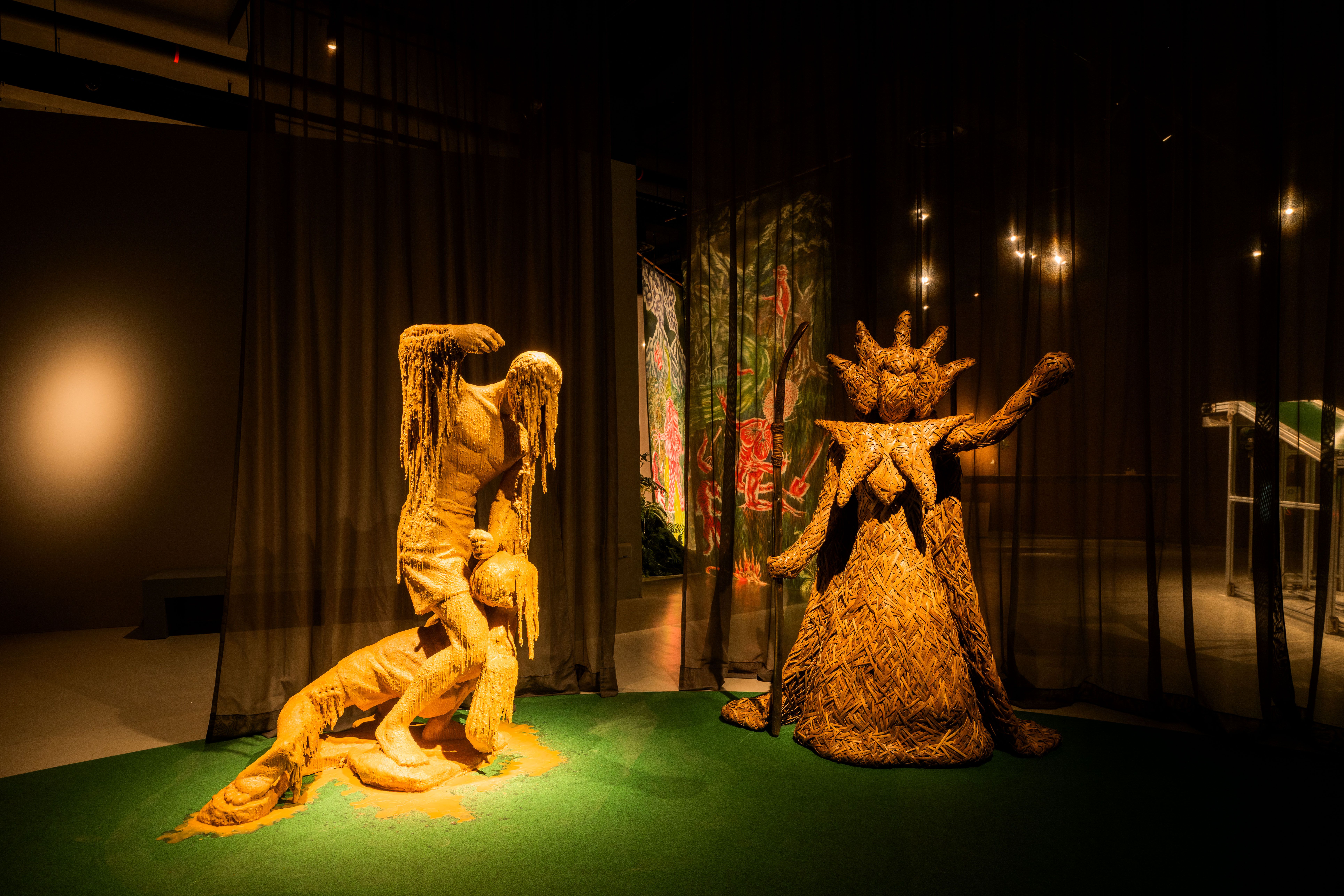
EN: I know Bagus, but this is my first time having a show with him. While we’re both talking about the extraction of resources, we also think about how our place in Indonesia is a site of extraction and there is very visible violence that is normalised. We take it for granted. There’s so much mining in Indonesia because we are very rich in resources and yet there are so many plantations because this is the biggest income source for the country; it’s become a very normalised thing.
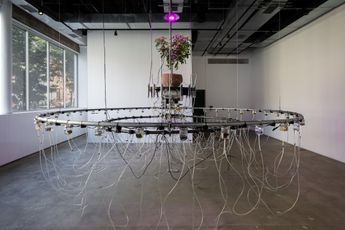
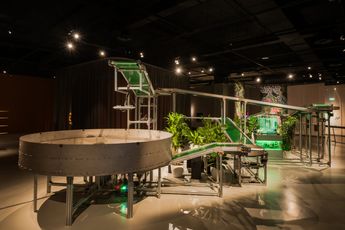
Bagus uses a lot of technology; he often mimics or replicates the machine, in part to bring the audience to feel the sense of loudness. I was thinking a lot about gender-based labour, the process of craft and slowing down. But I don’t want to see craft as an answer to, or pit it against, the industrial, that’s not my agenda.
EN: For me it started with the personal, the domestic. I like to cook; I like to try recipes. The kitchen is my territory. So it started from there, but slowly I could see that the power, the access, this inequality of it all, wasn’t abstract any more. It can be seen in the levels of access to food, about the feeling of inferiority through food.
With Bakudapan, I found a step more into ecology, like plantations and systems. We’ve worked on projects about rice, fast food: we see everything in a very critical way. I think it’s interesting to dig into—and be suspicious of—these very ordinary, daily things, like things in your kitchen that you take for granted. My friend was like, “You’re always problematising everything, even ingredients like sugar.” Yeah, that’s my job, actually.
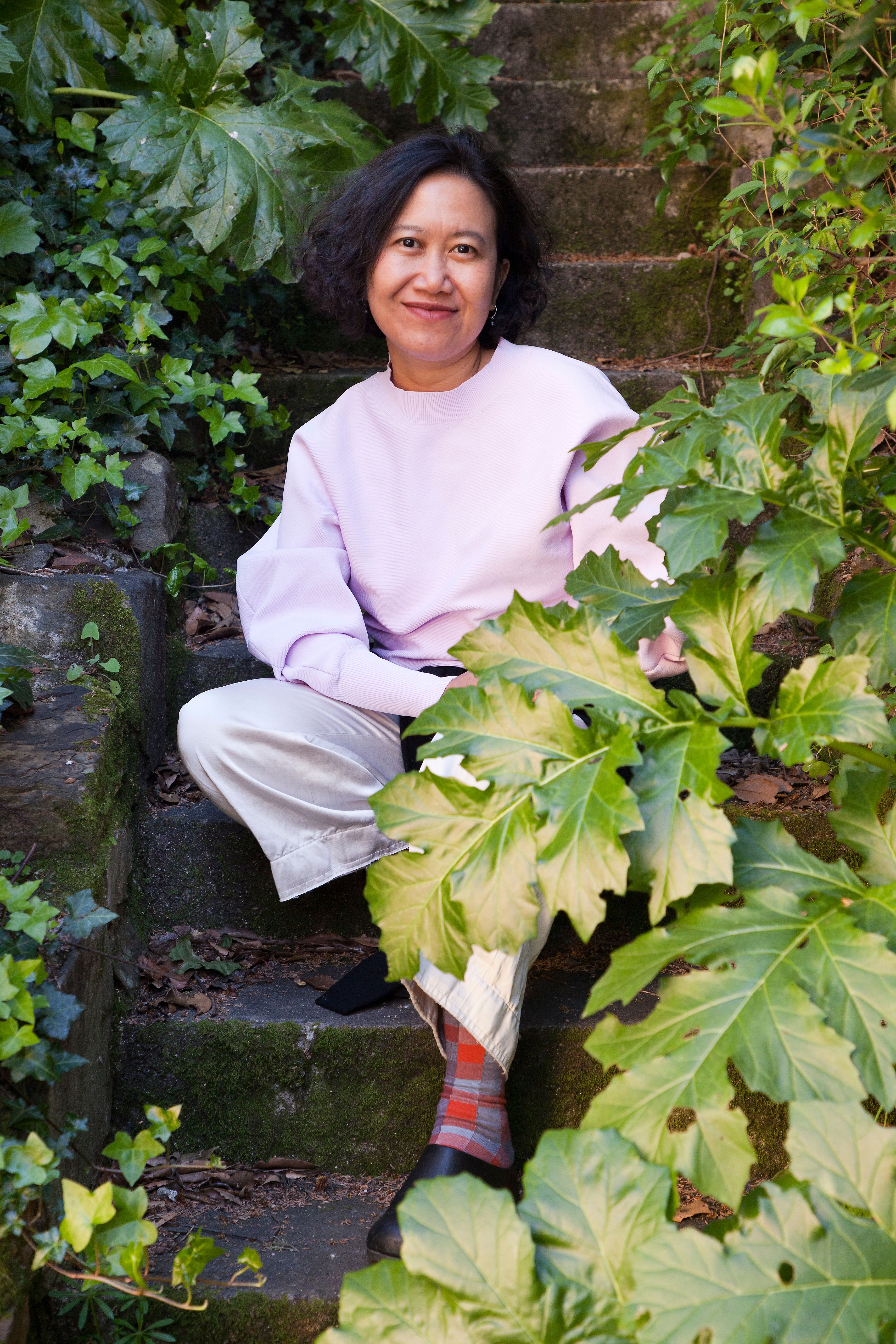
EN: It was started around 11 years ago. I was working on a lot of projects around food before, but as an individual artist. Then I met Nissa, my colleague who studied anthropology, who also wanted to research more about food and anthropology but outside of the university context. We decided to make a study group and recruited some friends. We’ve had many people come and go, and now we have eight members, many from an anthropology background.
Currently we’re developing a role-playing game about food systems [Hunger Tales]. It involves imagining the experiences of characters like the farmer, the middleman, a politician. It’s designed to create a conflict, to understand that the food system contains a lot of power, asymmetric access and so on. When we had a residency in Singapore, we tried to adapt a version to Singapore’s politics and food system, as they have a very small agriculture industry.
EN: Nasi goreng is fully overrated. Different countries have their own version. It’s actually a very common technique: you cook rice and mix it in the wok with eggs with other proteins, vegetables and some seasoning.
“I was thinking about what is of value and what is waste in this plantation system, and who gets to define that logic”
EN: Maybe organs: intestines or liver. They’re very “ew” for some people, but I like them. Usually they put some spices, Indonesian style, or they deep-fry them so they lose all the sliminess and become crunchy, and then eat them with sambal or another kind of spice.
My cooking style is “efficient”. I get frustrated when I cook with someone who is unnecessarily using a lot of tools, and then in the end there are so many dirty dishes. I also think “improvisational”, and “suspicious”, because when I read a recipe, I sometimes question the use of particular ingredients. I’m like, OK… why? Why does this need to be in here?
EN: Probably soto, a soupy broth. It’s complicated to cook, but it’s interesting because all of the Indonesian archipelagos each have their own variety; there are around 100 types. My father’s family has this variety, soto Banjar, which is from Kalimantan. It’s a very special kind of soto—you would only make it if the cook in the kitchen is not lazy; mostly for celebrations. Another favourite is the soto from East Java: soto Madura. —[O]
Elia Nurvista and Bagus Pandega: Nafasan Bumi ~ An Endless Harvest is on view at Singapore Art Museum until 31 May.
Palette Cleanser is a weekly interview series with the artists you need to watch, as selected by our editors.

A respected voice in contemporary art discourse.
Focusing on ambitious storytelling and insightful art-world commentary. Ocula Magazine publishes in-depth interviews, critical essays and timely analysis on the artists, exhibitions and ideas driving the global art world.
Learn more about Ocula Magazine
Showcasing the best of the art world.
Ocula partners with galleries from around the world to highlight their artists, artworks and exhibitions. Gallery membership is by application and invitation, with each member vetted by an independent panel.
Learn more about Ocula Membership
Specialises in the sale of major artworks.
Led by a team with deep ties to the world’s leading auction houses, galleries and collectors. Ocula’s advisory team offers bespoke services to high-net-worth clients from around the world who are looking to acquire the best of contemporary and modern art.
Learn more about our team and services