





FABRICE GYGI
b. 1965, SwitzerlandFabrice Gygi (b. 1965, Geneva) is a Swiss artist whose sculptures, installations, performances, and paintings interrogate the mechanisms of authority embedded in everyday structures. Best known for repurposing security and control infrastructures—such as barriers, tarpaulins, watchtowers, and modular frameworks—he stages viewers in relation to systems of protection and surveillance that feel at once functional and ambiguous.
Gygi’s work has been shown at institutions including MAMCO in Geneva, the Centre Culturel Suisse in Paris, the Swiss Institute in New York, Palais de Tokyo in Paris, Museum Ludwig in Cologne, and MoMA PS1 in New York, and he represented Switzerland at the 25th Bienal de São Paulo (2002) and the 53rd Venice Biennale (2009). In 2026 Gygi was awarded the Swiss Grand Award for Art / Prix Meret Oppenheim, confirming his status as one of the most significant Swiss artists of his generation.
Early life and Career
Born and based in Geneva, Gygi trained in etching at the Centre genevois de gravure contemporaine before continuing his studies at the city’s École des arts décoratifs and École supérieure d’arts visuels. He emerged from Geneva’s radical performance and squat scenes in the 1980s, where self-organisation and resistance to bourgeois norms shaped both his life and his early artistic language. In the 1990s he co-founded the independent contemporary art space Forde (1994) and later Galerie Darse (2007) in Geneva, embedding his practice within a wider culture of artist-run initiatives.
Initially recognised for extreme performances that tested the limits of his own body, Gygi gradually shifted towards sculpture, installation and printmaking while retaining an interest in constraint, exposure and the politics of public space. By the early 2000s he was presenting major solo exhibitions in Switzerland and abroad, including at MAMCO, the Centre Culturel Suisse, the Swiss Institute in New York and other institutions, and participating in landmark group shows that brought his work into dialogue with international debates on power and control.
Works, series and methods
Gygi’s best-known sculptures and installations derive their forms from contemporary security and control apparatus: tank traps, traffic barriers, watchtowers, shelves, tents, sandbags and tarpaulins. Enlarged, modified, or stripped of their original function, these elements are recomposed into quasi-architectural structures that oscillate between shelter and threat. A twelve-metre-high watchtower for the 25th Bienal de São Paulo, for example, turned a symbol of surveillance into a monumental yet isolated object, foregrounding the unease that accompanies being watched.
Performance remains an important though occasional method in Gygi’s practice, used as a way to probe physical limits and bodily submission within systems of authority. These actions echo the tensions present in his sculptural environments, which choreograph how viewers move, wait, or stand in relation to structures that recall checkpoints, protest equipment or institutional fixtures. Over the years he has also produced extensive bodies of engravings, linocuts and prints that transpose his concern with grids, repetition and structural order into two-dimensional form.
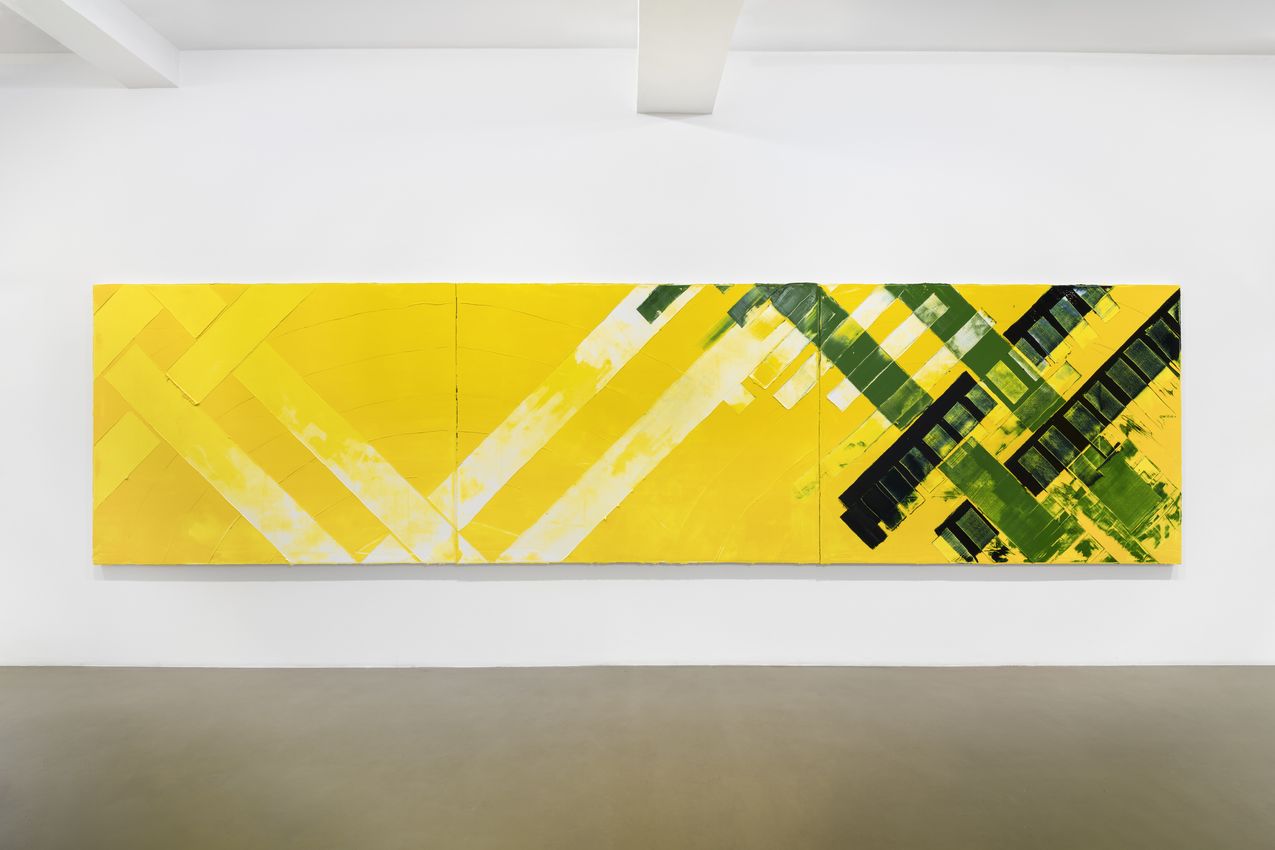
More recently, Gygi has put large-scale installation temporarily on hold to concentrate on watercolours, paintings, jewellery, bas-reliefs and more compact sculptures. His watercolours and painted works often feature intersecting bands or grids of translucent colour, in which wide, straight lines overlay one another to create rhythmic fields that recall planning diagrams, shelving systems or urban layouts. These works condense his interest in regulation and permeability into an abstract, surface-based language while preserving the sense of an underlying framework that organises movement and visibility.
Themes and Context
Across media, Gygi’s practice consistently questions how authority manifests in material form and how citizens negotiate their position within such frameworks. By isolating and reconfiguring elements from security infrastructures—such as barriers, sandbags, shelves, tents and tarps—he exposes the ideological charge of devices that normally pass as neutral tools of order. His work sits in dialogue with strands of socially inflected minimalism and institutional critique, combining reduced forms with highly specific references to contemporary control regimes.
The roots of his practice in Geneva’s alternative and squat scenes are visible in his ongoing concern with escape, refusal and the limits of freedom under Western democracies. Even as his recent focus on grids and abstract compositions in watercolour and relief may appear more formal, these works can be read as visualisations of systems, constraints, and flows—suggesting that power operates as much through subtle organisation as through overt coercion. The Prix Meret Oppenheim citation emphasises the coherence and lasting impact of this engagement with the mechanisms of authority over several decades.
Exhibitions, Collections and Recognition
Gygi has presented major solo exhibitions at MAMCO in Geneva, the Centre Culturel Suisse in Paris, the Swiss Institute in New York and other institutions in Switzerland and abroad, while his work has appeared in key group exhibitions at venues such as Palais de Tokyo in Paris, Museum Ludwig in Cologne and MoMA PS1 in New York. Internationally, he represented Switzerland at the 25th Bienal de São Paulo in 2002 and the 53rd Venice Biennale in 2009, bringing his investigations of surveillance and control to large-scale biennial contexts. His works are held in significant public and corporate collections, including Swiss Re, reflecting his position within contemporary Swiss art.
In 2025 Gygi participated in the second edition of Biennale Son in Valais, contributing to a wide-ranging programme of sound-related projects across multiple venues. In February 2026 he received the Swiss Grand Award for Art / Prix Meret Oppenheim from the Swiss Federal Office of Culture, alongside curator Hilar Stadler and architect Tilla Theus, with an award ceremony scheduled for June 15, 2026 in Basel and a related exhibition at Messe Basel. The prize, which includes a CHF 40,000 award, recognises the consistency, attitude and lasting impact of his oeuvre.
Fabrice Gygi FAQs
What is Fabrice Gygi best known for?
Fabrice Gygi is best known for sculptures, installations and performances that adapt elements from modern security and control systems—such as tank traps, barriers, tarpaulins and watchtowers—to explore how authority is exercised in public space. His work often appears minimal and functional but generates tension by placing viewers in relation to these charged structures.
What themes does Fabrice Gygi explore in his work?
Gygi’s work explores themes of authority, surveillance, civil obedience and disobedience, and the politics of infrastructure. He examines how seemingly ordinary devices like fences, tents or shelves structure behaviour, signal control and define who can pass, gather or speak.
How has Fabrice Gygi’s practice evolved over time?
Starting from radical performance and politically charged installations rooted in Geneva’s alternative scene, Gygi expanded into sculpture, engraving, linocut and large-scale architectural structures for biennials and museums. In recent years he has paused his installation work to focus on watercolours, paintings, jewellery and bas-reliefs that use grids and intersecting bands of colour to pursue his investigation of systems and control in a more abstract register.
What is the Prix Meret Oppenheim and why is it important for Fabrice Gygi?
The Swiss Grand Award for Art / Prix Meret Oppenheim is a prestigious prize established by the Swiss Federal Office of Culture to honour artists, architects and cultural figures whose work has made a lasting impact on Swiss art and architecture. Gygi’s receipt of the 2026 prize acknowledges the coherence of his decades-long inquiry into mechanisms of authority and places him among a select group of leading Swiss cultural practitioners.
Where can I see Fabrice Gygi’s work?
Gygi’s work has been exhibited at institutions such as MAMCO in Geneva, the Centre Culturel Suisse in Paris, the Swiss Institute in New York, Palais de Tokyo, Museum Ludwig and MoMA PS1, and he continues to show with Galerie Chantal Crousel in Paris. In 2025–26 his work is visible in the context of Biennale Son in Valais and will be highlighted in the exhibition accompanying the Prix Meret Oppenheim award at Messe Basel.
Ocula | 2026


Explore Fabrice Gygi's Exhibitions


Explore and Follow Artists Shaping Contemporary Art
A respected voice in contemporary art discourse.
Focusing on ambitious storytelling and insightful art-world commentary. Ocula Magazine publishes in-depth interviews, critical essays and timely analysis on the artists, exhibitions and ideas driving the global art world.
Learn more about Ocula Magazine
Showcasing the best of the art world.
Ocula partners with galleries from around the world to highlight their artists, artworks and exhibitions. Gallery membership is by application and invitation, with each member vetted by an independent panel.
Learn more about Ocula Membership
Specialises in the sale of major artworks.
Led by a team with deep ties to the world’s leading auction houses, galleries and collectors. Ocula’s advisory team offers bespoke services to high-net-worth clients from around the world who are looking to acquire the best of contemporary and modern art.
Learn more about our team and services